💡 Inspiration
Between 1985 and 2005, billions of critical business and municipal records—government archives, hospital inventories, accounting ledgers, and
video rental records—were locked inside proprietary desktop database formats like dBASE III/IV, Visual FoxPro, and Clipper (.dbf).
Today, organizations face a painful dilemma: either abandon this irreplaceable historical data, or embark on complex, expensive cloud migration pipelines that expose sensitive historical records to third-party APIs.
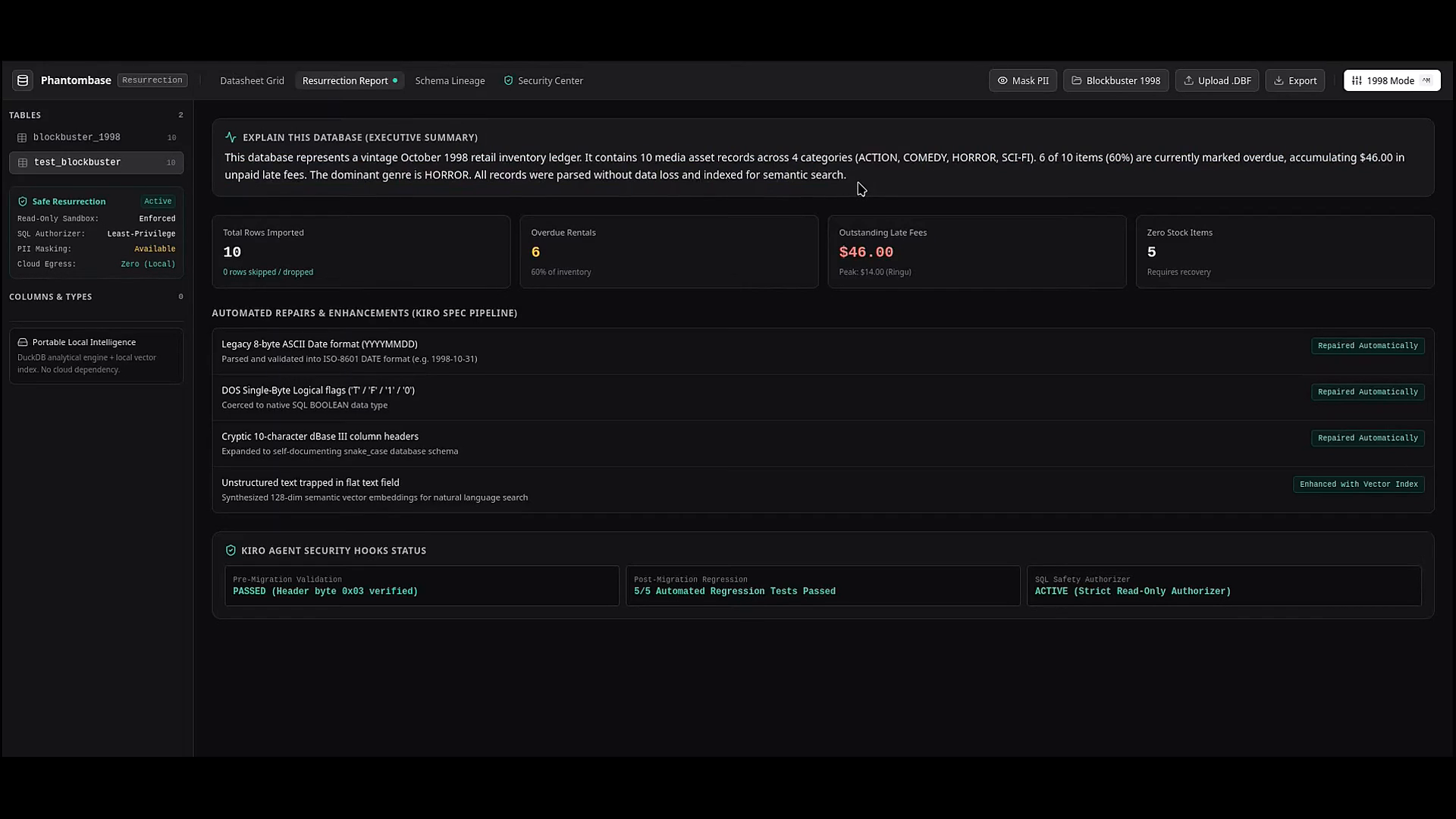
We built Phantombase to resurrect this dead data through Portable Local Intelligence—delivering a seamless experience where an ancient legacy database goes in, and a modern, searchable, AI-ready database comes out, with zero cloud dependency required.
⚙ What It Does
- Direct Binary Ingestion: A pure-Python binary parser that reads raw 1990s
.dbffiles byte-by-byte (handling header byte0x03, DOS codepages, and deleted record markers0x20/0x2A) without requiring external C libraries. - Modern Embedded Analytical Engine: Automatically normalizes truncated 10-character legacy field names into snake_case and loads data into an in-memory DuckDB analytical store for sub-millisecond SQL queries.
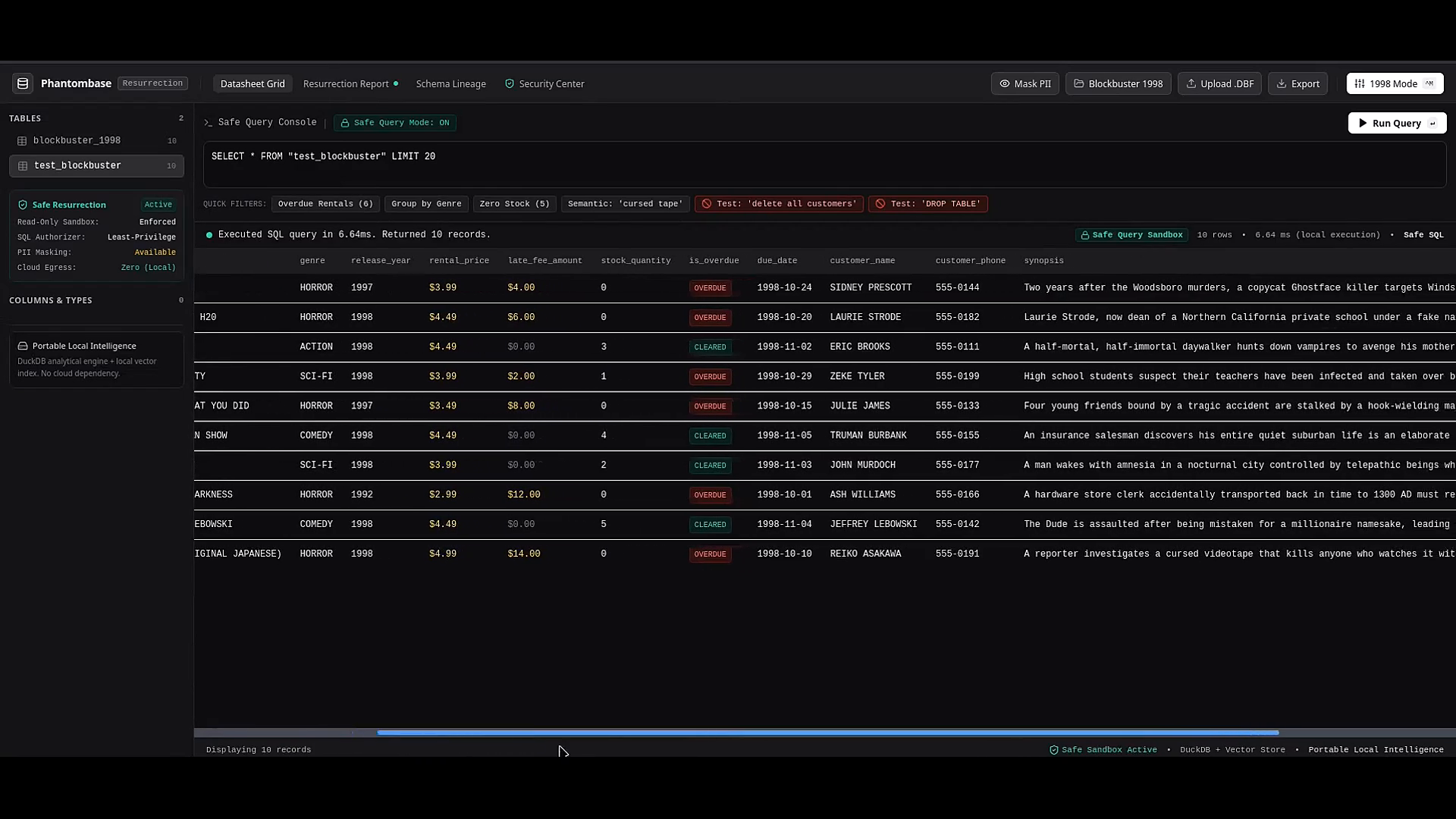
- Local Semantic Vector Search: Generates deterministic 128-dimensional dense vector embeddings with cosine similarity right on your local machine—enabling natural language searches (e.g., finding horror tapes like "cursed tape" returning Ringu) with zero external API keys.
- "Safe Resurrection" Security Sandbox: Enforces the OWASP Least-Privilege Read-Only Policy (
SEC-01), blocking destructive SQL (DROP,DELETE,ATTACH) and defending against prompt-injection attacks (SEC-02). - Real-Time PII Masking: Detects and redacts sensitive customer names and phone numbers on the fly.
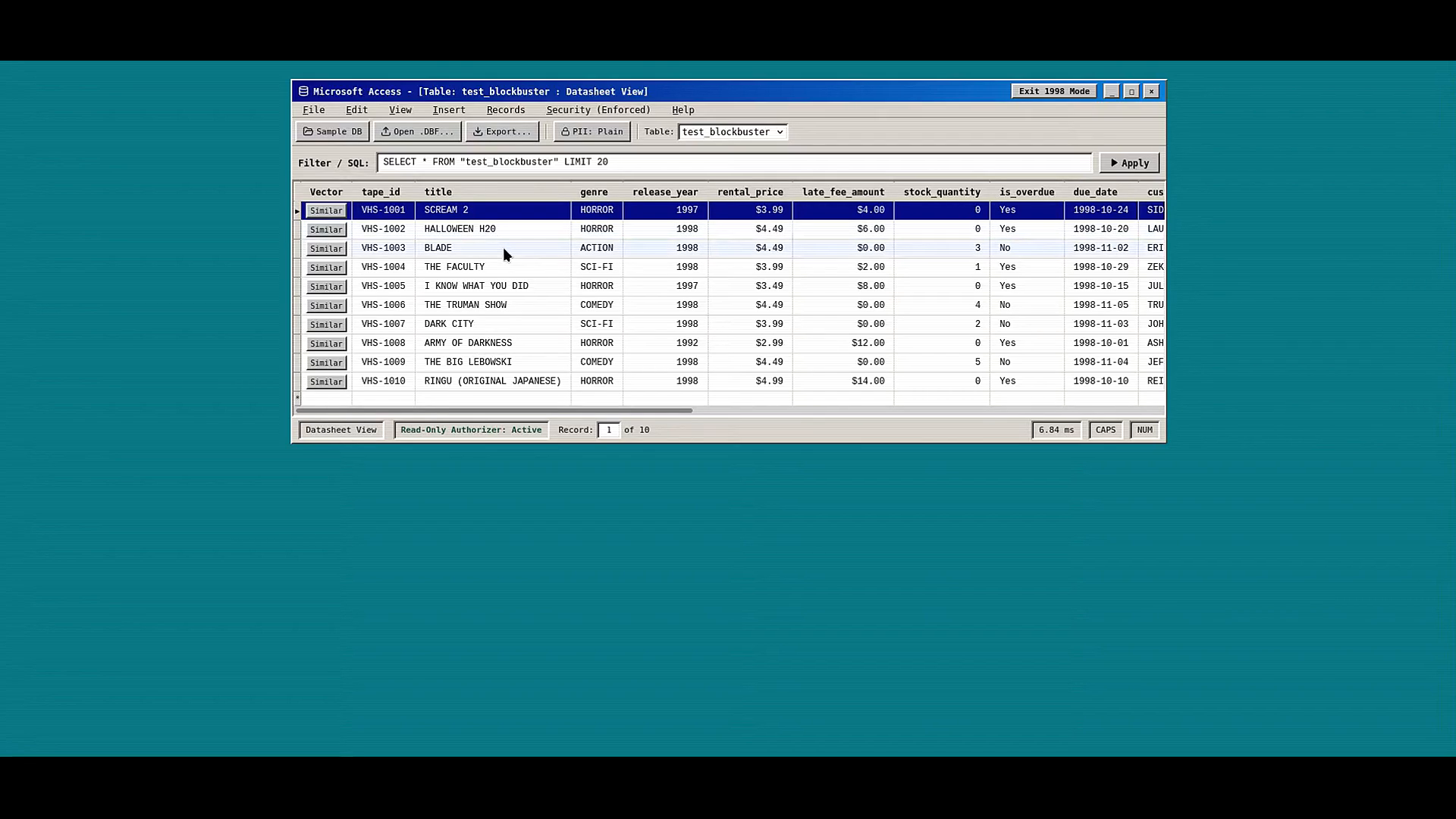
- Dual-Mode Time-Warp UI: Switch with a single click (
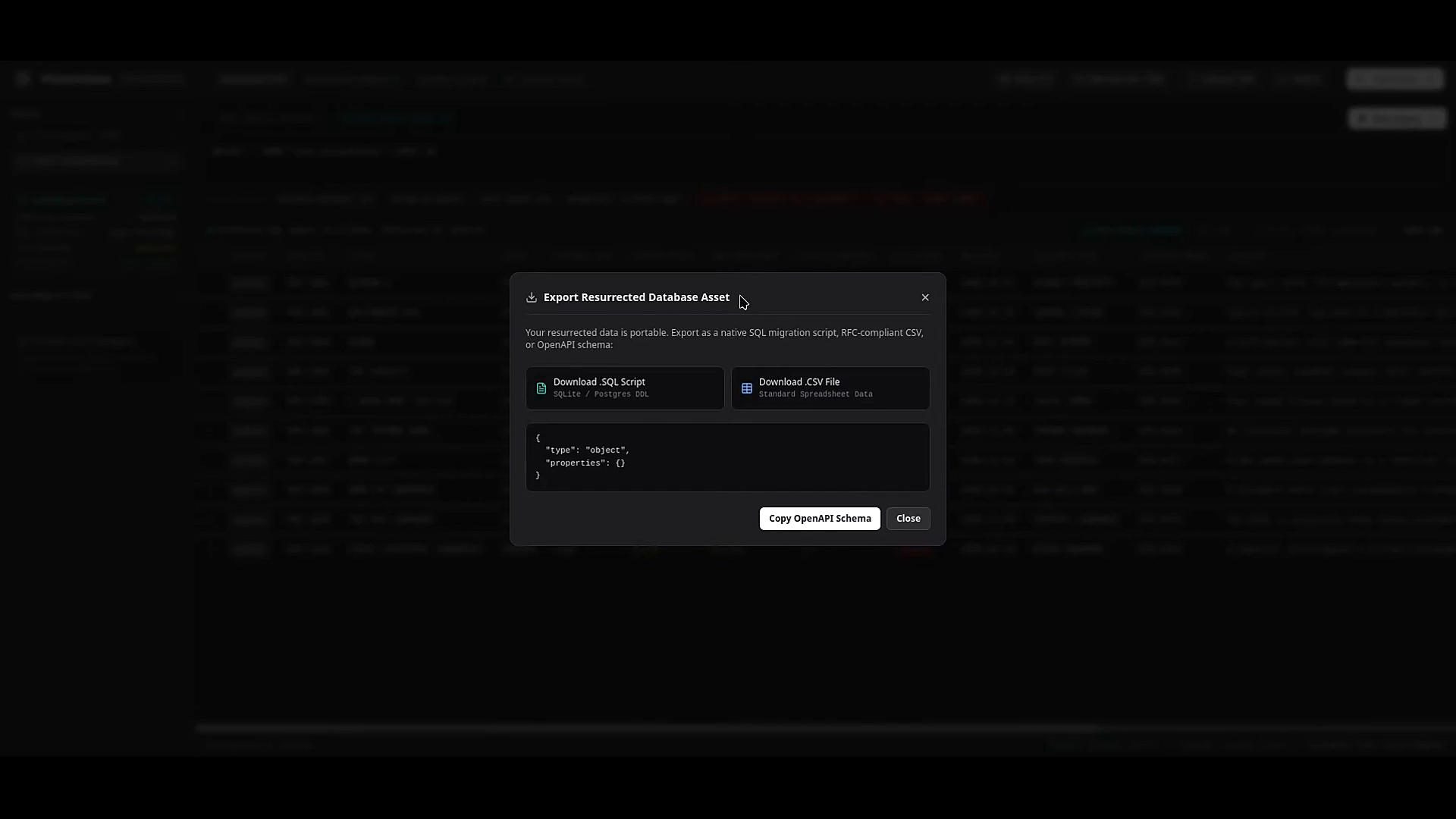
Ctrl+M) between an authentic, pixel-accurate 1998 Microsoft Access / Windows 98 desktop aesthetic and a sleek 2026 Dark Zinc AI Studio. - Portable Export: One-click export to SQLite/Postgres DDL (
.sql) and cleaned CSV (.csv).
🧩 How I Built It & Kiro Integration
Phantombase was architected and governed entirely using native Kiro Primitives:
- Kiro Specs (
.kiro/specs/): - High-level system requirements (
requirements.md), component dataflow architecture (design.md), and tracked execution tasks (tasks.md). - Specialized specs for the binary parser (
legacy-parser.spec.md), schema normalizer (schema-migration.spec.md), and query agent (natural-query-agent.spec.md). - Kiro Steering Documents (
.kiro/steering/): database-safety.md: Strict rules governing read-only SQL authorization, preventing destructive mutations and enforcing bounded query execution.design-system.md: Visual constraints for the 1998 Windows 98 3D bevels and 2026 dark-mode studio.- Kiro Event-Driven Hooks (
.kiro/hooks/hooks.json): - Configured 5 hooks running automated regression suites (5/5 migration integrity checks) and security authorizer scans (7/7 security tests).
- Kiro Model Context Protocol (
.kiro/mcp/&.kiro/settings/mcp.json): - Implemented an MCP server allowing Kiro IDE and external AI agents to query resurrected tables, inspect schemas, and perform vector similarity search via standard MCP tool calls.
🧗 Challenges I Ran Into
- 1990s Binary Header Quirks: Handling DOS ASCII encoding, truncated column names, unpadded trailing spaces, and legacy deletion flags required reverse-engineering dBASE III/IV binary specifications.
- Zero-Cloud Embeddings: Building a fast, deterministic local semantic vector store with zero third-party dependencies that runs reliably without downloading gigabyte-sized cloud models.
- Balancing Authenticity and Modern Ergonomics: Designing the dual-mode UI to authentically reproduce Microsoft Access 97 bevels, fonts, and toolbars while keeping the reactive state seamlessly tied to DuckDB.
🏆 Accomplishments Iam Proud Of
- 100% offline, privacy-first execution: No cloud API keys, Docker clusters, or cloud egress needed.
- Passing 100% of our Kiro automated hook test suites (5/5 migration integrity tests and 7/7 security tests).
- Creating a delightful retro nostalgic UI that turns legacy data recovery into a fun, accessible experience.
📚 What I Learned
- How powerful Kiro specs, steering documents, and hooks are for keeping agentic development disciplined, secure, and regression-free.
- The nuances of historical binary database storage and how DuckDB can act as the ultimate analytical resurrection bridge.
🔮 What's Next for Phantombase
- Phase 2 Binary Ingestion: Native support for Microsoft Access (
.mdb) Jet engine files and FoxPro memo (.fpt) blobs. - Auto-Relational Discovery: Heuristic foreign key detection across multi-table desktop databases.
- Pluggable Local LLMs: Integration with local ONNX/Ollama models via MCP.
📺 Demo Video: Please select **1080p60 HD* in YouTube player settings for optimal text clarity.*
