-
-
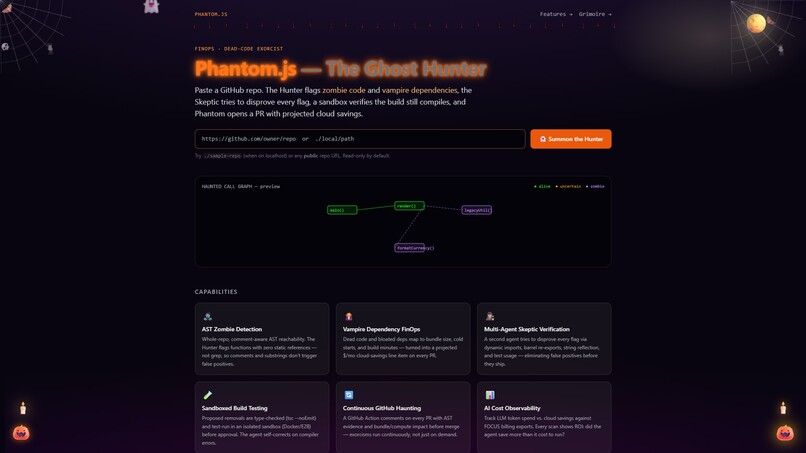
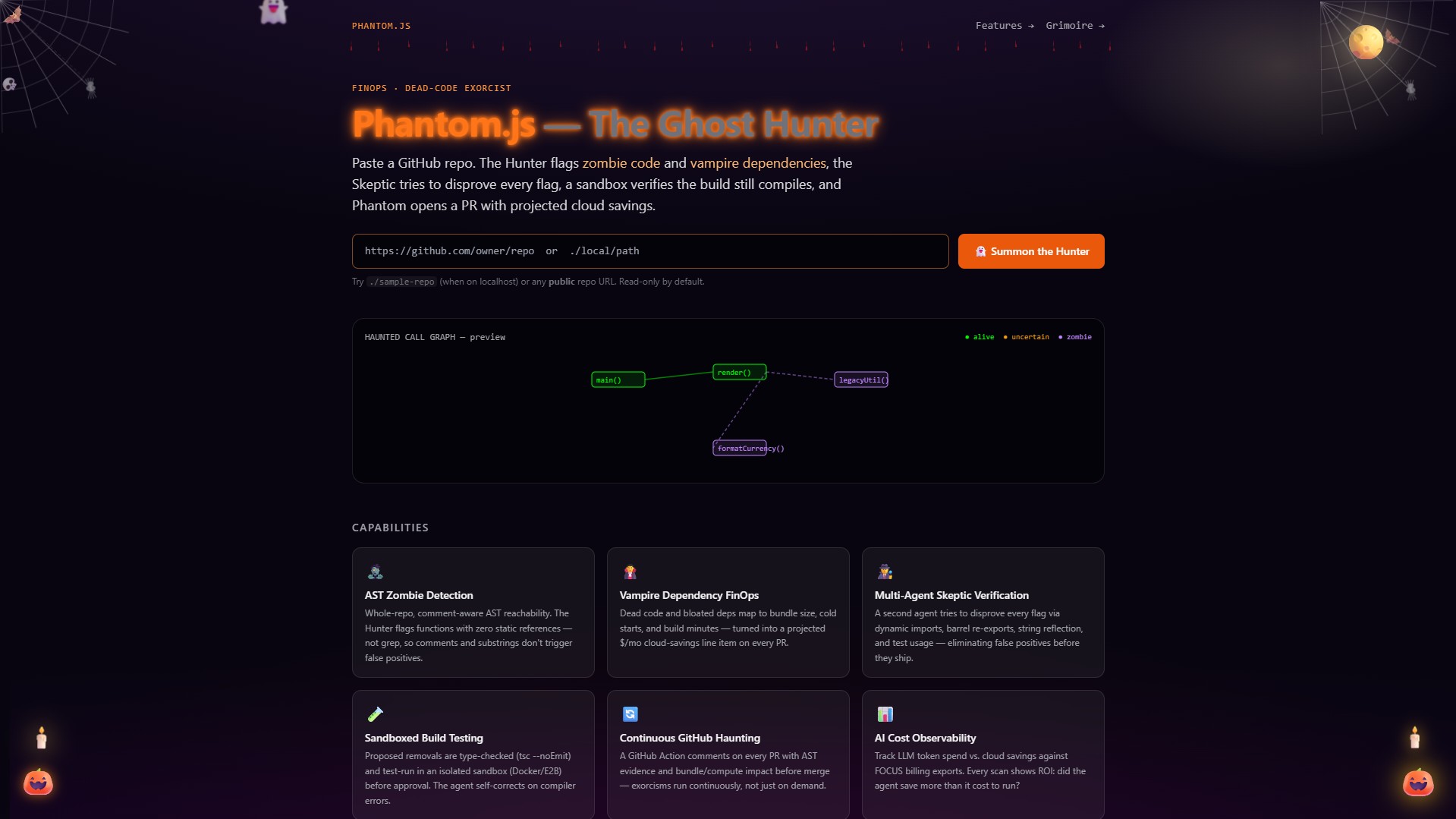
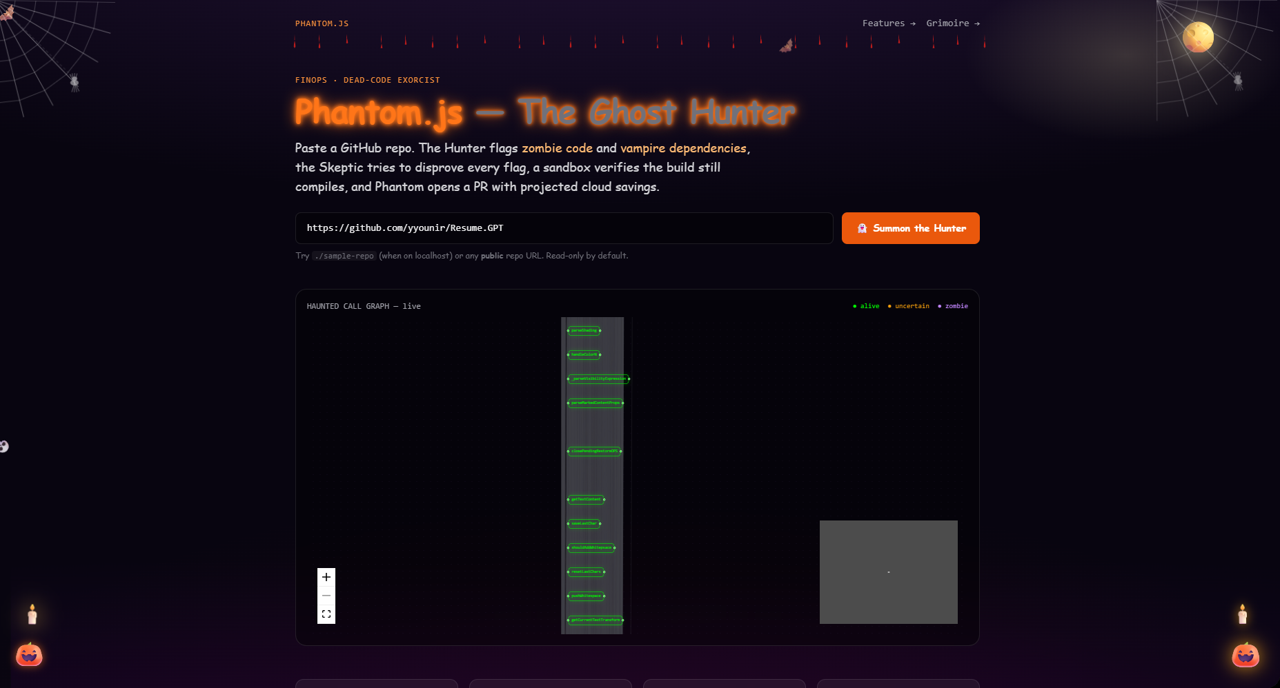
Homepage
-
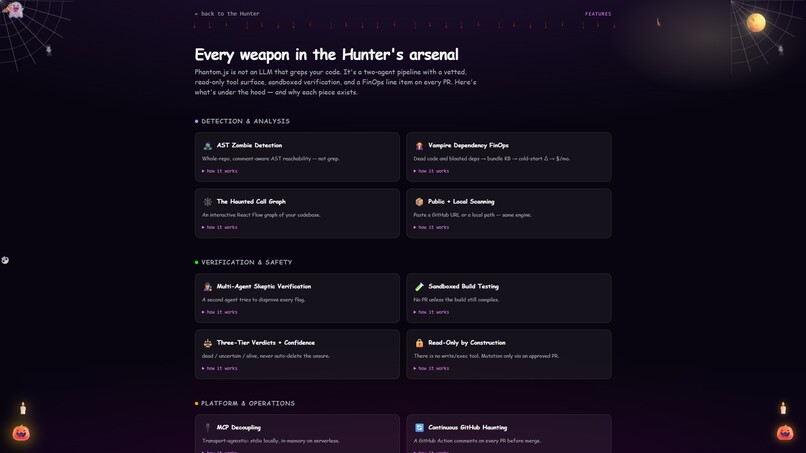
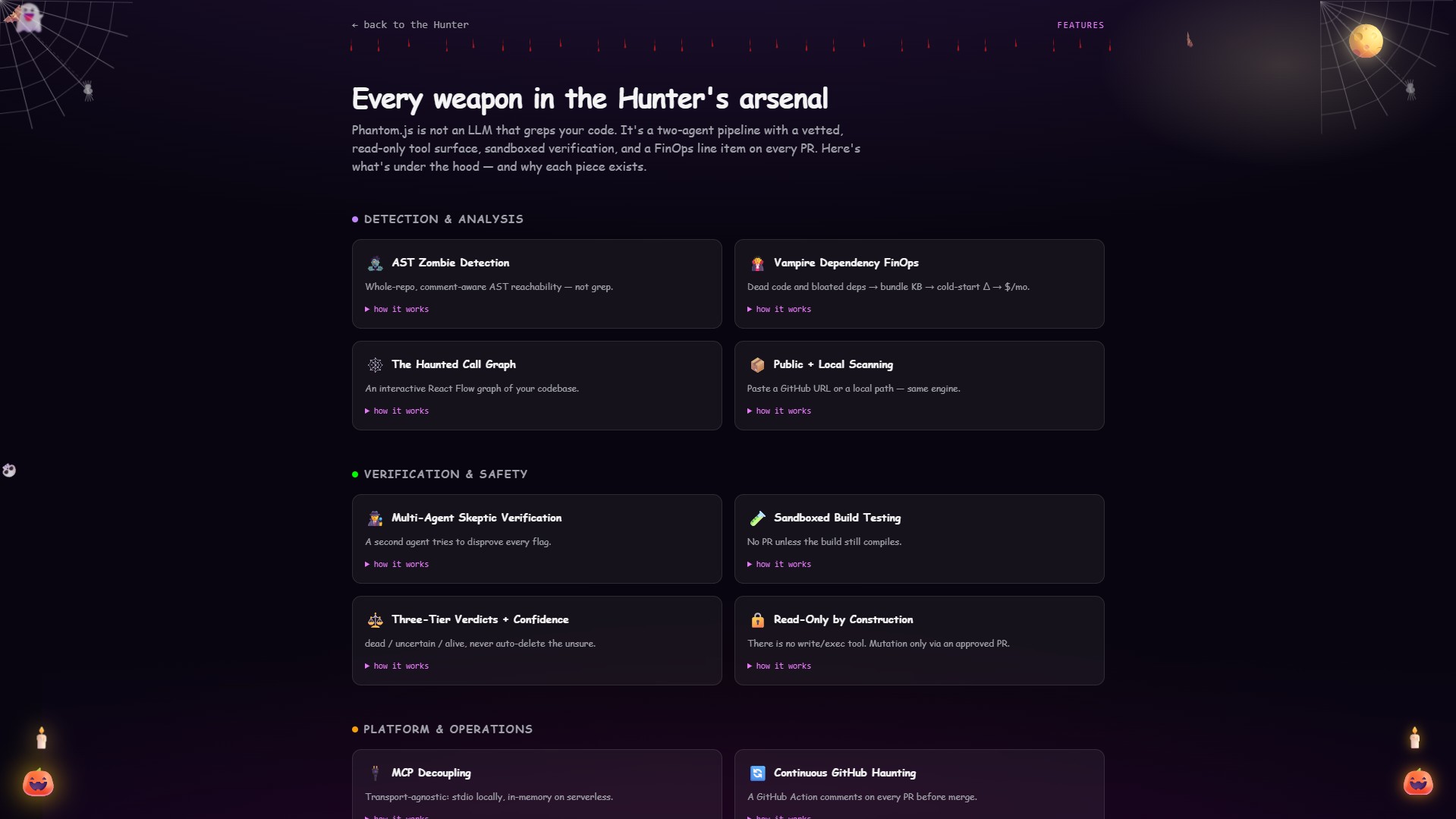
All Features
-
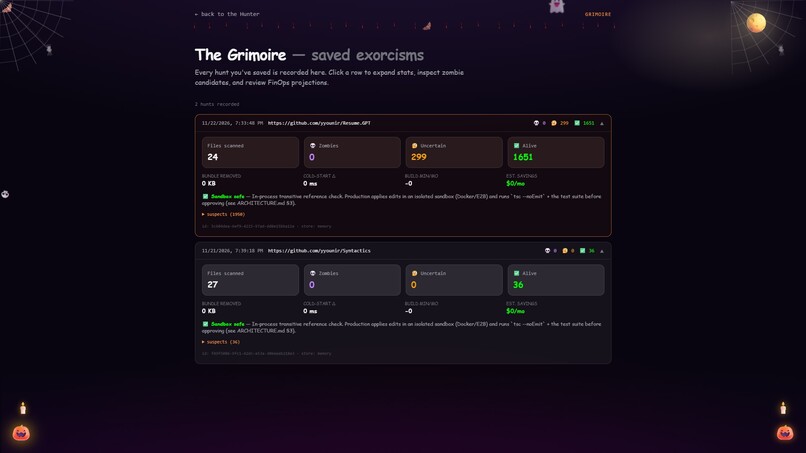
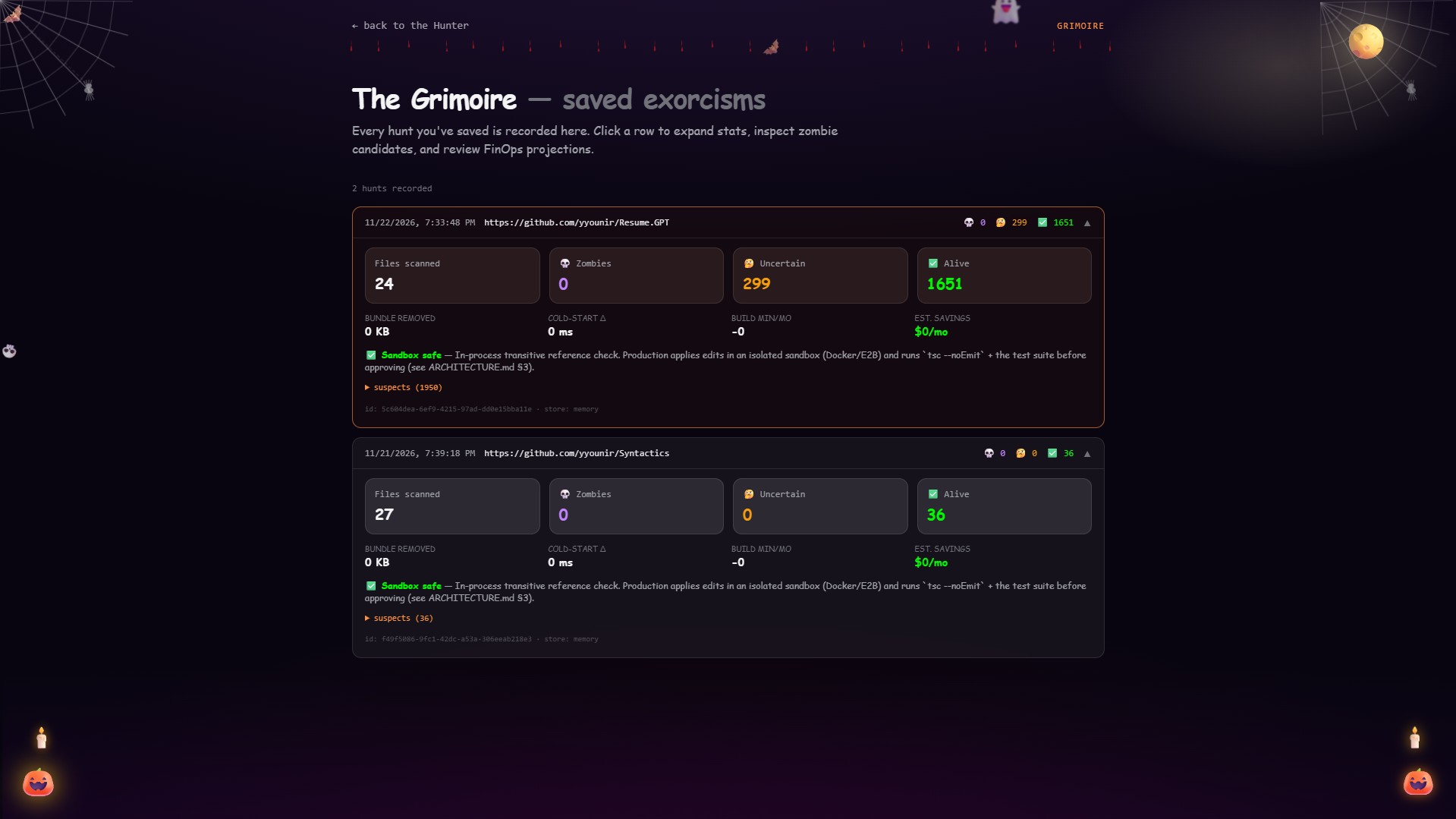
Saved Repositories that were scanned
-
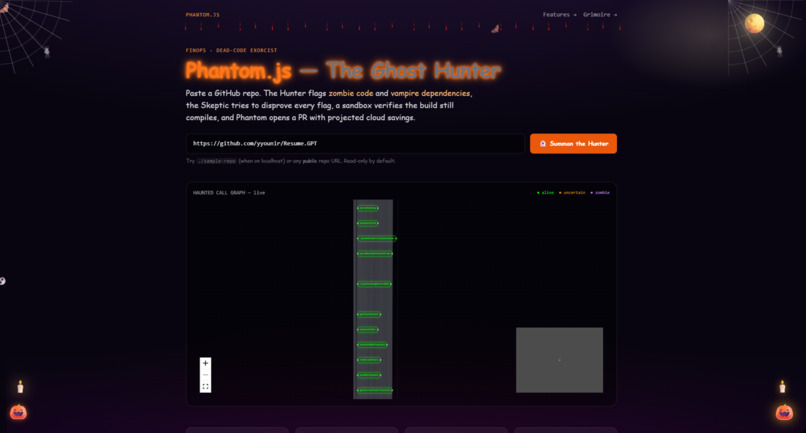
Map of the repository's structure
-
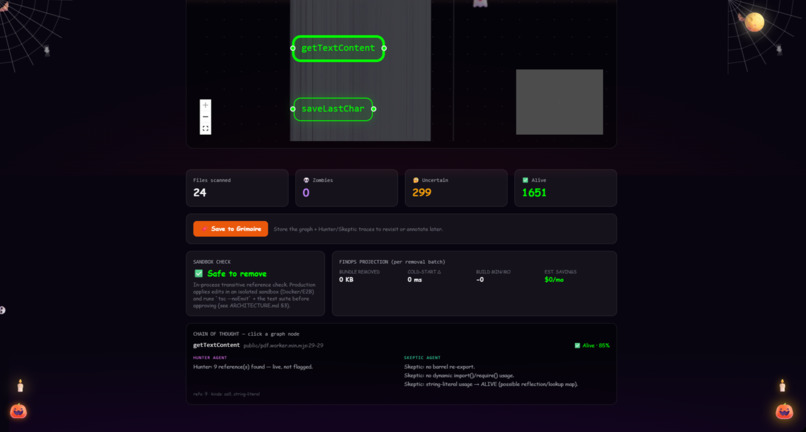
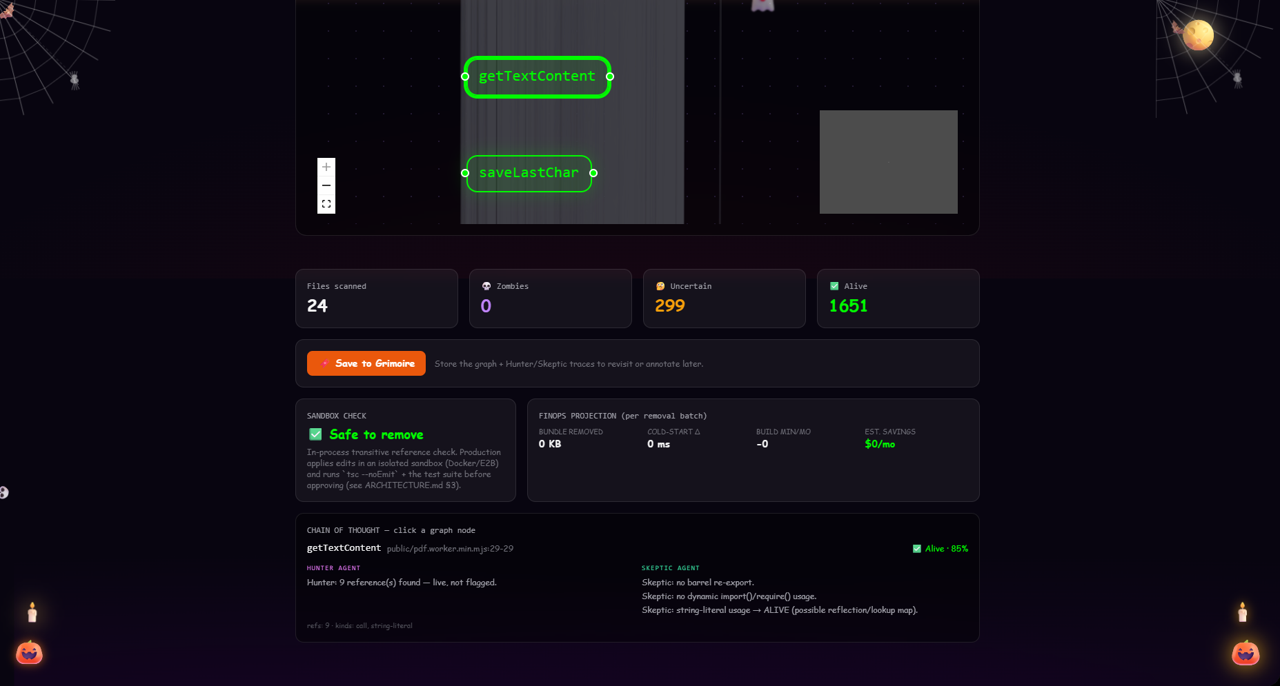
The results of the findings from the given repository
Inspiration
Dead code ("zombie functions") and bloated packages ("vampire dependencies") silently accumulate in almost every production codebase. They slow down CI/CD builds, inflate serverless bundle sizes, increase cold-start latency, and expand the CVE security surface—yet teams rarely clean them up because naive grep-based tools produce too many false positives and deleting live code is catastrophic. For the Kiroween 2026 Hackathon, we wanted to build an enterprise-grade FinOps and codebase-analysis agent that turns dead-code cleanup into a safe, auditable, and quantifiable cloud-cost savings lever.
What it does
Phantom.js is a multi-agent AI system built on the Model Context Protocol (MCP) that answers one question: "What code in this repository can be safely deleted, and how much will removing it save in cloud compute costs?"
- Summon & Scan: Accepts any local directory or public GitHub repository URL, streaming and untarring GitHub repos entirely in memory with zero disk writes.
- AST-Powered Analysis: Uses the TypeScript compiler API at runtime to extract function declarations, call graphs, and comment-aware references across .ts, .tsx, .js, and .jsx files.
- Two-Agent Adversarial Trial (Hunter → Skeptic): A Hunter agent flags zero-reference zombie candidates, and a Skeptic agent actively tries to disprove every flag using deterministic veto checks (barrel index.* re-exports, dynamic import() / require(), string-literal reflection, and test-only references).
- Three-Tier Verdicts & Interactive Graph: Classifies every function as Dead, Uncertain (routed to human review), or Alive, rendered in an interactive React Flow call graph with expandable Chain-of-Thought traces.
- Sandbox & FinOps Projection: Runs an in-process transitive reference check before projecting bundle KB removed, cold-start delta (ms), build minutes saved, and monthly cloud savings ($/mo).
- Grimoire & Continuous Haunting: Persists past hunts in Supabase (PostgreSQL) (with flat-file JSON and in-memory fallbacks) and includes a read-only GitHub Action (phantom-haunt.yml) that posts automated zombie reports on pull requests.
How I built it
We built Phantom.js with Next.js 14 (App Router), TypeScript 5.5, Tailwind CSS, React Flow, Supabase, and the Model Context Protocol (@modelcontextprotocol/sdk), deployed on Vercel.
To enforce strict security boundaries, we decoupled agent reasoning from tool execution via MCP. The agent loop never touches the filesystem or shell directly—it can only invoke 8 read-only MCP tools (list_source_files, run_ast_parser, find_references, list_exports, get_calls, get_imports, run_sandbox_check, and estimate_finops_impact).
Kiro IDE and Kiro AI (running in Vibe mode with dynamic Auto model selection) were used to design, scaffold, test, and refine the initial full-stack foundation from an empty workspace. Starting from an architectural prompt, Kiro authored ARCHITECTURE.md, built the read-only Node.js MCP AST server and Next.js agent client, created a sample-repo/ fixture with tricky edge cases, ran live end-to-end verification, and configured Tailwind CSS to spin up the initial Halloween-themed dashboard. From there, we expanded the architecture to support serverless in-memory MCP transport, streaming GitHub tarball ingestion, the Hunter → Skeptic trial, React Flow call graphs, and Supabase persistence.
Challenges I ran into
- Serverless MCP Transport: Spawning a local
stdiosubprocess for an MCP server works locally, but fails on Vercel serverless functions. We solved this by makingcreatePhantomServer()transport-agnostic and usingInMemoryTransport.createLinkedPair(), allowing the full MCP client-server handshake to run in-process on Vercel with zero subprocesses. - Comment-Matching Noise: During early end-to-end testing on sample-repo/, our reference scanner matched symbol names inside code comments, inflating reference counts and polluting reasoning traces. We refactored
find_referencesto use the TypeScript compiler's trivia API to strip comment ranges accurately. - MCP SDK Type Overloads: Strict TypeScript compilation surfaced type errors where the MCP SDK's generic
callToolreturn type collapsed to {}. We resolved this with a clean structural type guard so the client remains resilient across SDK versions. - Preventing False Positives: Distinguishing truly dead code from dynamically imported functions, barrel re-exports, or computed property keys required building a hard policy layer in the Skeptic agent that the LLM cannot override.
- Patience Needed: Scanning a public repository depends on the repository size and would take longer than a minute to scan the entire public repository. Longer repositories take significant amount of time to scan through each and every one of them to be verified.
Accomplishments that I'm proud of
- Read-Only Security by Construction: Even if a scanned repository contains a prompt injection, the agent's blast radius is strictly bounded to read-only AST tools—no
write_file, exec, or git tools exist on the MCP server. - Real-World Scale: Benchmarked live on
anthropics/anthropic-sdk-typescript/src, scanning 362 files and mapping 1,363 nodes and 5,011 call-graph edges in a single serverless request. - Zero-Config Fallbacks: The agent runs fully deterministically without requiring an ANTHROPIC_API_KEY, and the Grimoire seamlessly swaps between Supabase, local JSON, and in-memory storage via a unified HuntStore interface.
What I learned
- MCP is a powerful security seam: Decoupling judgment (the agent loop) from mechanics (the AST server) makes AI systems auditable, portable, and safe by default.
- Deterministic guards beat prompt engineering alone: Pairing Chain-of-Thought reasoning with a code-enforced Skeptic veto layer is the only reliable way to eliminate catastrophic false positives in automated refactoring.
- AST > Regex: Leveraging the TypeScript compiler API at runtime—especially its trivia API for comments—eliminates entire classes of noisy edge cases that break naive text scanners.
What's next for Phantom.js
- Sandboxed Compilation & Tests: Upgrading the in-process transitive check to a full Docker/E2B sandbox that runs
tscand the repository's test suite before opening a PR. - Semantic Type-Level Graph: Integrating
ts.LanguageServicefor full semantic reference resolution across parent-directory barrel re-exports and class hierarchies. - Redis AST Caching: Caching parsed ASTs by file content hash across runs and serverless instances for near-instant repeat scans.
- FOCUS Billing Reconciliation: Connecting a FOCUS FinOps MCP server to reconcile projected dead-code savings against real cloud billing data.
Built With
- kiro
- mcp
- next.js
- postgresql
- react
- redis
- tailwindcss
- typescript