Inspiration
I'm a second-year student in Chhapra, Bihar. Around me, many people still browse on prepaid data and one bar of 2G or 3G. Opening a single news article can pull down 2-5 MB of scripts, trackers and images before a word of text shows up. In 1991 the University of Minnesota had already solved this with Gopher: plain menus and plain text that load instantly on anything. The web replaced Gopher in 1993, and pages have only got heavier since. So for Kiroween I dug Gopher up.
What it does
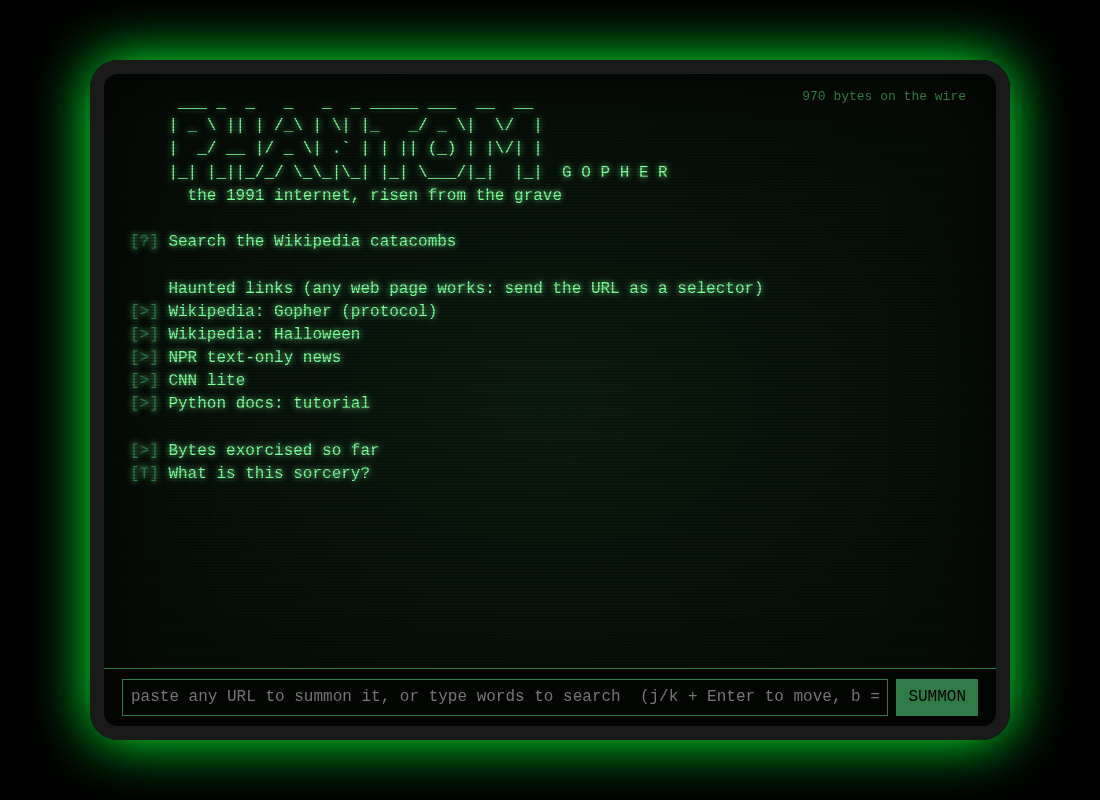
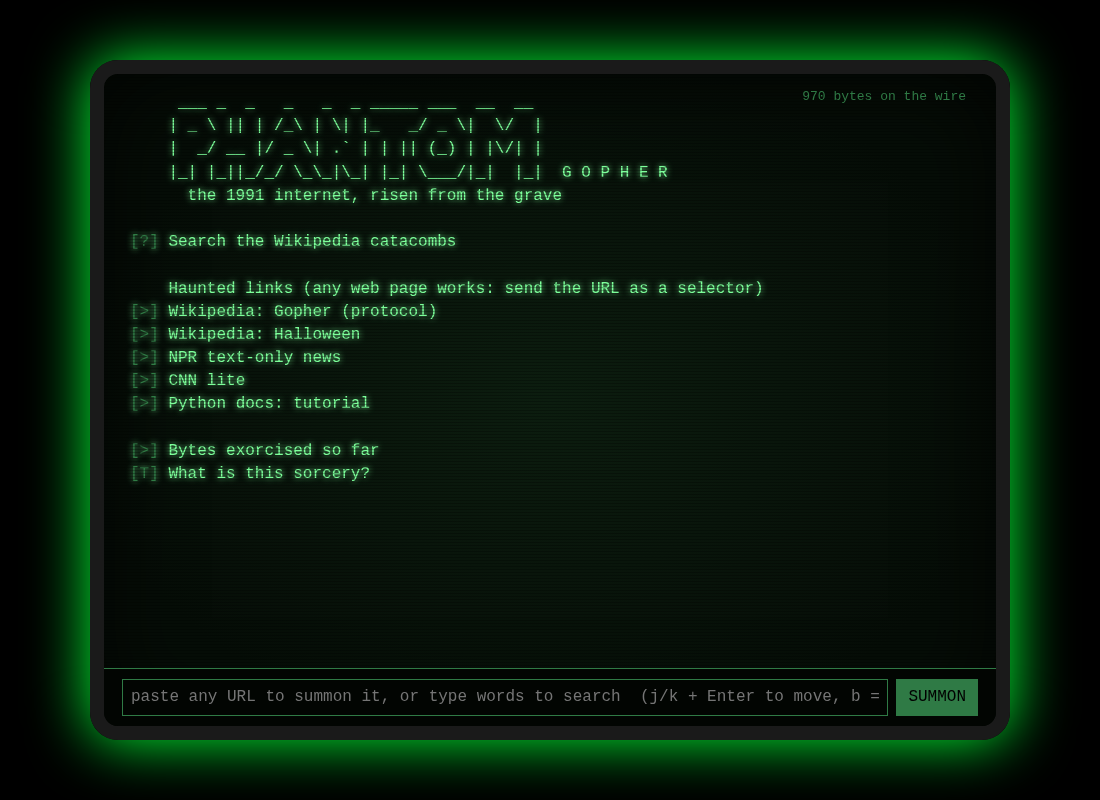
Phantom Gopher is a gateway that turns any web page into a Gopher menu:
- A seance summary at the top: 3-4 key sentences. It comes from a built-in extractive summariser, or from a free local open-weight model through Ollama.
- The outline of the page, a full-text item, and every link. Each link is itself a Gopher menu, so you can keep browsing the whole web this way.
- The weight it removed, shown in a line like original 474.6 KB -> gopher 4.9 KB (99.0% lighter). A
/statsledger counts the bytes exorcised in each session. - Search through Gopher type-7 items, backed by Wikipedia's free API.
There are two ways in, and both serve the same responses:
- A real RFC 1436 Gopher server on port 7070. Lynx, Bombadillo and
curl gopher://all work. - A haunted CRT web terminal for any browser: phosphor glow, scanlines, a drifting ghost, and full keyboard navigation. The whole terminal is about 6 KB.
It has no accounts, no API keys and no running cost.
How we built it with Kiro
- Spec-driven development.
- I started with a Kiro spec in
.kiro/specs/phantom-gopher/.requirements.mdhas 8 requirements in EARS notation, anddesign.mdhas the architecture and sequence diagrams. - The design also lists six correctness properties: menu framing round-trip, text termination, extractor totality, summary faithfulness, wrap safety and no duplicate sentences.
tasks.mdturns these into 11 tasks, and I ran them one at a time in Kiro.- Compared with vibe coding, the spec forced me to decide early that both front ends share one
Gateway.handle(). Because of that, the browser terminal never drifted from the real protocol.
- I started with a Kiro spec in
- Property-based testing.
- Every correctness property became a Hypothesis test.
- P1 caught display strings containing TAB characters, which corrupt a Gopher menu. P5 caught a wrap bug with very long URLs.
- P6 caught BBC teaser cards repeating the same sentence in the summary.
- Steering docs.
product.md,tech.mdandstructure.mdare always included. They hold the zero-cost rule: no paid APIs, no keys, standard library only.spooky-voice.mduses fileMatch, so it only loads for UI files. That kept the Halloween tone consistent without cluttering backend work.gopher-rfc1436.mduses auto inclusion, and Kiro pulls it in whenever I touch protocol code. Biggest win: Kiro stopped suggestingrequestsand API-key-based summarisers.
- Agent hooks.
tests-on-save.json(PostFileSave on*.py) runs the suite, including the properties, after every agent edit.guard-kiro-dir.json(PreToolUse on write tools) blocks any change that would gitignore/.kiro.rfc-review-on-stop.json(agent Stop) makes Kiro re-check protocol framing and the zero-cost rule before it finishes a turn.spec-task-done.jsonruns the tests plus a live TCP and HTTP smoke test after each spec task.
- MCP.
- The
fetchMCP server let Kiro read RFC 1436 and real heavy pages from inside the IDE, so it could test the extractor against live HTML. - The
gitMCP server gave it status and diffs while it worked through tasks.
- The
Challenges we ran into
- Finding the article inside modern HTML. My first extractor treated Wikipedia's
<body class="... vector-toc-available">as a table of contents and threw away the entire page. The fix was to match class tokens rather than substrings, and to never markhtml,body,mainorarticleas noise. - Free AI that runs on a laptop. Paid LLM APIs were off the table. Instead I wrote an extractive summariser that needs no model at all, and made Ollama with a 0.5B model an optional upgrade with automatic fallback.
- Keeping a 35-year-old protocol honest. Gopher menus are TAB-framed and terminated with a lone
.. One stray tab or dot breaks real clients, which is why those rules became property tests.
Accomplishments that we're proud of
- It cut a real Wikipedia page by 99% (474.6 KB to 4.9 KB) and the BBC News front page by 98%, measured live.
- It's a real Gopher server that real 1990s-style clients can browse.
- It runs on the standard library alone, needs zero dependencies, and costs nothing.
- It has 15 tests, including 6 property-based correctness properties tied back to the requirements.
What we learned
Gopher's tiny RFC 1436 protocol forced hard choices about what a page really needs: headings, text and links survive, scripts and trackers don't. Writing the requirements and correctness properties first, then property-based tests with Hypothesis, caught extractor edge cases (nested tables, broken HTML, non-ASCII titles) we would have missed by hand. And measuring every page's before/after size kept the project honest: BBC News went from 357 KB to 6.4 KB, Wikipedia's Gopher article from 474 KB to 4.9 KB.
What's next for Phantom Gopher
- Hindi and other Indian-language summaries from local open-weight models (
?lang=hi). - A rupee ledger that turns bytes saved into data money saved.
- An SMS or USSD bridge so feature phones with no data can request a page summary.
- A public Gopher hole people can reach from any Gopher client.
Built With
- asyncio
- gopher
- html
- hypothesis
- javascript
- kiro
- ollama
- python
- rfc1436
- wikipedia-api
