⚓ Phantom Fleet — Project Story
Inspiration
Battleship is the classic zero-knowledge thought experiment: two players hide their fleets, and every "hit" or "miss" answer requires a trusted referee. Online, that referee is a server that sees both boards. On-chain, it's worse — a smart contract is public state, so revealing your fleet to the contract ruins the game, and keeping it off-chain means trusting your opponent not to lie.
When I read Midnight's pitch — private state with public verifiability — it clicked: Midnight is the referee Battleship always needed. I set myself one hard rule for the hackathon: no mocks, no commit-reveal shortcuts. Every single hit/miss answer in the game had to be a real zero-knowledge proof, generated and verified live. If I couldn't make cheating mathematically impossible, the project wasn't worth submitting.
What it does
Phantom Fleet is a fully playable Battleship game (you vs. a hunt/target bot AI) where:
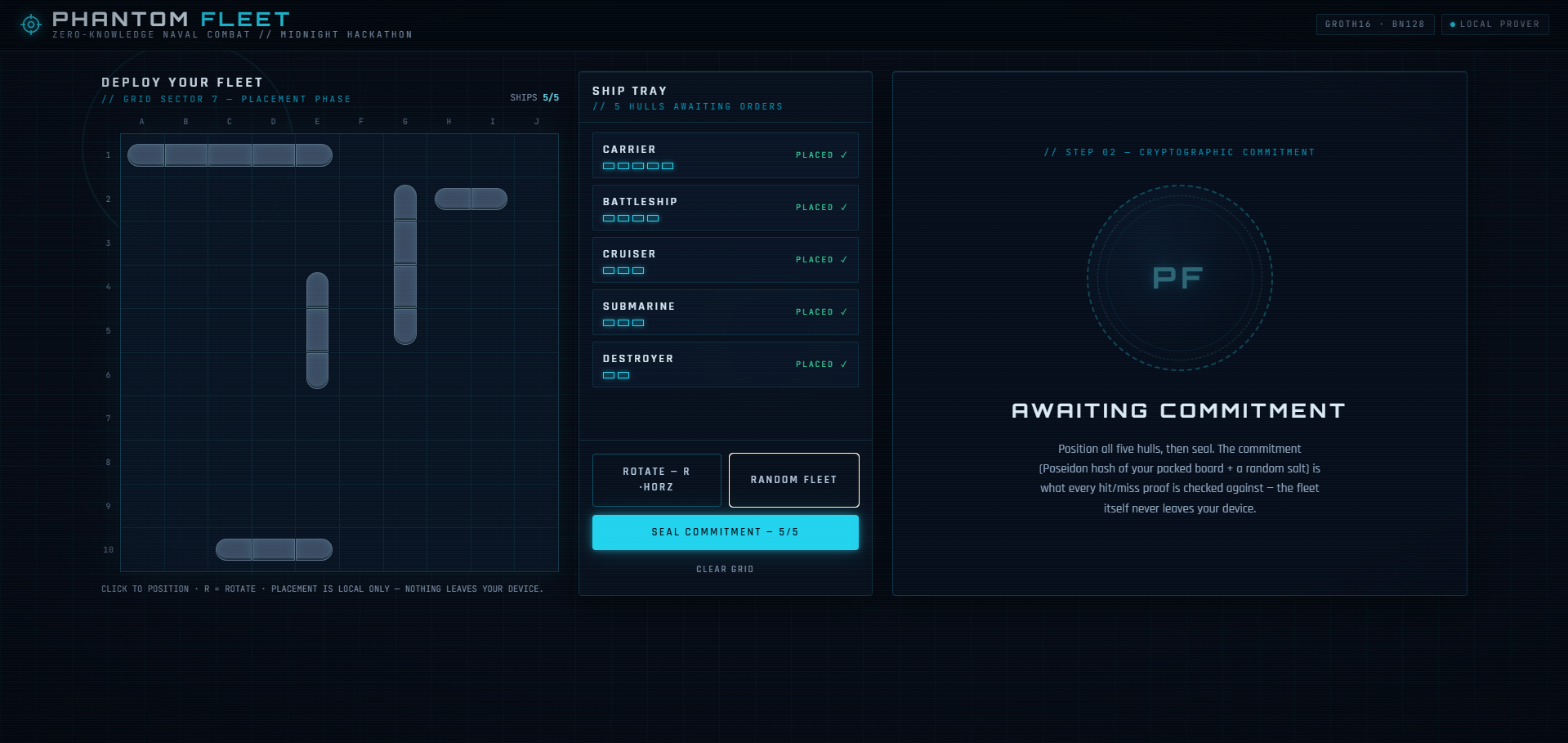
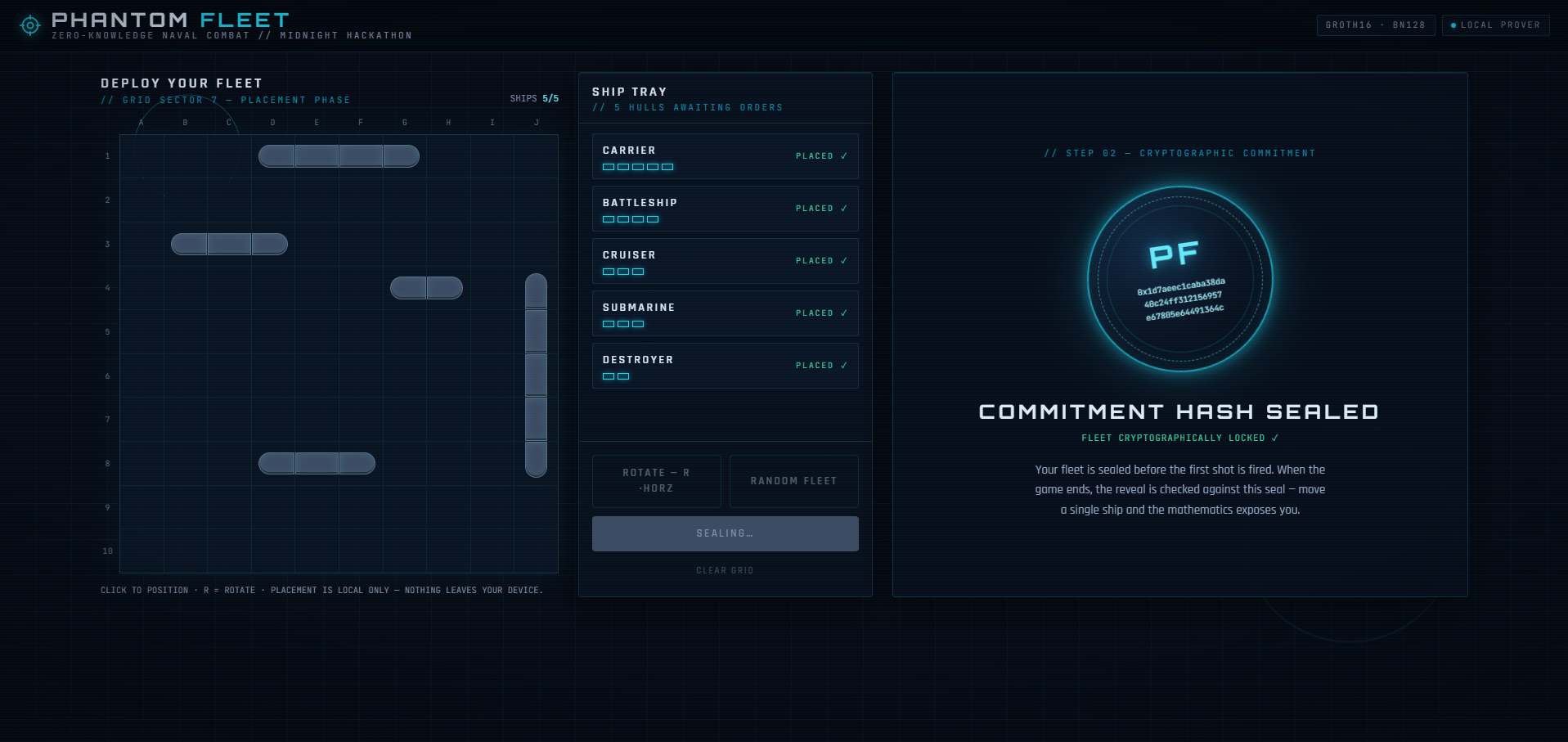
- Each side packs its 10×10 board into one field element $packed = \sum_{i=0}^{99} b_i \cdot 2^i$, picks a random salt, and publishes a Poseidon commitment $C = \mathrm{Poseidon}(packed, salt)$.
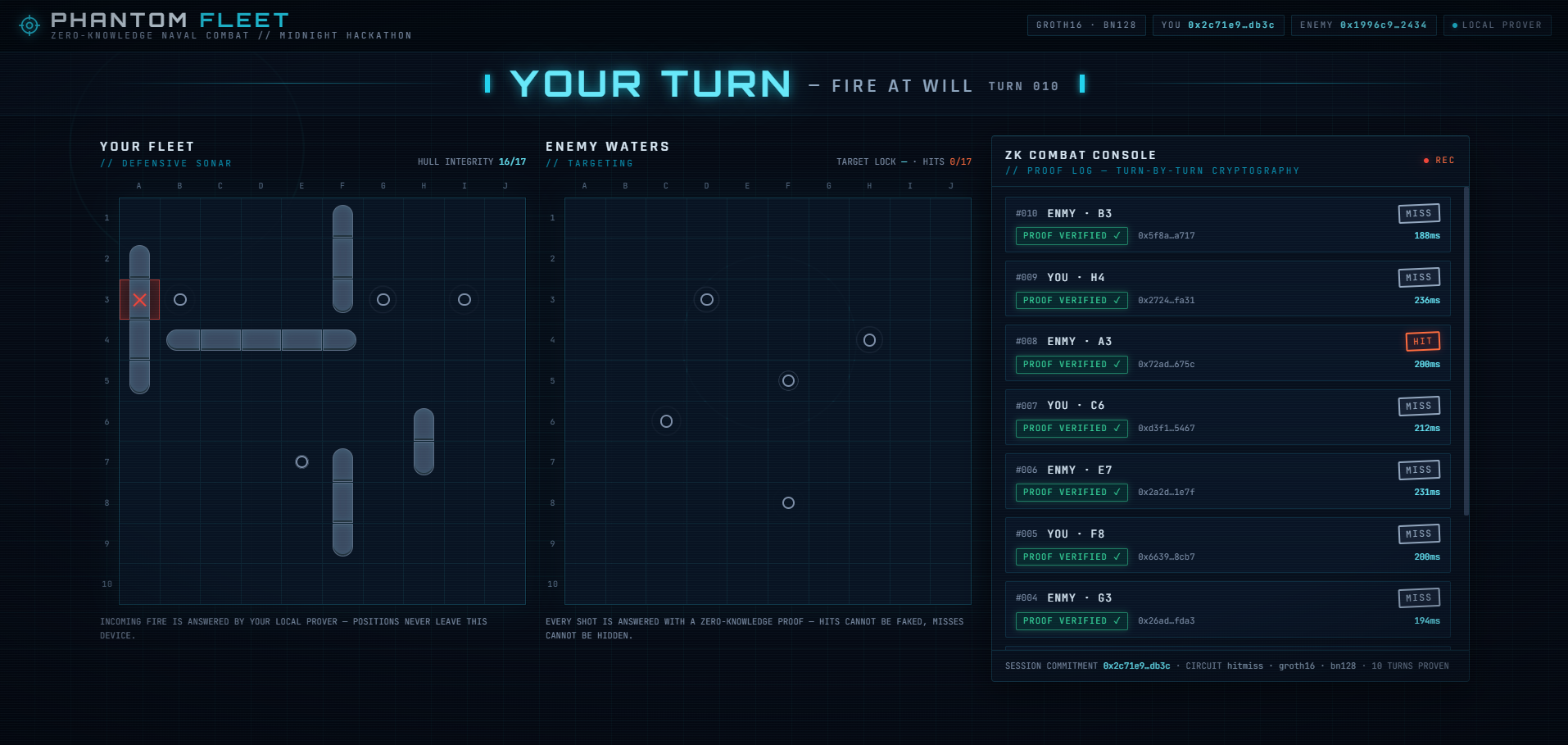
- On every shot, the defender runs a Groth16 circuit proving $result = board[10x + y]$ against the public commitment — inside the browser, in a Web Worker.
- The attacker verifies the proof in ~30 ms. Only
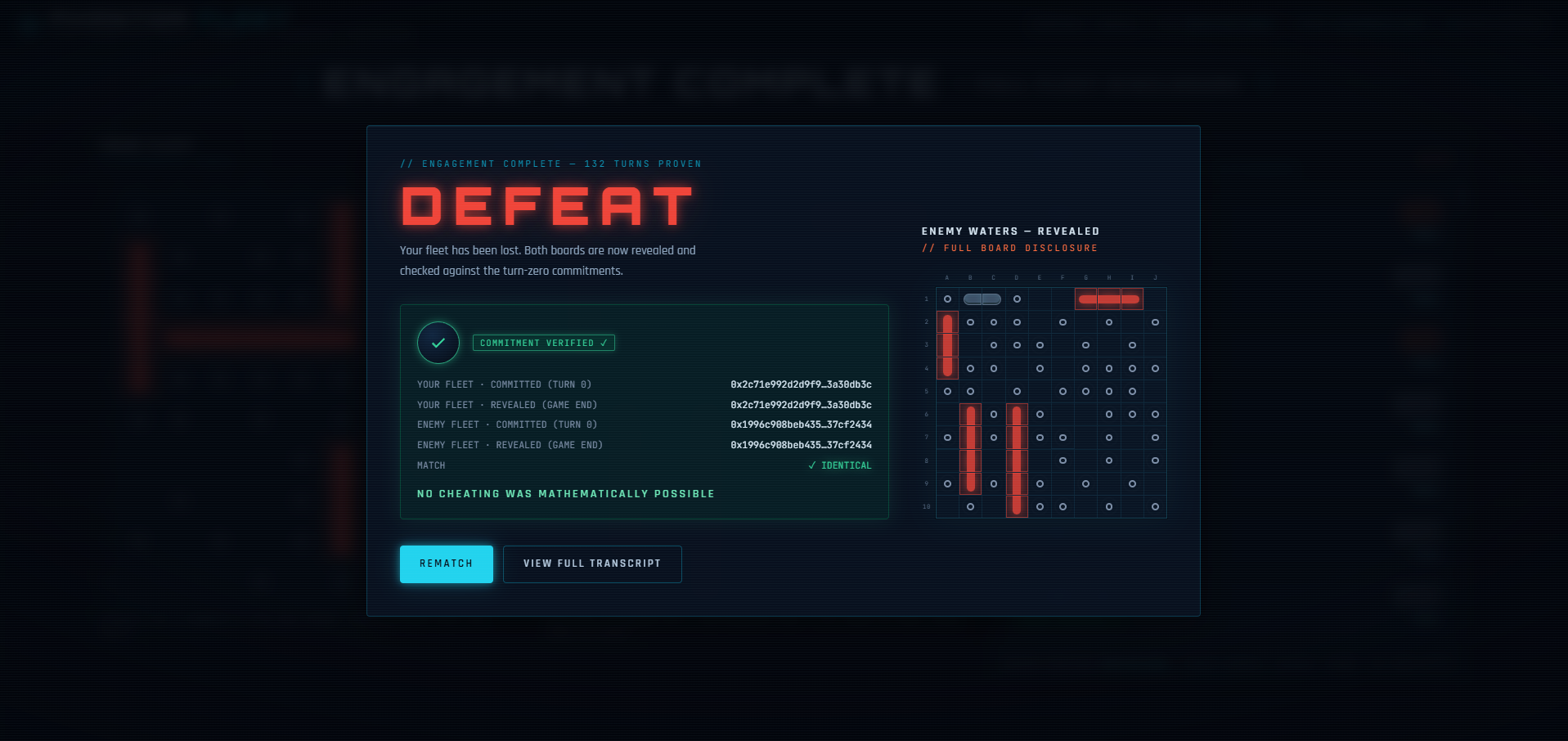
hit/missis ever revealed; the board never leaves the machine. - At game over, both boards and salts are revealed and the commitments are recomputed — matching the ones announced before the first shot.
A live ZK Proof Log shows every proof: generation time, verification time, and the checkmark. A dishonest answer doesn't get "caught" — it simply fails witness generation. You cannot answer dishonestly.
How I built it
- Circuit:
hitmiss.circom(1,047 constraints), compiled with the official circom 2.2.3 compiler. It enforces that every cell is a bit ($b_i(b_i - 1) = 0$), that the packed board matches the Poseidon commitment, that the coordinate is in range, and that the claimed result equals the committed cell. - Proving pipeline: snarkjs 0.7 — powers-of-tau (bn128, pot12) → Groth16 setup → zkey + verification key, shipped as static assets so the game runs without rebuilding.
- Frontend: React 19 + Vite 8 + TypeScript + Tailwind CSS 4. Proving runs
in a Web Worker (
snarkjs.groth16.fullProve) so the UI stays responsive; verification happens on the main thread. - Midnight layer: the identical protocol written as a Compact reference
contract (
newGame,joinGame,fireShot,respondShot,claimWin), with the private board and salt as witnesses — ready for deployment, with the JS commitment code already computing exactly the witness values the contract expects. - Verification culture: a headless test suite proves a hit, proves a miss, and — the important part — confirms that a false claim and a wrong commitment are both rejected.
Challenges I ran into
The environment fought back. My build machine was Windows 11 with no
Docker, no admin rights, no reboot budget. Midnight's documented path — WSL2 +
Docker Desktop, compactc (no Windows build exists), and a Docker-only proof
server — was completely blocked. Rather than fake the ZK layer, I pivoted the
architecture: circom ships an official Windows binary and snarkjs runs
anywhere JavaScript runs, so I moved all proving into the browser itself and
kept the Compact contract as a faithful, deployment-ready reference
implementation. The constraint became the design.
snarkjs in a Web Worker is not a paved road. Groth16 proving needs Node
APIs, WASM, and multi-megabyte zkeys inside a Vite worker bundle. Solving that
(vite-plugin-node-polyfills, careful asset loading) is what turned "ZK demo"
into "playable game" — first proof takes a few seconds of warmup, every proof
after that lands in ~0.3–1 s.
Hash parity across three languages. The commitment is computed in JavaScript (circomlibjs), enforced in circom, and mirrored in Compact. One off-by-one in the packing convention ($idx = 10x + y$) and every proof fails silently. I pinned one convention everywhere and tested the JS output against the circuit's public input directly.
What I learned
- Circuits change how you think about cheating. You don't detect a lie; you make it unrepresentable. If the witness doesn't satisfy the constraints, there is no proof — the concept of "lying about hit/miss" stops existing.
- Groth16's cost is its trusted setup (my demo uses a fixed-entropy pot12 ceremony) — which is precisely what Midnight's ledger-side proving eliminates, making the deployment path genuinely exciting rather than a chore.
- Poseidon exists because keccak is murder inside a SNARK. Choosing a SNARK-friendly hash is the difference between 1k constraints and 100k.
- A feasibility report before writing code saved the hackathon. Two hours of verifying toolchains (compiler builds, proof-server options, network endpoints) prevented me from burning the weekend on a blocked path.
What's next
Deploy the Compact contract to Midnight's preprod testnet: compile in CI, reuse the existing commitment code as witness values, swap the snarkjs calls for the generated contract bindings, and let two real players face each other across the ledger — same game, no shared browser.
Built With
- blockchain
- bn128
- circom
- circomlib
- compact
- cryptography
- gaming
- groth16
- midnight
- node.js
- poseidon
- privacy
- react
- snarkjs
- tailwind-css
- typescript
- vite
- web-workers
- zero-knowledge-proofs
- zk-snark


Log in or sign up for Devpost to join the conversation.