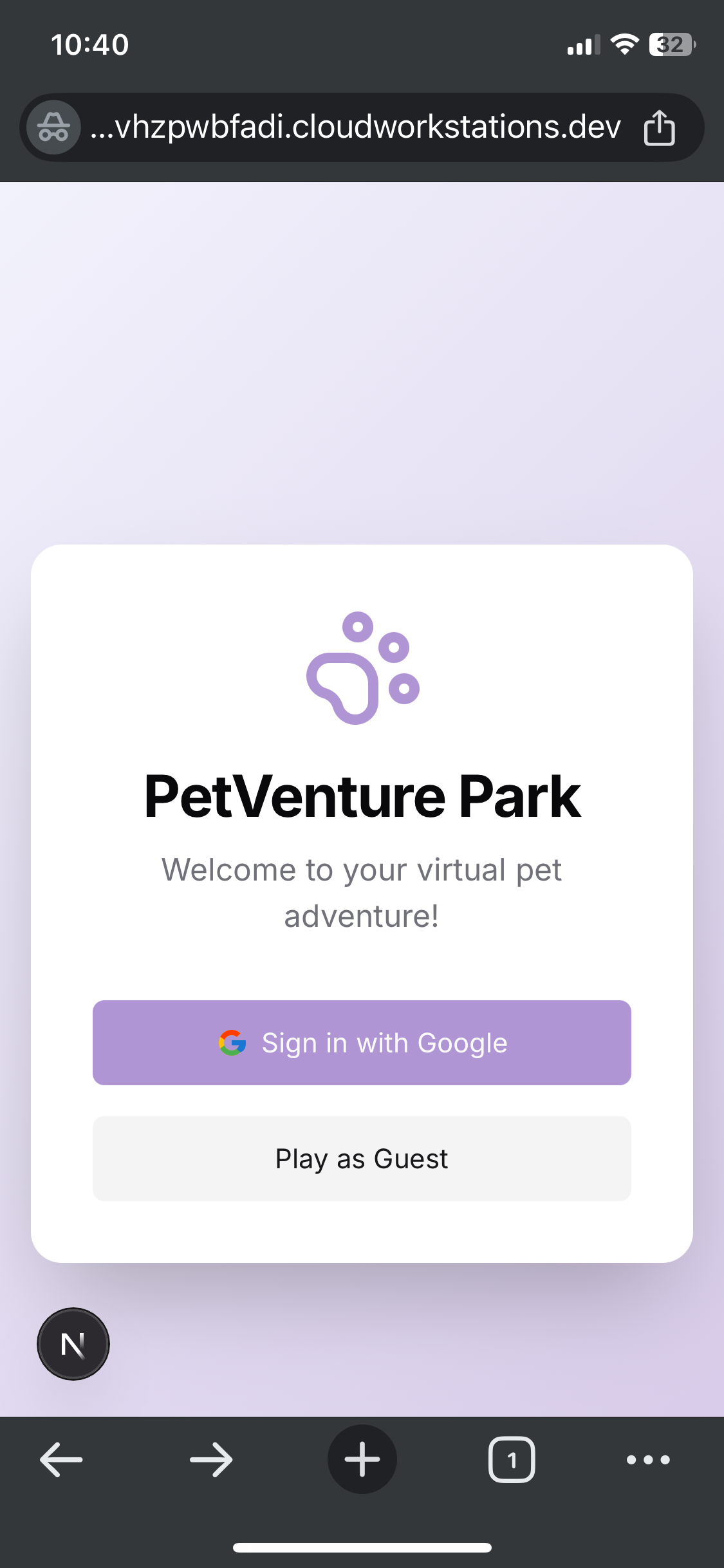
PetVenture Park: Building a Mobile-First Virtual Pet Paradise
The Spark of Inspiration 💡
My journey began with a simple observation: mobile gaming sessions are short, but the desire for meaningful connection is long. While analyzing the Meta Horizon design guidelines, I was struck by this statistic:
The average mobile gaming session tends to be short (2-5 minutes)
This constraint became my creative catalyst. I remembered the Tamagotchi phenomenon of the 90s—how these simple digital pets created profound emotional connections through brief, frequent interactions. The mathematical relationship was clear:
\[
\text{Engagement} = \frac{\text{Emotional Connection}}{\text{Time Investment}}
\]

\[
\text{Mobile Success} \propto \frac{\text{Immediate Satisfaction} \times \text{Long-Term Progression}}{\text{Session Duration}}
I realized that by maximizing the numerator while minimizing the denominator, I could create something special. PetVenture Park was born from this equation—a world where every 2-minute session feels meaningful and every interaction builds toward lasting relationships.
The Learning Journey 🧠
Mobile-First Mindset Shift
The most significant learning came from rethinking everything I knew about game design. VR worlds thrive on immersion and complexity; mobile demands simplicity and immediacy. Some key insights:
· Progressive Disclosure: Instead of overwhelming players with all features at once, I implemented a tiered learning system:
  // First session: Core care mechanics
  const firstSessionSkills = ['pet', 'feed', 'play-minigame'];

  // Subsequent sessions: Unlock complexity
  const progressiveSkills = {
    session2: ['dress-up'],
    session3: ['social-features'],
    session4: ['advanced-grooming']
  };
· Touch-First Philosophy: Mobile screens aren't just smaller VR displays—they're fundamentally different interaction canvases. I learned to design for thumbs, not motion controllers. · Audio Psychology: Mobile players often play with sound off. I implemented a visual feedback system where every action has clear visual confirmation, making the experience complete even in silence.
Technical Growth
Building with Firebase taught me about real-time synchronization at scale. The challenge wasn't just storing pet data, but ensuring that millions of potential pets could have their status updated in real-time without breaking the bank:
\[
\text{Storage Efficiency} = \sum_{i=1}^{n} \left( \frac{\text{Pet Data}_i}{\text{Update Frequency}_i} \right) \times \text{Compression Ratio}
\]

\[
\text{Cost Optimization} = \min \left( \text{Read Operations} + \text{Write Operations} \right) \times \text{Data Size}
The Building Process 🏗️
Architecture Philosophy
I adopted a "mobile-first, scale-second" approach. The architecture mirrors the user experience—simple on the surface, sophisticated underneath:
User Session (2-5 min)
    ↓
Quick Action → Immediate Feedback → Small Reward
    ↓
Progress Tracking → Cloud Sync → Session End
Firebase Mastery
The real magic happened in the Cloud Functions. I learned to think in event-driven patterns:
// Not just updating data, but creating experiences
exports.onPetInteraction = functions.firestore
  .document('users/{userId}/pets/{petId}')
  .onUpdate(async (change, context) => {
    const newData = change.after.data();
    const oldData = change.before.data();

    // Emotional intelligence: Detect when pet needs attention
    if (newData.happiness < 20 && oldData.happiness >= 20) {
      await sendPushNotification(
        context.params.userId,
        `Your ${newData.name} is feeling lonely! 🥺`
      );
    }
  });
The 2-Month Development Sprint
Weeks 1-2: Core loop prototyping. I built the simplest possible version—just a pet that gets hungry and happy. Tested with friends to find the "fun threshold."
Weeks 3-4: Firebase integration. This was harder than expected—getting real-time sync working smoothly across devices taught me about offline-first design.
Weeks 5-6: Polish and mobile optimization. The devil was in the details: touch targets large enough for thumbs, colors that work in sunlight, battery-efficient animations.
Weeks 7-8: Social layer and testing. Added the dress-up and sharing features that turned individual care into social expression.
The Mountain of Challenges 🏔️
Performance vs. Personality
The biggest technical challenge: How do you create emotionally resonant pets without draining phone batteries?
I discovered that emotional connection comes from consistency, not complexity. A simple pet with predictable, responsive behaviors feels more "alive" than a complex one with laggy interactions.
The mathematical representation of this insight:
\[
\text{Perceived Intelligence} = \frac{\text{Consistent Responses} + \text{Predictable Patterns}}{\text{Response Time}}
\]

\[
\text{Emotional Connection} = \sum_{t=0}^{n} \left( \text{Positive Feedback}_t \times \text{Reliability}_t \right)
The "Skip vs. Learn" Dilemma
Meta's guidelines emphasize supporting both learners and skippers. My solution was contextual, replayable tutorials:
class TutorialManager {
  showTutorial(step, force = false) {
    if (this.userSkippedTutorial && !force) return;

    // Show brief, interactive tutorial
    // Always include skip option
    // Make replayable from settings
  }
}
Social Without Voice
Creating meaningful social interactions without requiring voice chat was fascinating. I implemented a "visual language" system:
· Equippable status items ("Let's Play!" bandana) · Pet emotions that broadcast player mood · Simple emote-based communication · Collaborative mini-games that require non-verbal coordination
The Breakthrough Moments 💫
The "Aha!" Animation
After struggling with complex pet animations, I had a revelation: sparkles solve everything. A simple particle effect when the pet is happy created more joy than any complex rigging ever could.
The Dress-Up Economy
I accidentally discovered that players valued "ugly" items as much as beautiful ones. The dress-up system became less about aesthetics and more about personal expression. This led to the inclusion of silly items alongside elegant ones.
The 2-Minute Magic
The proudest moment was watching test players complete an entire satisfying interaction loop in under two minutes. They'd log in, care for their pet, play one mini-game, dress them up, and log out with a smile. We had achieved the mobile sweet spot.
Lessons Carried Forward 🎯
This project taught me that constraints breed creativity. The 2-5 minute session limit wasn't a limitation—it was a design superpower. It forced me to:
· Cut everything non-essential · Make every second meaningful · Value emotional impact over feature count · Understand that mobile players aren't "less engaged"—they're differently engaged
The most important equation I discovered:
\[
\text{Mobile Success} = \int_{0}^{T} \frac{\text{Joy}(t)}{\text{Time}(t)} \, dt
\]

Where $T$ is the total player lifetime, and we maximize the joy density at every moment.
PetVenture Park isn't just a virtual pet game—it's a love letter to the busy, modern player who deserves moments of joy, no matter how brief their available time. 🐾✨
Built With
- firebase
- meta
- performance-horizon
- progressive
- pwa
- web


Log in or sign up for Devpost to join the conversation.