-
-
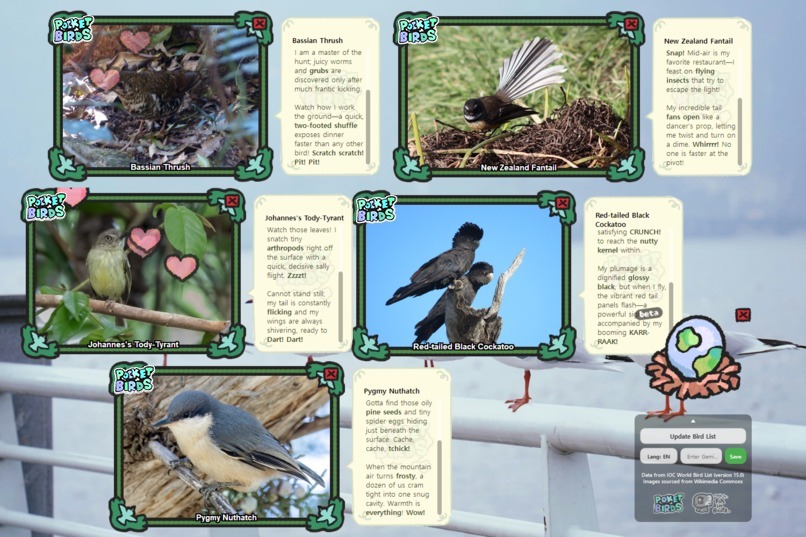
Highly recommended for all bird lovers!
-
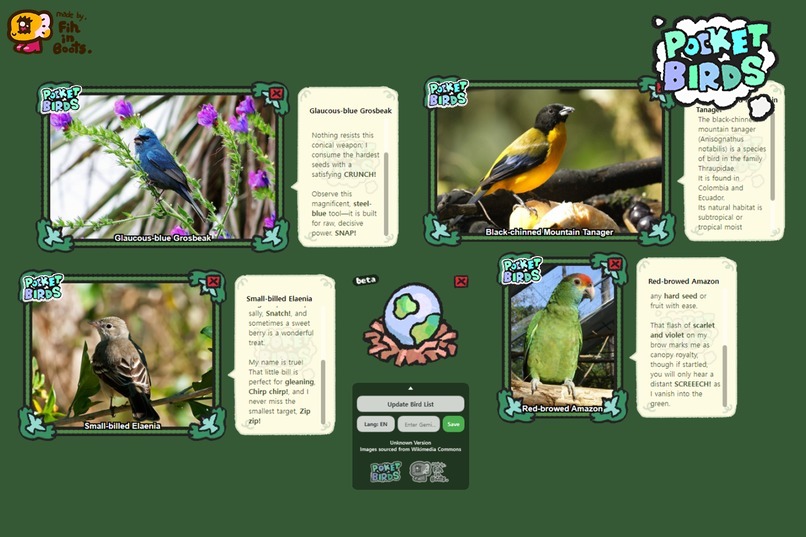
Meet birds with their own unique personalities and charms.
-
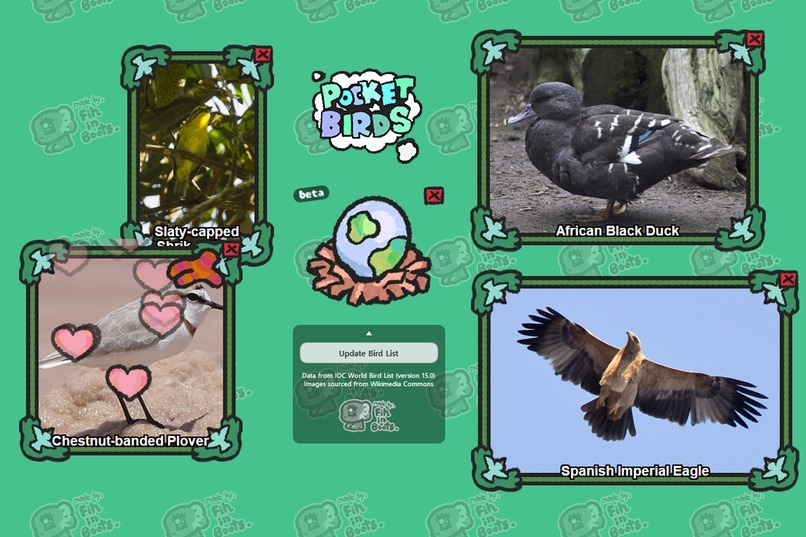
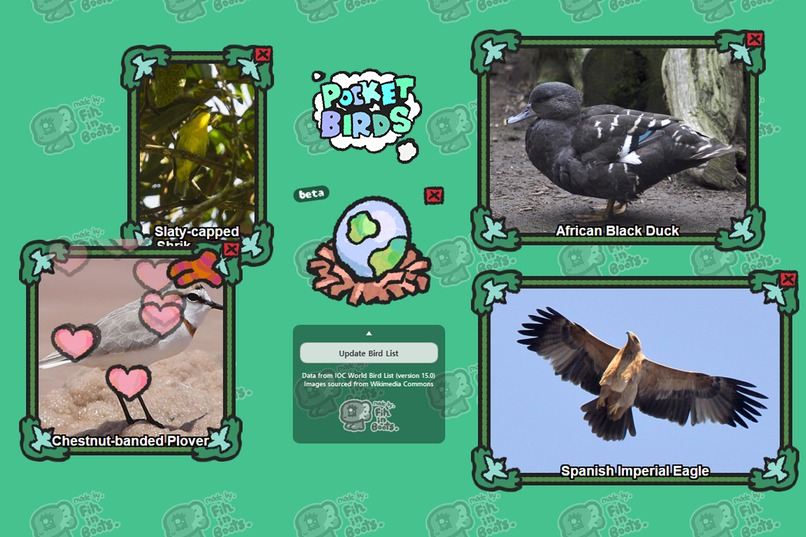
Pet your bird and send hearts
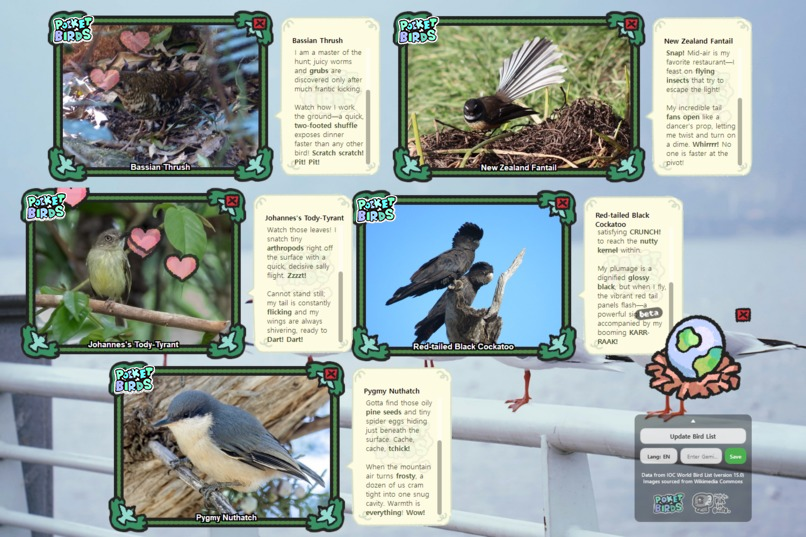
Inspiration

I love birds.
My journey began with birdwatching at Olympic Park in Seoul. Expecting only to see common pigeons and magpies, I was amazed to discover 15 different species in just two hours. This experience sparked a deep curiosity. How diverse and colorful are the birds inhabiting the rest of our world? I wanted to get to know each and every one of them, and that’s how this project took flight.
What it does

Let's send hearts to all the birds in the world!
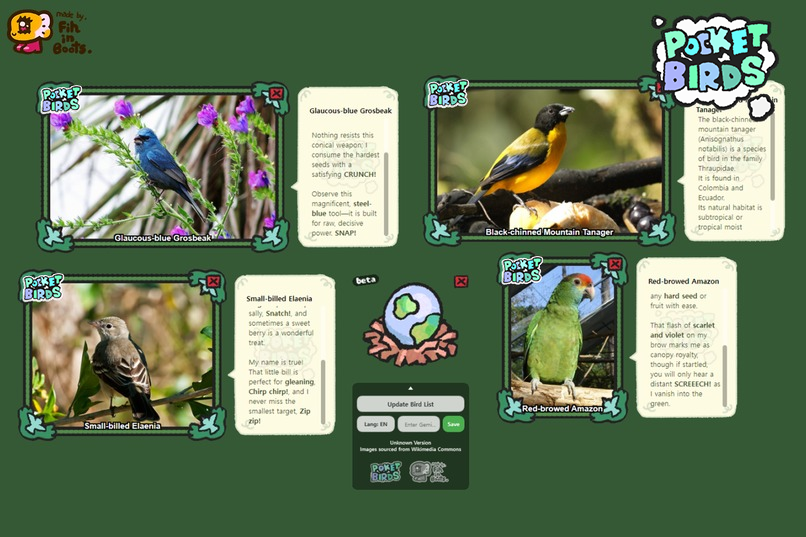
Pocketbirds is a Windows-based desktop application that lets you "hatch" and meet birds from every corner of the globe. Utilizing a massive dataset of over 11,250 recorded species, the app offers a randomly selected encounter with a unique bird every time you interact with it.
The journey begins with the "Earth Egg" at the center of the screen. When you click the egg, it hatches to reveal a random bird, bringing a sense of surprise and discovery to every session. Once a bird appears, it introduces itself through Gemini 3, allowing you to discover fun facts and encounter rare species you might never see in daily life. You can even click to pet them and send hearts to express your affection.
How we built it

Hatching eggs!
The core focus of this app is "Fun." I wanted to give users the simple joy of hatching eggs one by one to see what's inside. The Earth-patterned egg sitting in a nest was designed to visually symbolize the mission of meeting every bird on the planet. To deepen the immersion, I customized the mouse cursor into a bird’s foot, making users feel truly part of the avian world.
The project seamlessly integrates the IOC World Bird List, Wikimedia, and the Gemini 3 Flash API. I focused on an emotional and interactive design where features like petting the birds and sending hearts allow users to express affection directly. Rather than reading dry facts, the information is delivered as if the bird is speaking to the user, fostering a sense of curiosity and closeness, even with species from the other side of the globe.

The Gemini API plays two vital roles. First, it provides detailed and accurate facts about each randomly selected bird in real-time. Second, Gemini 3 Flash creatively crafts a unique personality for each bird. It generates distinct personas. For instance, a swift, predatory bird might use a faster, more assertive tone, while a small songbird might sound cheerful and bright.

This approach offers two major advantages over static data. The app supports both Korean and English. While many species lack Korean Wikipedia entries, Gemini immediately translates and summarizes their characteristics into natural Korean. Likewise, English users can access new facts derived from data in other languages. Also, it transforms rigid descriptions into lively dialogue, making the learning process far more immersive.
Challenges I ran into
Selecting the IOC World Bird List as my primary data source was the first major challenge. To create a more approachable experience, I focused on a list of familiar common names. I also implemented an "Update" button to ensure new or reclassified species can be synced seamlessly, keeping the information current.
Handling the raw IOC dataset was technically demanding, as its massive file size caused frequent errors. To resolve this, I manually filtered and optimized the data into a lightweight file format. This critical step ensured the application runs smoothly and remains stable even when searching through thousands of species.

For imagery, I initially considered using Google Image Search. However, I was concerned about search accuracy and, more importantly, strict copyright compliance. To address these issues, I switched to Wikimedia Commons.
Filtering the results was also a significant hurdle. I had to implement logic to exclude non-bird images such as cats, planes, or cars. Refining the filter to distinguish between living birds and taxidermy (stuffed birds) was particularly tricky. Although most are filtered out, a few "stuffed" surprises still appear with a very low probability.
Accomplishments that I'm proud of
One of my key achievements was finding a balanced way to utilize the Gemini API. Rather than relying on AI for all data, I prioritized scientific accuracy by using authoritative sources like the IOC World Bird List, while leveraging Gemini 3 Flash for creative synthesis and unique persona building. This synergy allowed me to create an app that is both educational and deeply engaging.
Building a Python-based desktop application with deep API integration was a significant challenge, especially with only basic web knowledge. I focused my energy on the overall planning, design, and creative direction, and was able to bring the project to life through Antigravity-based Vibe Coding.
What I learned
I witnessed firsthand how "touching sentences," dialogue that feels personal and sincere, profoundly enhance the user experience. The generative power of Gemini 3 Flash breathed life into the application, offering a level of diversity and emotional depth that a static version could never achieve. This project taught me that in the AI era, the true value of a service lies in how naturally and meaningfully it connects with the user’s emotions.
What's next for Pocketbirds
The future of Pocketbirds is focused on deeper immersion and expanding our reach across the natural world. I plan to transition from manual dataset management to a fully automated syncing process with the IOC World Bird List. I also want to implement a "Favorite" feature so users can collect, save, and revisit their favorite bird encounters. Finally, I hope to develop new applications for other biological groups, such as plants and diverse land animals.

Log in or sign up for Devpost to join the conversation.