-

intro
-
competition
-
buiesness model
-

team


What is Petrik?
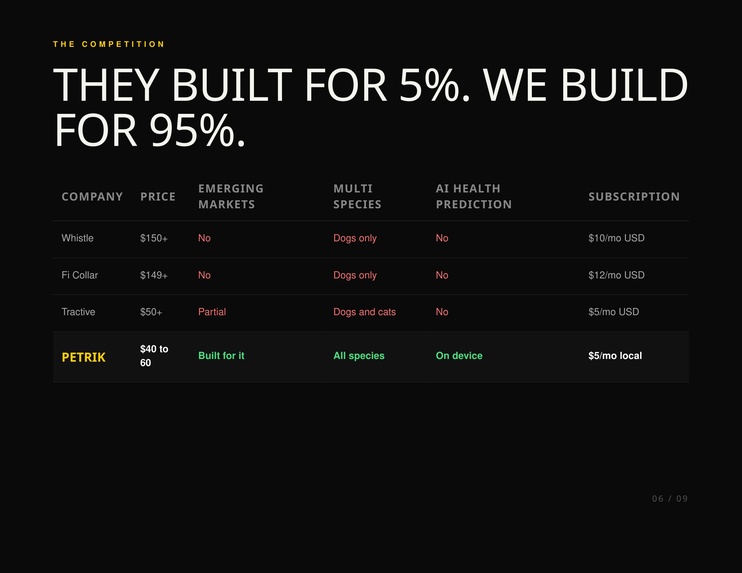
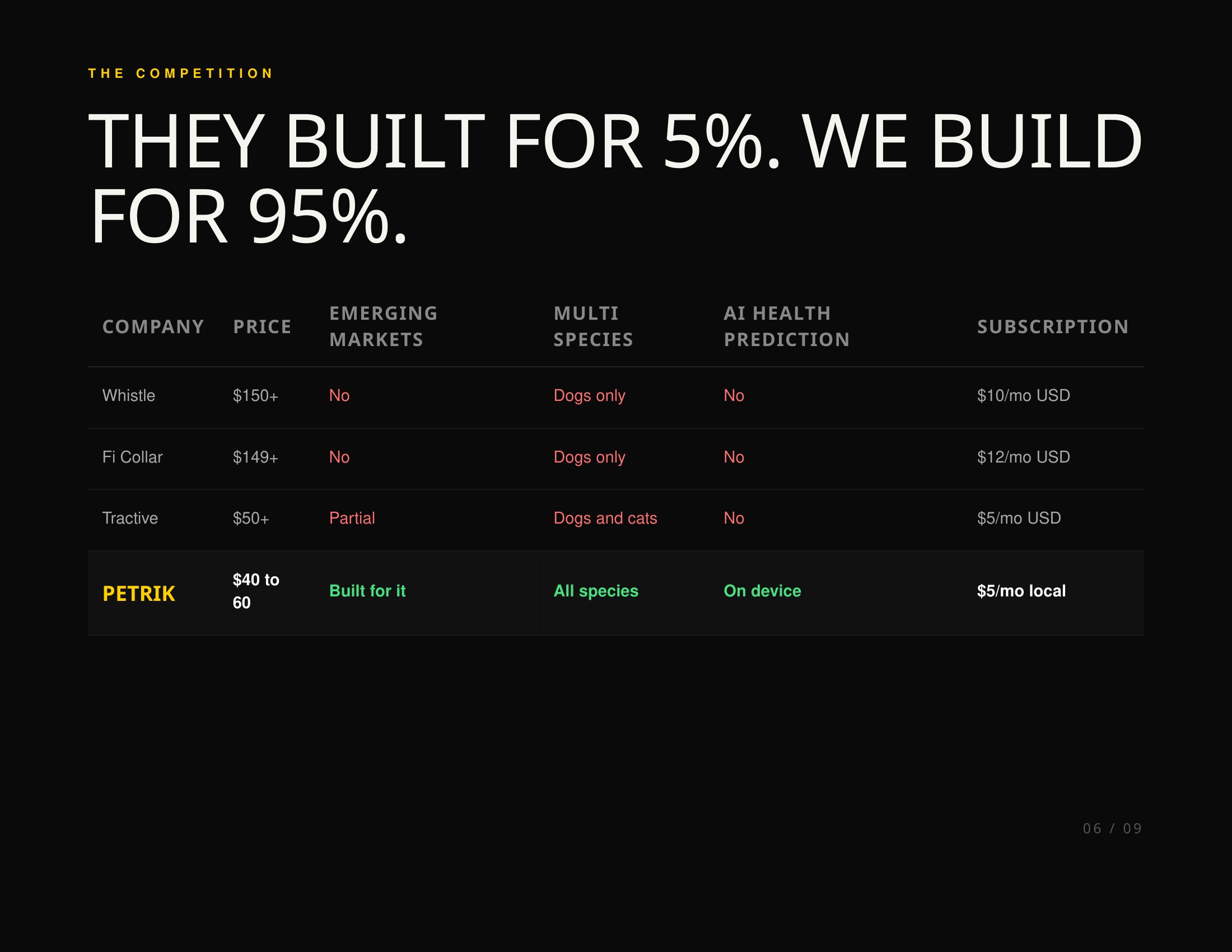
Pet owners in India, Southeast Asia, and Latin America love their animals just as much as anyone in San Francisco. They just can't afford a $150 smart collar with a $12 monthly subscription priced for American wallets.
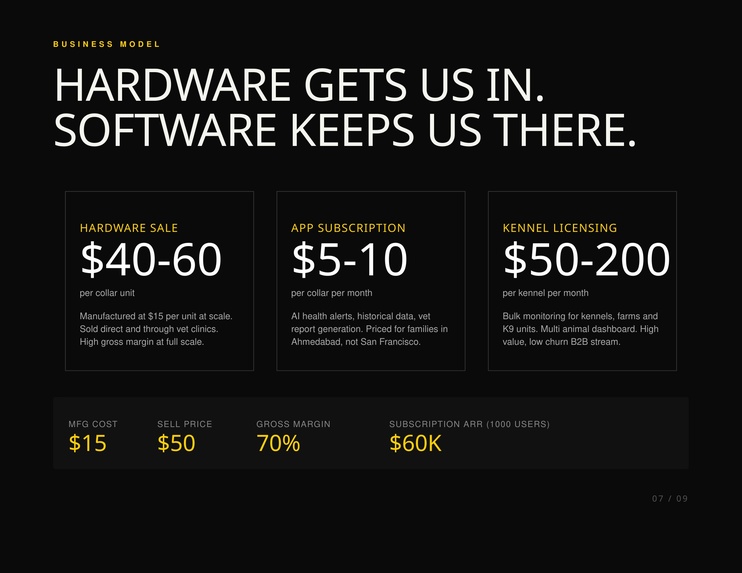
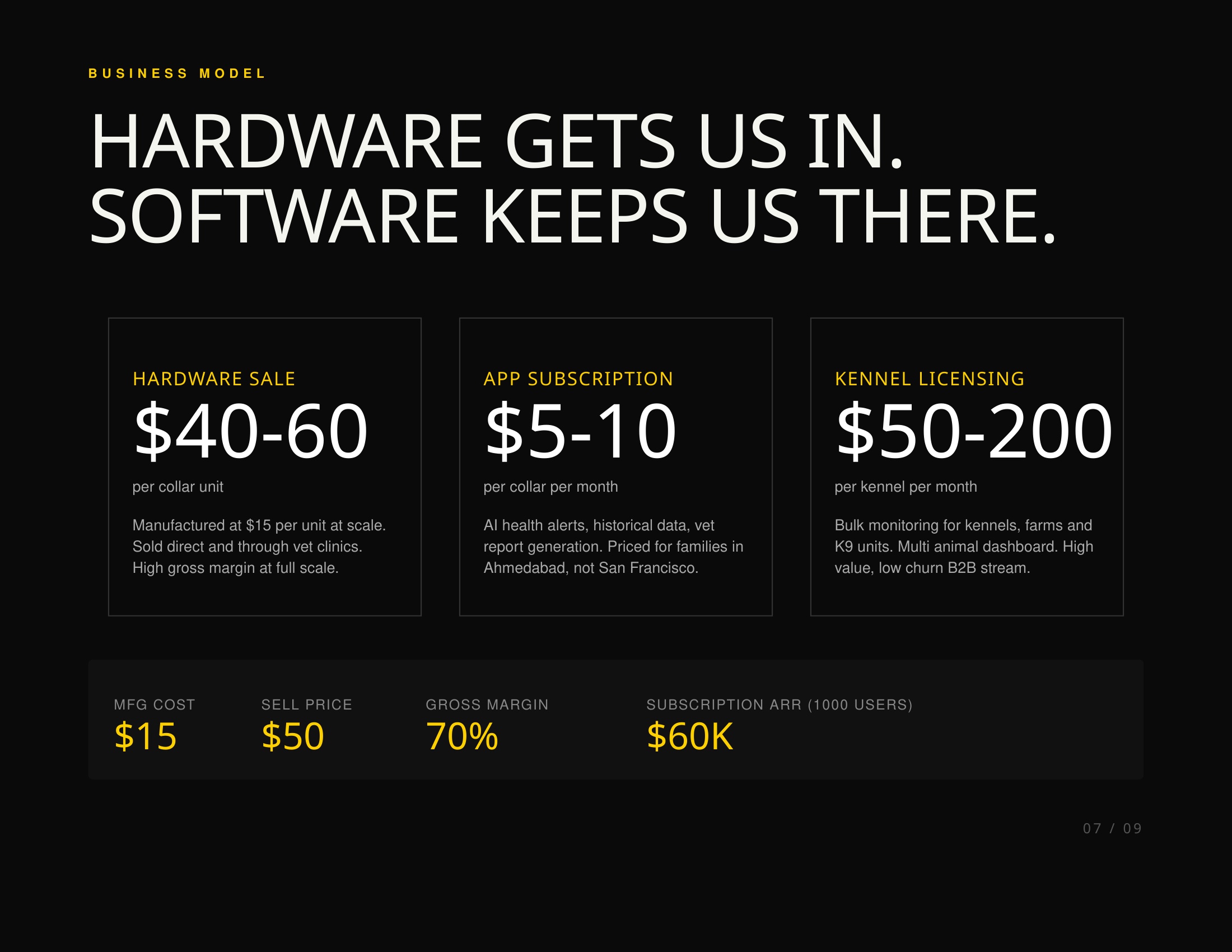
Petrik is a smart health collar that tracks vitals, GPS location, and activity in real time - and uses on-device AI to catch illness before the vet visit becomes an emergency. We sell at $40 to $60 with a $5 monthly subscription. Built for the 300 million pet owners that Whistle and Fi have never thought about.
What Inspired Us
We didn't start with a product idea. We started with a question. Why does every smart pet device assume you live in America and earn in dollars?
We're first year Electronics Engineering students at Rashtriya Raksha University in Gandhinagar, India. Before writing a single line of code, we went on Reddit, explained the problem to real pet owners, and asked if they'd test a prototype. Several strangers said yes. A few offered to pay before it even existed. That told us everything we needed to know.
How We Built It
The hardware runs on an ESP32-S3 microcontroller connected to four sensors. A MAX30102 optical sensor reads heart rate using PPG. A TMP117 measures body temperature with 0.1 degree precision. A LIS3DH accelerometer tracks activity and detects falls. A Quectel L86-M33 GPS module handles real-time location. Connectivity uses a Quectel BG95-M3 LTE-M and NB-IoT module so it works across rural India and Southeast Asia, not just cities.
The enclosure is 3D printed in PETG with an IP rated silicone gasket seal. Wireless charging via BQ51013B receiver IC. The whole unit costs around $15 to manufacture at scale.
On the software side we are building a React Native app with a Node.js backend using MQTT protocol. TensorFlow Lite runs anomaly detection directly on the ESP32, no cloud dependency, no patchy network issues.
Challenges We Faced
Getting accurate heart rate readings through fur is genuinely hard. PPG sensors are designed for human skin. We had to experiment with sensor positioning, pressure fit, and light shielding to get consistent readings.
Power management was the other big one. Fitting GPS, LTE-M, heart rate, temperature, and accelerometer onto a 300mAh LiPo battery meant every component had to be duty-cycled carefully using the BQ25120A power management IC.
What We Learned
Talk to users before you build. Validate before you prototype. Hardware is slower than software but the moat it builds is ten times deeper.
India is an incredible place to build hardware. Components cost a fraction of US prices. Our university runs India's national K9 training facility, which means we test on real dogs, not simulations. That's an unfair advantage and we plan to use it fully.
What's Next
Working prototype by August 1, 2025 for the IEEE SSCS International Arduino Contest. Beta testing on RRU's K9 facility. App launch. Scale across Gujarat, then India, then globally after we graduate in May 2029.
Log in or sign up for Devpost to join the conversation.