

Inspiration
Driving uphill through many different colleges to look for parking spots is tiring and time-consuming. Being late to class solely due to parking isn't rare. We thought we should solve this problem that students from all backgrounds are currently facing.
What it does
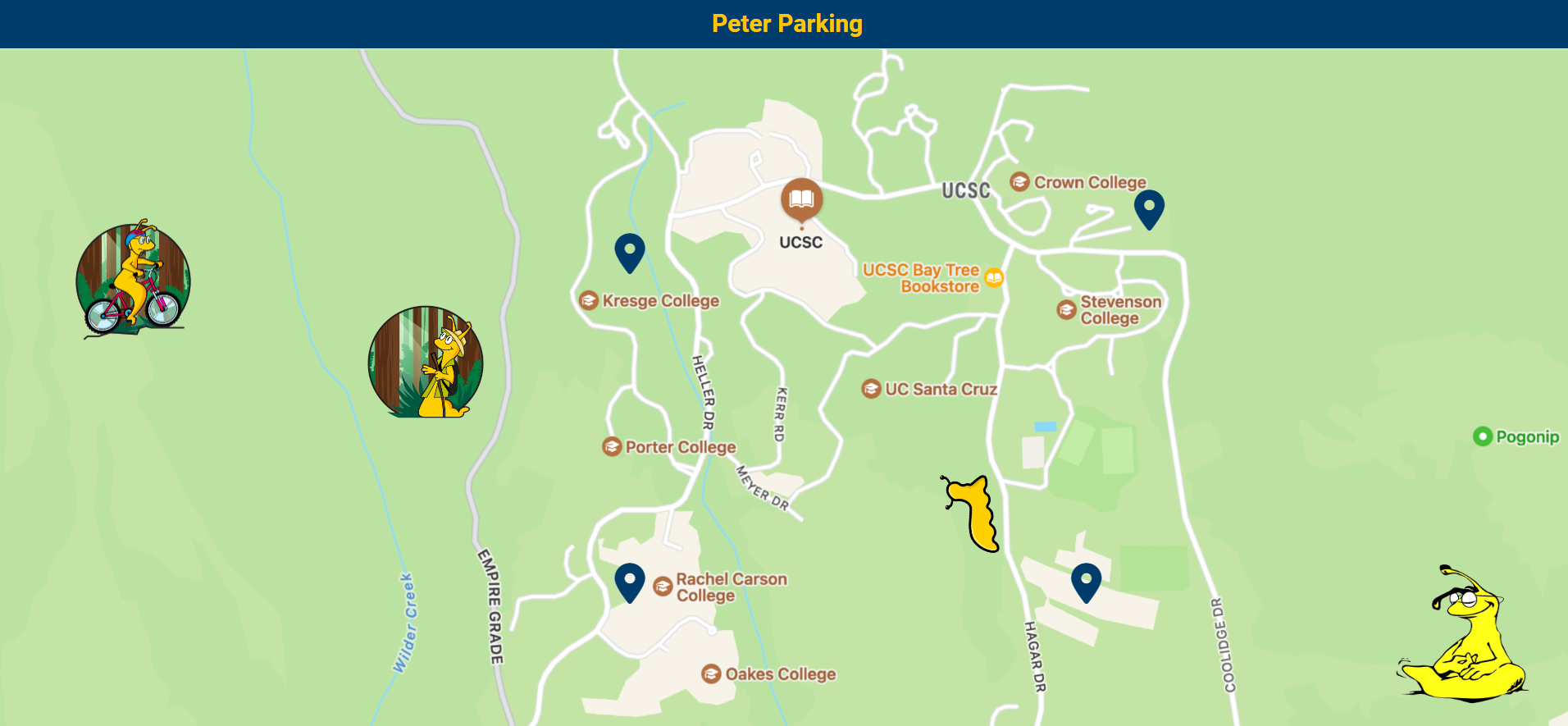
Peter Parking shows available parking lots throughout the UCSC campus based on user interactions. People can report how many parking spots were available at a certain parking lot, and that information gets saved into our data storage and becomes available to view on the website.
How we built it
We used html, css, and js to build our website, and we used Flask to transfer user reports from the website to Python where the data gets stored.
Challenges we ran into
As a team of beginner coders, our biggest challenge was connecting the website (frontend) to our data storage (backend). We watched countless tutorials on YouTube and finally found our way to navigate through this using Flask, a program that works as a bridge between python codes and html/css/js.
Accomplishments that we're proud of
We're proud of ourselves for starting with 0 and ending with a 1; we learned so many new assets by problem-solving real challenges we faced during development of Peter Parking.
What we learned
We learned the importance of prior planning, teamwork, dedication and strong mentality during day 1 of CruzHacks, as we were still lost on what idea to materialize until the very start of day 2. However we were able to gather and push ourselves toward our goal and finally made it happen.
What's next for Peter Parking
Our first step for improving Peter Parking is adding a server so people can check the parking status on campus from anywhere. Next is making Peter Parking show the status for every single parking lot on campus, and last is adding motorcycle and bicycle parking lot supports.
