-
-

Home page
-
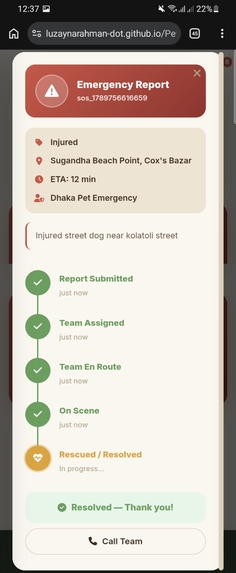
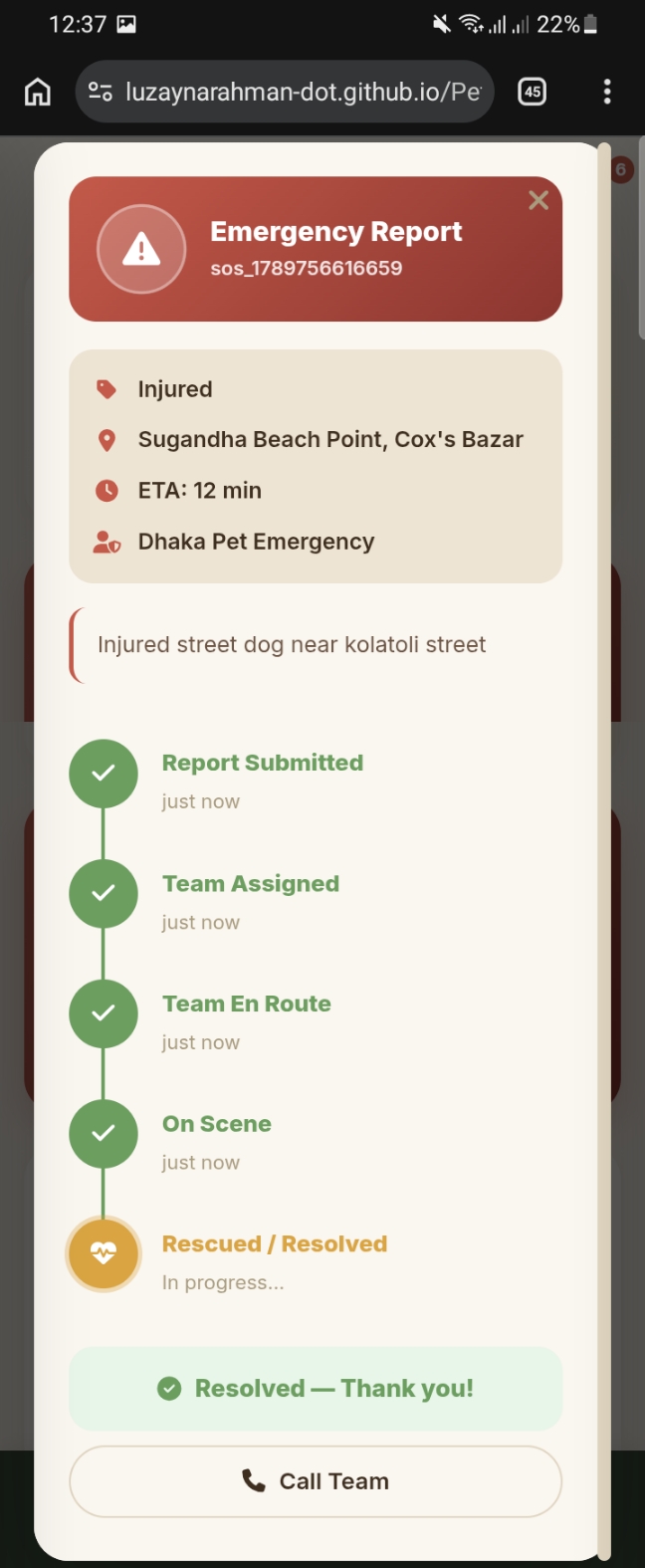
SOS Modal
-
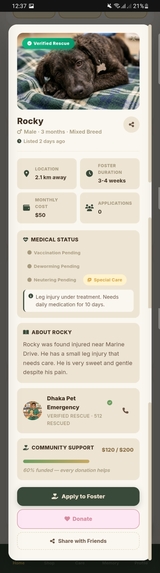
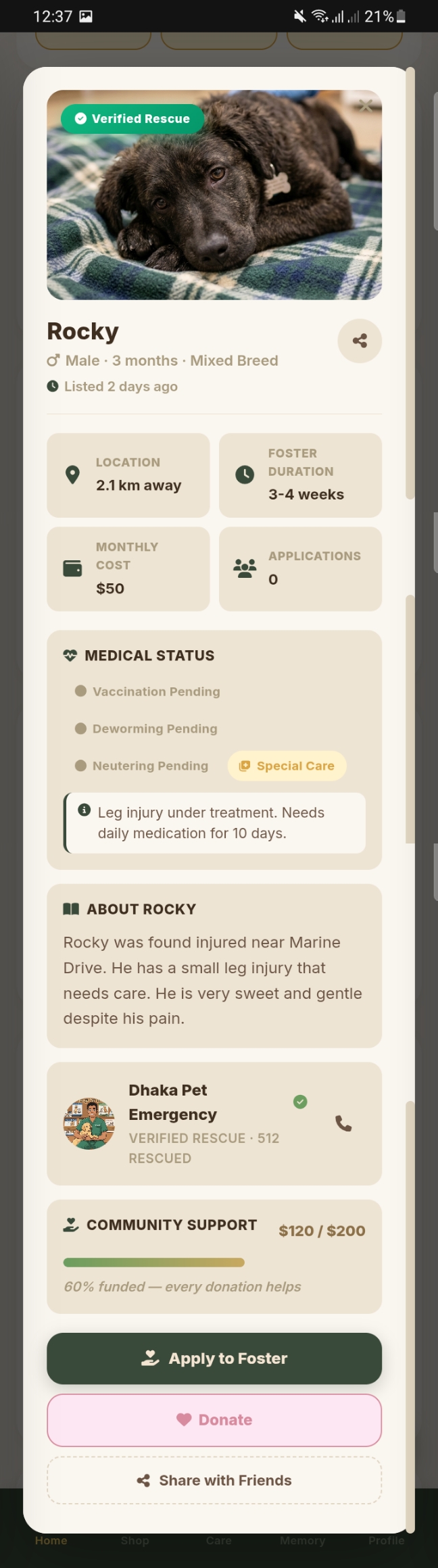
Foster Modal
-
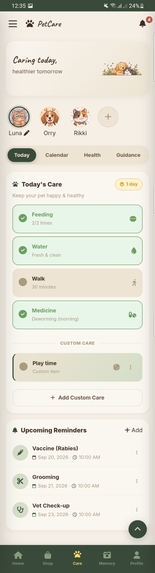
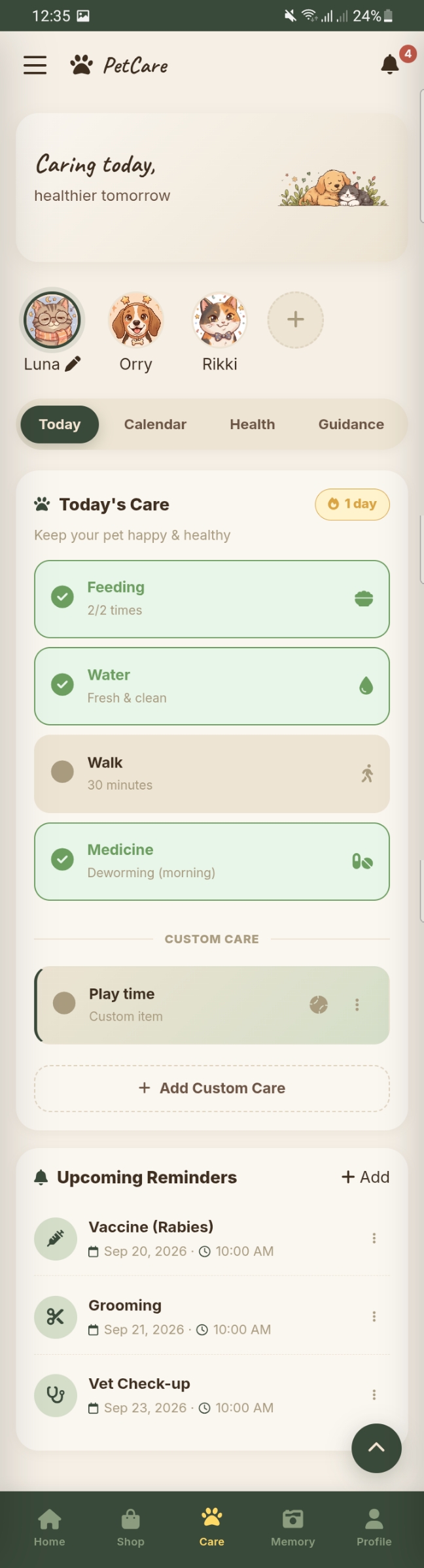
Care page, today tab
-
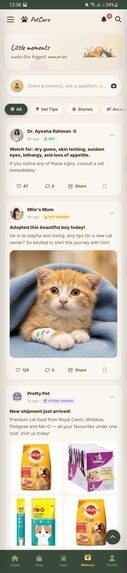
Memory feed
-

Shop page, products tab
-
Pwa install


Inspiration
I don't have a pet yet. But I love animals, and I want to have my own house with pets someday.
Living in Cox's Bazar, Bangladesh, I noticed a real problem: when a pet gets lost or injured, most people don't know who to call. There's no unified system for animal rescue, no emergency hotline, no easy way to find nearby vets. Pet owners juggle between 5+ apps — one for health tracking, one for shopping, one for booking vet appointments, one for community. Vets and small pet store owners have no unified platform to reach their audience.
I also noticed something else: many people rescue kittens and post about it on Instagram stories, hoping someone will adopt them. But most pet lovers who actually want to adopt never see those stories. There's a gap between rescuers and adopters.
I thought: what if I built a small "pet city" — one app that has everything a pet needs? PetCare is my answer.
What it does
PetCare is a Progressive Web App (PWA) that combines 6 apps in one:
Multi-Pet Health Tracking — unlimited pets, weight charts with Chart.js, vaccination records, medication reminders, health logs, custom care items, and a real streak system based on actual daily completion.
E-Commerce — product catalog across 8 categories, shopping cart, multi-method checkout (bKash, Card, COD), 4-stage order tracking, wishlist, and favorite stores.
Vet Appointments — book chat, video, or in-person consultations with history tracking.
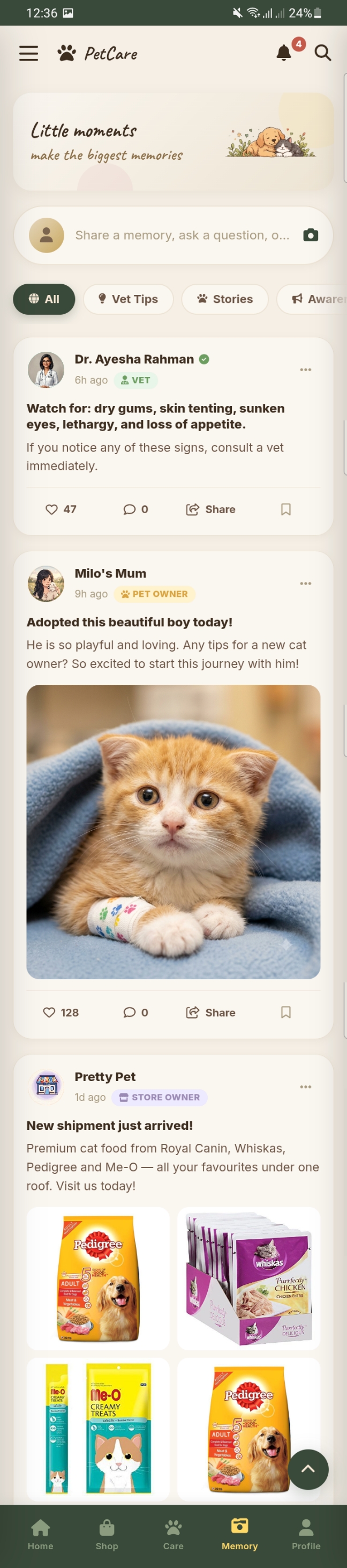
Memories (Social Feed) — posts with likes, comments, nested replies, save/share, follow/unfollow, and search across users, posts, and tags.
Emergency SOS — report injured, lost, or abused animals, 5-stage tracking timeline, auto-assign nearest open vet using Haversine formula, plus 6 first-aid emergency guides.
Foster & Adopt — verified rescue organizations with badges, community-listed foster pets, full application workflow (apply, review, accept/reject), donation tracking, and organization profile pages.
Plus a multi-role system (Pet Owner / Vet / Store Owner), light and dark modes, PWA installability, offline support, and a one-click demo mode for judges.
How we built it
I built the entire thing on an Android phone — a Samsung Galaxy A30. No laptop. No desktop. Every line of code was typed on a touchscreen using Acode editor.
Tech stack:
- Vanilla JavaScript (ES6+) — no framework
- HTML5 + CSS3 with CSS variables, Grid, and Flexbox
- LocalStorage for persistence
- Service Worker + Web App Manifest for PWA
- Chart.js for weight charts
- jsPDF for health records export
- Canvas Confetti for celebrations
- Font Awesome 6 for icons
- Hosted on GitHub Pages
Architecture: Three-layer design — Core (app, data, utilities), Features (home, shop, care, foster), and Social/Profile. Each layer depends only on layers above it. Every page render is a pure function that reads state and produces HTML.
Challenges we ran into
1. Building without a laptop. No multi-window, no keyboard shortcuts. Every Ctrl+C was done by tapping. I used Acode editor, Chrome for Android with chrome://inspect for debugging, and GitHub Mobile for commits.
2. Making features feel real, not fake. My first streak system used Math.random() — judges would notice. I rewrote it to read actual care history and count consecutive days with 3+ completed items. Same for SOS tracking (real timeline with persistence) and vet distance (real Haversine calculation).
3. Race conditions in demo mode. User's foster listings were being overwritten on page reload. Fixed with a backup localStorage key and synchronous injection before reload.
4. PWA offline support. My first service worker cached nothing because one failed asset broke the entire cache. Switched from Promise.all() to Promise.allSettled() so individual failures don't break everything.
5. State management without a framework. Data flow between 10+ pages. Solution: single source of truth (localStorage), helper functions shared across modules, and event-driven re-rendering on page switch.
Accomplishments that we're proud of
- Built entirely on Android — no laptop used
- Installable PWA that works offline
- Rich demo mode loading 3 pets, 48 health logs, 10 posts in one click
- Real logic for streak, SOS tracking, vet distance, and foster workflow
- Multi-role system with vet application and store creation
- 18,000+ lines of hand-typed code
- Zero frameworks — pure vanilla JavaScript
- Multi-role posting (post as Pet Owner, Vet, or Store Owner)
- Verified rescue organization system with green checkmark badges
What we learned
Technical lessons:
- PWA architecture — service workers, caching strategies, install prompts
- State management without a framework
- Real data models beat fake data every time
- Security basics —
escapeHtml()prevents XSS in user content - CSS architecture — variables for theming, responsive Grid
- Haversine formula for real distance calculation
Non-technical lessons:
- Mobile-first development — literally, since I built on mobile
- Debugging systematically — console, DevTools, breakpoints
- Documenting honestly — mistakes are the most valuable part
- Focus beats features — a small app with real logic beats a big app with fake logic
Biggest surprise: I learned more from bugs than from tutorials.
Biggest pride: Building this entire thing on an Android phone without a laptop.
What's next for PetCare
Short-term:
- Real backend with Node.js, Express, and MongoDB
- User authentication with JWT
- Real image uploads via Cloudinary
- Real-time chat between pet owners and vets
Medium-term:
- Push notifications via Firebase
- Payment gateway integration (bKash API for Bangladesh)
- Vet verification system with admin panel
- Marketplace commission model
Long-term:
- Multi-language support (Bengali first)
- Native mobile apps (React Native)
- Partnership with local animal rescue organizations
- Expansion to other cities in Bangladesh
The frontend is designed so swapping localStorage for API calls is a small change — the architecture is ready for a backend.
— Luzayna Rahman, Cox's Bazar, Bangladesh
Built With
- acode
- android
- canvas-confetti
- chart.js
- css
- css-grid
- css-variables
- dark-mode
- flexbox
- font-awesome
- github
- google-fonts
- haversine-formula
- html
- intersection-observer
- javascript
- jspdf
- localstorage
- offline
- pwa
- responsive-design
- service-worker
- vanilla-js
- web-share-api


Log in or sign up for Devpost to join the conversation.