Pet_Rescue_OpenClawer_AWS_Agent
Inspiration
Bengaluru has a huge network of animal rescuers, shelters, NGOs, foster homes, emergency vets, and independent volunteers. However, most rescue coordination still happens through fragmented WhatsApp groups, spreadsheets, Instagram posts, and local rescue communities.
During emergencies, especially late at night, people often struggle to quickly identify:
- which rescuer is available,
- which emergency vet is open,
- where shelter space exists,
- and how to coordinate transportation and rescue logistics.
We wanted to build an AI-powered coordination platform that could act like a real-time rescue assistant for injured, missing, and adoptable animals.
Our goal was simple:
Reduce rescue response time and help more animals receive emergency care and adoption support faster.
What it does
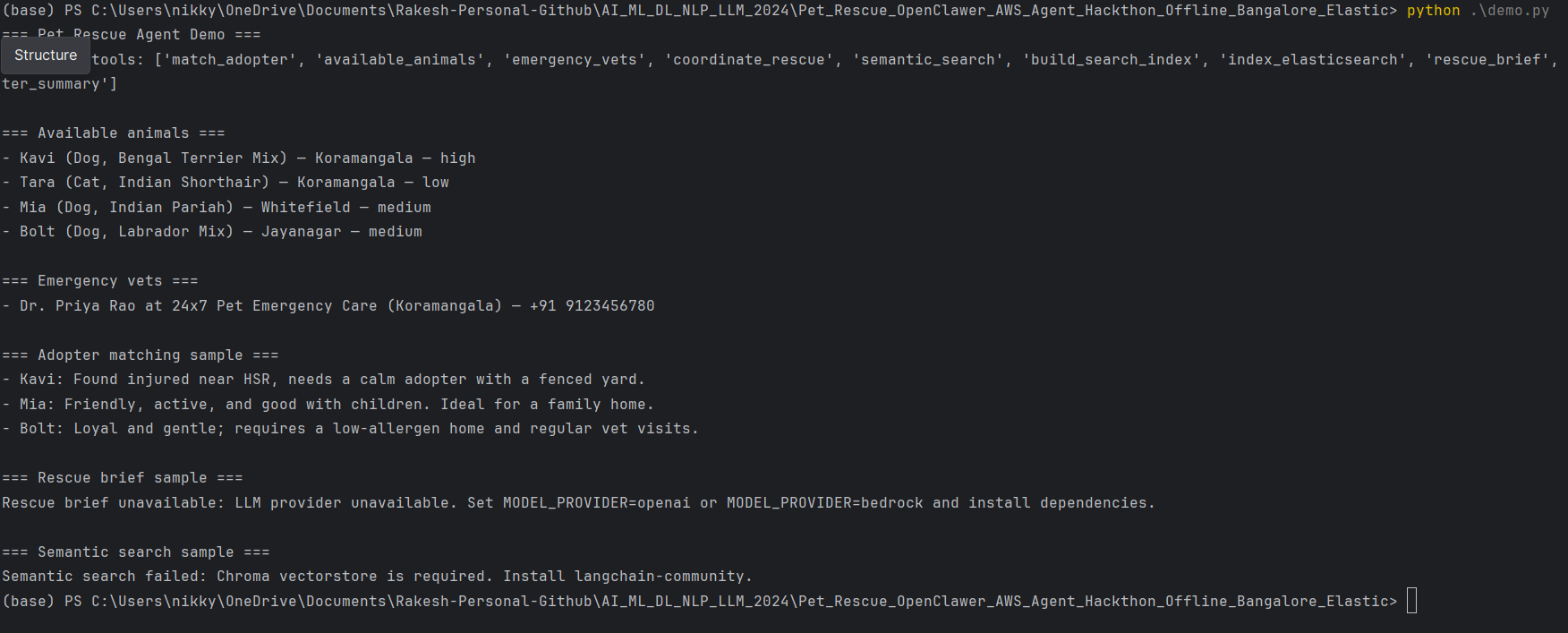
Pet_Rescue_OpenClawer_AWS_Agent is an AI-powered multi-agent rescue and adoption coordination platform.
The platform helps users:
- report injured or missing animals,
- find nearby emergency vets,
- discover rescue organizations and shelters,
- coordinate rescue logistics,
- and match adopters with suitable pets.
The system combines:
- semantic search,
- AI reasoning,
- vector embeddings,
- and multi-agent orchestration into one intelligent rescue workflow.
Example Workflow
A user can enter:
"Injured dog near Whitefield bridge bleeding heavily"
The system:
- Detects emergency intent
- Extracts location information
- Finds nearby vets and rescuers
- Prioritizes emergency response
- Generates rescue coordination details
The platform also supports semantic pet adoption matching using natural language queries such as:
"Looking for a calm apartment-friendly dog"
How we built it
We built the project using a combination of AI agents, semantic search, cloud deployment, and vector databases.
Open Crawler
Used to crawl:
- NGO rescue pages,
- vet directories,
- adoption listings,
- and shelter information.
Jina Embeddings
Used for:
- semantic pet matching,
- intelligent search,
- contextual retrieval,
- and similarity-based recommendations.
Elastic Agent Builder
Used to orchestrate multiple AI agents:
- Rescue Agent
- Vet Discovery Agent
- Adoption Matching Agent
- Search Agent
- Notification Agent
Amazon Bedrock
Used as the LLM reasoning engine for:
- emergency classification,
- summarization,
- conversational responses,
- and intelligent rescue coordination.
EC2
Used for cloud deployment and hosting of backend services and APIs.
Additional Stack
- Python
- FastAPI
- Streamlit
- ChromaDB / Vector Store
Challenges we ran into
Fragmented Rescue Data
The rescue ecosystem does not have a centralized structured database. Most information exists across social media pages, community groups, and scattered rescue posts.
We solved this by building a crawler-driven ingestion pipeline.
Semantic Search Accuracy
Adoption matching and rescue search are highly contextual problems. Exact keyword search was not sufficient.
Using vector embeddings significantly improved recommendation quality and contextual search.
Multi-Agent Coordination
Managing communication and context flow between multiple AI agents required careful orchestration and routing logic.
Hackathon Time Constraints
Building a production-style AI platform within limited hackathon time was challenging. We focused on delivering a functional MVP with real-world impact.
Accomplishments that we're proud of
- Built a working multi-agent AI rescue coordination platform
- Integrated semantic search using Jina embeddings
- Designed an AI workflow using Elastic Agent Builder
- Implemented emergency vet discovery and rescue coordination
- Created an intelligent adoption matching system
- Successfully combined AI + social impact into a real-world use case
- Developed a scalable cloud-based architecture using AWS services
What we learned
Through this project we learned:
- practical multi-agent orchestration,
- semantic retrieval systems,
- vector embeddings,
- Bedrock-based AI workflows,
- cloud deployment using EC2,
- and real-world AI system design.
We also learned how impactful AI systems can be when applied to emergency and community-driven use cases.
What's next for Pet_Rescue_OpenClawer_AWS_Agent
We plan to extend the platform with:
- WhatsApp integration,
- voice-based emergency reporting,
- image-based missing pet detection,
- live rescue tracking,
- multilingual support,
- volunteer coordination systems,
- and real-time shelter availability updates.
In the future, we aim to scale the platform beyond Bengaluru and support rescue ecosystems across multiple cities.
Built With
- agent
- amazon-web-services
- elastic-server-manager
- openclaw
- python

Log in or sign up for Devpost to join the conversation.