-
-
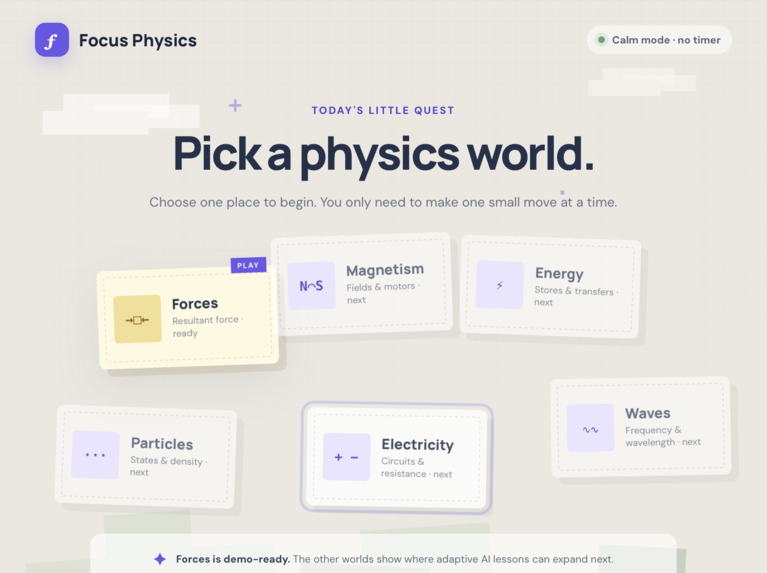
The opening page
-
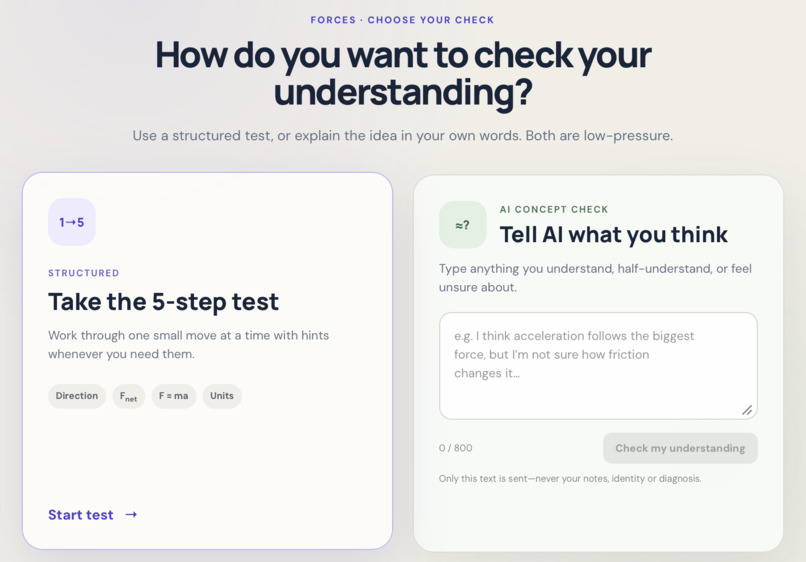
The two options for student
-
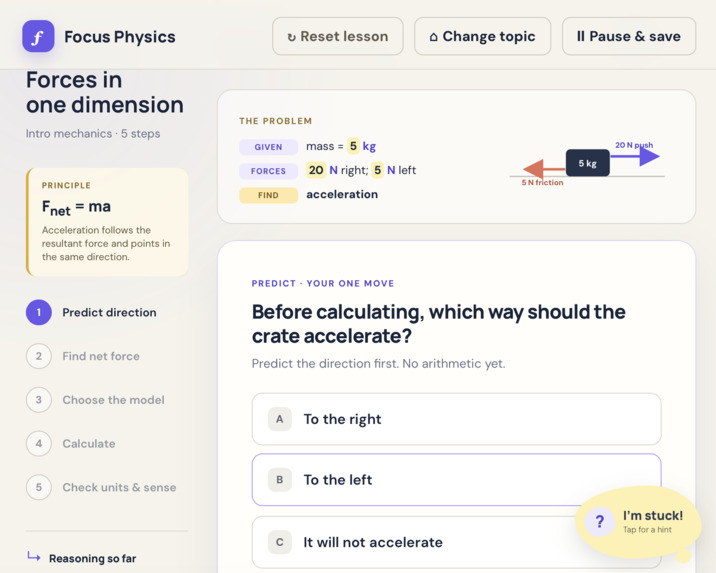
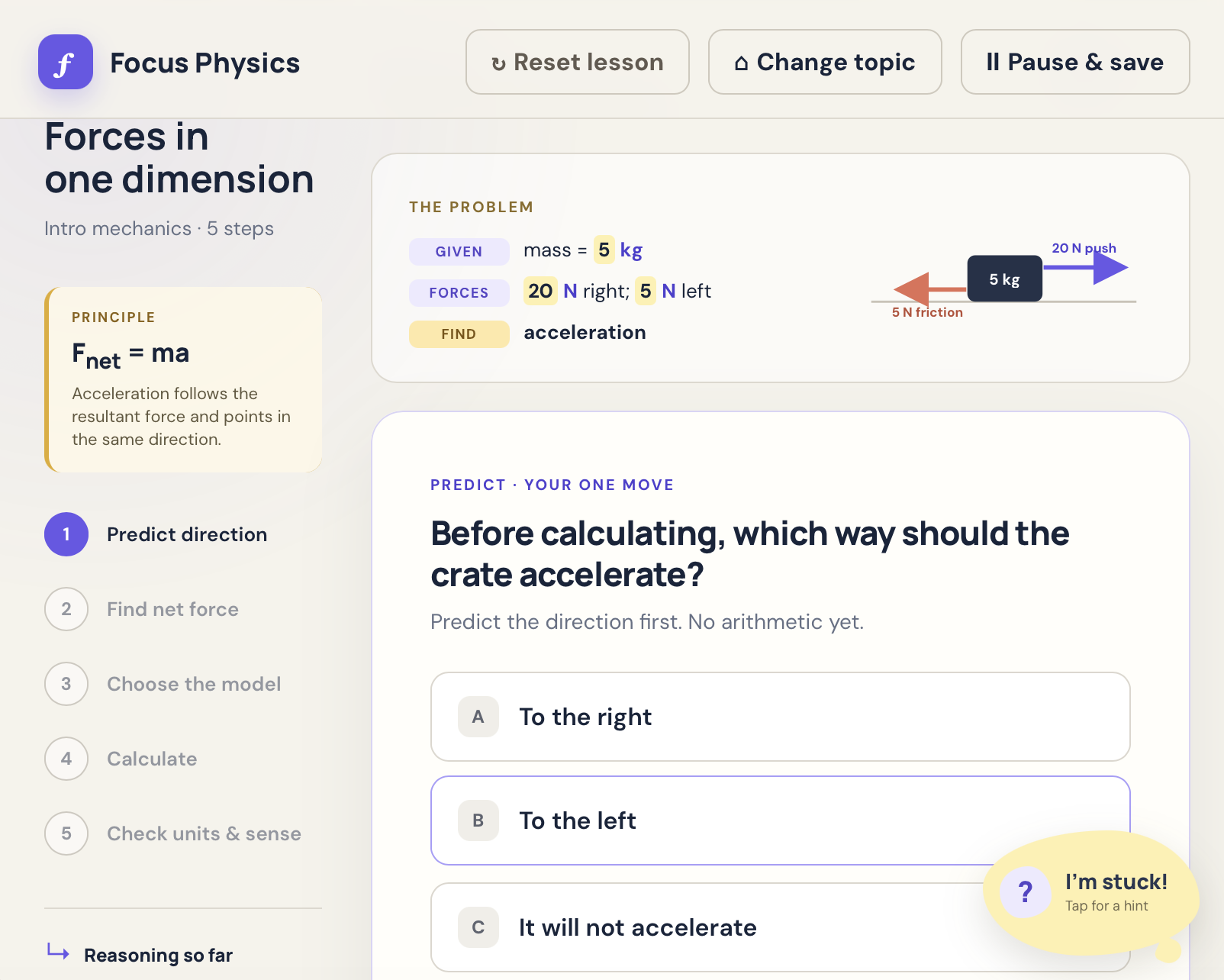
The test of understanding in small steps
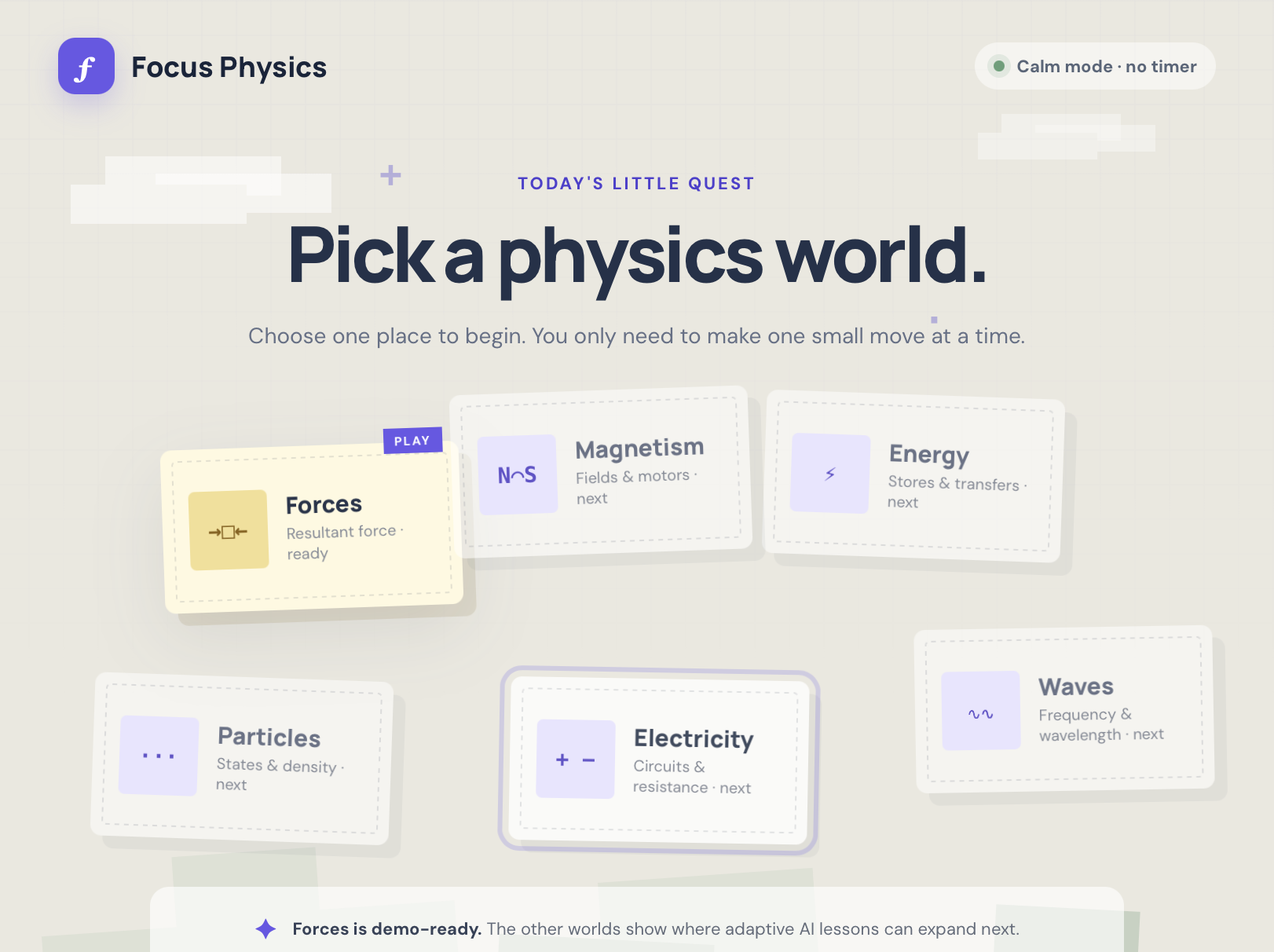
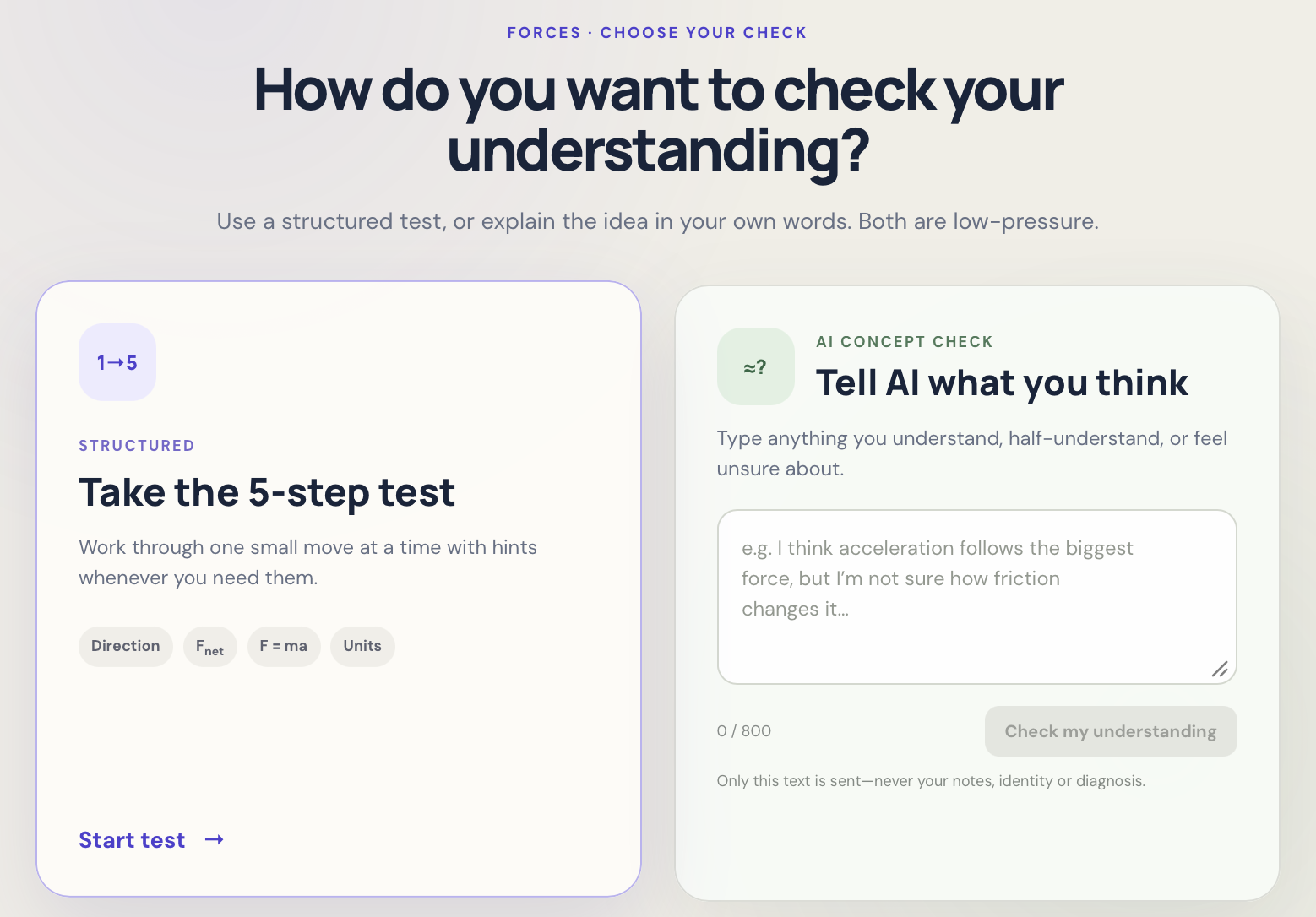
Inspiration
For students with ADHD, the hardest part of solving a physics problem is not always understanding the physics. It can be knowing where to start, keeping track of multiple steps, or staying focused long enough to reach an answer.
Traditional learning platforms often present students with lengthy explanations, multiple tasks and overwhelming amounts of information at once. For students who struggle with attention and working memory, this can turn even a manageable physics question into a frustrating experience.
We created Focus Physics with a simple idea: What if learning physics felt less like solving one enormous problem and more like completing a series of small, achievable challenges?
Our goal is to make physics learning more accessible, engaging and less stressful for students with ADHD, starting with GCSE Physics.
What it does
Focus Physics is an interactive learning platform designed around micro-step learning, personalised support and immediate feedback.
Instead of asking students to solve an entire physics problem at once, Focus Physics breaks the process into manageable steps, presenting just one task at a time.
Key features include:
One step at a time: Complex physics problems are broken into short tasks, helping students focus on their next action.
Adaptive learning support: An "I'm stuck!" feature offers different types of guidance, including simplifying the question, suggesting a starting point and recovering previous reasoning.
Interactive physics practice: Students work through GCSE-level topics using structured questions, calculations and experimental activities.
Instant feedback: Students receive immediate explanations after checking their answers, helping them identify mistakes without discouragement.
Visual learning: Diagrams and interactive experiments help connect physics equations to physical concepts.
Progress tracking: A reasoning trail records completed steps, allowing students to see how their understanding develops.
Pause and resume: Students can take breaks without losing their place, making learning more flexible and less demanding.
For example, rather than immediately asking students to calculate acceleration using Newton's second law,
$$F_{\text{net}} = ma$$
Focus Physics guides them through predicting the direction of motion, identifying the resultant force, choosing the correct equation, calculating the acceleration and checking whether the answer makes physical sense.
The aim is not simply to help students get the right answer, but to help them understand how to reach it.
How we built it
We built Focus Physics as a lightweight web application using HTML, CSS and JavaScript, prioritising accessibility, responsive design and straightforward deployment.
The learning experience uses structured problem-solving sequences, step-by-step answer validation and contextual feedback.
We designed the interface to minimise unnecessary distractions, with clear visual hierarchies, highlighted physical quantities, a persistent reasoning trail and a dedicated scratchpad.
Browser local storage preserves learning progress and notes, while responsive layouts allow the platform to work across desktop and mobile devices.
The project was developed through rapid prototyping and iterative improvements during the hackathon.
Challenges we ran into
Our biggest challenge was balancing engagement with simplicity.
Educational platforms often rely on colourful interfaces, frequent notifications and gamification to maintain engagement. However, these same features can become distractions for students with ADHD.
We therefore focused on keeping interactions short, feedback immediate and the interface visually calm.
Another challenge was simplifying physics questions without removing the reasoning needed to understand them. We wanted students to develop genuine problem-solving skills rather than simply follow instructions or memorise formulas.
We also had to design a learning experience that could accommodate interruptions, mistakes and different levels of confidence.
Accomplishments that we're proud of
Our biggest accomplishment is turning an idea for ADHD-friendly education into a working, interactive GCSE Physics learning platform within a 24-hour hackathon.
We're particularly proud of:
Making complex problems feel manageable: We designed a micro-step learning system that guides students through physics questions one decision at a time, while preserving the reasoning behind each answer.
Building support without giving away answers: Our "I'm stuck!" feature provides different types of guidance depending on whether students struggle with understanding the question, getting started or remembering their previous reasoning.
Making learning less overwhelming: We created a low-distraction interface with clear visual cues, immediate feedback and a persistent reasoning trail to reduce unnecessary cognitive demands.
Supporting flexible learning: Students can pause, resume and return to their notes without losing their progress, recognising that sustained attention is not always possible.
Connecting theory with practice: We incorporated interactive physics exercises and experiments to help students move beyond memorising equations towards understanding physical principles.
Most importantly, we're proud that we didn't simply build another physics question-and-answer website. We built a learning experience around the challenges that students with ADHD can face.
Focus Physics is still an early prototype, but it demonstrates how thoughtful interface design and structured learning support can make STEM education more approachable.
What we learned
Building Focus Physics helped us explore how principles of cognitive accessibility can influence educational software design.
We learned that breaking a problem into smaller steps involves more than shortening the question. It requires identifying the reasoning process, deciding what information students need at each stage and providing the right support when they struggle.
We also gained practical experience in developing interactive learning interfaces, implementing immediate feedback and translating educational ideas into a working prototype.
Most importantly, the project reinforced an important principle: effective educational technology should adapt to how students learn, rather than expecting every student to learn in the same way.
What's next for Focus Physics
Focus Physics is currently an MVP demonstrating how structured, low-distraction learning can support GCSE Physics practice.
Our next steps are to expand the question library, explore AI-driven personalisation, introduce more interactive physics experiments and test the platform with students to evaluate its usability and learning impact.
Our long-term vision is to build a learning companion that recognises when a student needs extra guidance, adjusts the learning experience accordingly and helps every student develop confidence in STEM.
Built With
- chatgpt
- cloudflare
- css3
- generativeai
- groq
- html5
- javascript
- json

Log in or sign up for Devpost to join the conversation.