-
-
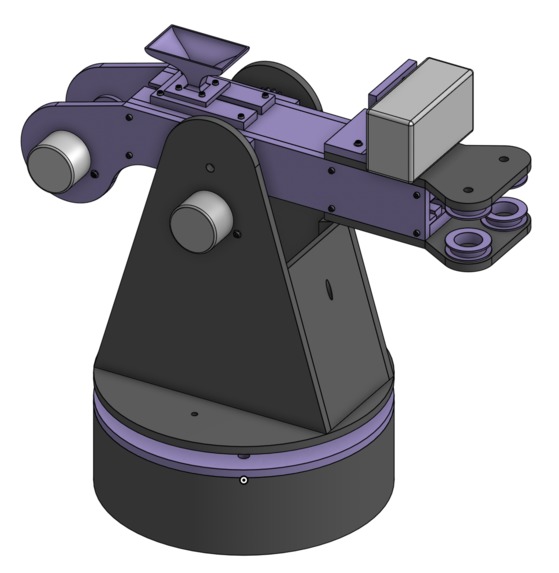
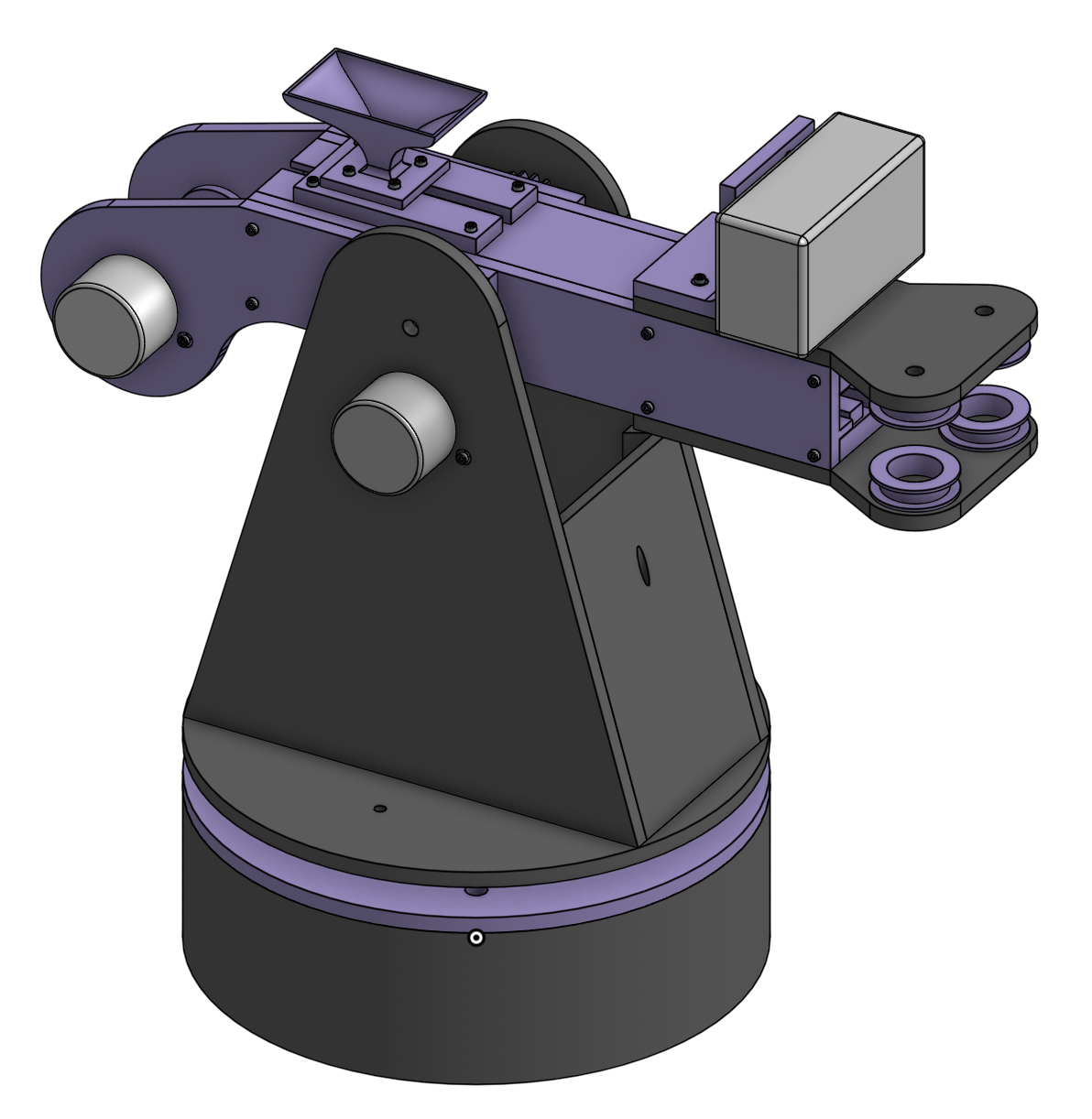
Full Assembly CAD
-
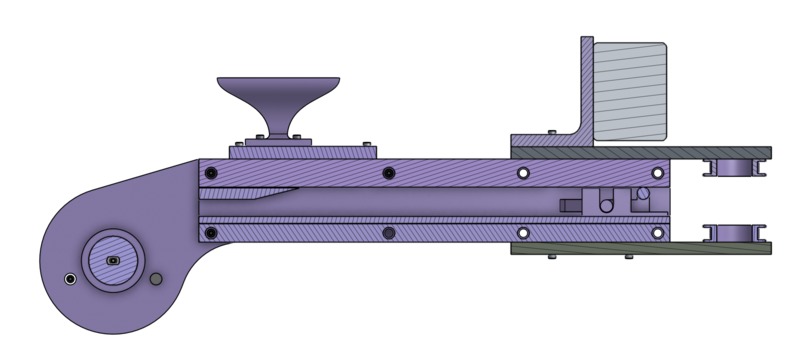
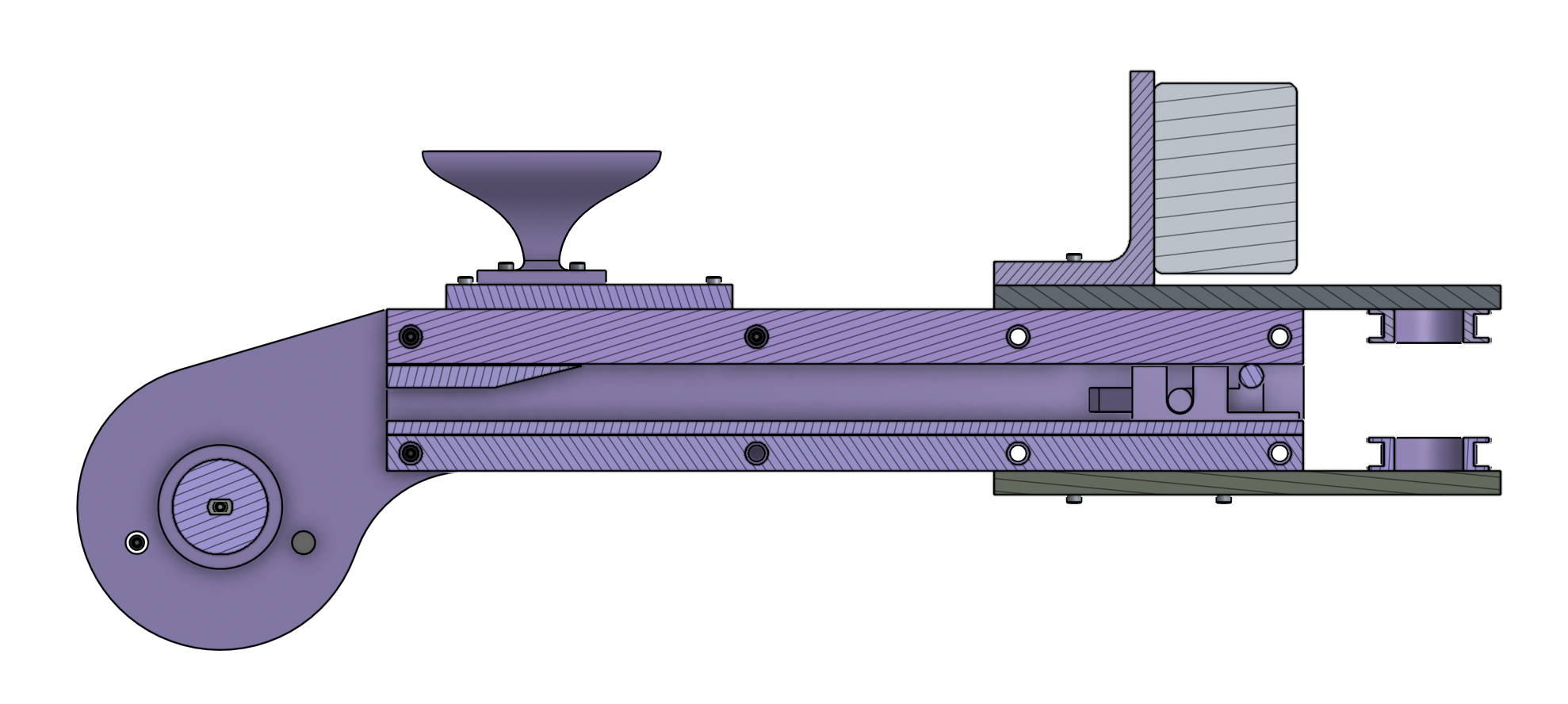
Section View of Salt Launcher
-
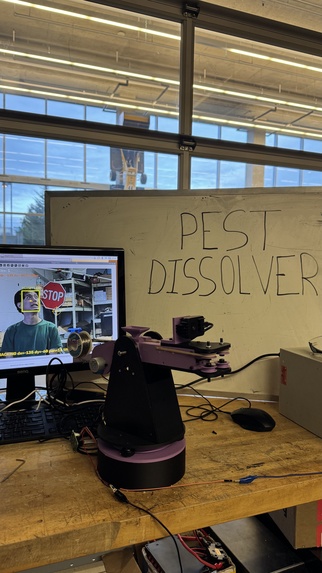
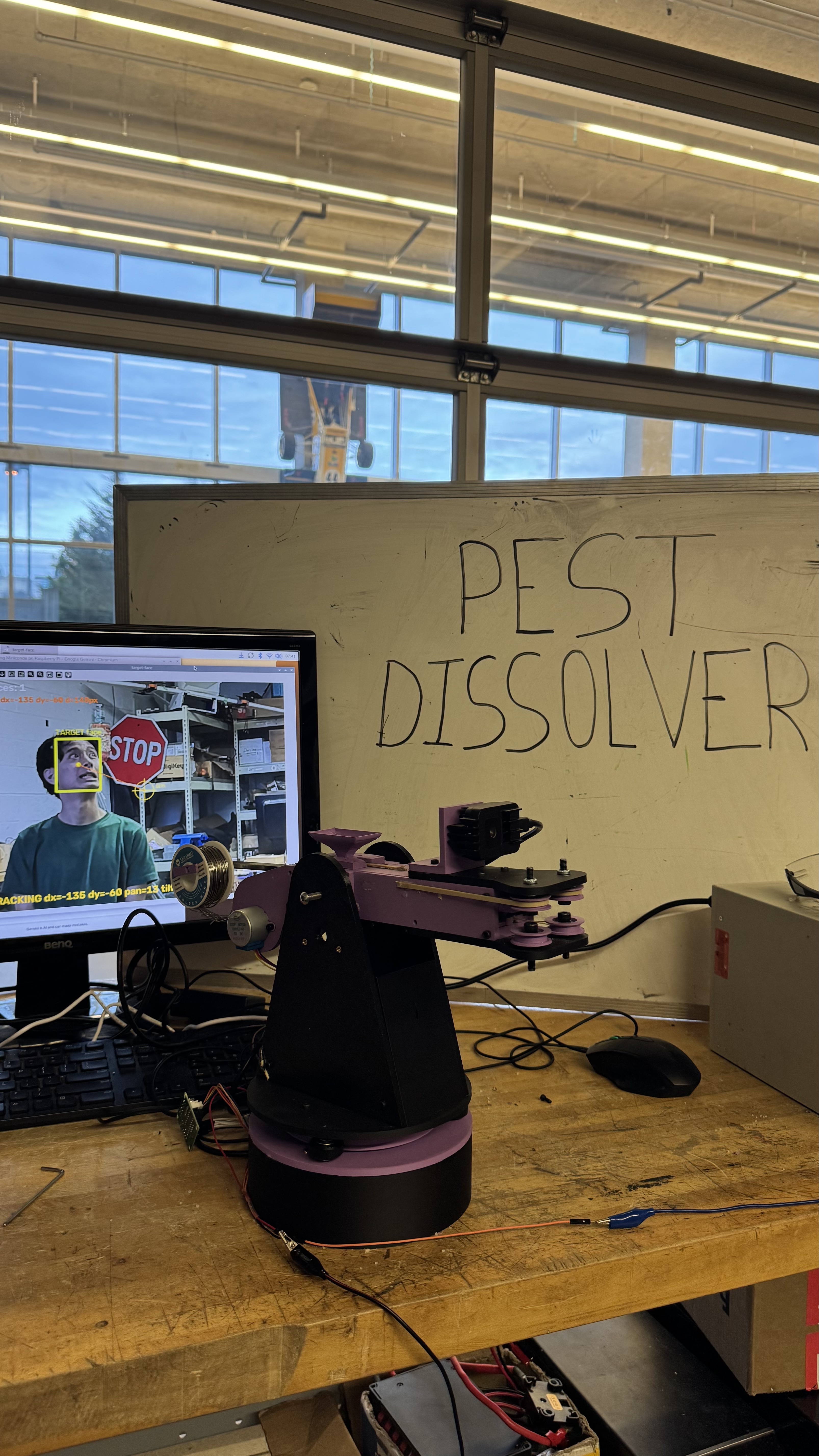
Full Realization of Pest Dissolver
Inspiration
We wanted to make something fly but we quickly realized the components at our disposal were not light enough to make take off. But, through this planning, we got reminded about how much we hate flies. Therefore, we decided to make an extreme form of bug repellent in the form of a salt turret. But if you can shoot a fly, you can shoot a lot of other pests.
What it does
It automatically detects faces before aligning it's turret and spraying out a horrifying amount of salt to neutralize the target. The salt launching mechanism is a unique piece of engineering that uses a bidirectional winch with an automatic trigger to charge rubber bands that launch a container of salt out the front of the turret. It also uses a set of pulleys to wrap bands around the outside of the launcher, letting us store more energy in the same footprint. (and letting it fit on the 3d printer bed). It pans in an 100 degree arc to search for a face in the frame, in which when detected, it will "lock-on" to the target. It "locks-on" to the target by calculating the distance in pixels we need the travel in order to reach the target and have tuned two PID loops to try their hardest to center the target in the x and y axis frame at all times.
How we built it
We built it using a Raspberry Pi 5 which hosts a local model which tracks faces and then calculates where the turret head needs to be and moves it using four stepper motors. We designed the whole assembly in Onshape.
Challenges we ran into
The strength (or lack thereof) of the stepper motors was one of the biggest mechanical challenges. At higher speeds they would skip steps or struggle with the loading of the turret. Because of this, we had to gear them down for most of the movement mechanisms. Another main challenge we ran into was just the amount of bandwidth we could provide. We are only two people so we had to scale down our scope a lot. We originally wanted to train our own models for the turret but eventually had to resort to predetermined weights because we did not have enough time or resources.
Accomplishments that we're proud of
We are proud that even though we went into this hackathon with none of the hardware pre-assembled or printed, we were able to complete it alongside prototyping and iterating through the design of the turret. As well, even though we had many roadblocks from 3D printing failures or software not working as it should, we were still able to output a machine which effectively completes what we set out to do.
What we learned
Concerning the project, we learnt that it would have been better to have run the math on the critical components (steppers, bands, gear ratios) before building, as to avoid having to redesign and remanufacture to make systems work.
Overall, given that this was our first hackathon, we learned a lot in the way of time and resource management. We knew we would end up tight on time, but we had not anticipated so much of it being taken up by 3d printing time. Going forward, in hackathons and similar situations, it makes sense to fully understand the resources at our disposal, and make changes to plans when these resources are unfavourable to our ideas
What's next for Pest Dissolver
We hope that we can try to get a model trained on flies so that we can try to shoot those down. As well, putting better motors on the mechanisms so we can see it at it's full potential.
Built With
- bambu-studio
- machine-learning
- oak-1
- onshape
- python
- raspberry-pi

Log in or sign up for Devpost to join the conversation.