Inspiration
The inspiration behind Persora came from a simple observation: people often have free time but struggle to decide how to make the most of it. Traditional calendars are excellent at organising classes, meetings, deadlines, and appointments, but they rarely help people discover opportunities within their free time.
We were particularly inspired by the difficulty of planning holidays. Finding a suitable destination, comparing travel costs, checking availability, and fitting everything around an existing schedule can become a time-consuming process. Sometimes, people have the time and desire to travel but never take the opportunity because planning feels overwhelming.
We asked ourselves: What if a calendar could do more than show us when we are free? What if it could help us discover what we could do with that time?
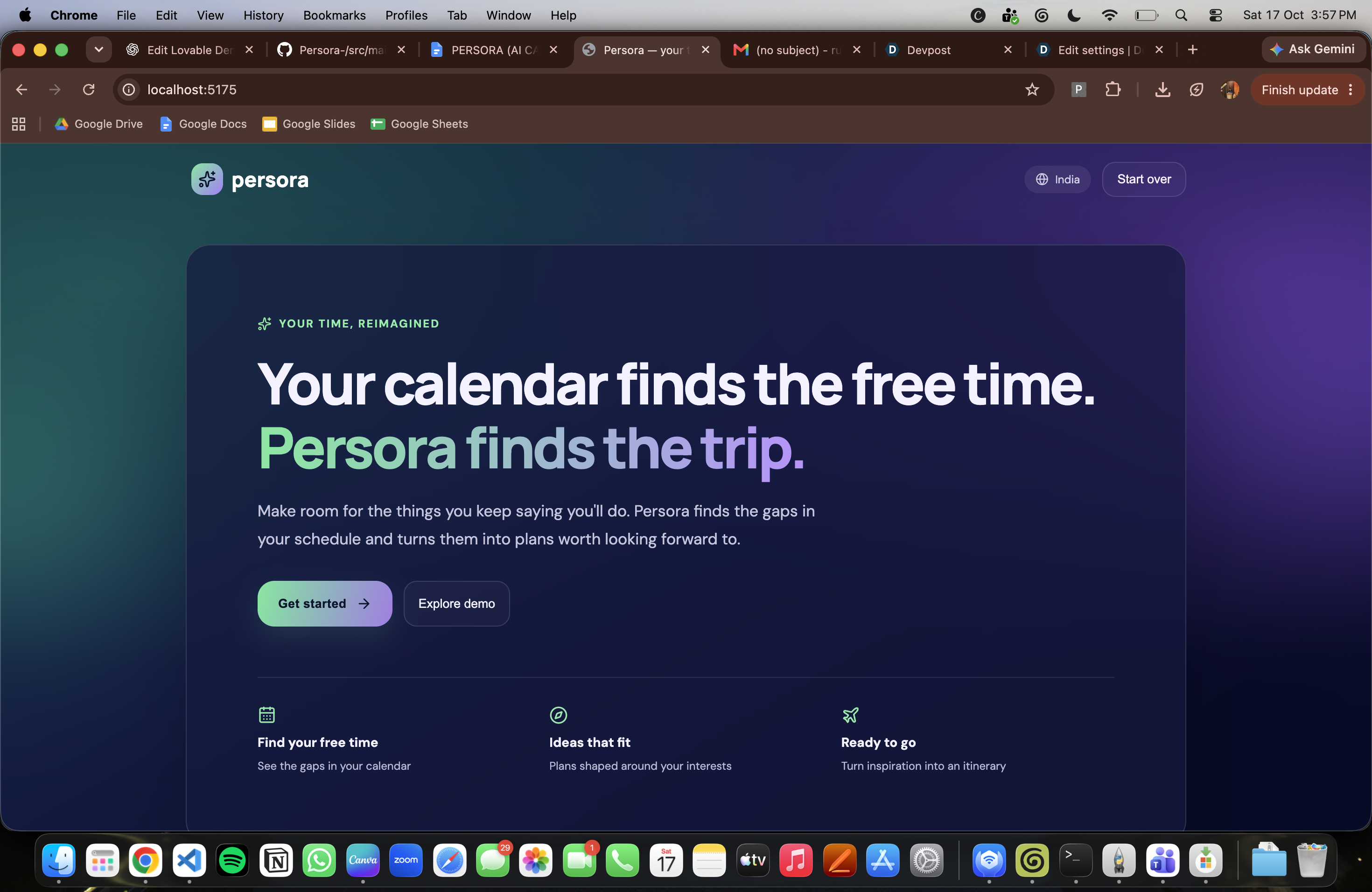
This question led to Persora, an AI-powered personalised calendar designed to turn available time into meaningful experiences.
What it does
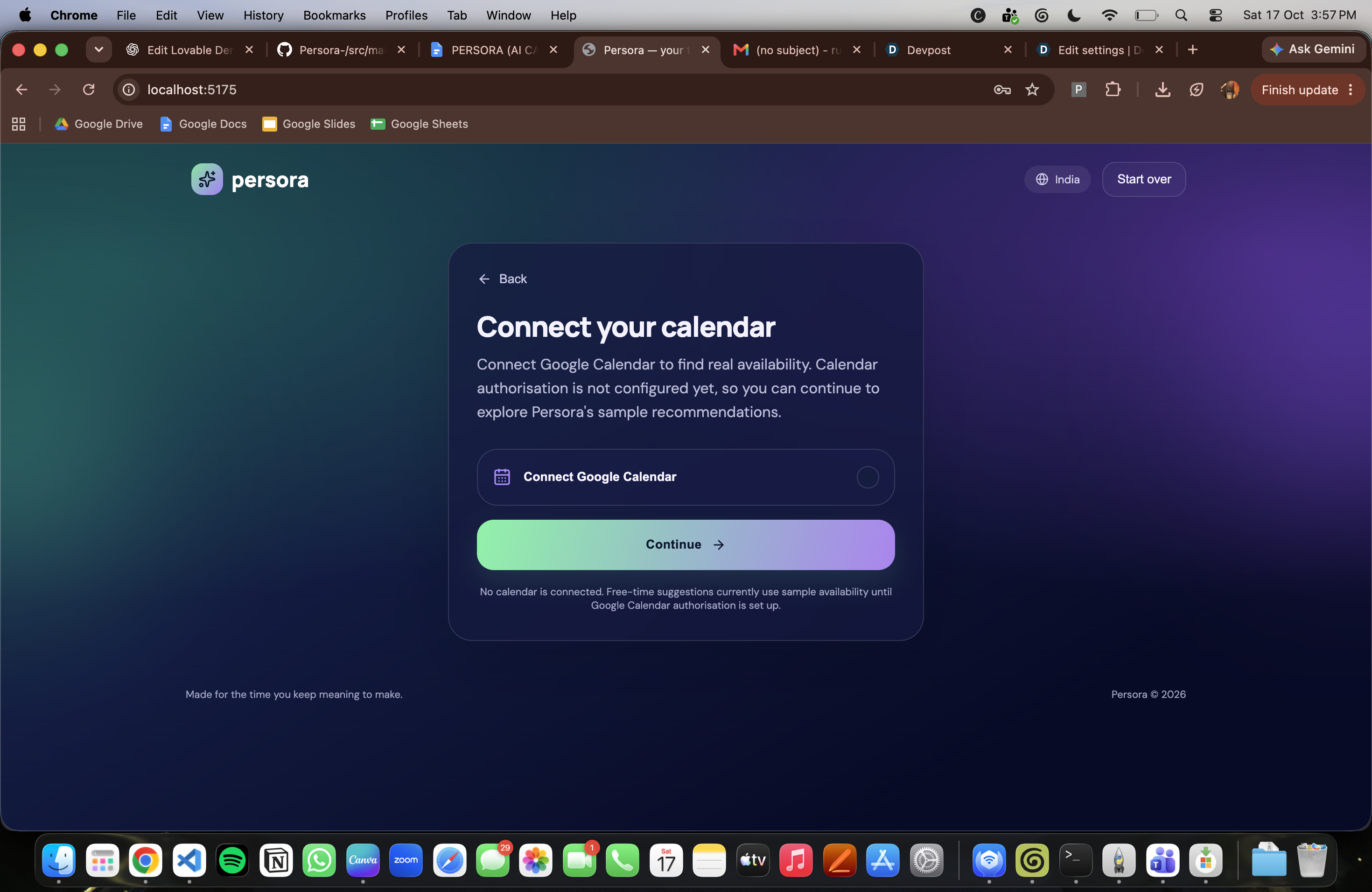
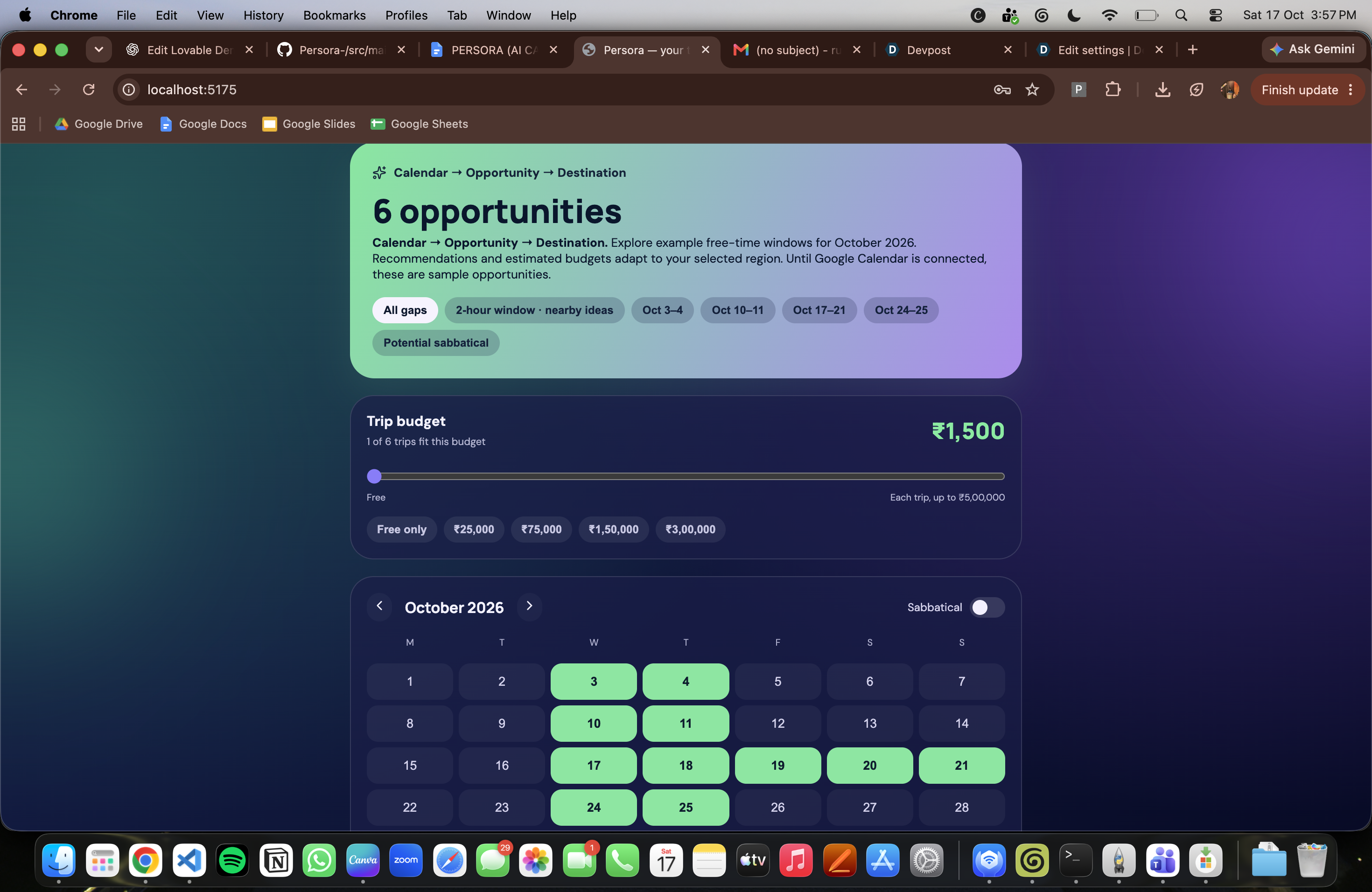
Persora aims to transform calendar availability into personalised activity and travel recommendations. Rather than requiring users to choose an activity first and then find time for it, Persora starts with their available time and explores suitable possibilities.
Its core concept brings together several capabilities:
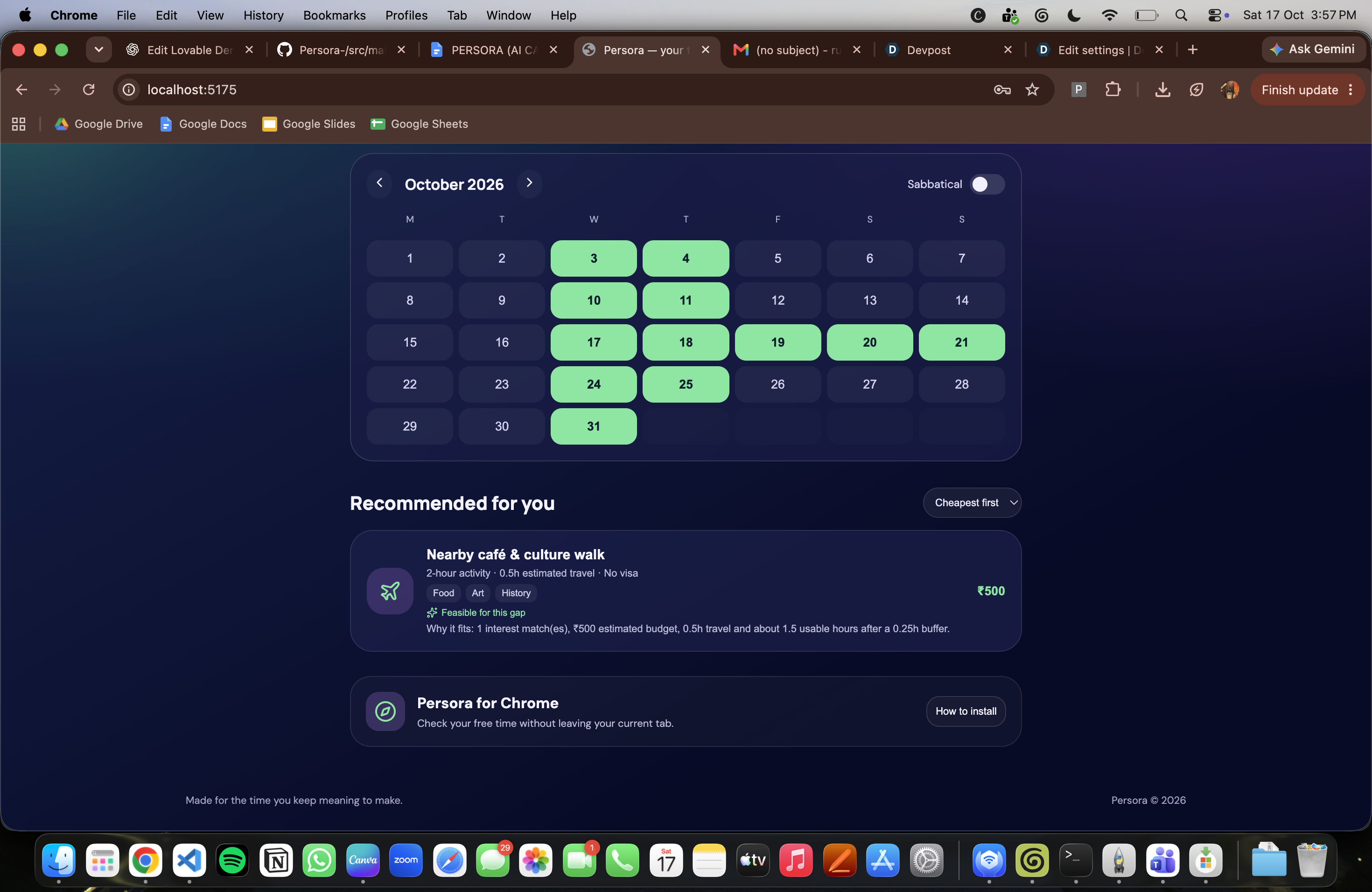
Smart availability discovery: Identify suitable free-time windows around existing commitments.
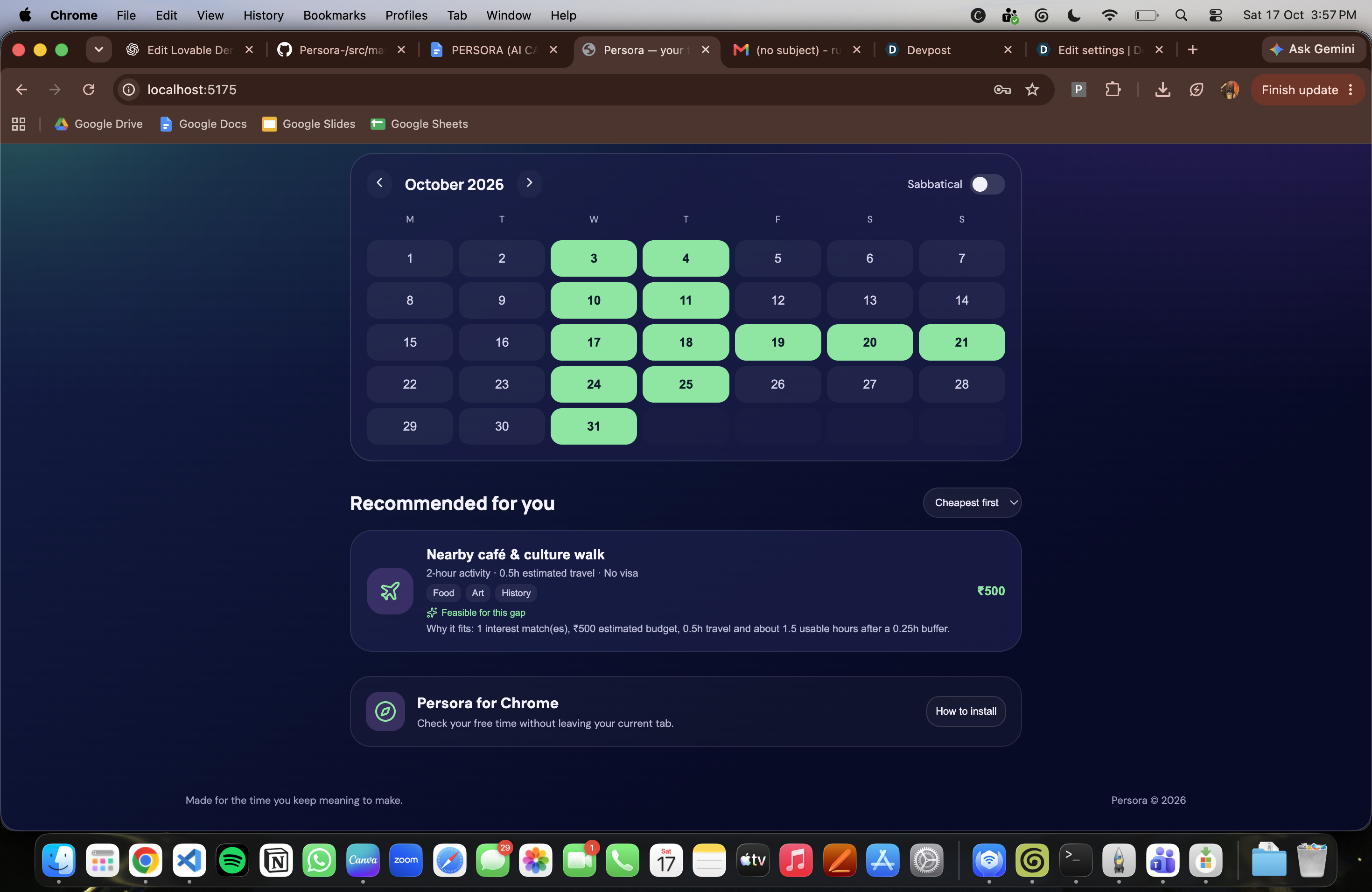
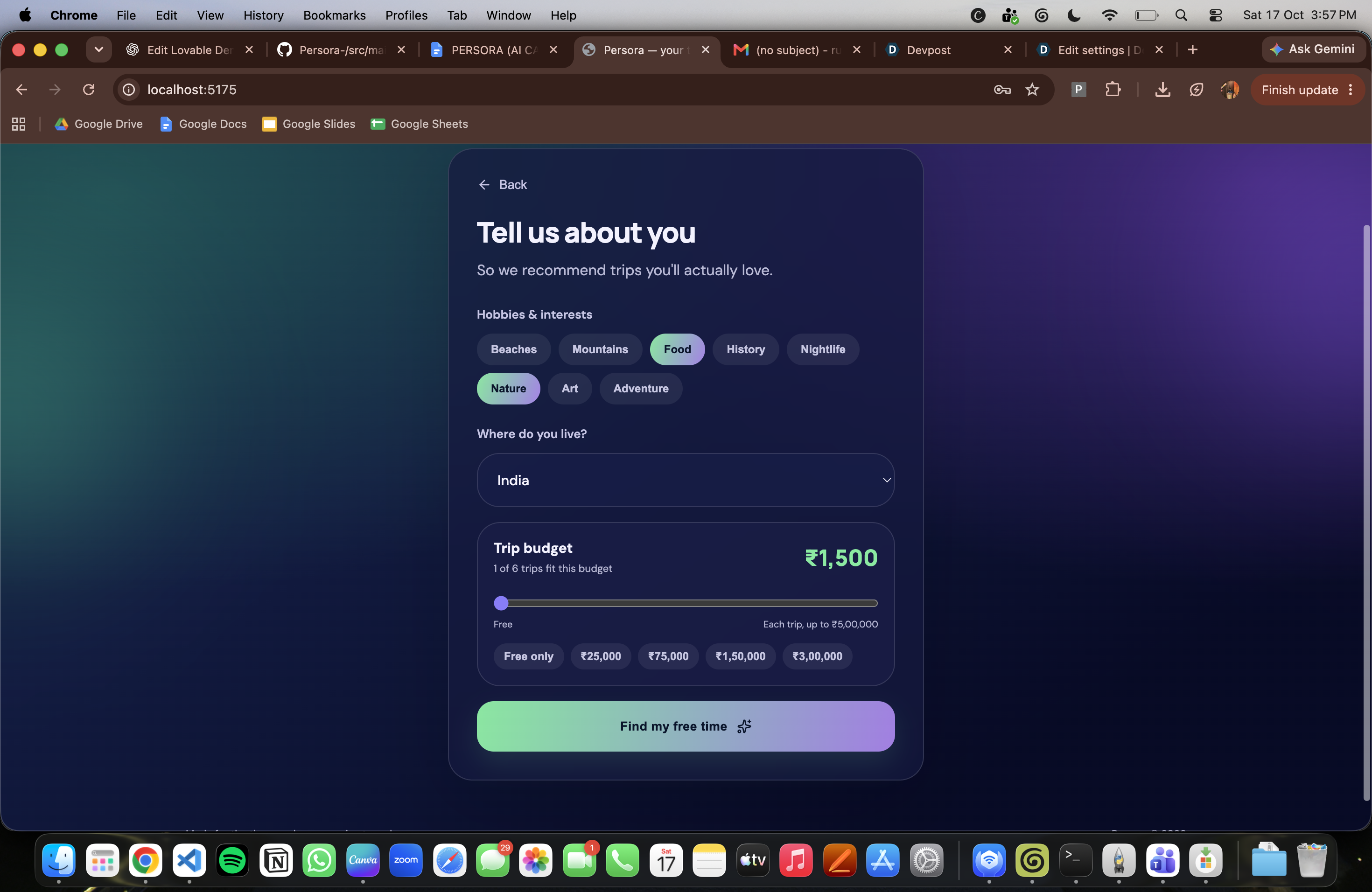
Personalised recommendations: Suggest activities and experiences based on preferences, interests, location, available time, and budget.
Weekend getaways: Help users explore potential short trips that fit within their available days and financial constraints.
Travel planning: Support the comparison of suitable travel options, estimated costs, and journey durations using relevant data sources where available.
Sabbatical Mode: Explore the possibilities offered by longer periods of availability, such as university holidays, career breaks, or several months between commitments.
Responsible planning: Keep users in control of their decisions and treat calendar access and personal information with care.
For example, someone with a free afternoon could discover a local activity, while someone with an uninterrupted weekend could explore a short getaway. A person with several months available could use the concept behind Sabbatical Mode to investigate longer journeys, estimated costs, and relevant travel and visa information.
Our goal is to make planning more intuitive by bringing together time management, personalisation, and travel discovery in one experience.
How we built it
We approached Persora by first defining the problem we wanted to solve and designing the experience around the user's available time. Instead of treating the calendar as a static schedule, we developed the concept of using availability as the starting point for personalised recommendations.
We organised the project around a simple workflow:
Understand availability: Determine which time windows may be suitable for activities or trips.
Consider user preferences: Use relevant information, such as interests, location, budget, and trip duration, to narrow down possible options.
Generate possibilities: Present recommendations that align with the user's schedule and preferences.
Support decision-making: Help users evaluate suitable activities and travel opportunities before deciding what to do.
We focused on presenting Persora as a clear, accessible product rather than simply another calendar interface. The design communicates the relationship between a user's schedule and the opportunities available to them.
Our prototype demonstrates the core product concept, while capabilities that depend on external integrations—such as live travel prices, comprehensive visa checks, or fully connected calendar services—need to be assessed according to their actual implementation. This distinction allows us to communicate the current project honestly while showing how it can evolve into a more complete product.
Challenges we ran into
One of our main challenges was turning a broad idea into a focused and understandable product. Persora could potentially involve calendars, recommendations, travel searches, budget comparisons, destination discovery, and visa information. Bringing these ideas together without making the project confusing required us to identify the central problem: helping people discover what they can do with their free time.
Another challenge was balancing personalisation with practicality. A recommendation needs to fit more than someone's interests; it should also make sense in terms of available time, location, and budget. A destination may sound appealing but be unrealistic for a short weekend, while a seemingly affordable trip may involve inconvenient travel times.
We also had to think about the difference between an appealing product vision and a technically reliable implementation. Real-time travel costs, transport schedules, and visa requirements depend on appropriate external data sources and can change. These capabilities must be implemented and validated carefully rather than assumed to work automatically.
Finally, calendar information can be sensitive. Designing an experience that benefits from availability information while respecting permission, privacy, and user control is an important consideration for the product's future development.
These challenges helped us recognise that building a useful AI-powered product involves more than generating recommendations. It requires a clear problem definition, thoughtful design, reliable information, and a realistic understanding of technical limitations.
Accomplishments that we're proud of
We are proud of turning an everyday problem into a product concept with a clear purpose and a broader vision. Persora starts with a familiar tool—a calendar—and reimagines it as a way to discover opportunities rather than simply manage responsibilities.
We are particularly proud of the idea behind Sabbatical Mode, which extends the concept beyond ordinary daily scheduling. Most people think about planning an activity or holiday over a weekend or a few days. By considering longer periods of availability, Persora explores a different question: what could someone experience if they had weeks or months to use differently?
We are also proud of bringing several related areas into one coherent user journey: availability discovery, personal preferences, activity recommendations, travel planning, and budget awareness.
What we learned
Through Persora, we learned the importance of starting with a clearly defined user problem before deciding which features to build. A project becomes more coherent when every feature supports the same central objective.
We also learned that personalisation requires more than producing generic suggestions. Useful recommendations need to account for constraints such as time, cost, location, and individual preferences.
Another key lesson was the importance of separating a product's long-term vision from the capabilities demonstrated by its current prototype. Integrations, external data sources, privacy safeguards, and recommendation quality all matter when moving from an idea to a dependable application.
Finally, we gained a stronger appreciation for the role of user experience in AI products. Even a sophisticated recommendation system is only valuable if users can understand the suggestions, evaluate their options, and remain in control of the decisions they make.
What's next for Persora
Future development could include calendar integrations that identify availability with the user's permission, recommendation systems that adapt to individual preferences, and connections to reliable travel-data providers for up-to-date prices, routes, and schedules.
We also want to develop Sabbatical Mode further by supporting longer itineraries, comparing potential destinations, estimating total travel budgets, and directing users to authoritative sources for entry and visa requirements.
Other possible improvements include saving favourite recommendations, building itineraries around existing commitments, accounting for travel time, and refining suggestions based on user feedback.
Privacy and reliability will remain central to these improvements. We want users to understand why an option is recommended, have control over their personal information, and verify important travel details before making bookings.
Ultimately, our vision is for Persora to become more than a calendar. We want it to help people recognise opportunities they might otherwise overlook and make better use of the time available to them.
Instead of finding a holiday and then searching for time, Persora finds your time and discovers your possibilities.
Built With
- c++
- css
- html
- javascript
- jsx
- react
- vite

Log in or sign up for Devpost to join the conversation.