-
-
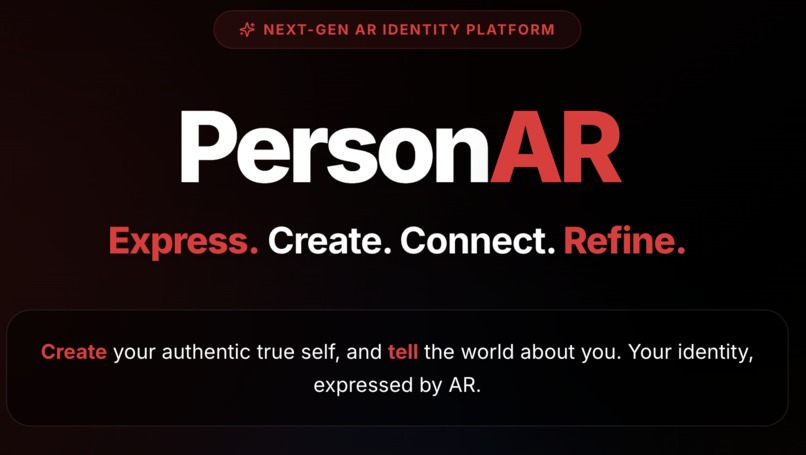
Landing Page
Inspiration
In an age where technology often pulls people into their phones, expressing and discovering individual identity has become harder in social settings. Meeting new people can feel awkward and intimidating when we lack context or insight into who someone truly is. We were inspired by the idea that augmented reality could surface aspects of a person’s identity naturally: interests, passions, and trait, so that individuals feel more understood and approachable rather than judged. PersonAR flips the script: technology becomes a canvas for identity, helping people express themselves and connect with others in real life.
What it does
PersonAR is an AR-based social tool that displays interactive profile cards above people’s heads, allowing others to see shared interests, hobbies in real time. Instead of technology isolating individuals, PersonAR helps people approach each other with context, fostering meaningful connections and breaking social barriers.
How we built it
Frontend: React with a video feed and overlay canvas for AR display.
Face detection & recognition: face-api.js for real-time face detection, landmark recognition, and matching known identities.
Data & models: Profiles stored as labeled face descriptors with AR profile cards displaying interests and traits.
AR overlay: Canvas renders dynamic bounding boxes and profile info on each recognized individual, updating continuously with movement.
Challenges we ran into
Handling multiple faces in a single frame and differentiating them reliably.
Achieving stable identity recognition across frames, especially in real-time video.
Optimizing AR overlays for performance to avoid lag or flickering.
Ensuring the system feels natural without overwhelming the user with information.
Accomplishments that we're proud of
Successfully detecting multiple people and overlaying AR profile cards in real time.
Making the system robust to different lighting conditions and angles.
Creating a working prototype that turns the camera into a social tool
Demonstrating a concept where technology enhances identity expression and human connection.
What we learned
Real-time AR requires careful optimization of detection loops and canvas rendering.
Face recognition can feel personal—accuracy and labeling matter when displaying identity information.
Technology can be a bridge for social interaction if designed around human context rather than abstraction.
What's next for PersonAR
Next, We plan to expand AR profile cards to include shared interests, mutual connections, and personal traits. Longer-term, we aim to explore integrating PersonAR into everyday life, ensuring that as technology advances, it unites people rather than isolates them, and helping individuals express themselves and connect authentically in the real world.
Built With
- css
- face-api.js
- fast-api
- fast-api.js
- javascript
- mongodb
- python
- react
- typescript

Log in or sign up for Devpost to join the conversation.