-
-
Concept Art and app's icon
-
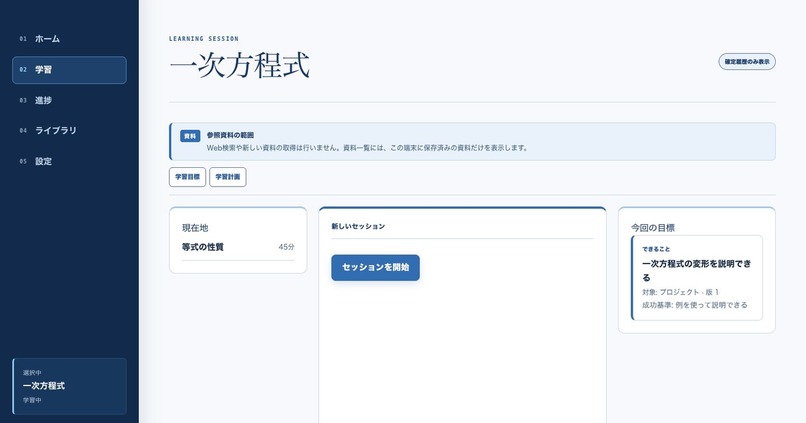
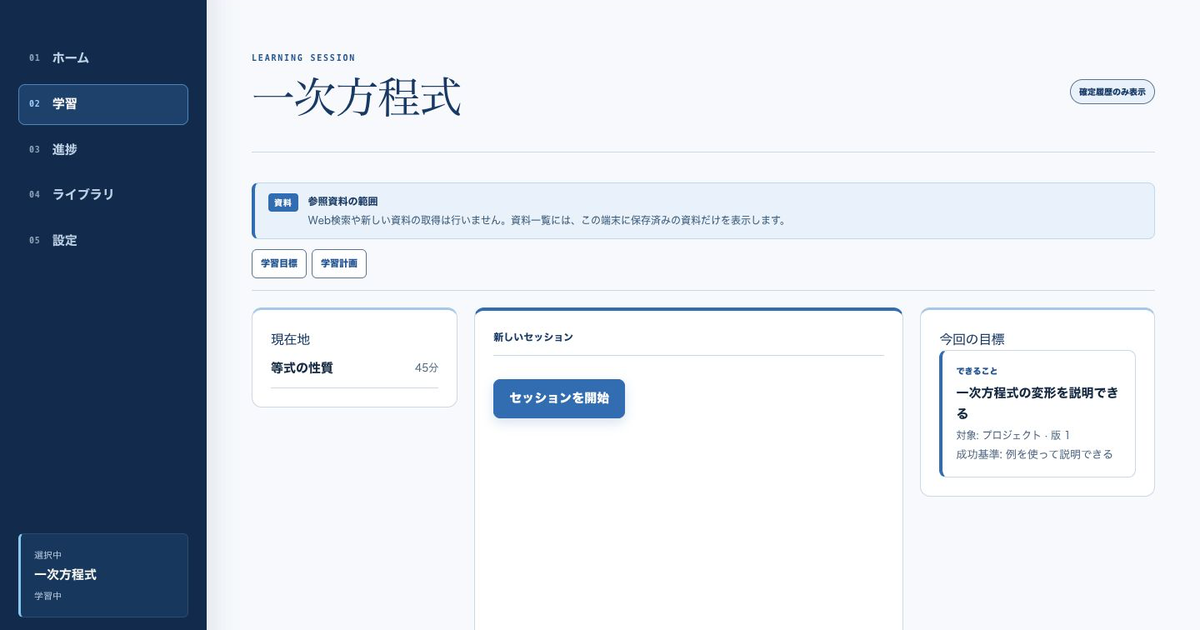
demo screen
What it does
LearnStepper turns an open-ended topic into a persistent learning workspace. An adult learner can create a topic, connect a ChatGPT account through an externally authenticated official Codex CLI, start a guided conversation, and return to the same project after restarting the desktop app. The product keeps confirmed conversation history, saved learning objectives, a read-only actionable plan, evidence-backed progress, notes, and bookmarks in a local SQLite database.
The difference from a disposable AI chat is continuity with accountability. A learner can see what they intended to learn, what evidence actually supports progress, and what remains incomplete. The record stays on the learner's own device, while live tutoring is available only when the learner chooses to connect through Codex.
The focused Build Week version deliberately does less, more honestly. It does not claim Web grounding when no Web retrieval occurred, does not execute learner code, does not send telemetry, and hides incomplete curriculum, diagnosis, exercise, and final-assessment flows. Authentication tokens never enter the Renderer or LearnStepper database; the external Codex CLI owns them in its configured credential store.
How we built it
The desktop product has three explicit boundaries:
- A React/Vinext Renderer owns the focused learning experience and immediate interaction feedback.
- An Electron host exposes a narrow, allow-listed IPC surface and starts local services only after eligibility confirmation.
- A framework-independent Python application core owns SQLite persistence, learning contracts, and a typed stdio/JSONL gateway to an external, version-pinned Codex App Server.
The packaged macOS arm64 DMG includes the Renderer and a self-contained Python sidecar. It requires external Codex CLI 0.144.5 for AI tutoring, while a missing or mismatched CLI leaves local data available with actionable guidance. The project is validated across Node, React, and Python, plus build, lint, type, package, checksum, signature, responsive, keyboard, zoom, and reduced-motion checks.
How Codex and GPT-5.6 were used
GPT-5.6 through Codex was the development partner across the Build Week window. It helped translate product requirements into testable contracts, implement the persistence and conversation models, reconcile the React/Electron/Python boundaries, inspect the Codex App Server protocol, generate failure-path tests, review UI states, and automate standalone packaging verification.
The project owner retained the consequential decisions: local-first storage, official ChatGPT authentication, adult-only focused scope, no misleading feature claims, no Web retrieval, no learner-code execution, and the rule that observable evidence must exist before a capability appears in the submission UI. Codex accelerated the path from those decisions to a tested implementation; it did not replace product judgment.
The repository was created and meaningfully built during the July 13–21, 2026 submission period. Dated commits, test evidence, packaging checks, and the exact Build Week change narrative are documented in the repository.
Challenges we ran into
The hardest problem was not generating a tutor reply. It was making AI conversation behave like durable product state. Streaming items, interruption, restart recovery, thread identity, local confirmation, and stale responses all cross process boundaries. We solved this with typed events, explicit ownership, idempotent commands, confirmed-item persistence, and conflict-safe reconciliation.
Desktop packaging was the second challenge. A judge should not need a system Python or uv; the build bundles a PyInstaller sidecar. Codex remains an explicit prerequisite because LearnStepper is an App Server client and the ChatGPT desktop app does not expose its private embedded runtime as a supported third-party endpoint.
The final challenge was scope. A broad education design existed, but several advanced paths were not end-to-end. We removed those surfaces from the submission rather than presenting disabled controls or simulated completion.
Accomplishments that we're proud of
- A runnable local-first desktop product, not only a browser mockup.
- Official external Codex CLI device login without exposing tokens to the app UI or database.
- Persistent Project → LearningSession → CodexThread → Turn → Item history with restart resume.
- Evidence-backed progress that excludes unsupported self-report from core attainment.
- An installable macOS arm64 DMG with a pinned external CLI contract, checksum, and deep-signature verification.
- 202 passing automated tests and durable visual evidence at desktop, tablet, mobile, 200% zoom, keyboard focus, and reduced motion.
What we learned
AI education quality depends as much on state boundaries and truthful feedback as it does on model capability. Keeping learning history local changes the architecture: authentication, tutor execution, user records, and UI state must be separated deliberately. We also learned that hiding an unverified capability produces a more coherent product than preserving an impressive-looking but incomplete screen.
What's next for LearnStepper
The next release will add generated, reviewable learning plans; curriculum alignment; diagnostic and formative assessment; evidence-grounded retrieval; export and backup; full local-data deletion semantics; Developer ID notarization; and Windows/Linux distribution. These remain explicit Future Updates until their complete contracts and observable behavior are verified.
Built With
- chatgpt
- codex

Log in or sign up for Devpost to join the conversation.