-
-
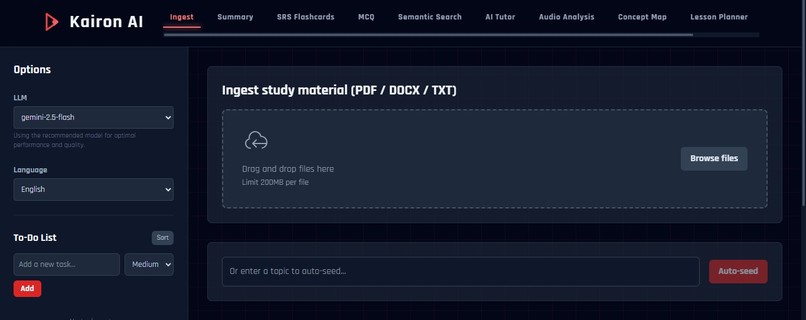
Thumnail
Inspiration
The modern learning environment is saturated with information, but true understanding often remains elusive. We drew inspiration from Chiron, the mythological centaur known for his wisdom and role as a personal tutor to the greatest heroes. Our goal was to create a "digital Chiron"—an AI assistant that doesn't just present information, but actively helps users engage with, question, and master it. We wanted to build a tool that could transform any static document or lecture into a dynamic and personalized learning journey.
What it does
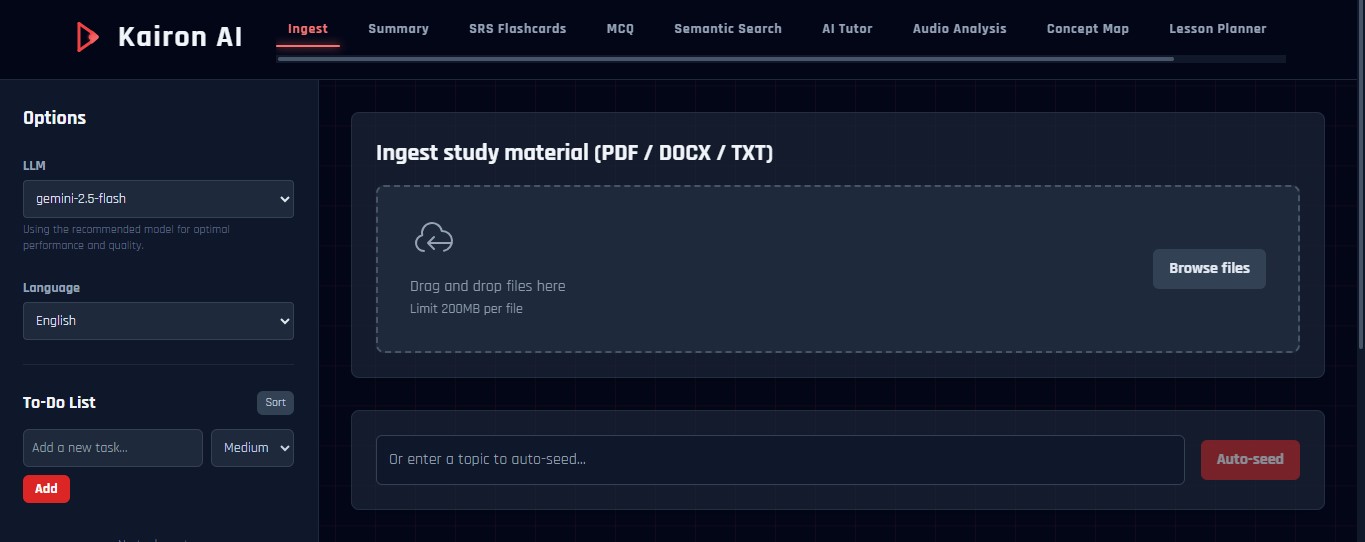
Kairon AI is a one-stop shop for accelerated learning. A user starts by providing their study material—by uploading files (PDF, DOCX, TXT), pasting text, or generating notes from scratch on any topic. Once this context is established, Kairon unlocks a suite of powerful tools. It can distill the material into concise summaries and interactive concept maps. It reinforces knowledge through smart SRS flashcards and adaptive quizzes. For deeper engagement, it offers a Socratic AI tutor, an essay outlining assistant, and a semantic search engine. It even caters to educators with a lesson planner and helps students with a personalized study schedule generator, all supporting dozens of languages.
How we built it
Kairon AI is built as a modern, single-page application using React and TypeScript for a robust and type-safe foundation. The futuristic user interface is crafted with Tailwind CSS, emphasizing a clean, responsive, and aesthetically pleasing design.
The core intelligence is powered by the Google Gemini API. We created a dedicated geminiService module to handle all interactions with the model. A key part of our approach was leveraging Gemini's responseSchema feature to request structured JSON output for complex features like flashcards, MCQs, concept maps, and lesson plans. This ensured data consistency and reliability, minimizing the need for complex text parsing on the frontend. For data visualization, we integrated D3.js to render the dynamic and interactive concept maps. Global state, such as the ingested text and active tab, is managed cleanly using React's Context API.
Challenges we ran into
One of the primary challenges was prompt engineering for structured data. It took significant iteration to design prompts and schemas that consistently yielded the correct JSON format from the Gemini API, especially for nested structures like lesson plans and concept maps.
Another challenge was handling potentially large text inputs. We had to ensure the application remained responsive when users uploaded large documents. Although we did not implement full client-side chunking, we designed the architecture to support it in the future, and focused on efficient state management to prevent UI freezes.
Finally, ensuring the AI Tutor adhered strictly to the Socratic method without defaulting to giving direct answers required careful crafting of its system instructions and prompts.
Accomplishments that we're proud of
We are incredibly proud of creating a comprehensive and cohesive platform that integrates over ten distinct AI-powered learning tools into a single, intuitive interface. The Personalized Study Guide, which adapts to a user's quiz performance, is a feature we believe truly embodies the spirit of a personal tutor.
Successfully integrating the Gemini API to generate complex, structured data for features like the interactive D3.js Concept Map and the multi-part Lesson Planner was a major technical achievement. We are also proud of the polished, futuristic UI, which makes the powerful technology feel accessible and engaging.
What we learned
This project was a deep dive into the practical applications of large language models. We learned how crucial prompt engineering and schema design are to building reliable AI features. Requesting JSON is far more robust than parsing plain text. We also gained valuable experience in architecting a feature-rich React application, using context for state management, and integrating external libraries like D3.js. Most importantly, we learned how to think about user workflows in an AI-native application, guiding the user from raw information to structured, actionable knowledge.
What's next for Kairon AI - Personalized Learning Platform
The potential for Kairon AI is vast. Our roadmap includes several exciting new directions:
- Real-time Voice-to-Voice Tutoring: Enhance the AI Tutor with live voice interaction using the Web Speech API and Gemini's audio capabilities for a truly conversational experience.
- Deeper Analytics & Progress Tracking: Introduce a dashboard that visualizes a user's learning journey, highlighting mastered topics and areas needing more focus over time.
- Collaborative Study Sessions: Allow multiple users to share and work on the same ingested material, generating flashcards and quizzes together.
- Browser Extension: Enable users to ingest articles and web pages directly from their browser with a single click.
- Integration with Learning Management Systems (LMS): Connect Kairon AI with platforms like Moodle or Canvas to import course materials and sync study progress.
Built With
- api
- d3.js
- gemini
- html5
- react
- tailwind
- typescript


Log in or sign up for Devpost to join the conversation.