Inspiration Students study from lecture videos, textbook PDFs, and slide decks scattered across different places. When they turn to a general AI chatbot, the answers often aren’t tied to their course, can’t be checked against the material, and ignore what the student already understands. We wanted a study companion that is trustworthy, where every claim traces back to an exact page, slide, or timestamp, and personal, where it knows what you’ve mastered and where you’re stuck.
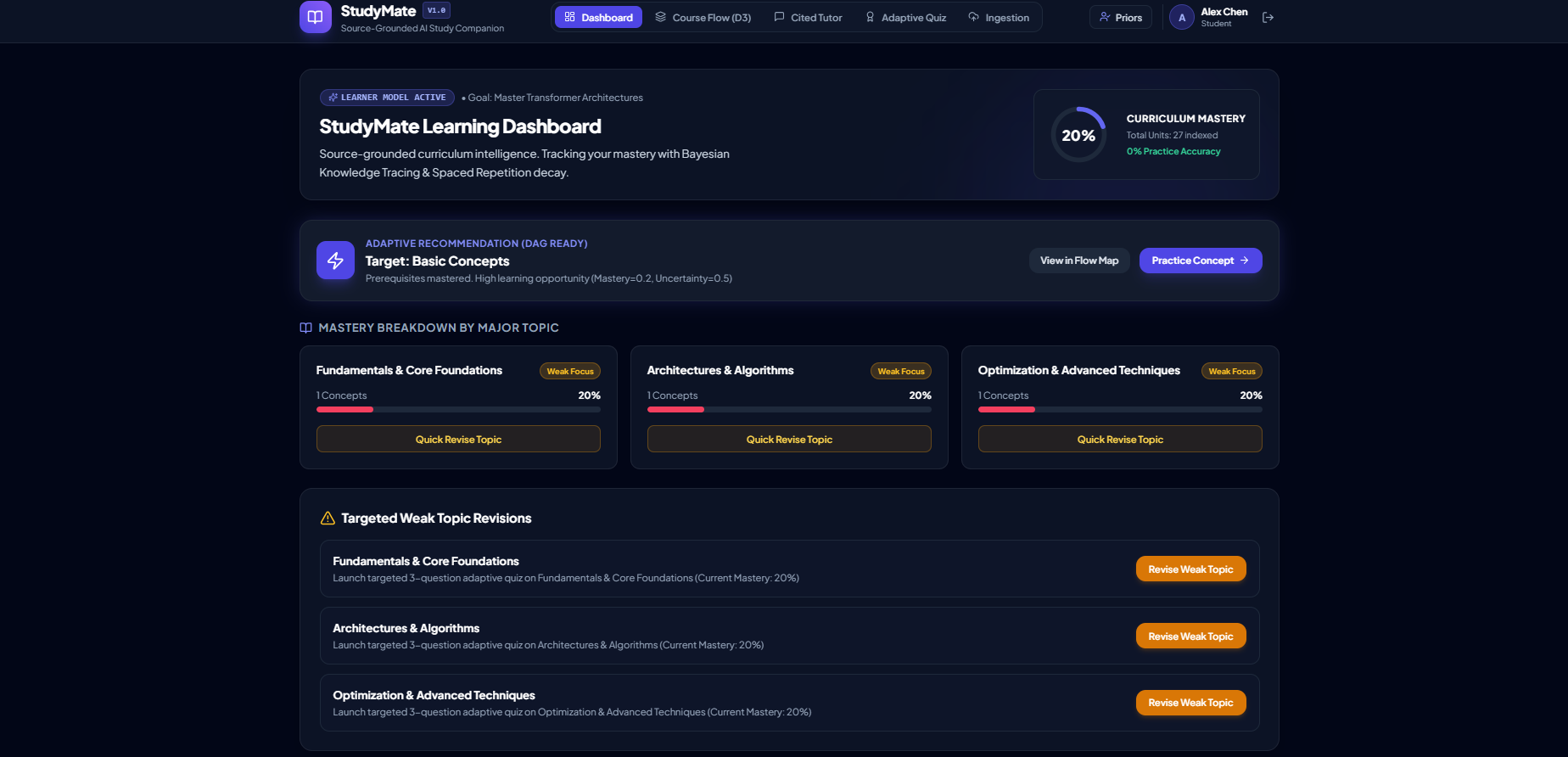
What it does StudyMate turns a student’s own course material into a source-cited tutor and adaptive assessment engine. Unified knowledge base: Upload lecture videos, textbooks, and slide decks with no manual preprocessing. StudyMate organizes them into topics, concepts, and prerequisites, and links every content unit to its origin (page, slide number, or video timestamp). Diagrams and figures are captioned by a vision model and become searchable too. Grounded tutor chat: Ask a question and get an explanation with inline citations. Clicking a citation opens the exact page, slide, or video moment. If the material doesn’t cover the question, the tutor says so, and any outside knowledge is clearly labeled and kept separate from source-backed content. Adaptive assessments: Generate quizzes and mock exams (MCQ, short answer, numerical) on any scope you choose. Every question is tagged with topic, source location, and difficulty, verified for correctness, and checked against past questions so you don’t see repeats. Cited feedback and reports: Each answer gets feedback with a link to the source, and a post-assessment report highlights weak topics and likely misconceptions. Learner model: Per-topic mastery updates after every quiz and conversation. New students start with a diagnostic quiz and a short intake chat. Dashboard: Mastery by topic, weak-topic list, progress over time, and an interactive course flow map colored by your mastery.
How we built it Ingestion: Videos are transcribed with Whisper and split into timestamped segments. PDFs and slides are parsed page by page with PyMuPDF and python-pptx, and a vision model captions figures and diagrams. Every chunk keeps its source metadata. Knowledge graph: An LLM extracts topics, subtopics, concepts, and prerequisite edges, then tags every content unit to them. We validate the result as a DAG and render it as an interactive map with d3.js. Retrieval and grounding: Hybrid retrieval (sentence-transformer embeddings in pgvector plus BM25) with reranking. The tutor answers only from retrieved units and cites them. A relevance threshold triggers the “not covered in your material” response. Assessment engine: Questions are generated from retrieved source units. Numerical answers are recomputed in Python, and other questions are cross-validated by a second model. Questions that fail verification are rejected. Embedding-based deduplication prevents repeats across sessions. Learner model: Bayesian Knowledge Tracing per concept, rolled up to topic mastery, with a forgetting-curve decay. A question selector targets low-mastery concepts whose prerequisites are already mastered. Evaluation: RAGAS on a team-built test set of questions with known source locations plus off-material queries, and simulated student profiles run across multiple sessions. Stack: Python, FastAPI, PostgreSQL with pgvector, React, TypeScript, Tailwind, and Docker Compose. Challenges we ran into Precise citations: Linking answers to the exact slide, page, or timestamp rather than a whole document took careful metadata design from ingestion onward. Understanding visuals: Diagrams and figures carry meaning that plain text extraction misses, so we added vision-model captioning. Knowing when not to answer: We had to tune the relevance threshold so the tutor declines off-topic questions without refusing valid ones. Trustworthy questions: Generated quizzes can contain wrong answers or ambiguous wording, so we built computed checks and cross-model validation. Avoiding repetition: Keeping questions fresh across sessions while still targeting the same weak topics required similarity-based deduplication. Evaluating personalization: Without real students, we had to design simulated learners with realistic, noisy behavior. Accomplishments that we’re proud of A complete pipeline from raw lectures, textbooks, and slides to cited answers and adaptive quizzes, with no manual preprocessing. Every answer, question, and piece of feedback links back to its exact source location. A tutor that admits what it doesn’t know instead of guessing. Verified quiz questions: numerical answers are recomputed and others are cross-checked by a second model. A reproducible evaluation covering faithfulness, answer relevancy, context precision and recall, off-material refusal, mastery gains, and question repetition rate.
What we learned Grounding is a system design problem, not just a prompt. Metadata, retrieval quality, and refusal logic matter as much as the model. Verification is essential for educational content, because a confidently wrong quiz question does real harm. Even a simple learner model makes a study tool feel noticeably more personal. Evaluation needs both pipeline metrics and learner-level metrics to tell the full story. What’s next for Personalized Tutoring & Adaptive Learning Voice-based tutoring sessions and Hindi and other Indian-language support, including English lectures with Hindi explanations. Study schedules built from weak topics, forgetting curves, and exam dates. Targeted revision material for weak topics: flashcards, slides, and audio briefs. Pilots with real students and instructors to validate learning gains. Instructor tools to review the knowledge graph and spot gaps in course material.

Log in or sign up for Devpost to join the conversation.