-
-
Asha - By Aspen Health AI

Inspiration
42% of all US adults suffer from two or more Chronic conditions. That means, visiting a number of providers over the course of many years. Their health data is fragmented across provider portals, PDFs and Paper documents. This makes it very hard for them to get a full picture of their health and they don't have any good way to understand it, or securely share it with any health expert for medical advice.
The founder, Nitin is an engineer with over 25 years of solution building experience, with recent experience building Healthcare AI solutions for large health providers. He was personally dealing with this problem first hand at home, helping his elderly parents and a young child with chronic health conditions.
What it does
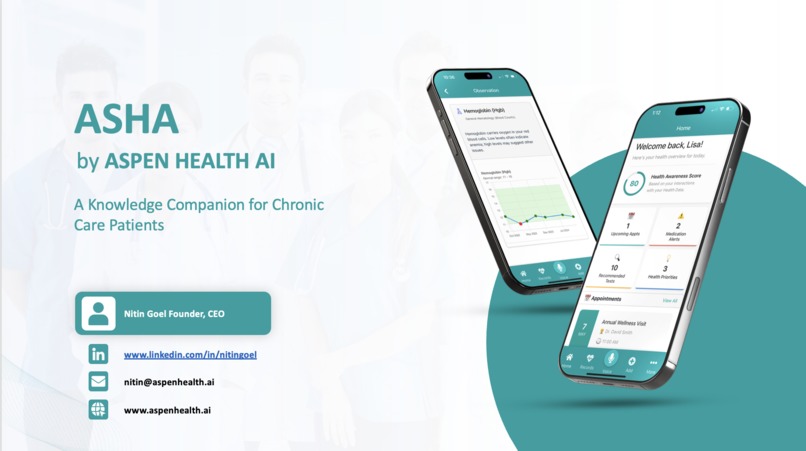
Asha - by Aspen Health AI is a personal health knowledge companion. It integrates with all your providers, can scan in your paper records and upload health documents into a single consolidated health database. It allows you to find and understand anything in your records in simple terms using a voice or chat interface.
For this Rag-A-Thon, we built a new feature which shows users their HEALTH ENGAGEMENT SCORE. The goal is to tell the user what they have been doing well for their health and where they might have opportunities to take actions to improve their health. Creating a gamified incentive to encourage patients to be more engaged with their health.
How we built it
To achieve this , we build an agentic system that reviews a patient’s entire health journey; compares that to the latest medical guidelines as they apply to the specific health conditions and risk factors; and presents an intuitive interface where the user can see how well they are doing and things they could consider doing.
We used synthea to generate longitudinal patient journeys simulating decades of management of chronic conditions. Our agent taps into the U.S Preventive Services Task Force database to pull in published guidelines. Our agent also searches online resources for guidelines and recommendations tailored to the patient’s specific conditions and risk factors. The agent then reasons over each guideline against the patient’s health data to determine if: The guideline is truly applicable for them There is evidence in the health records to confirm they have been following the guideline Generate questions to ask the user in case there is insufficient evidence in their health records.
On the frontend, we present an overall health engagement score that the user can drill into, to go to different categories and specific guidelines and recommendations. The user can learn more about what they should be doing and why. They can see evidence of things they are already doing well. And answer questions to provide information not already in their health data.
Challenges we ran into
We approached this with a multi agent pattern with tool use and a coordinator agent managing the entire flow. We found that this approach was too in-deterministic, with the coordinator often going off the rails, injecting its own reasoning into the flow, failing to delegate to function-specific agents appropriately.
We later switched to a more deterministic overall flow, giving individual agents limited freedom for tool use within a tight scope. We ensured every agent provided structured outputs and built evals at every stage to spot deviations from instructions and tuned the prompts for each agent.
Accomplishments that we're proud of
We are proud to have built something that increases personal health literacy and awareness for people who need it the most.
We believe we have created a viable alternative to copy pasting bits of health data into ChatGPT.
Our framework allows advanced reasoning models to go to work on patients behalf, reviewing their entire health journey, to surface insights and nudge people along to better health outcomes,
What we learned
We experienced first hand the pitfalls of not starting with evals first. With agents calling tools and other agents, the execution graph gets very complex very fast. Debugging which step is introducing issues which could cascade down is hard!
Every agent and sub agent needs clearly defined evaluation metrics as part of the design of the agent itself.
Forcing agents to produce structured outputs and include their reasoning for their outputs goes a long way in simplifying the process of creating evaluations.
What's next for ASHA by Aspen Health AI
As next steps, we will be fully integrating this into our app which is being used by volunteers serving as alpha users. They will be able to provide this feature against their own health records and provide real life feedback. We will have our clinical volunteers assess the agent’s output for clinical accuracy and further tune the agentic system.
Going forward we plan to add social features where your loved ones can give you high fives for having made progress towards better health.
For the app overall, we are actively working towards getting HIPAA compliance fully built out and conducting legal reviews. We hope to have our app launched for broader use within the next 3 months.
Built With
- arize-ai
- celery
- django
- fastapi
- fhir
- material-ui
- openai-agent-sdk
- postgresql
- react
- redis
- synthea-synthetic-patient-generator
- typescript
- uspstf-guidelines


Log in or sign up for Devpost to join the conversation.