Inspiration
I’m the kind of person who doesn't really know how to spend money efficiently. I want to be financially safe, but I also want to have fun. I realized many people struggle with this same paradox. While most finance assistants just throw numbers and charts at the user, I wondered: How can I make this data look and feel different? I decided to transform behavioral data into emotional variables. It sounds a bit crazy, I know. I also took inspiration from quantitative finance—using math and logic to make things predictable—and applied that rigor to the "messy" world of human emotions.
What it does
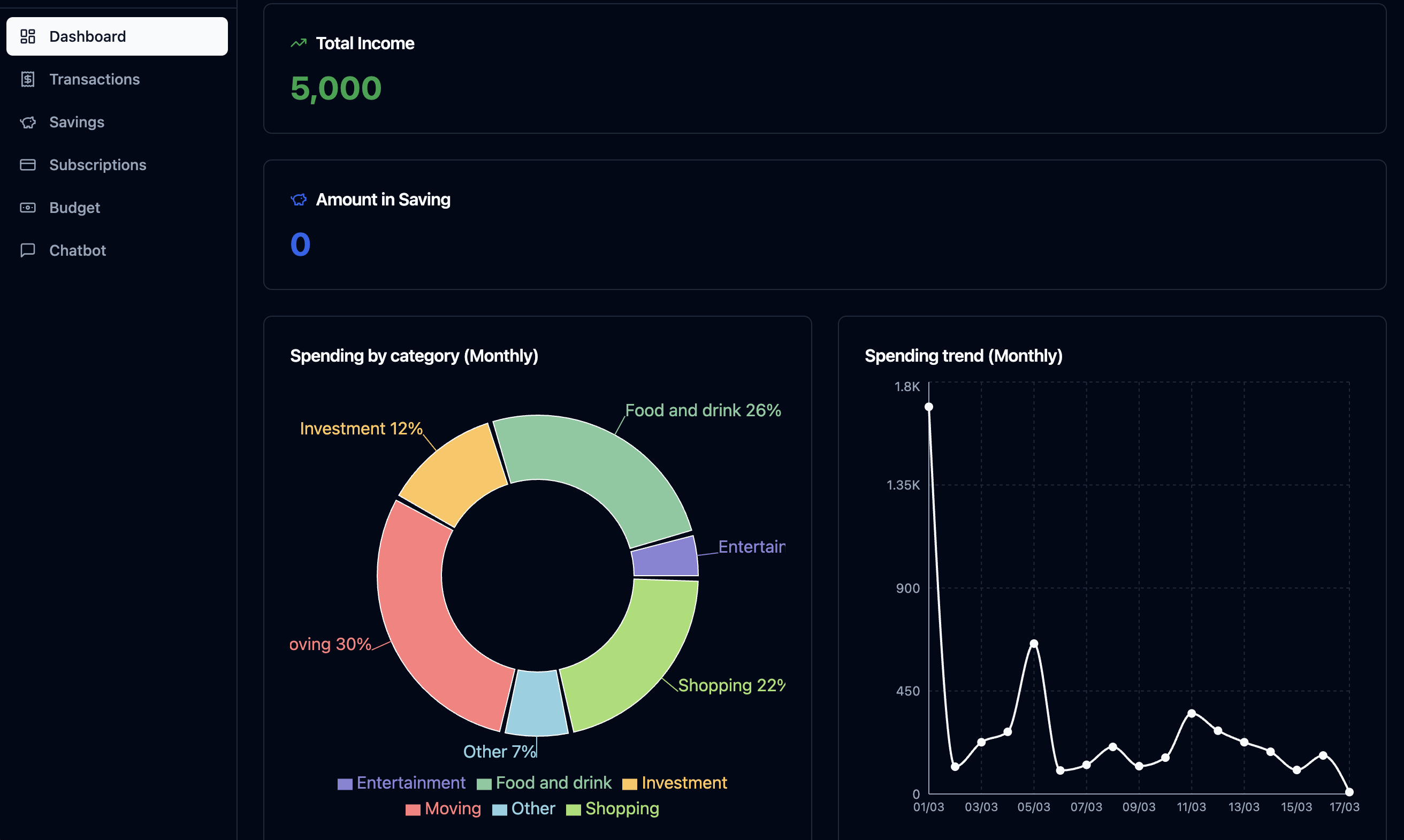
The core feature provides alerts when it predicts a planned transaction will result in high "regret," alongside a chatbot that answers questions about a user’s future financial intentions. While the interface looks like a standard finance app, the soul of the project is the solution itself. It’s designed to increase user retention for fintech apps by acting as a "friend" who makes financial management less dry and more personal.
How we built it
By leveraging user data (income, budget, savings goals, and expense history) and diving deep into behavioral psychology and consumer economics, we developed formulas for three primary metrics:
- IRS (Immediate Regret Score)
- PRS (Period Regret Score)
- Resilience Level (Detailed formulas can be found in our GitHub hackathon_pitch.md file)
Challenges we ran into
Data Scarcity: Our biggest hurdle was high-quality data. Market surveys and public datasets weren't providing the depth we needed. To pivot, we used survey insights to build a simulation system that models "average" spending behaviors, giving us a robust dataset to study. The ML vs. Math Dilemma: We originally planned to use Machine Learning. However, we realized ML can be a "black box" that is hard to explain to users, and we feared the "garbage in, garbage out" trap. We decided to stick with transparent, logic-based calculations instead.
Accomplishments that we're proud of
Even though we worked with simulated data, building these formulas based on psychological and economic concepts yielded surprisingly accurate results. We successfully managed to predict, with reasonable logic, how a user would actually feel about their spending habits.
What we learned
We learned a lesson in humility. Initially, we didn't realize how deep the insights for this idea went—it was a lot to handle at our current level. We also learned the value of simplicity over complexity. Sometimes, a stable, effective calculation is better than a complex model that you can't fully control.
What's next for Personal finance assistant
There is a behavioral psychology concept we haven't implemented yet: Time-delay (the gap between thought and action). Research shows this is a crucial factor in calculating IRS and PRS. To make this viable, we envision a future where travel, food, and banking apps share data via an API. On the technical side, we are experimenting with deploying a custom LLM on AWS to handle alerts and suggestions. We believe that uploading sensitive user financial data to third-party LLMs is a major privacy risk, so building our own secure pipeline is the next big step.
Built With
- amazon-web-services
- fastapi
- llm
- postgresql
- react


Log in or sign up for Devpost to join the conversation.