-
-
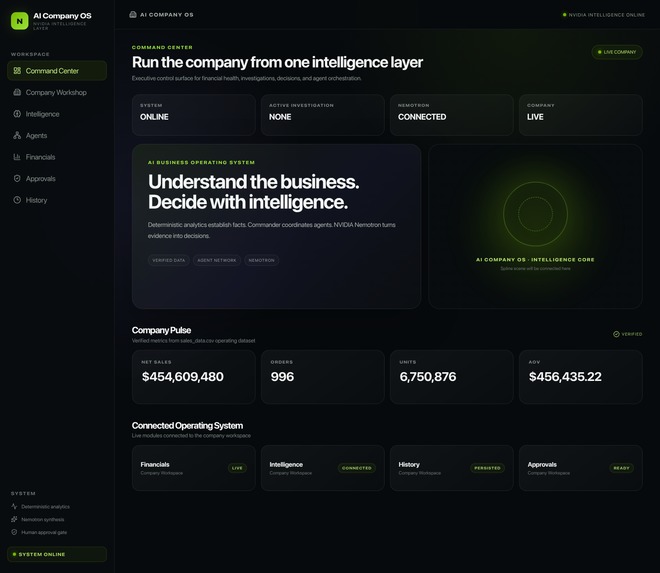
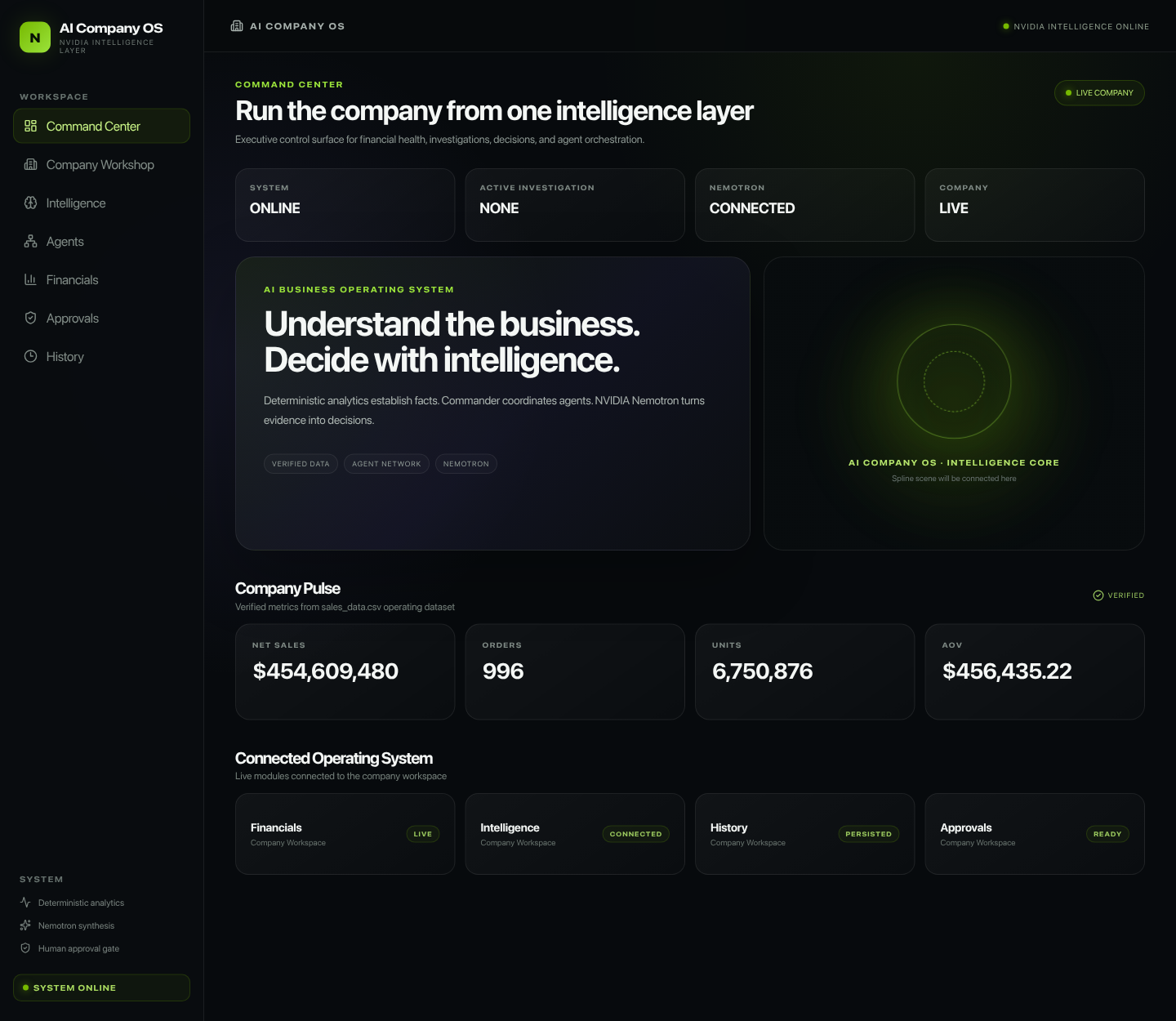
Command Center: verified analytics, a Commander agent, and NVIDIA Nemotron on Nebius turn company data into decisions.
-
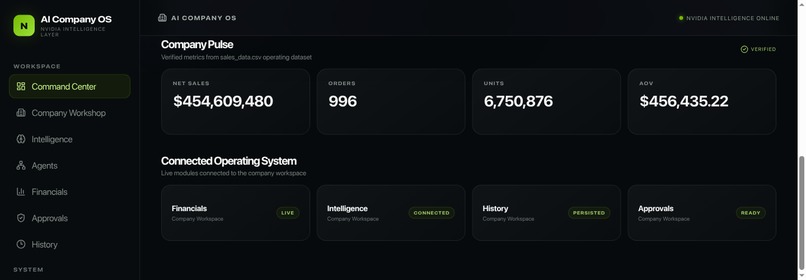
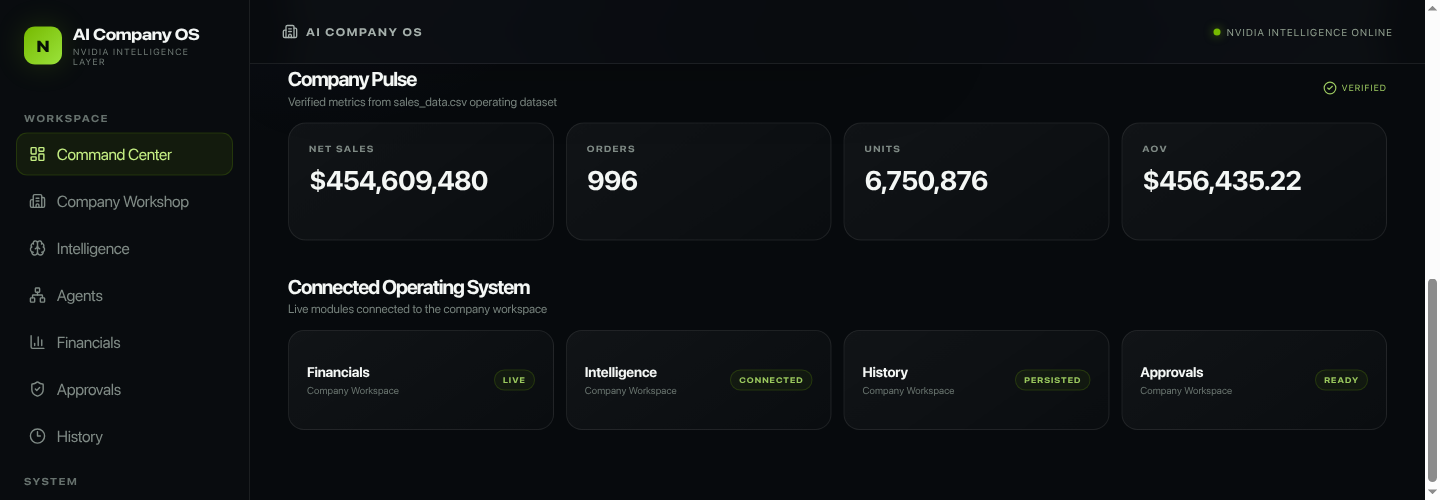
Company Pulse: verified net sales, units and live module status, computed deterministically from the uploaded dataset.
-
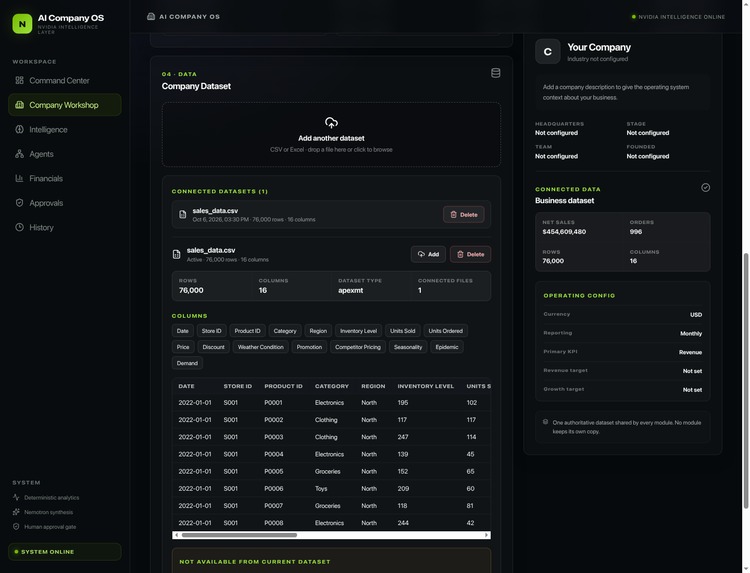
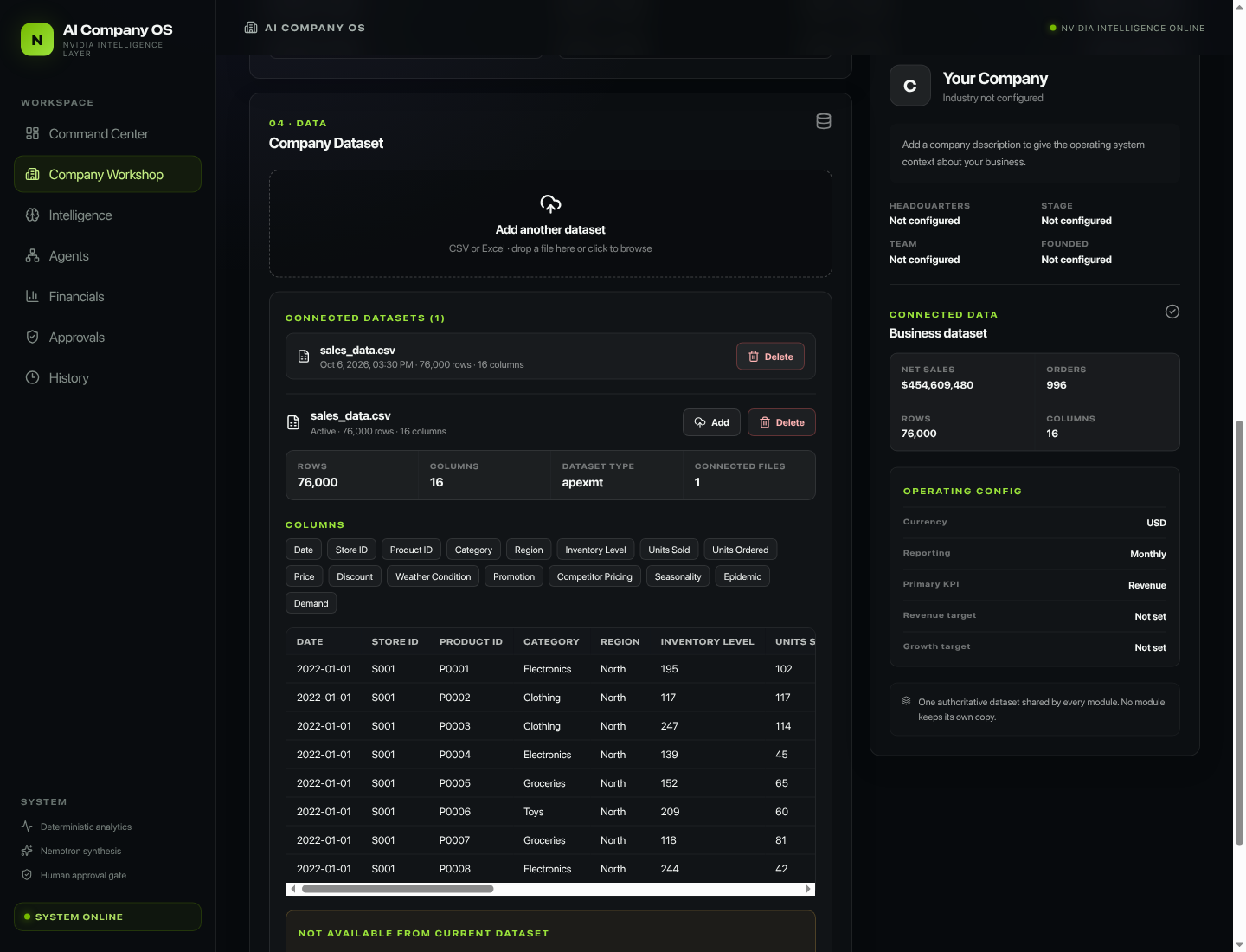
Company Dataset: upload a CSV or Excel file and every module reads the same verified source (76,000 rows, 16 columns).
-
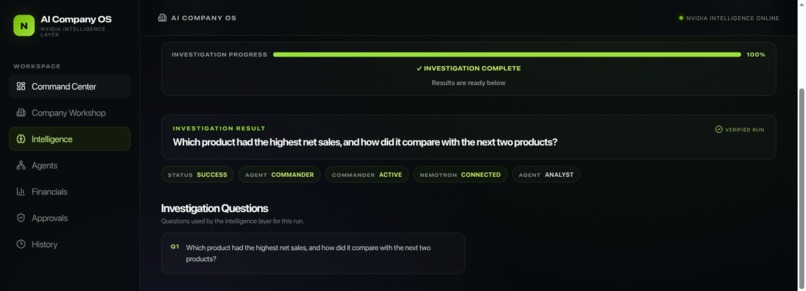
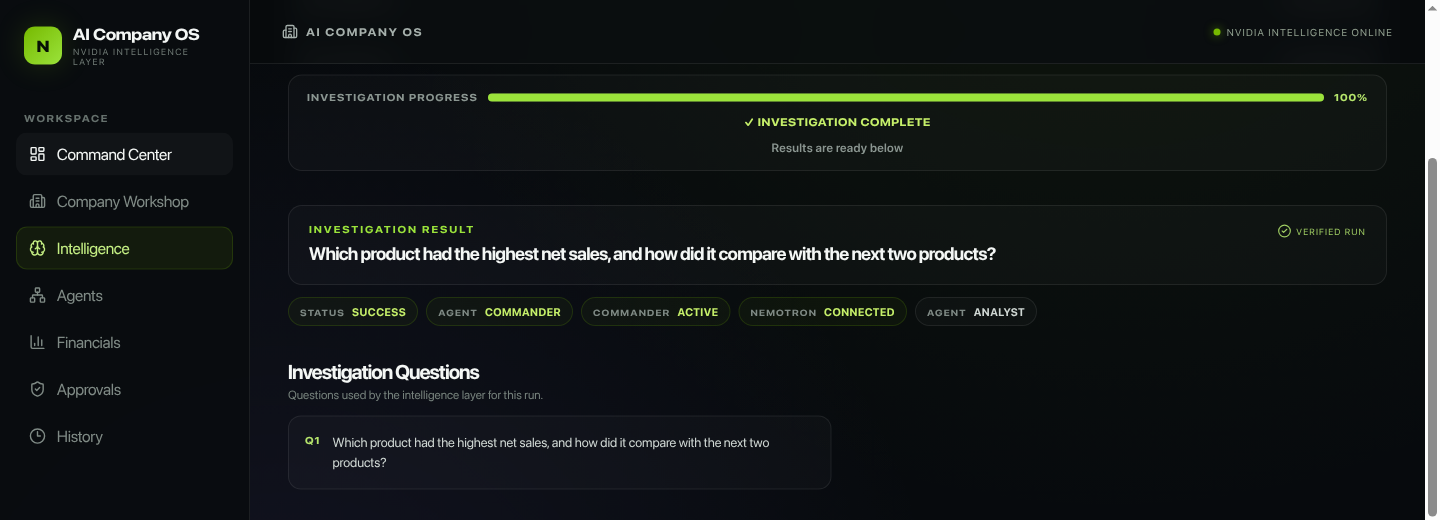
Investigation Progress: a live run reaches 100% and returns a verified result from the Commander and Nemotron.
-
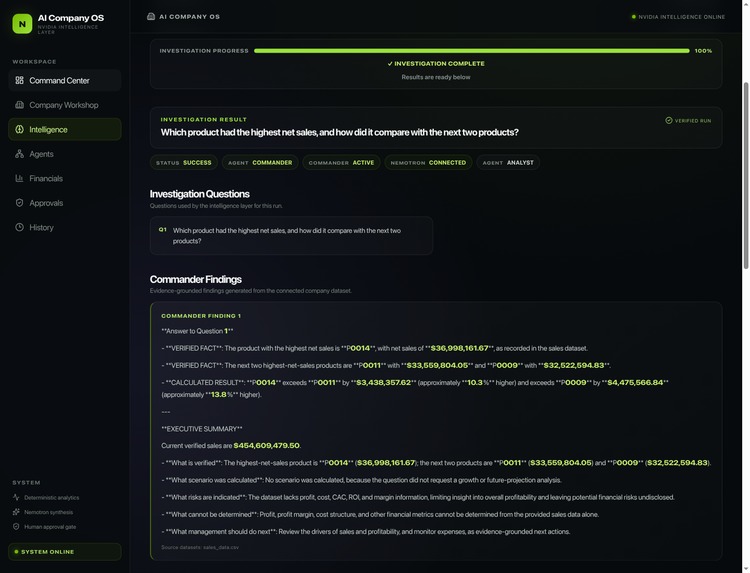
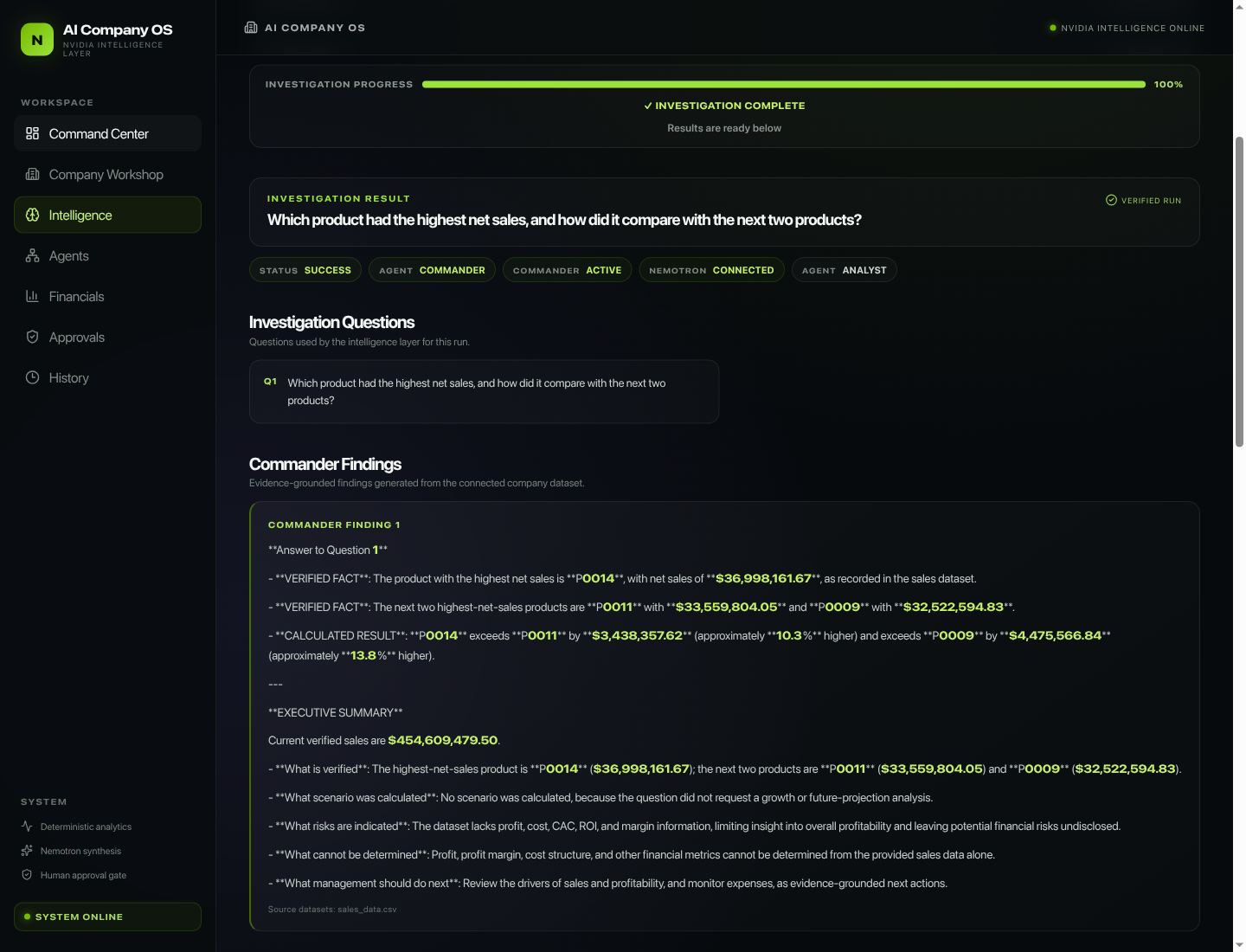
Commander Findings: every claim is labeled VERIFIED FACT, CALCULATED RESULT or LIMITATION, and sourced from the dataset.
-
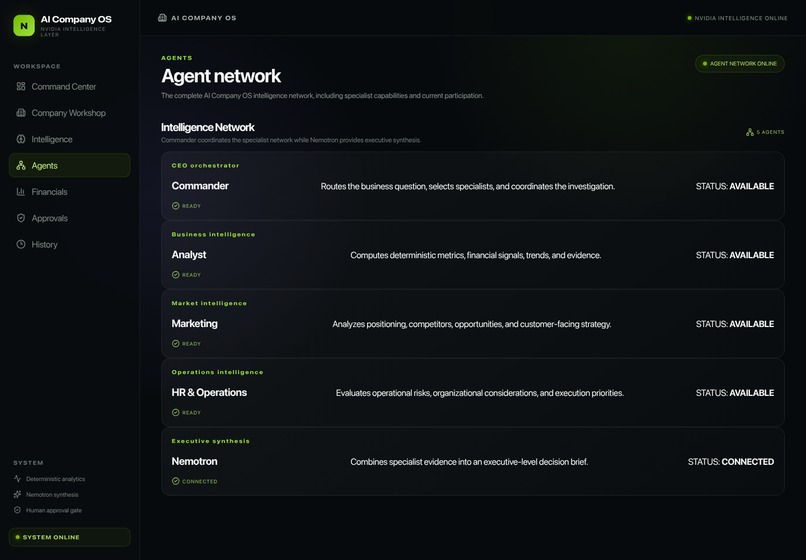
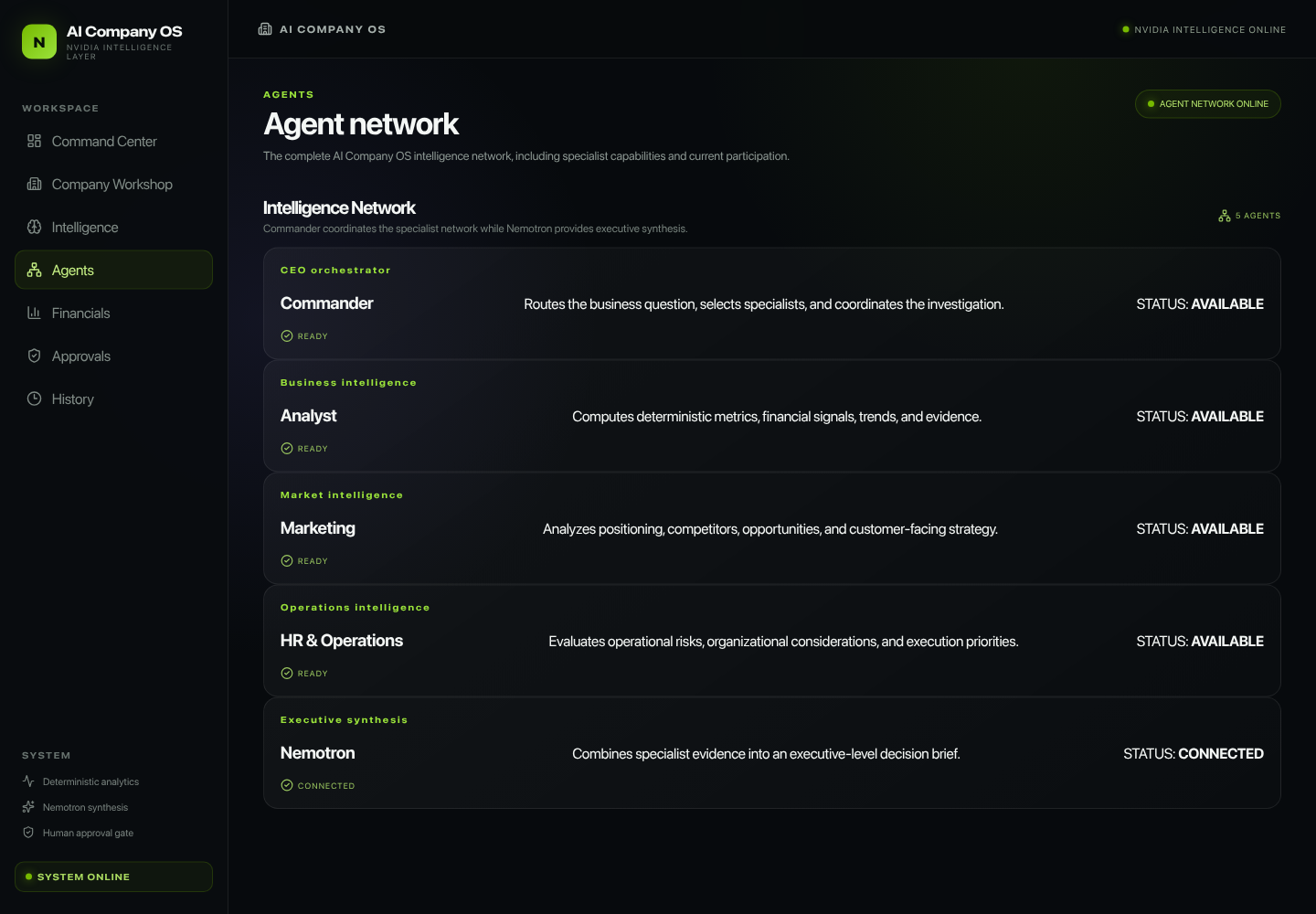
Agent Network: a Commander routes each question to specialist agents, and Nemotron on Nebius writes the executive brief.
-
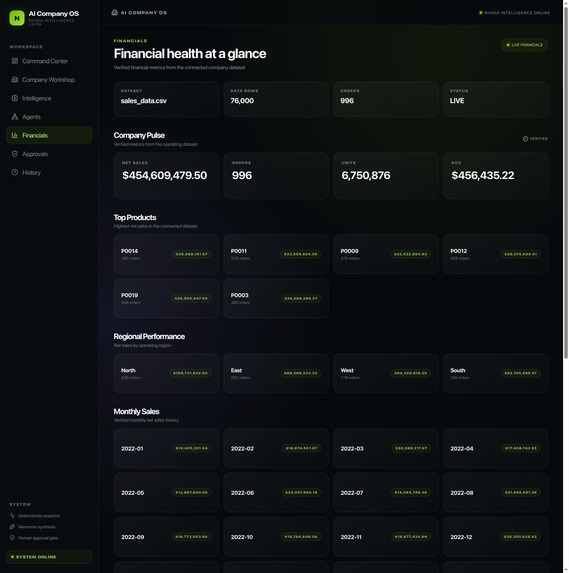
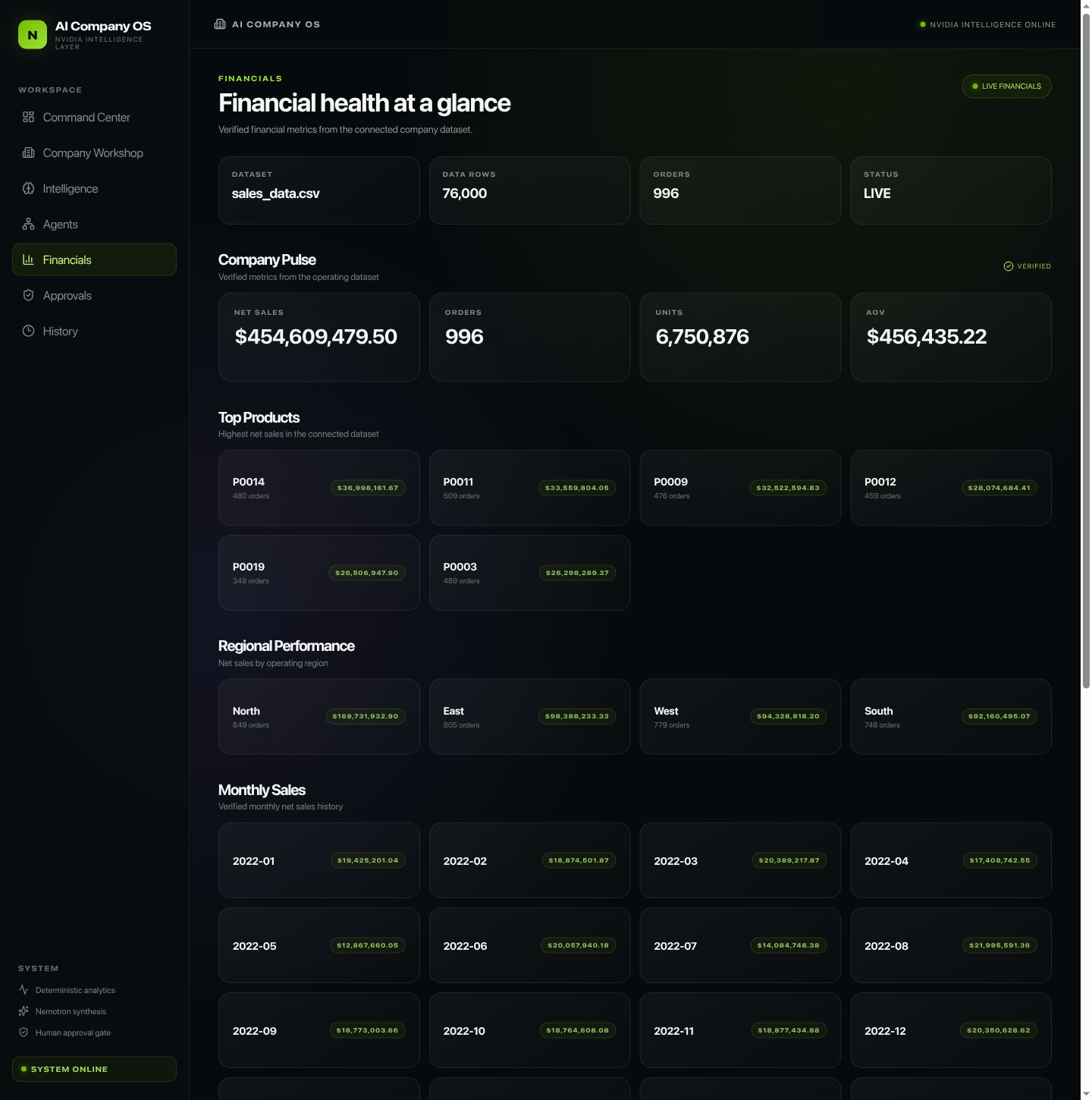
Financials: net sales, top products, regions and monthly history, all computed deterministically from the uploaded data.
Inspiration
Most businesses already have plenty of data, but turning that data into reliable decisions is still difficult. Dashboards can show hundreds of numbers, while executives still have to figure out what matters, why it matters, and what should happen next.
We wanted to build something closer to an AI operating system for a company — not just a chatbot that answers questions, and not just another analytics dashboard.
The idea behind AI Company OS was to create a system where deterministic analytics establish what is actually happening in the business, specialist agents investigate different aspects of the problem, and NVIDIA Nemotron running through Nebius Token Factory turns that verified evidence into an executive-level decision.
Our goal was simple:
Understand the business. Decide with intelligence. Keep humans in control.
What it does
AI Company OS is an evidence-grounded, multi-agent business intelligence and decision-support platform.
A user can connect company data and ask questions such as:
Which product had the highest net sales, and how did it compare with the next two products?
Instead of sending the raw dataset directly to an LLM, the system follows a structured workflow:
Company Data → Deterministic Analytics → Commander → Specialist Agents → Verified Evidence → NVIDIA Nemotron → Executive Decision → Human Approval → History
The deterministic analytics layer calculates the facts from the underlying data. The Commander determines which specialist agent should investigate the question. The resulting evidence is then passed to NVIDIA Nemotron for executive synthesis.
The final response separates verified facts, calculated results, recommendations, and unavailable metrics so that the AI does not pretend to know something that the dataset cannot support.
The platform also includes:
- Company workspace and profile
- Company Pulse dashboard
- Multi-agent investigations
- NVIDIA Nemotron synthesis
- Financial and business analytics
- Human-in-the-loop approval
- Investigation history and auditability
- Large CSV dataset handling
- Dockerized deployment
- React frontend with a FastAPI backend
The application is deployed as a working production demo.
How we built it
We built AI Company OS as a full-stack application using React, FastAPI, Python, Pandas, SQLite, and Docker.
The intelligence pipeline was deliberately designed so that the LLM is not responsible for basic arithmetic or inventing business facts.
The system first performs deterministic analysis on the company's dataset. Specialist agents then investigate the relevant evidence. Finally, NVIDIA Nemotron is used for reasoning and executive synthesis through Nebius Token Factory.
This separation allows the application to combine traditional data analysis with generative AI while keeping the final answer grounded in measurable evidence.
For large datasets, we also built a context-management layer. During testing with a 421,570-row dataset, the original synthesis context was too large and caused the model to terminate with a length limit before producing an answer.
Instead of simply increasing the output limit, we redesigned the synthesis context to send only decision-relevant evidence while keeping the complete deterministic analysis available inside the application.
This reduced one representative synthesis prompt from approximately 65,000 characters to about 12,000 characters, while preserving the important evidence.
We tested the application with automated tests, Docker, and a production deployment.
Challenges we ran into
One of our biggest challenges was making an LLM work reliably with real business data rather than a small demonstration dataset.
Large datasets produced extremely large intermediate evidence and reasoning contexts. In one production test, this caused NVIDIA Nemotron to return an empty response because the request reached its length limit.
We initially considered increasing the token limit, but our investigation showed that the real problem was duplicated and unnecessary context.
We solved this by introducing bounded evidence extraction and compact decision-relevant summaries before sending the information to Nemotron.
Another challenge was maintaining a clear boundary between what the dataset proves and what the AI recommends. We added explicit distinctions between verified facts, calculated results, recommendations, and unavailable metrics.
We also had to make the system portable and reproducible across environments. The application was packaged with Docker, tested independently, and deployed publicly so the complete system could be evaluated outside our development environment.
Accomplishments that we're proud of
We are proud that AI Company OS became a working end-to-end system rather than just a concept or mockup.
We are particularly proud that:
- NVIDIA Nemotron is used as the executive intelligence layer through Nebius Token Factory.
- The system combines deterministic analytics with multi-agent reasoning.
- Human approval is built into the decision workflow.
- Large datasets can be analyzed without sending the entire dataset into the LLM context.
- A 421,570-row production-style dataset was successfully analyzed.
- The application has a complete React + FastAPI architecture.
- The project is Dockerized and publicly deployed.
- The system maintains investigation history for auditability.
- The application clearly distinguishes available evidence from unavailable business metrics.
In one production test, the system correctly identified December 2010 as the strongest sales month, with approximately $288.76 million in sales, and compared it against the other months using the underlying dataset.
That result came from the actual analytical pipeline rather than manually hard-coded demo text.
What we learned
We learned that building an AI application is not just about choosing a powerful model.
The quality of the system depends heavily on the architecture around the model.
We learned that:
- Deterministic computation should handle deterministic facts.
- LLMs are most valuable when they reason over curated evidence rather than raw data dumps.
- Context management can be just as important as model selection.
- Human approval is important when AI moves from analysis toward business decisions.
- A production-ready AI application needs observability, testing, portability, and clear limitations — not just a good prompt.
Most importantly, we learned to treat the LLM as an intelligence layer inside a larger system rather than treating the LLM itself as the entire product.
What's next for AI Company OS
Our next step is to move AI Company OS from a powerful business intelligence prototype toward a more complete autonomous company operating layer.
Future versions could add:
- More specialized business agents
- Deeper financial and operational planning
- Forecasting and anomaly detection
- CRM and ERP integrations
- Automated recurring business reviews
- More advanced approval workflows
- Role-based access and enterprise security
- Persistent company memory
- Scenario simulation and what-if analysis
- Automated execution of approved business actions
Our long-term vision is an AI system that does not simply tell a company what happened, but continuously helps it understand what is happening, why it is happening, what could happen next, and what action should be taken — while keeping humans in control of important decisions.


Log in or sign up for Devpost to join the conversation.