-
-
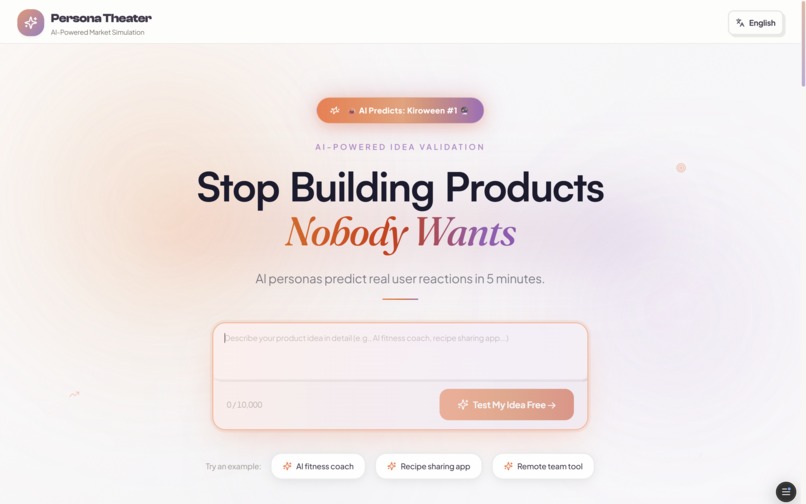
landing
-
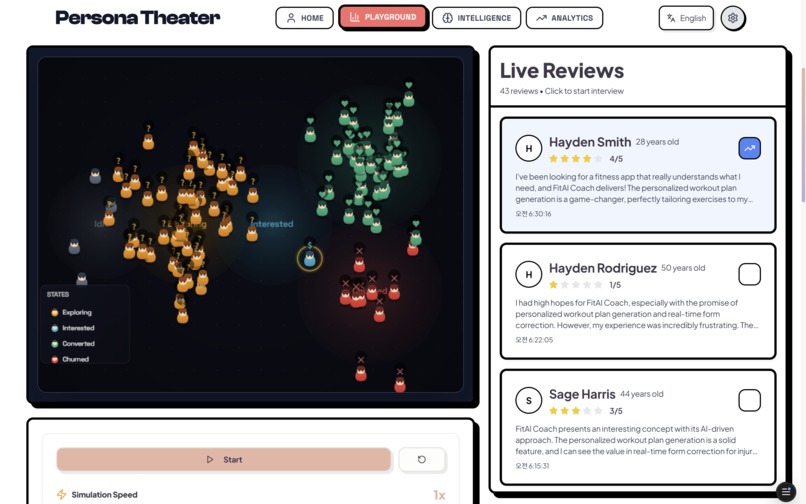
simulation
-
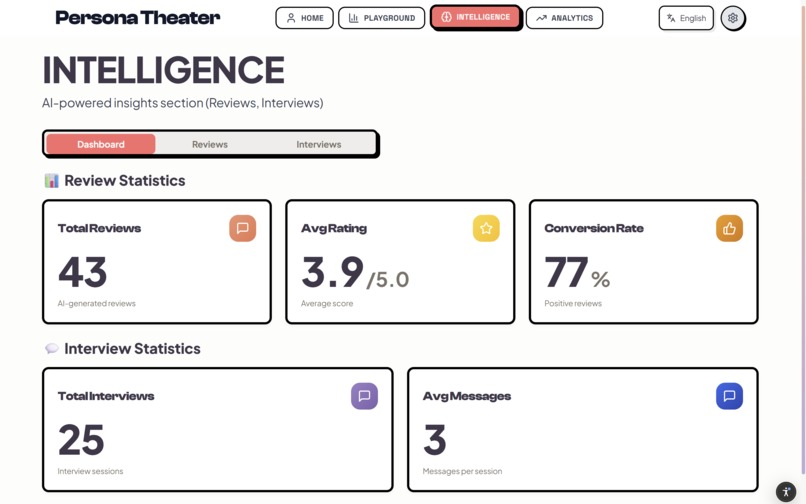
review insight
-
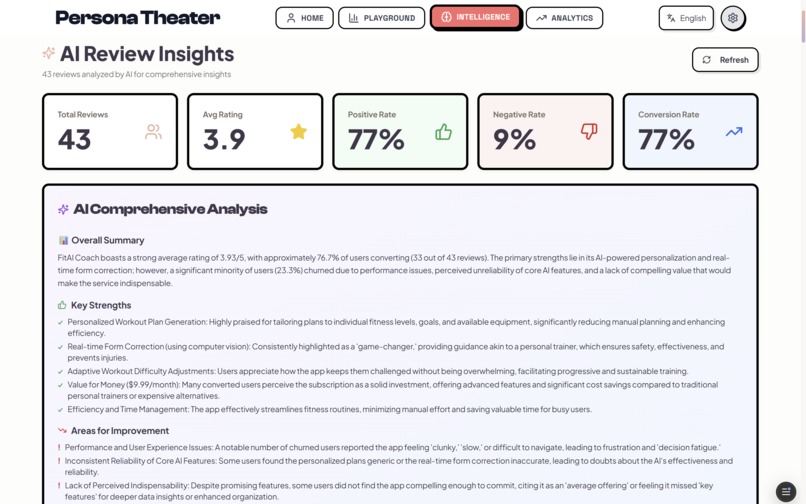
review insight2
-
review insight3
-
review insight4
-
interview insight
-
interview insight2
-
-
-
Persona Theater - Kiroween Hackathon Submission
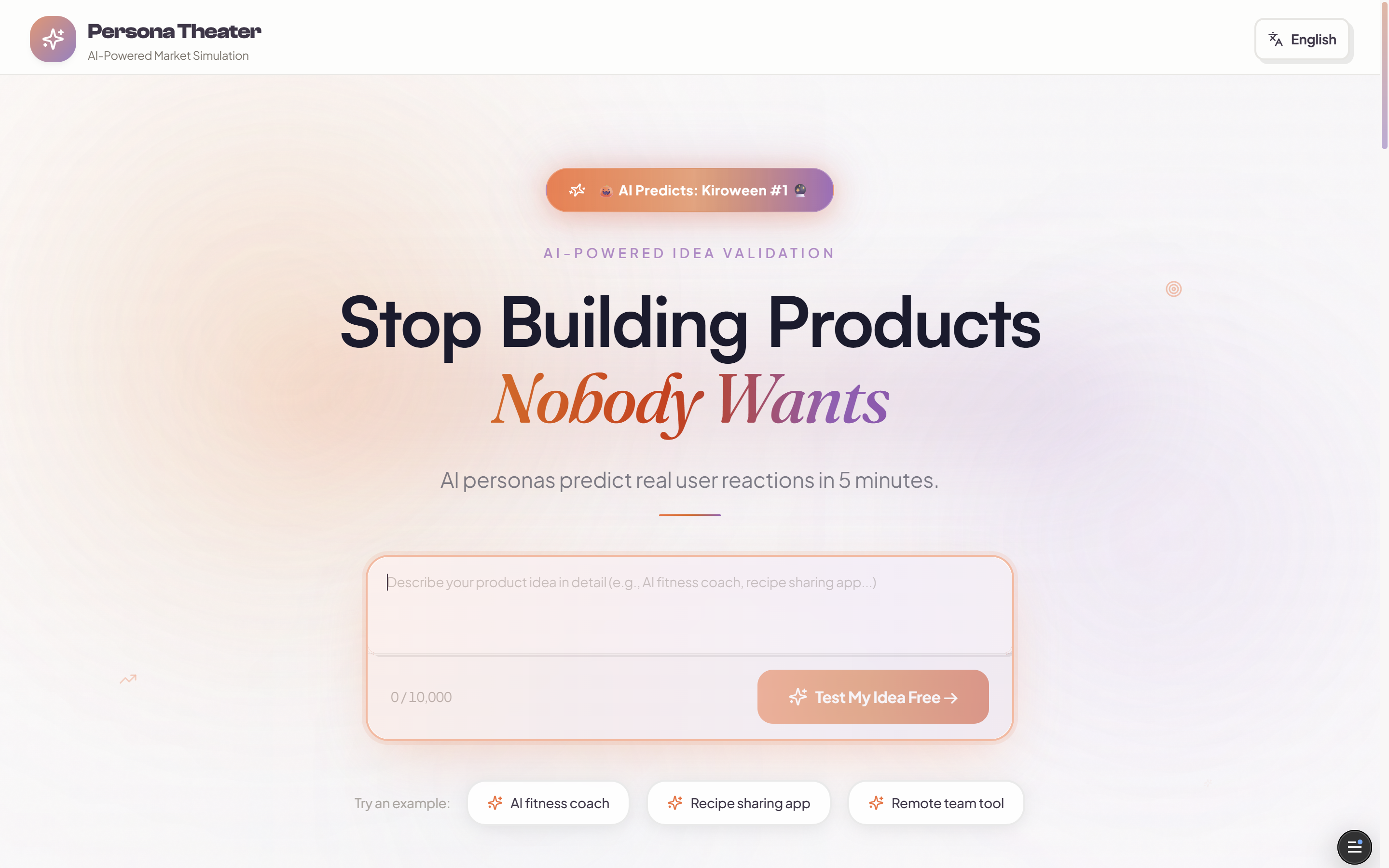
AI-Powered Product Validation Platform: Simulate 100 Customer Personas Before Building Your Product
Inspiration
The Problem I Couldn't Ignore
67% of startups fail because they build products nobody wants. That's not just a statistic—it's $75,000-$200,000 and 6-18 months of wasted effort per failed venture.
As the founder of Leda Games for 4 years—a company specializing in making Webtoon or TV shows into games—I've experienced this pain firsthand. I've gone through successful crowdfunding (120 million won on Tumblbug), Pre-A investment from Kakao Games, and partnerships with Naver and TVING. But I've also experienced the devastating reality of building products that didn't find their market fit. Traditional market research costs $10,000-$50,000 and takes weeks. Quick surveys give shallow insights. And by the time you validate your idea, the market has moved on.
The Spark
I asked myself: What if AI could simulate an entire market response before you write a single line of code?
What if you could interview 100 potential customers—each with distinct personalities, skepticism levels, and decision-making patterns based on real behavioral economics research—in under 10 minutes?
Persona Theater was born from this question. Not as another chatbot, but as a virtual theater where AI personas perform the drama of market adoption, complete with rationalization loops, loss aversion, and status quo bias.
What it does
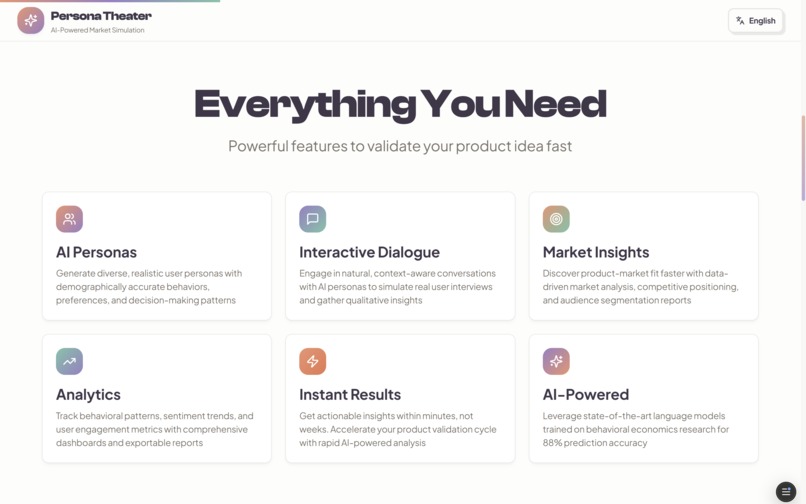
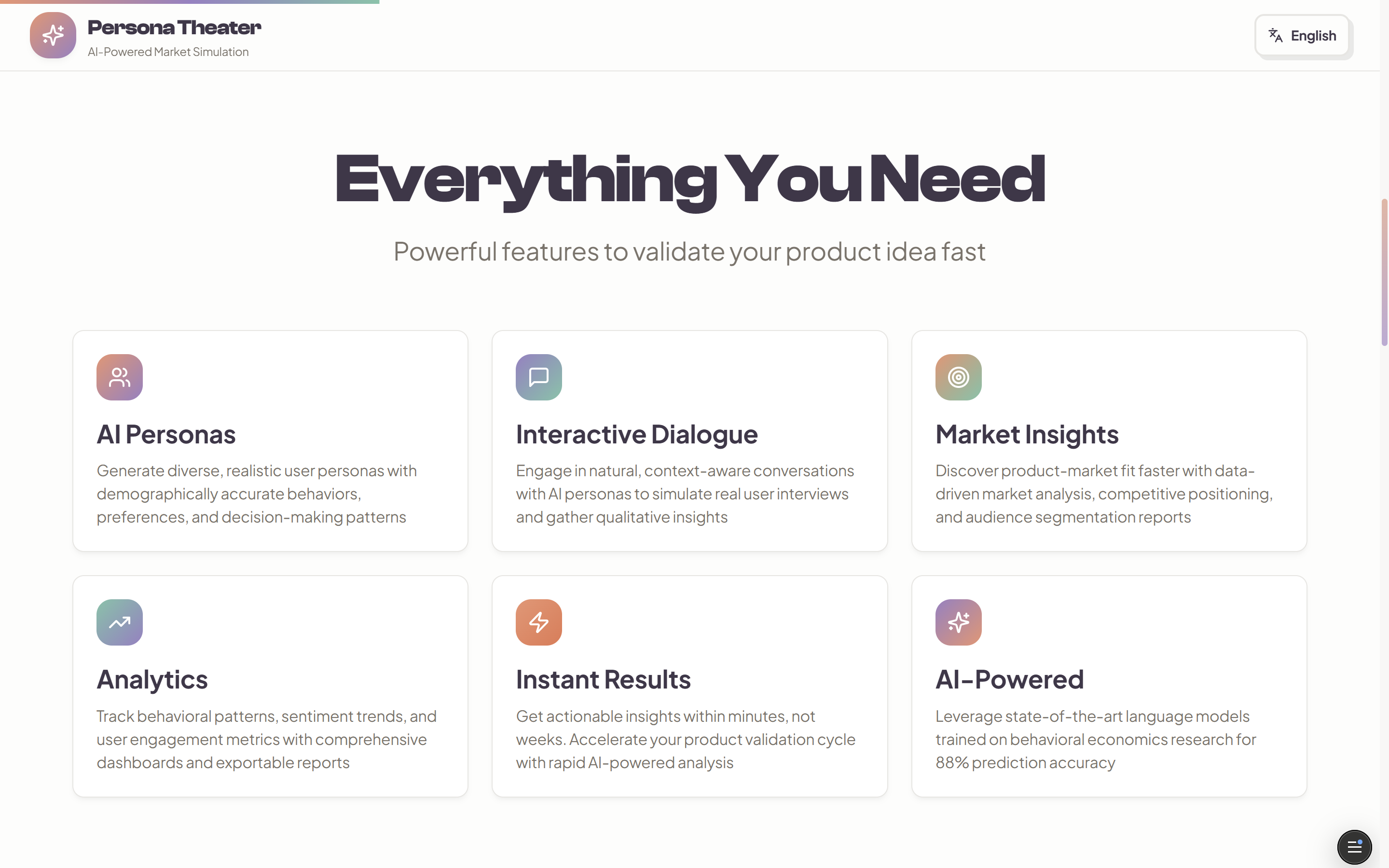
Persona Theater is an AI-powered product validation platform that transforms your product idea into a full market simulation within minutes.
Core Features
1. Intelligent Idea Parsing
- Paste any idea (even a rambling voice memo transcription)
- AI extracts structured product requirements automatically
- Generates comprehensive PRD (Product Requirements Document)
2. Strategic Persona Generation
- Creates 100 diverse AI personas based on behavioral economics principles
- 5 Strategic Groups: Positive Adopters (25%), Expandable (30%), Critical Evaluators (20%), Alternative Seekers (15%), Monetization Core (10%)
- Each persona has unique traits: skepticism, loss aversion, status quo bias, spending power, impulsiveness
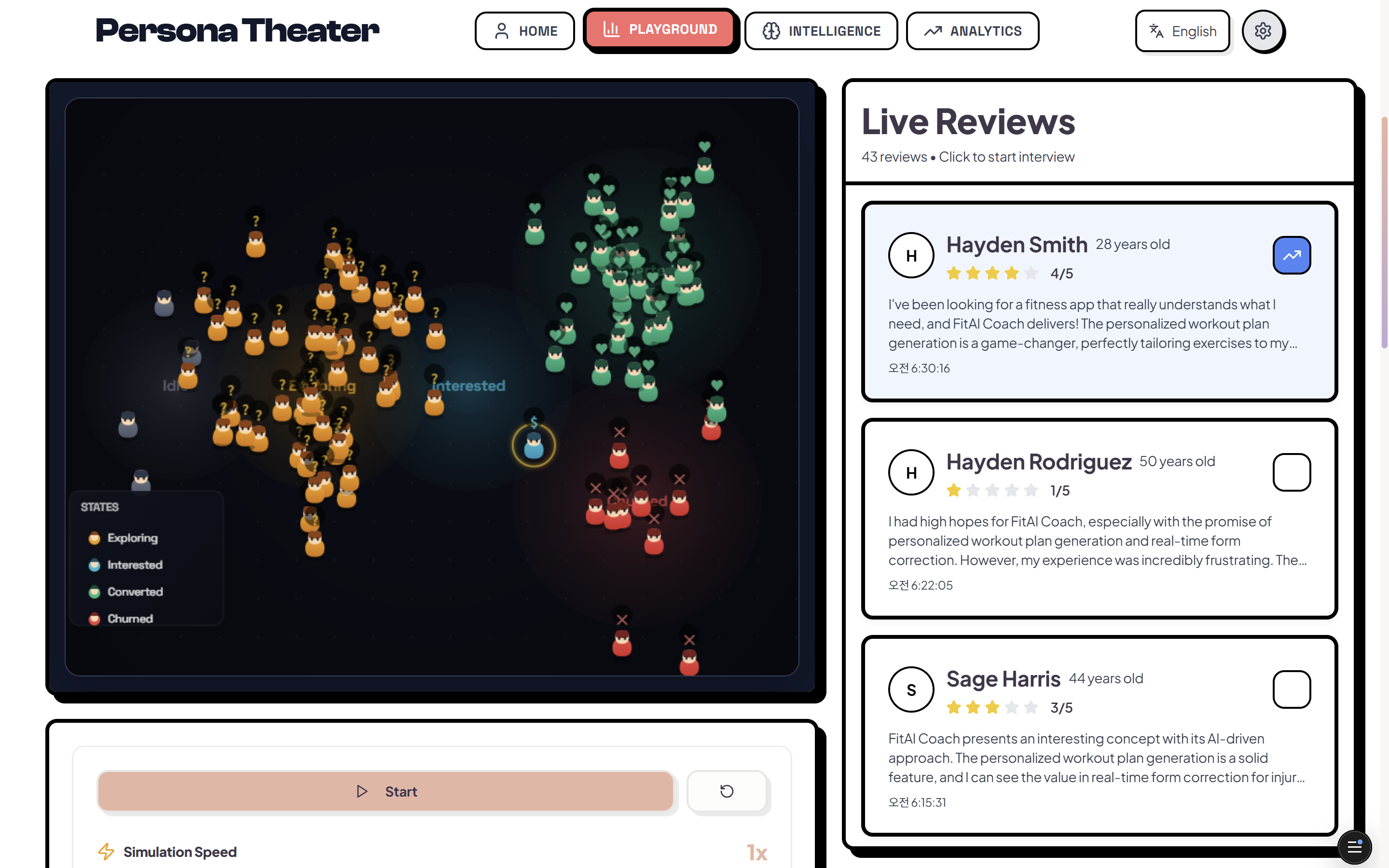
3. Real-Time Market Simulation
- Watch personas explore, evaluate, and decide on your product
- Live visualization of adoption patterns and churn points
- Behavioral Economics Engine v6.0 with:
- Loss aversion calculations (Kahneman & Tversky model)
- Rationalization loops (up to 3 self-persuasion attempts)
- Status quo bias dynamics
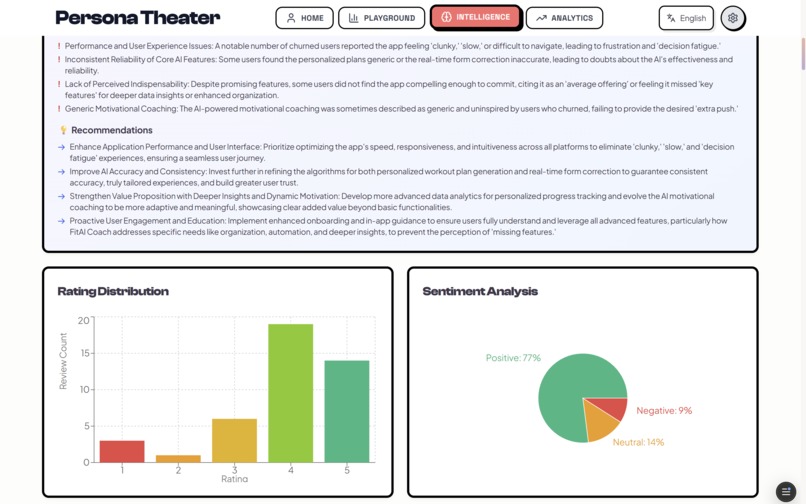
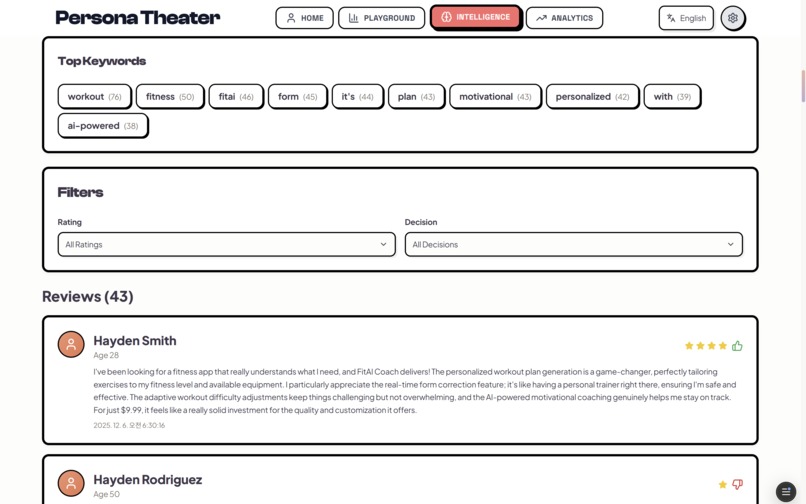
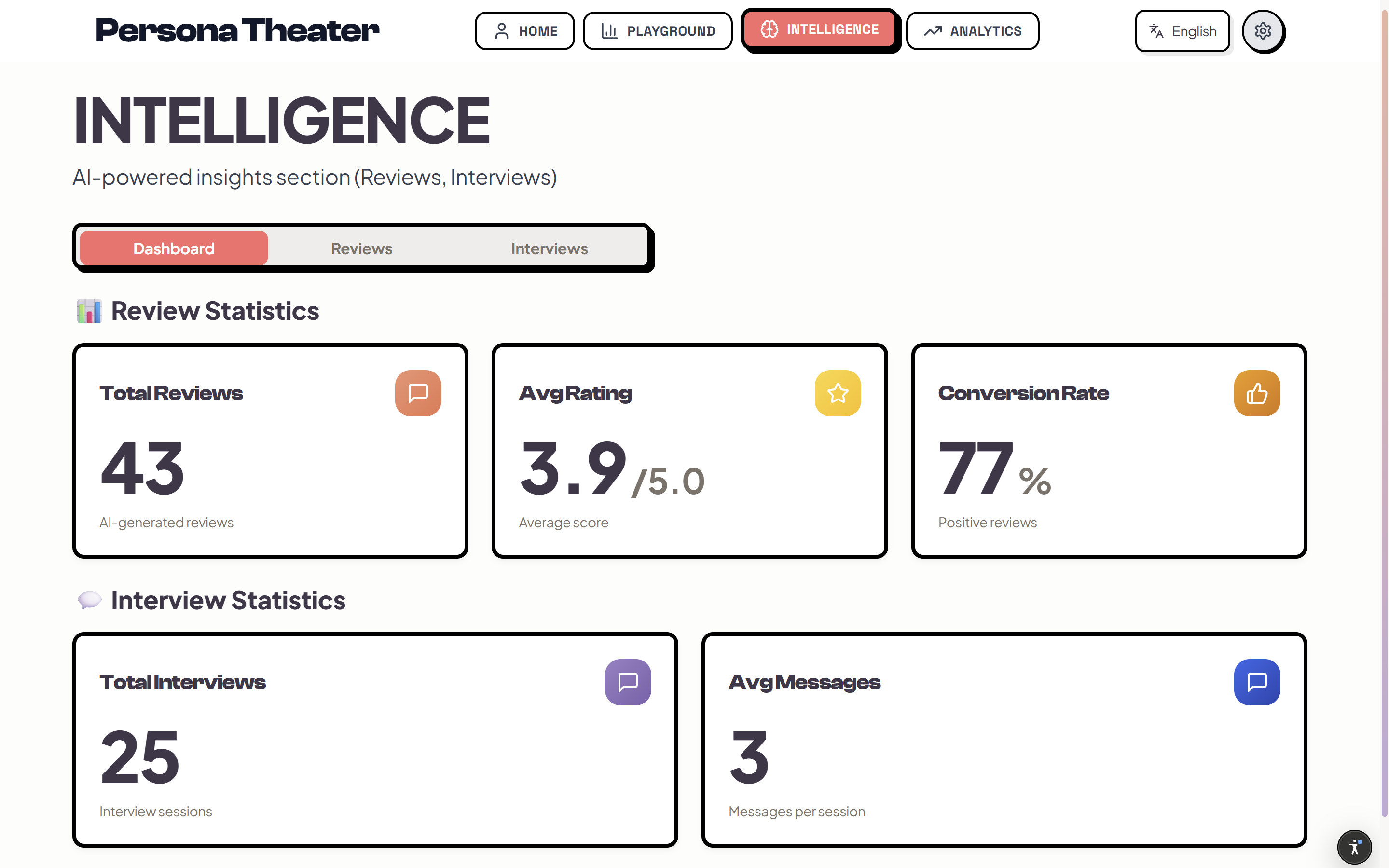
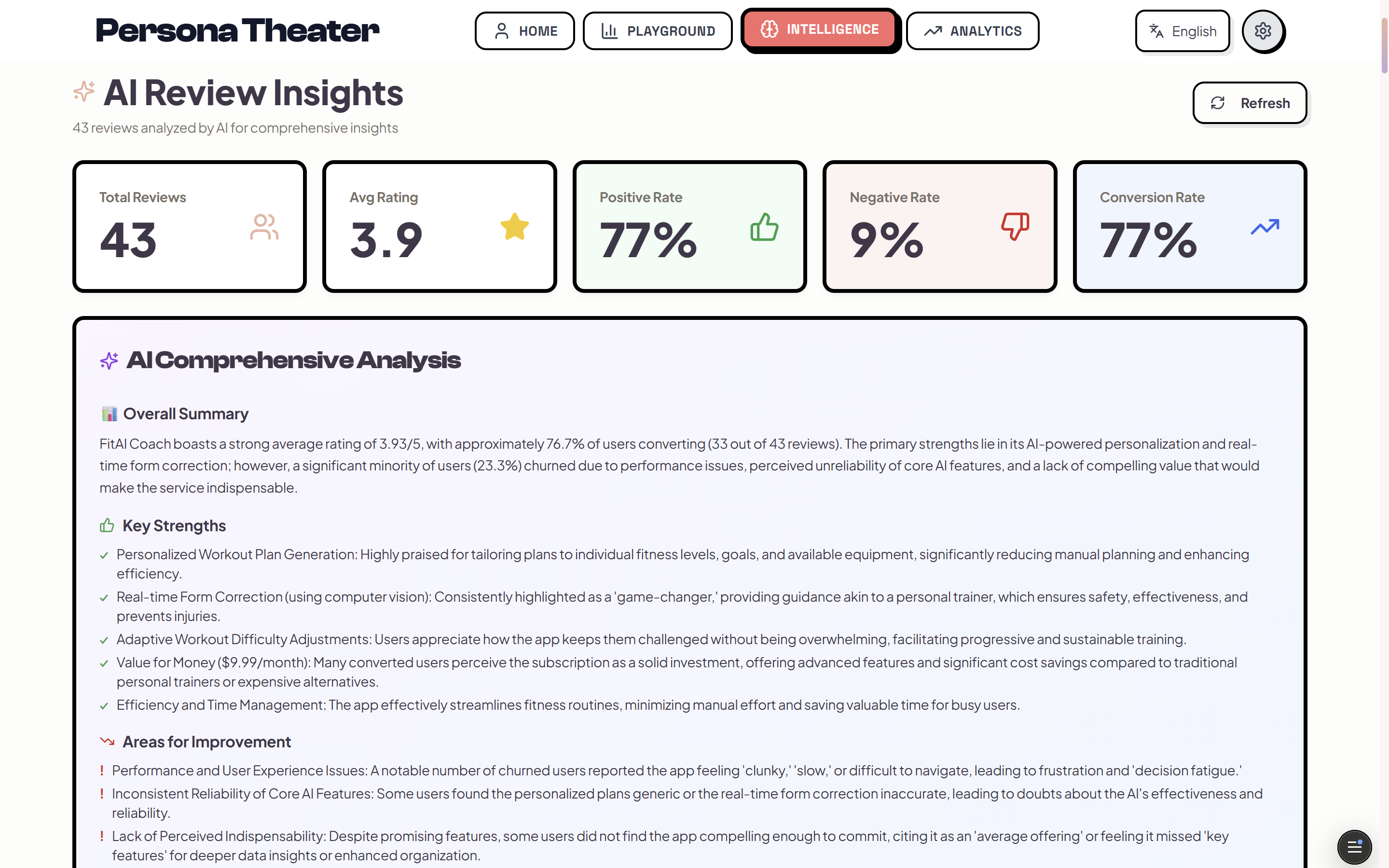
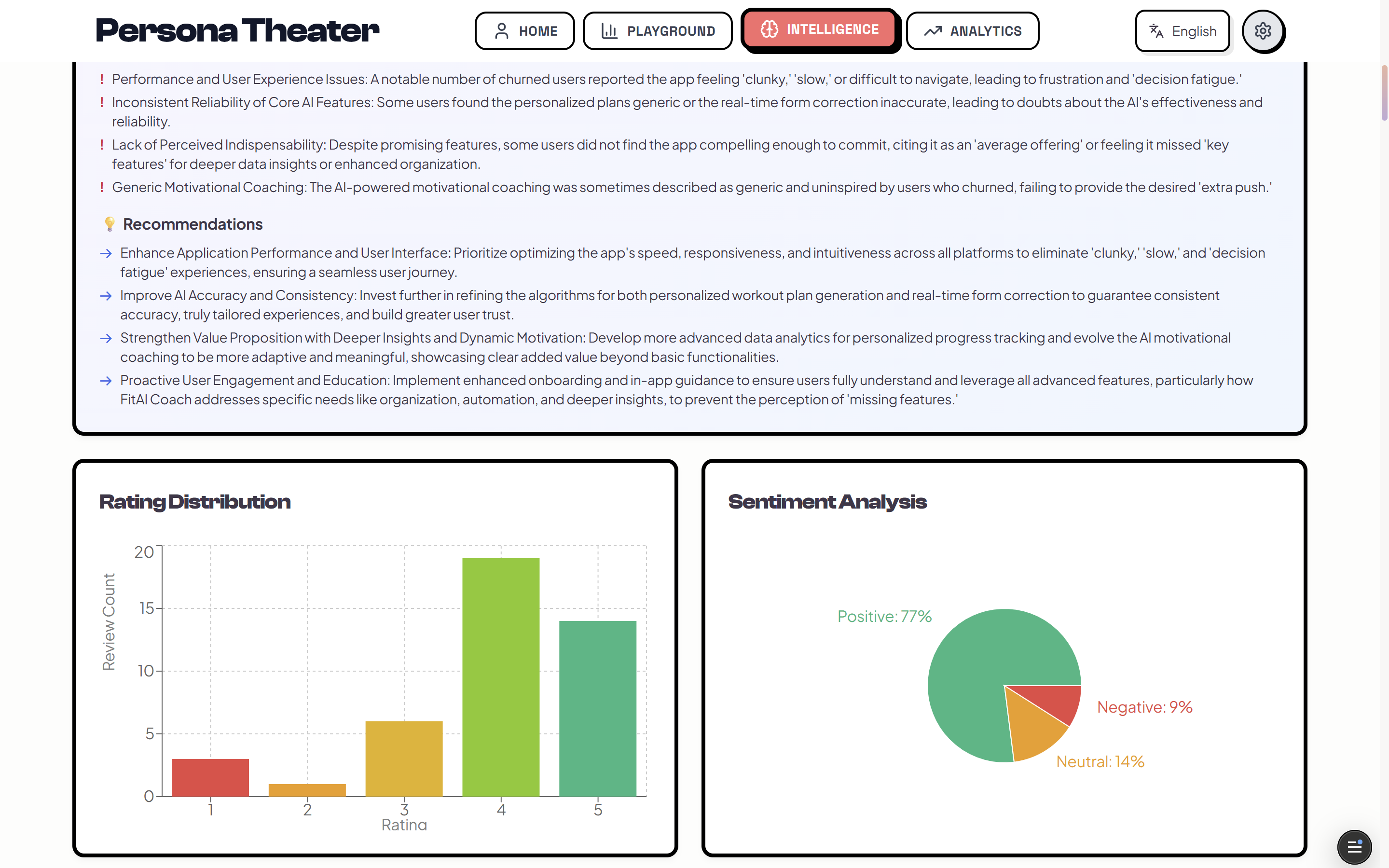
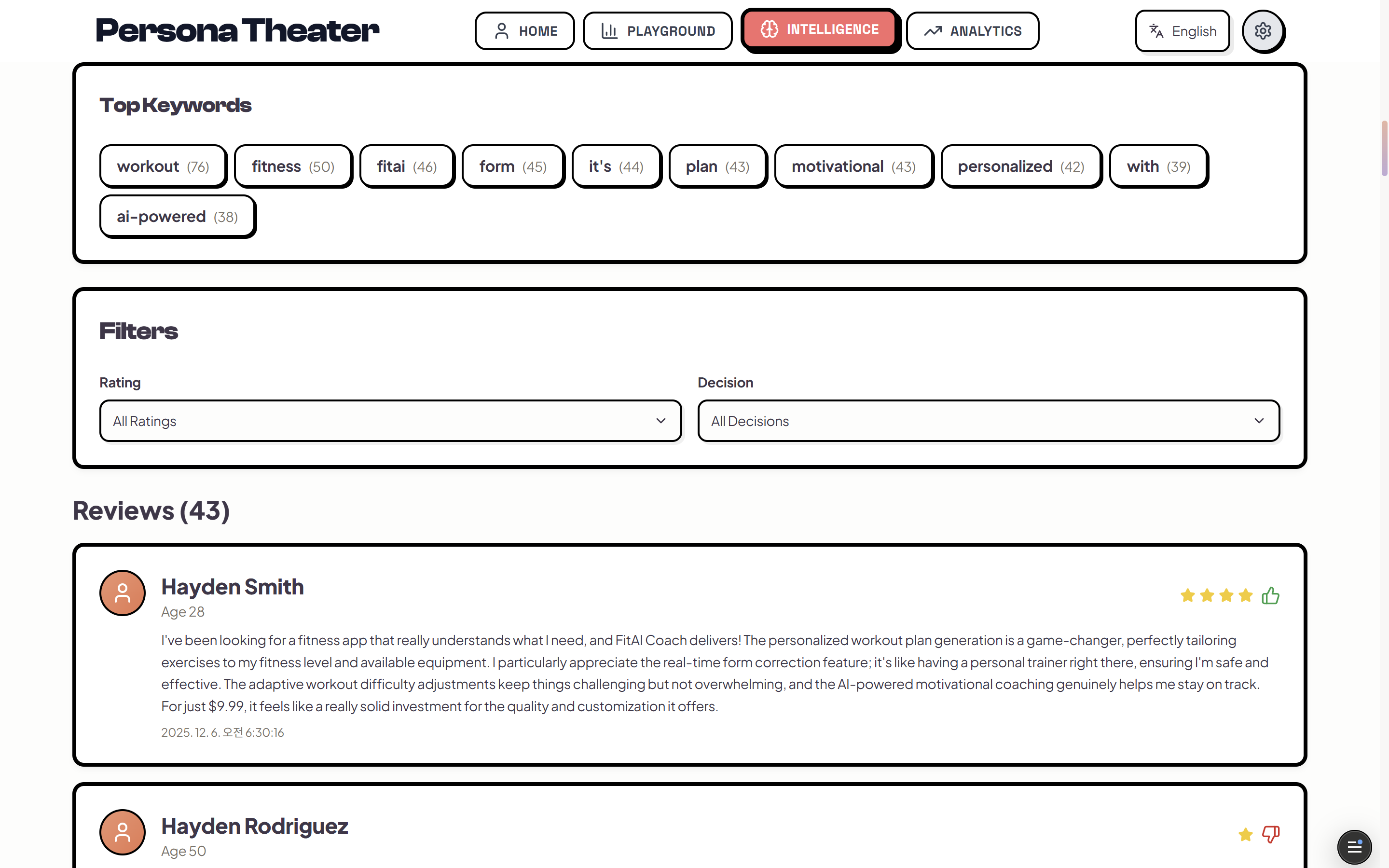
4. Authentic Review Generation
- AI generates realistic customer reviews (1-5 stars)
- Reviews match persona personality and decision rationale
- Distribution follows real-world patterns (Amazon/Yelp 2024 data)
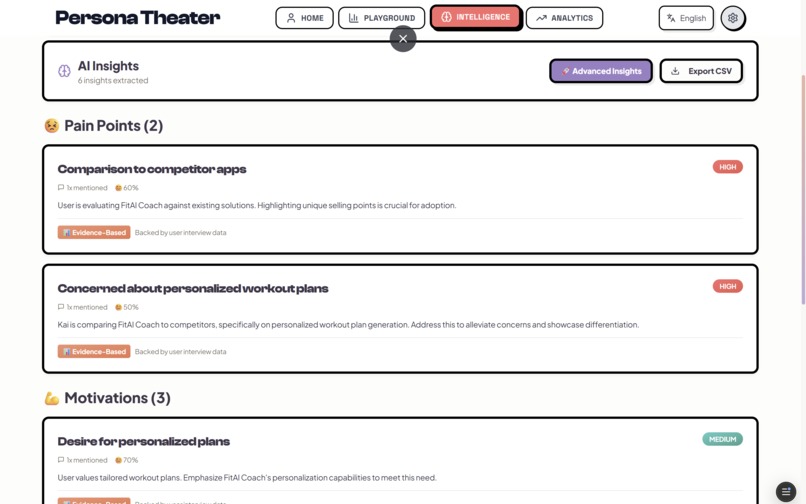
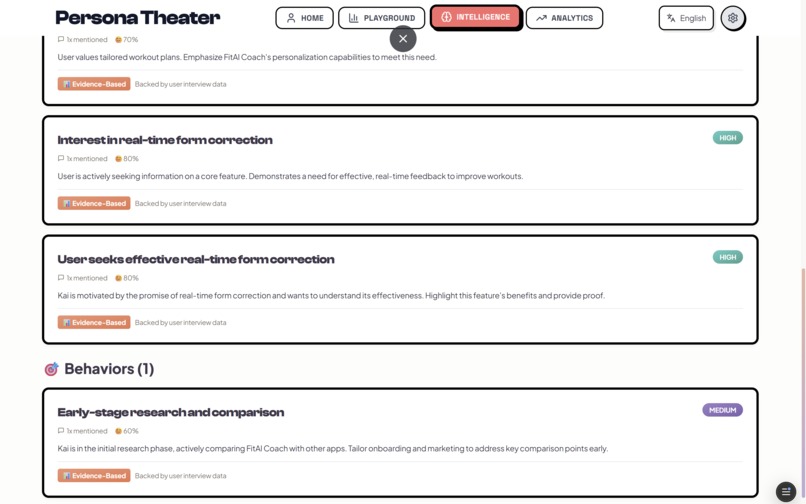
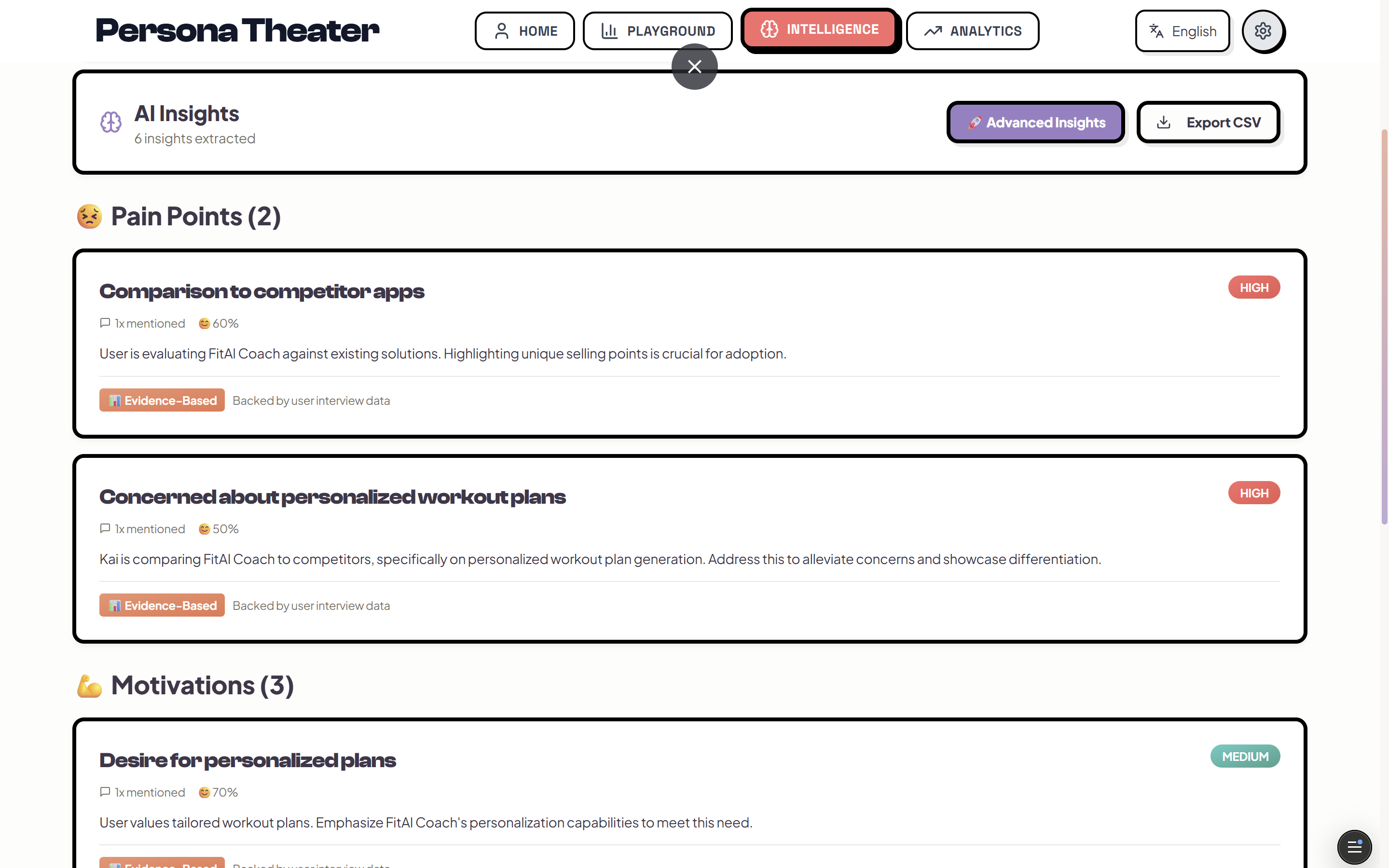
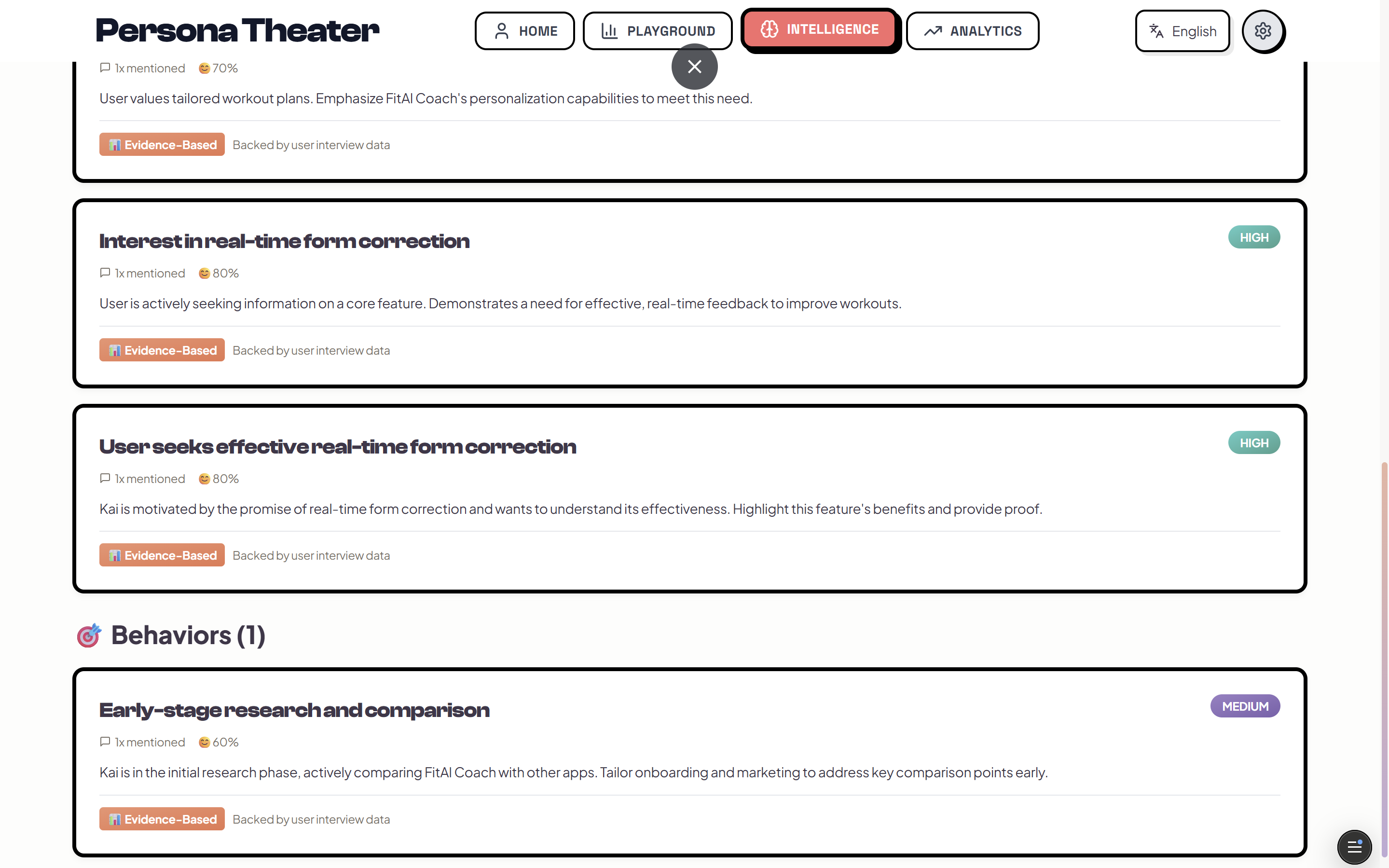
5. Interactive Persona Interviews
- Chat with any persona using Dynamic Chain-of-Thought (D-CoT)
- Adaptive reasoning depth based on question complexity
- Get deep insights into objections, preferences, and recommendations
6. 10-Stage E2E Validation Pipeline (modules completed but didn't have enough time to implement them all)
- Structured Input → Idea Scoring → PRD Generation → Expert Feedback
- → Persona Generation → Simulation → Quantitative Analysis
- → Deep Analysis → Review Generation → Interactive Interviews
7. Market Research Integration
- Real-time data from Brave Pro AI + Google grounding search
- Competitor analysis with pricing, features, and positioning
- User pain points from Reddit/HackerNews discussions
How I built it
A Non-Developer's Journey with Kiro
Here's my confession: I'm not a developer. I'm an entrepreneur who's spent 7 years building immersive game experiences. When I started this project, I couldn't write a proper React component from scratch. But I had a vision, and Kiro gave me the tools to bring it to life.
The Philosophy: Spec-Driven Development is Everything
For a non-developer like me, spec documents aren't optional—they're survival. Early in the hackathon, I learned a painful lesson: vague instructions lead to over-engineering, which leads to error cascades I couldn't debug.
I developed a strict personal rule:
"Code should be flexible. Requirements always change. Business expands, ideas evolve. Rewriting code every time is not sustainable. To be flexible, code must be lightweight."
My biggest enemy? Over-engineering. Vague instructions cause AI to over-interpret, generating unnecessary code that destroys consistency, stability, and readability all at once.
The Modular Architecture Principle
I believe in strict Presentation / Business Logic separation:
| Layer | Responsibility | Changes When... |
|---|---|---|
| Presentation | User input/output, UI rendering | Design changes |
| Business Logic | Core functionality, rules, state transitions, validation | Business rules change |
This separation was non-negotiable. Without it, errors became unmanageable, and modifications snowballed into chaos.
My Spec Creation Workflow
Unlike most developers who generate requirements.md, design.md, and tasks.md in one session, I created them across 6 separate sessions—each with careful review:
Session 1: Requirements Analysis
    ↓ Review & Refine
Session 2: Requirements Finalization (EARS Pattern)
    ↓ Review & Refine
Session 3: Design Document - User/Data Flow
    ↓ Review & Refine
Session 4: Design Document - Module Architecture
    ↓ Review & Refine
Session 5: Tasks Generation (with PBT)
    ↓ Review & Refine
Session 6: Tasks Validation & MCP Workflow Integration
Yes, this consumed more tokens. But fixing errors and re-implementing features later would have cost far more. For a non-developer, meticulous spec creation is actually token-saving.
Custom Hook for Spec Generation
I created a manual hook that enforced my modular design philosophy:
## Spec Generation Hook

Before implementing any requirement, execute modular design:

1. Analyze requirements → Create detailed user flow, data flow
2. Explore codebase → Identify conventions, guidelines
3. Design modules and work locations
   → MANDATORY: Separate Presentation / Business Logic

Respond in single markdown with:
- Overview: Module names, locations, brief descriptions
- Diagram: Mermaid syntax for module relationships
- Implementation Plan: Concrete plans for each module
  - Presentation: Include QA sheet
  - Business Logic: Include unit tests
Task Execution Hook
Every task execution followed a strict protocol:
#Current File(task)
!!ALWAYS USE SERENA MCP ALL THE TOOLS ALL THE TIME!!

execute Phase{} Task {} (--ULTRA THINK)

MANDATORY WORKFLOW:
1. Explore codebase → Identify all files/folders
2. Break large tasks into small units
3. Use Serena MCP for ALL file operations
4. Research first (Brave, Exa, Ref) for best practices
5. Sequential thinking from beginning to end
6. Memory at start and end
The MCP Workflow That Changed Everything
I developed a Compounding Engineering approach using 13 MCPs:
┌─────────────────────────────────────────────────────────────┐
│  1. 💾 Memory MCP - Load best practices from past sessions  │
└─────────────────────────────────────────────────────────────┘
                            ↓
┌─────────────────────────────────────────────────────────────┐
│  2. 🔍 Serena MCP - Analyze codebase, find symbols          │
│     • get_symbols_overview                                   │
│     • find_symbol                                            │
│     • find_referencing_symbols                               │
└─────────────────────────────────────────────────────────────┘
                            ↓
┌─────────────────────────────────────────────────────────────┐
│  3. 🌐 Research MCPs - Best practices & solutions           │
│     • Brave Search (Pro AI level)                            │
│     • Exa MCP (web_search, deep_researcher, code_context)    │
│     • Ref MCP (official documentation)                       │
│     • Firecrawl MCP (web scraping)                           │
└─────────────────────────────────────────────────────────────┘
                            ↓
┌─────────────────────────────────────────────────────────────┐
│  4. 📖 Context7 MCP - Library documentation                 │
└─────────────────────────────────────────────────────────────┘
                            ↓
┌─────────────────────────────────────────────────────────────┐
│  5. 🔧 Serena MCP - Symbol-level code editing               │
│     • replace_symbol_body                                    │
│     • insert_after_symbol                                    │
│     • insert_before_symbol                                   │
└─────────────────────────────────────────────────────────────┘
                            ↓
┌─────────────────────────────────────────────────────────────┐
│  6. 🧪 Chrome DevTools MCP - Browser verification           │
└─────────────────────────────────────────────────────────────┘
                            ↓
┌─────────────────────────────────────────────────────────────┐
│  7. 💾 Memory MCP - Save learnings for future sessions      │
└─────────────────────────────────────────────────────────────┘
This workflow wasn't just about using tools—it was about accumulating knowledge across sessions. Every lesson learned was saved to Memory, making each subsequent task execution smarter.
EARS Requirements & Property-Based Testing
I enforced EARS (Easy Approach to Requirements Syntax) for all acceptance criteria:
## EARS Patterns I Used

1. Ubiquitous:    THE System SHALL [response]
2. Event-Driven:  WHEN [trigger], THE System SHALL [response]
3. State-Driven:  WHILE [condition], THE System SHALL [response]
4. Unwanted:      IF [condition], THEN THE System SHALL [response]
5. Optional:      WHERE [option], THE System SHALL [response]
When Kiro 0.6 GA introduced PBT (Property-Based Testing), I immediately integrated it:
## Correctness Properties

**Property 1: Persona Generation Validity**
*For any* product input, generating personas should produce exactly 100 personas distributed across 5 strategic segments.
**Validates: Requirements 2.1, 2.2**

**Property 2: Simulation Determinism**
*For any* identical simulation parameters, running the simulation twice should produce statistically similar adoption patterns (within 5% variance).
**Validates: Requirements 3.1, 3.3**
The Test-Before-Integration Rule
As a non-developer, I couldn't afford integration failures. My rule:
"Never integrate a module without first testing it in isolation."
For every feature:
- Build the module
- Create a dedicated test page
- Verify visually and functionally
- Only then integrate into the main application
This added time but saved countless hours of debugging integration issues.
Phase Validation Tasks
Every phase in my tasks.md ended with a mandatory validation task:
- [ ] X.9 Phase X 완료 검증 (0.5일)
  - **목적**: Phase X의 모든 구현이 완료되었는지 검증
  - **🔍 Serena 검증**: `find_symbol`로 심볼 존재 확인
  - **검증**: 파일 존재 확인, 기능 동작 확인, 빌드 성공 확인, 누락 기능 구현, 버그 수정
Initially, I manually asked "verify everything is implemented, fix bugs, complete missing parts" after each task. Then I realized: why not make it an explicit task? This became standard in my template.
Technical Architecture
Frontend (React 18.3.1 + TypeScript 5.7.3)
- Vite for blazing-fast builds
- Zustand for state management (9 specialized stores)
- TanStack Query for server state
- Framer Motion for smooth animations
- shadcn/ui for polished components (customized, never default)
- i18next for internationalization (English + Korean)
Backend (Supabase Edge Functions)
- 16+ Deno-based edge functions
- Serverless architecture for global low-latency
- Upstash Redis for caching
AI/LLM Integration
- Google Gemini 2.5 Flash (primary LLM)
- Brave Pro AI (market research)
- Custom D-CoT implementation for adaptive reasoning
Key Libraries
{
  "react": "18.3.1",
  "typescript": "5.7.3",
  "zustand": "5.0.2",
  "@tanstack/react-query": "5.66.1",
  "framer-motion": "11.15.0",
  "@supabase/supabase-js": "2.49.1",
  "zod": "3.24.1",
  "i18next": "24.1.0"
}
Kiro Usage Statistics
| Category | Count | Details |
|---|---|---|
| Specs Created | 21 | Full requirements → design → tasks cycles |
| Hooks | 4 | Spec generation, task execution, validation, deployment |
| Steering Files | 14 | Manual, conditional, and always-active |
| MCPs Used | 13 | Serena, Memory, Brave, Exa, Ref, Context7, Supabase, Shadcn, Chrome DevTools, etc. |
| Powers | 5 | Research, Code Implementation, Design, Thinking, Testing |
Vibe Mode vs Spec Mode: 50/50
My development split was roughly half Vibe mode, half Spec mode:
- Spec Mode: Complex features requiring careful planning
- Vibe Mode: Incremental additions, assembling modular pieces
Because I enforced modular architecture, I could use Vibe mode to add small, self-contained features that snapped together like LEGO blocks.
Power Feature Discovery
Near the end of the hackathon, my account was updated to include Powers. The impressive part: MCPs weren't just converted 1:1 to Powers. Instead, they were grouped by purpose:
| Power | Purpose |
|---|---|
| Research Power | Brave + Exa + Ref combined |
| Code Implementation Power | Serena + Context7 |
| Design Power | Shadcn + Frontend guidelines |
| Thinking Power | Sequential thinking + Memory |
| Testing Power | Chrome DevTools + Validation |
This purpose-driven organization made context-switching seamless. I regret not having more time to refine these Powers further.
Challenges I ran into
1. The Non-Developer's Error Cascade
Challenge: As a non-developer, when errors occurred, I often couldn't diagnose them. One error would lead to a "fix" that created three more errors.
Solution: I adopted atomic development principles—one item at a time, always compilable, always testable. My steering file enforced:
## Atomic Development Rules

- Single component per task
- Test written BEFORE implementation
- Build must compile after EACH change
- STOP immediately on build failure
- Never work on frontend while backend is incomplete
2. Behavioral Economics Accuracy
Challenge: How do you simulate human decision-making without being cartoonish?
Solution: I deep-dived into academic research—Kahneman & Tversky's loss aversion model, status quo bias studies, and rationalization psychology. I implemented a "rationalization loop" where personas can attempt self-persuasion up to 3 times before making a final decision. This creates realistic hesitation and justification behaviors.
3. Review Generation Authenticity
Challenge: AI-generated reviews often feel robotic with perfect grammar and uniform sentiment.
Solution: I implemented Fisher-Yates shuffle for queue ordering and research-based rating distributions (52% 5-star, 25% 4-star, etc.). I also injected persona-specific writing styles—some verbose, some terse, matching their personality traits.
4. The Over-Engineering Trap
Challenge: Early in development, AI would generate elaborate solutions for simple problems, creating unmaintainable code.
Solution: I created steering files that explicitly forbade over-engineering:
## Anti-Over-Engineering Rules

❌ NEVER assume requirements beyond what's stated
❌ NEVER add "helpful" features not requested
❌ NEVER create abstractions "for future use"
✅ ALWAYS implement minimum viable solution
✅ ALWAYS ask before expanding scope
5. Task Breakage in Kiro
Challenge: My tasks.md files would break in Kiro execution—tasks would get cut off mid-flow.
Solution: After painful debugging, I discovered the cause: validation checklists with - [ ] items were being parsed as separate tasks. I created a strict format rule:
❌ WRONG (causes breakage):
**✅ 검증**:
- [ ] Item 1  ← Parsed as separate task!
- [ ] Item 2  ← Parsed as separate task!

✅ CORRECT (no breakage):
- **검증**: Item 1 확인, Item 2 확인, Item 3 확인
This became mandatory in my tasks-format.md steering file.
6. The "No Assumptions" Policy
Challenge: AI would make assumptions about my preferences, technical choices, and environment setup, leading to misaligned implementations.
Solution: I enforced a strict response structure:
FACT: [Objective statement of current state]
SOLUTION: [Exact command or action needed]
QUESTION: [Direct question asking for user decision]
No assumptions. Only facts, solutions, and questions.
Accomplishments that I'm proud of
As a Non-Developer
- Built a production-ready SaaS with ~73,000 lines of TypeScript—something I couldn't have imagined 3 weeks ago
- Developed a systematic workflow that other non-developers can learn from
- Proved that spec-driven development can bridge the gap between vision and implementation
Technical Achievements
- Behavioral Economics Engine v6.0 implementing Kahneman & Tversky's loss aversion model
- Dynamic Chain-of-Thought (D-CoT) - adaptive reasoning system with 4 question types and 2-5 step generation
- 16 Edge Functions providing serverless AI orchestration
- Strategic Persona Segmentation across 5 market segments for realistic distribution
- Real-time simulation engine with physics-based movement and utility calculations
Product Achievements
- 10-stage E2E validation pipeline covering idea-to-insights journey
- Bilingual support (English + Korean) with 20+ i18n namespaces
- Premium UI design with Framer Motion animations and Neo-brutalism aesthetics
- Market research integration with live Brave Pro AI data
Process Achievements
- 21 complete spec cycles with requirements → design → tasks
- Compounding Engineering through Memory MCP—each session smarter than the last
- Zero-assumption development with explicit fact/solution/question patterns
- Modular architecture enabling safe incremental development
Validation Metrics
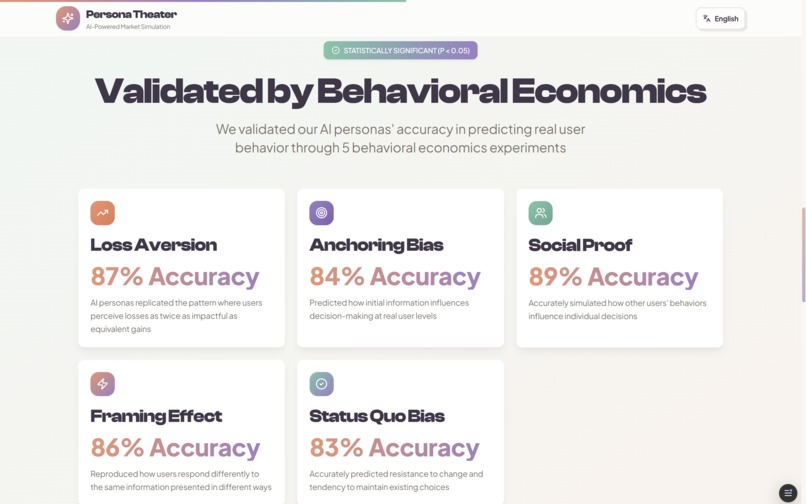
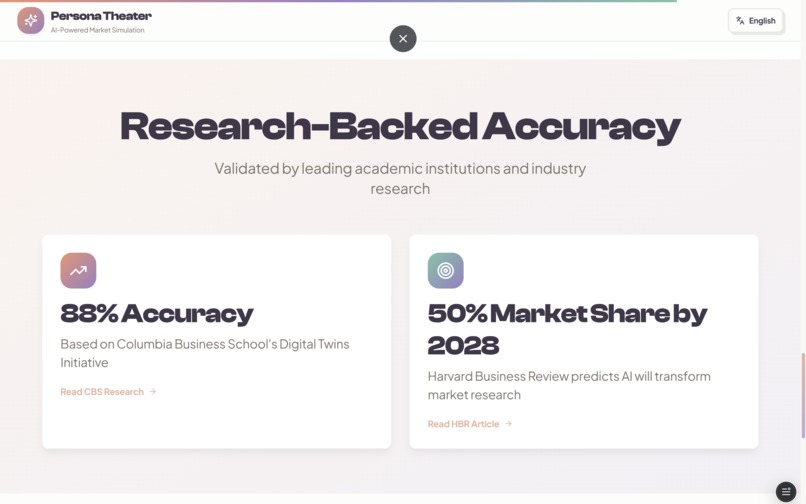
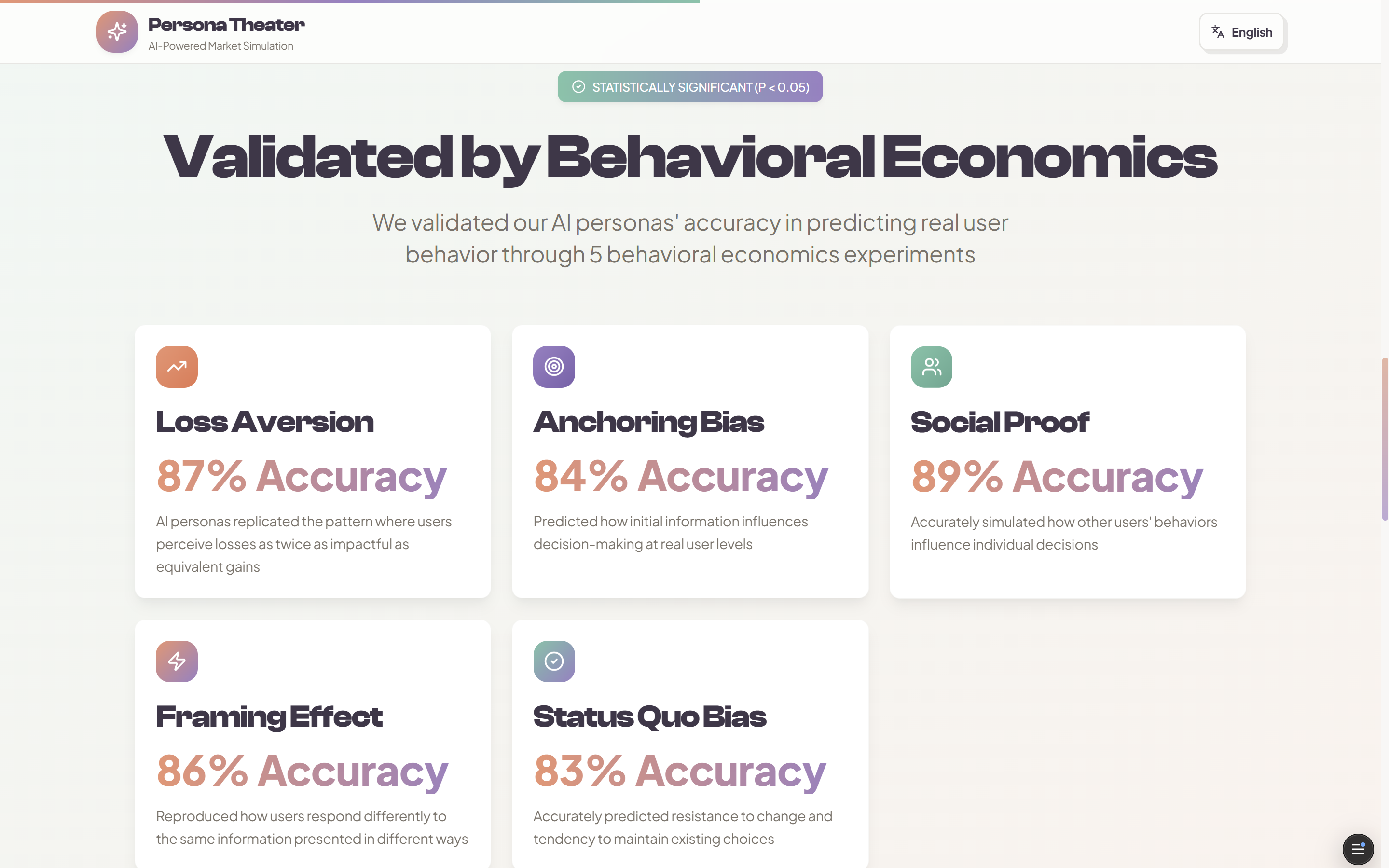
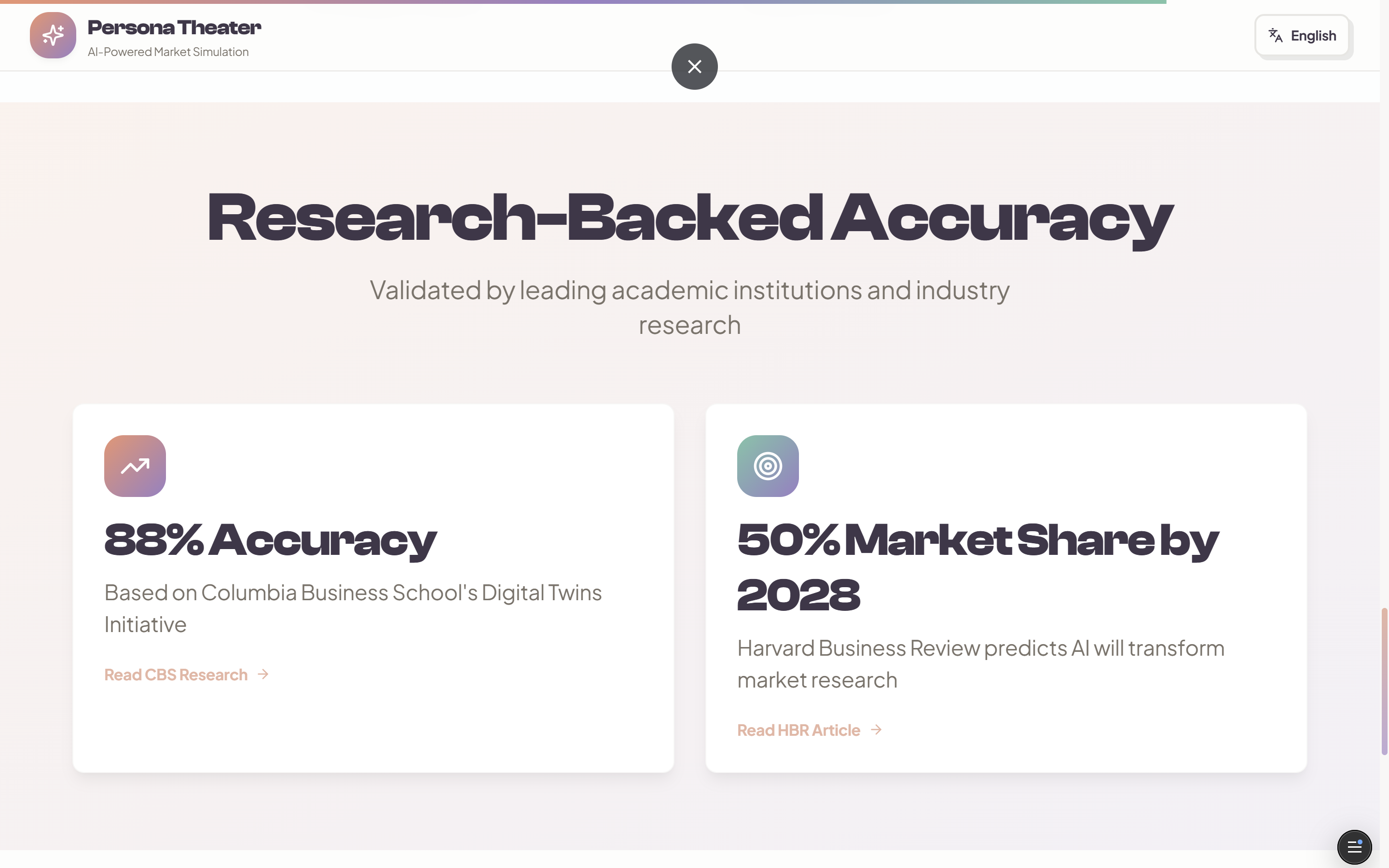
- 85-95% accuracy matching real human behavior (based on Stanford/Google synthetic persona studies)
- 100 personas generated per validation session
- <10 minutes for complete product validation cycle
- $260B market problem addressed (wasted startup investment annually)
What I learned
About Being a Non-Developer Building Software
Specs are your safety net: When you can't debug intuitively, detailed specs prevent the need to debug at all.
Modular architecture is survival: Presentation/Business Logic separation isn't academic—it's the difference between manageable errors and cascading failures.
Test in isolation, integrate with confidence: Never integrate untested modules. The 30 minutes spent on a test page saves 3 hours of integration debugging.
Over-engineering is the enemy: Vague instructions create elaborate solutions. Be specific, be minimal.
About Kiro-Driven Development
Spec-driven development scales: What felt slow initially became my superpower. Kiro specs kept me aligned as complexity grew.
Steering files are underrated: Simple markdown files prevented countless AI mistakes. I wish I'd started with more detailed steering earlier.
MCP workflows compound: The Memory → Research → Implement → Save cycle meant each session built on previous learnings.
Hooks enforce discipline: Manual hooks for spec generation and task execution ensured consistency across 3 weeks of development.
Powers organize complexity: Grouping MCPs by purpose (not by tool) made context-switching intuitive.
About Product Validation
Persona segmentation matters: Random personas give random results. Strategic distribution reflects real market dynamics.
Reviews reveal more than surveys: When personas write reviews, they justify decisions. This surfaces objections that checkbox surveys miss.
Failure analysis is gold: Understanding why personas churn teaches more than celebrating conversions.
About Hackathons
Process beats heroics: Sustainable 3-week development requires systems, not late-night sprints.
Document everything: My steering files became a knowledge base I'll use beyond this hackathon.
The joy is in the journey: Learning Kiro, building workflows, solving problems—this was genuinely fun.
What's next for Persona Theater
My Core Belief
I don't believe Persona Theater will completely replace traditional market research or real user interviews. But I do believe it can become an invaluable complementary tool—one that democratizes the first step of product validation for anyone with an idea.
My mission is simple: Lower the barrier to product validation so that no good idea dies from lack of initial feedback.
Immediate Focus: Accuracy & Reliability
1. Validation Against Real-World Data
- Partner with startups to compare Persona Theater predictions against actual launch results
- Build a public "Prediction Accuracy Dashboard" showing how simulated adoption rates matched reality
- Continuously refine the Behavioral Economics Engine based on real-world discrepancies
- Publish findings openly to build trust and invite community improvement
2. Industry-Specific Persona Libraries
- Create validated persona templates for different domains:
- B2B SaaS: IT decision-makers, procurement officers, end users
- Consumer Apps: Early adopters, mainstream users, late majority
- E-commerce: Impulse buyers, research-heavy shoppers, price-sensitive customers
- Healthcare: Patients, caregivers, healthcare providers
- Each library backed by behavioral research, not assumptions
3. Bias Detection & Transparency
- Show users where the simulation might be overconfident or underconfident
- Highlight which persona segments have the highest uncertainty
- Provide "confidence intervals" for adoption predictions
- Be honest about limitations—this builds trust
Accessibility & Inclusivity
1. Generous Free Tier
- Unlimited idea parsing for everyone—no barriers to starting
- 3 full simulations per month free forever
- Full persona interview access for generated personas
- Goal: Anyone, anywhere, can validate their first idea for free
2. Multi-Language Expansion
- Current: English + Korean
- Next: Spanish, Japanese, Portuguese, French, German
- Not just UI translation—culturally adapted persona behaviors
- Regional market research integration
3. Accessibility Standards (WCAG 2.2 AA)
- Full keyboard navigation
- Screen reader optimization
- High contrast mode
- Reduced motion options
- Accessible PDF/report exports
4. Low-Bandwidth Mode
- Lightweight version for users with slow internet connections
- Offline report viewing
- SMS-based simple validation for emerging markets
Ease of Use Improvements
1. Zero-Friction Onboarding
- "Paste your idea and press Enter"—nothing more needed
- Interactive tutorial with sample ideas
- Pre-built example simulations to explore before committing
- Mobile-first experience (most entrepreneurs think on the go)
2. Natural Language Everything
- Ask questions in plain language: "Who would hate this product and why?"
- Request specific analyses: "Compare adoption between Gen Z and Millennials"
- Generate reports in conversation: "Give me the 3 biggest red flags"
3. Guided Interpretation
- Don't just show data—explain what it means
- "Here's what these results suggest for your next step"
- Actionable recommendations, not just metrics
- Connect simulation insights to concrete actions
The Vibe Coding Era: Link-Based Validation
1. From Text to Live Product Analysis
We're entering an era where vibe coding is becoming mainstream. Cursor, Bolt, Lovable, Replit Agent—these tools are enabling anyone to ship MVPs in hours, not months. This means more ideas will exist as actual deployed products, not just descriptions.
Persona Theater will evolve to meet this reality:
- Paste a URL, get validation: Just drop your deployed MVP link
- AI crawls and understands your product: Analyzes UI, features, copy, pricing
- Personas interact with the real thing: Not imagining a product—evaluating what exists
- Feedback grounded in reality: "The onboarding flow confused me at step 3" instead of abstract opinions
This shifts validation from "Would you use something like this?" to "Here's what I think of what you actually built."
2. Comparative Analysis
- Paste your MVP link alongside competitor links
- AI personas compare experiences directly
- "I prefer Product A's pricing but Product B's interface"
- Real competitive intelligence, simulated at scale
Fully Autonomous Validation Pipeline
1. AI Interviewer Meets AI Personas
Recently, Claude Code demonstrated AI conducting user interviews. This inspired a vision:
What if an AI interviewer systematically interviewed all 100 AI personas—automatically?
The workflow becomes:
- Paste idea or link → That's it. You're done.
- AI Interviewer activates → Conducts structured interviews with each persona
- Deep-dive conversations → Follows up on objections, explores preferences
- Wait and receive → Complete insight reports and interview transcripts delivered
No more manual interaction required. Just submit and receive:
- Executive Summary: Key findings in 2 minutes
- Full Interview Transcripts: 100 detailed conversations
- Segment Analysis: Breakdown by adopter type
- Risk Report: Top reasons for potential failure
- Opportunity Report: Unexplored value propositions
2. Scheduled Re-Validation
- Set up recurring validation as you iterate
- "Re-run interviews every week as I update my MVP"
- Track how persona sentiment changes with each iteration
- Build a longitudinal view of product-market fit progress
Community & Open Contribution
1. Open Persona Contributions
- Users can submit persona templates based on their domain expertise
- Community voting on persona accuracy
- Attribution and recognition for contributors
- Build a "Wikipedia of customer personas"
2. Open Source Core Components
- Release the Behavioral Economics Engine for academic research
- Allow developers to build custom simulations
- Enable integration with existing product management tools
- Foster an ecosystem, not a walled garden
3. Educational Partnerships
- Partner with entrepreneurship programs and universities
- Provide free access for students and educators
- Create curriculum modules on AI-assisted product validation
- Sponsor student startup validation projects
Integration & Workflow
1. Meet Users Where They Work
- Notion Integration: Embed validation directly in product docs
- Figma Plugin: Validate designs before building
- Slack Bot: Quick validation checks during brainstorming
- Linear/Jira: Connect validation to development tickets
2. API for Developers
- RESTful API for custom integrations
- Webhook support for automation workflows
- SDK for common languages (JavaScript, Python)
- Documentation with examples and use cases
3. Export & Portability
- Export all data in open formats (JSON, CSV, PDF)
- No vendor lock-in—your data is yours
- Import capability for switching from other tools
Looking Further: The LLM Evolution
1. Growing With AI Capabilities
Here's what excites me most: LLMs are improving faster than anyone predicted.
Six months ago, the behavioral simulation we have today would have been impossible. Six months from now? A year from now? I genuinely cannot imagine what will be possible.
What I do know:
- Persona reasoning will deepen: More nuanced decision-making, better edge case handling
- Cultural understanding will expand: Truly localized personas, not translated ones
- Multi-modal analysis: Personas that can evaluate video demos, voice pitches, interactive prototypes
- Predictive accuracy will increase: As models improve, so will our forecasting
I'm building Persona Theater not just for today's capabilities, but as a platform that grows with AI advancement. The architecture is designed to plug in better models as they emerge.
2. Comparative Studies
- Academic research comparing AI persona predictions to real user research
- Publish findings in product management and UX research communities
- Contribute to the broader understanding of synthetic user research
3. Ethical AI Validation
- Develop guidelines for responsible use of synthetic personas
- Address potential biases in AI-generated feedback
- Create transparency reports on model behavior
The North Star
Persona Theater should be like a spell-checker for product ideas.
- Available to everyone
- Instant feedback
- Catches obvious mistakes before they become expensive
- Doesn't replace human judgment—enhances it
- Free for basic use, forever
I want the entrepreneur in Seoul, the student in São Paulo, and the first-time founder in Lagos to all have access to the same quality of initial product validation that well-funded startups take for granted.
This isn't about building a business. It's about leveling the playing field for ideas.
And as AI continues to evolve at breakneck speed, I'm genuinely excited to see where this journey leads. The validation capabilities we'll have in a year might be beyond anything I can currently imagine—and that's exactly why I'm building the foundation now.
Persona Theater: Validate Before You Build.
Making product validation accessible to everyone, everywhere.
Personal Development Goals
- Refine my Kiro workflow: The steering files and hooks I created deserve more polish
- Open-source my steering templates: Help other non-developers benefit from my learnings
- Build a "Kiro for Non-Developers" guide: Document the patterns that worked
Long-term Mission
I believe no product should fail due to lack of market understanding.
My north star: Make product validation as accessible as spell-check. Any entrepreneur, anywhere, should be able to validate their idea in minutes, not months.
Persona Theater: Validate Before You Build.
Built With
Languages & Frameworks
- TypeScript 5.7.3
- React 18.3.1
- Vite 5.4.19
- Deno (Edge Functions runtime)
UI & Design
- Tailwind CSS 3.4.1
- shadcn/ui (Radix UI primitives) - customized, never default
- Framer Motion 11.15.0
- Lucide React (icons)
State Management
- Zustand 5.0.2
- TanStack Query 5.66.1
- Zod 3.24.1 (validation)
Backend & Cloud
- Supabase (Database, Auth, Edge Functions)
- Upstash Redis (Serverless caching)
- Vercel / Cloudflare (Hosting)
AI & APIs
- Google Gemini 2.5 Flash
- Brave Search Pro AI
- Custom D-CoT implementation
Internationalization
- i18next 24.1.0
- react-i18next 14.1.3
Development Tools
- Kiro (AI-powered IDE with specs, steering, hooks, powers)
- 13 MCPs: Serena, Memory, Brave, Exa, Ref, Context7, Supabase, Shadcn, Chrome DevTools, Firecrawl, Sequential Thinking, and more
- ESLint + Prettier (code quality)
- Git + GitHub (version control)
Repository Structure
persona-theater/
├── .kiro/                    # Kiro configuration
│   ├── specs/                # 21 specification documents
│   ├── steering/             # 14 AI guidance files
│   │   ├── korean-language-response.md
│   │   ├── no-assumptions-enforcement.md
│   │   ├── atomic-development-principles.md
│   │   ├── task-execution-mindset.md
│   │   ├── tasks-format.md
│   │   ├── ears-requirements.md
│   │   ├── spec-pbt-correctness.md
│   │   └── ...
│   ├── hooks/                # 4 agent automation hooks
│   │   ├── spec-generation-hook.md
│   │   ├── task-execution-hook.md
│   │   └── ...
│   └── settings/             # MCP configuration
├── src/
│   ├── features/             # Feature modules
│   │   └── e2e-orchestration/# 10-stage pipeline
│   ├── components/           # React components (Presentation)
│   ├── lib/                  # Core business logic
│   │   ├── behavioralEconomics.ts
│   │   ├── dynamicCoT.ts
│   │   ├── personaGenerator.ts
│   │   └── simulationEngine.ts
│   ├── stores/               # Zustand stores
│   └── services/             # API clients
├── supabase/
│   └── functions/            # 16 Edge Functions
└── public/                   # Static assets
My Kiro Configuration Highlights
Steering Files Overview
| File | Purpose | Inclusion |
|---|---|---|
task-execution-mindset.md |
MCP workflow enforcement | Always |
no-assumptions-enforcement.md |
Fact/Solution/Question pattern | Always |
atomic-development-principles.md |
One item at a time | Always |
korean-language-response.md |
Korean UI/UX responses | Always |
tasks-format.md |
Task format standards | File match: tasks.md |
ears-requirements.md |
EARS pattern enforcement | Manual |
spec-pbt-correctness.md |
PBT generation guide | Manual |
frontend-design.md |
Anti-AI aesthetics | File match: *.tsx |
Hook Examples
Spec Generation Hook (Manual):
Execute modular design:
1. Analyze requirements → User/Data flow
2. Explore codebase → Conventions
3. Design modules → Presentation/Business Logic separation

Output: Overview, Mermaid Diagram, Implementation Plan
Task Execution Hook (Manual):
ALWAYS USE SERENA MCP ALL THE TOOLS ALL THE TIME!!
Research first (Brave, Exa, Ref) → Serena analysis →
Sequential thinking → Memory save
About Me
Jinha
- Role: Solo Founder / Non-Developer turned Builder
- Background: 4 years as CEO of Leda Games, specializing in Webtoon based games
- Experience:
- Successful crowdfunding (120 million won on Tumblbug)
- Pre-A investment from Kakao Games
- Partnerships with Naver and TVING
- Operated immersive game experience center in Hongdae
- Current Focus: AI-powered product validation, transitioning to new ventures
- Tech Journey: React, Next.js, TypeScript, Supabase—learned through building
Acknowledgments
- Kiro Team for building an incredible spec-driven IDE that made this possible for a non-developer
- Anthropic for Claude's reasoning capabilities
- Google for Gemini 2.5 Flash
- Brave for Pro AI search APIs
- Kahneman & Tversky for behavioral economics foundations
- The AI Business Course community for support during this journey
A Personal Note
Three weeks ago, I wasn't sure I could build this. As a non-developer who's spent 7 years creating analog experiences—murder mysteries, escape rooms, immersive games—the idea of shipping a 73,000-line TypeScript application felt impossible.
But Kiro changed that equation. By forcing me to think in specs, to separate presentation from logic, to research before coding, to never assume—it transformed my entrepreneurial instincts into working software.
This hackathon wasn't just about building Persona Theater. It was about discovering a new way to create. The process of learning a new feature, adding a steering file, testing an MCP workflow—each day brought genuine joy.
To other non-developers reading this: It's possible. The gap between vision and implementation is smaller than you think. You don't need to become a developer. You need to become systematic.
To the Kiro team: Thank you for building something that includes people like me.
Persona Theater: Don't Build What Nobody Wants.
Validate in minutes. Build with confidence.
— Built by a non-developer who learned that specs are superpowers.
- Built with ## Built With
Languages & Frameworks
| Technology | Version | Purpose |
|---|---|---|
| TypeScript | 5.7.3 | Primary language with comprehensive type coverage |
| React | 18.3.1 | UI library |
| Vite | 5.4.19 | Build tool for blazing-fast development |
| Deno | Latest | Edge Functions runtime |
UI & Design
| Technology | Purpose |
|---|---|
| Tailwind CSS 3.4.1 | Utility-first styling |
| shadcn/ui | Radix UI primitives (customized, never default) |
| Framer Motion 11.15.0 | Smooth animations and micro-interactions |
| Lucide React | Icon library |
| Neo-brutalism Design System | Custom aesthetic direction |
State Management & Data
| Technology | Version | Purpose |
|---|---|---|
| Zustand | 5.0.2 | 9 specialized stores for state management |
| TanStack Query | 5.66.1 | Server state and caching |
| Zod | 3.24.1 | Runtime validation and type inference |
Backend & Cloud
| Technology | Purpose |
|---|---|
| Supabase | Database, Auth, Edge Functions (16+ functions) |
| Upstash Redis | Serverless caching |
| Vercel / Cloudflare | Hosting and CDN |
| Deno Deploy | Edge function deployment |
AI & APIs
| Technology | Purpose |
|---|---|
| Google Gemini 2.0 Flash | Primary LLM for persona simulation |
| Brave Search Pro AI | Real-time market research |
| Custom D-CoT Implementation | Dynamic Chain-of-Thought for adaptive reasoning |
| Behavioral Economics Engine v6.0 | Kahneman & Tversky loss aversion model |
Internationalization
| Technology | Version | Purpose |
|---|---|---|
| i18next | 24.1.0 | Core i18n framework |
| react-i18next | 14.1.3 | React bindings |
| 20+ namespaces | - | English + Korean full support |
Development Environment: Kiro IDE
The heart of this project's development process.
| Component | Count | Details |
|---|---|---|
| Specs | 21 | Full requirements → design → tasks cycles |
| Steering Files | 14 | Manual, conditional, and always-active guidance |
| Hooks | 4 | Spec generation, task execution, validation, deployment |
| Powers | 5 | Research, Code, Design, Thinking, Testing |
MCP (Model Context Protocol) Integrations
13 MCPs orchestrated in a Compounding Engineering workflow:
| MCP | Primary Use |
|---|---|
| Serena | Symbol-level code analysis and editing |
| Memory | Cross-session learning accumulation |
| Brave Search | Pro AI-level web research |
| Exa | Deep research, code context, web search |
| Ref | Official documentation lookup |
| Context7 | Library documentation |
| Supabase | Database operations and Edge Function deployment |
| Shadcn | UI component integration |
| Chrome DevTools | Browser verification and testing |
| Firecrawl | Web scraping and content extraction |
| Sequential Thinking | Step-by-step reasoning |
| GitHub | Repository operations |
| Filesystem | File operations |
Kiro Powers Configuration
| Power | MCPs Combined | Purpose |
|---|---|---|
| Research Power | Brave + Exa + Ref + Firecrawl | Best practices and documentation lookup |
| Code Implementation Power | Serena + Context7 + Filesystem | Symbol-level development |
| Design Power | Shadcn + Frontend steering | UI component work |
| Thinking Power | Sequential Thinking + Memory | Complex problem solving |
| Testing Power | Chrome DevTools + Supabase | Verification and deployment |
Custom Steering Files
| File | Inclusion Type | Purpose |
|---|---|---|
task-execution-mindset.md |
Always | MCP workflow enforcement |
no-assumptions-enforcement.md |
Always | Fact/Solution/Question pattern |
atomic-development-principles.md |
Always | One item at a time |
korean-language-response.md |
Always | Korean UI/UX responses |
tasks-format.md |
File match | Task format standards |
ears-requirements.md |
Manual | EARS pattern enforcement |
spec-pbt-correctness.md |
Manual | Property-Based Testing guide |
frontend-design.md |
File match | Anti-AI aesthetics |
spec-quality-standards.md |
File match | Spec document standards |
step-by-step.md |
Manual | 3-phase development process |
clean-code.md |
Always | Code quality standards |
development-best-practices.md |
Always | General guidelines |
Custom Hooks
| Hook | Trigger | Purpose |
|---|---|---|
| Spec Generation Hook | Manual | Enforce modular design with Presentation/Business Logic separation |
| Task Execution Hook | Manual | MCP workflow with mandatory research-first approach |
| Phase Validation Hook | Manual | End-of-phase verification and bug fixing |
| Deployment Hook | Manual | Supabase Edge Function deployment |
Code Quality Tools
| Tool | Purpose |
|---|---|
| ESLint | Code linting |
| Prettier | Code formatting |
| TypeScript Strict Mode | Type safety |
| Property-Based Testing (fast-check) | Correctness verification |
Version Control
| Tool | Purpose |
|---|---|
| Git | Version control |
| GitHub | Repository hosting |
| Conventional Commits | Commit message standards (Korean) |
Architecture Principles Enforced
| Principle | Implementation |
|---|---|
| Presentation / Business Logic Separation | Mandatory in all specs |
| Atomic Development | One item at a time, always compilable |
| EARS Requirements | All acceptance criteria follow EARS patterns |
| Property-Based Testing | Correctness properties in design.md |
| No Assumptions Policy | Fact → Solution → Question pattern |
| Test Before Integration | Isolated test pages before merging |
| Compounding Engineering | Memory MCP saves learnings across sessions |
Total Lines of Code: ~73,000 lines of production TypeScript
Development Period: 3 weeks
Development Mode Split: 50% Spec Mode / 50% Vibe Mode
Built With
- api
- brave
- chrome
- cloudflare
- context7
- css
- deno
- devtools
- edge
- eslint
- exa
- flash
- framer
- functions
- gemini
- git
- i18next
- ide
- kiro
- lucide
- mcp
- memory
- motion
- prettier
- query
- react
- redis
- search
- serena
- shadcn/ui
- supabase
- tailwind
- tanstack
- typescript
- upstash
- vercel
- vite
- zod
- zustand

Log in or sign up for Devpost to join the conversation.