Inspiration
I help small businesses and chambers of commerce in Japan adopt AI. Every startup plan and grant application has a "target customer" paragraph, and many of them describe people who barely exist: "men aged 45-54 who ride Harley-Davidson, listen to BTS and collect Sanrio." In Qloo's data, Harley-Davidson's audience does over-index at 45-54, but BTS fans skew 25-29 and Sanrio fans 24 and under, and the three audiences barely overlap. Advisors can sense it but can't prove it, so plans go ahead with the wrong customer in mind.
What it does
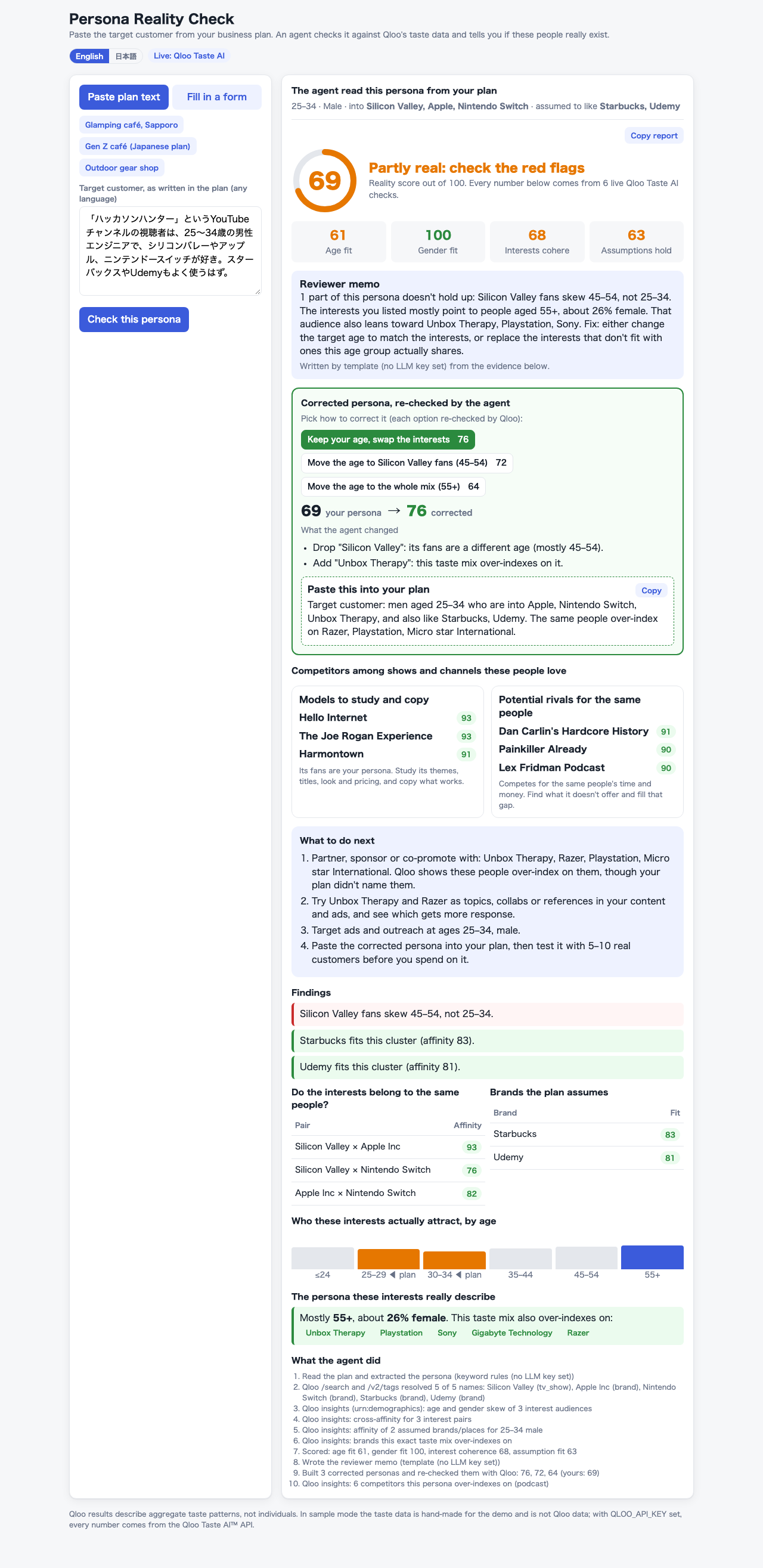
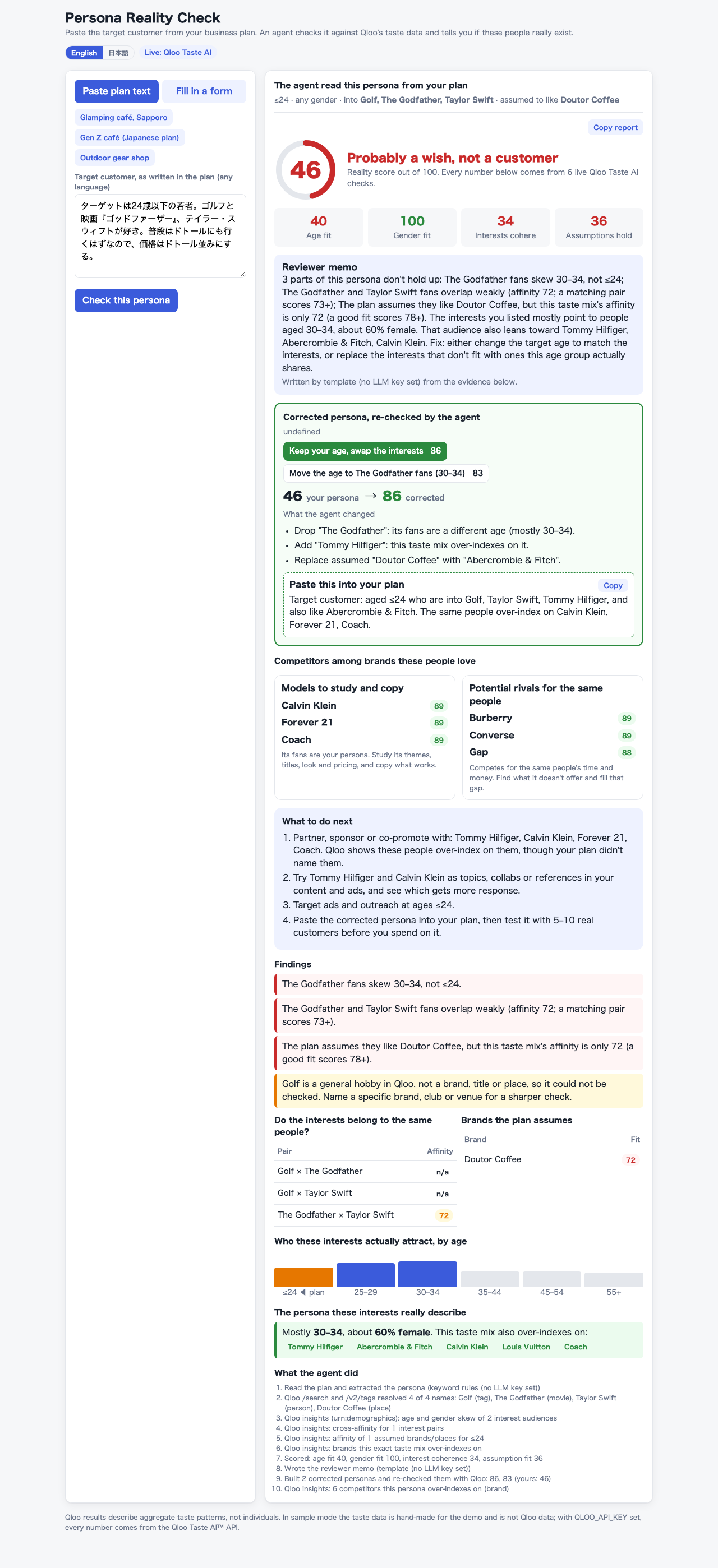
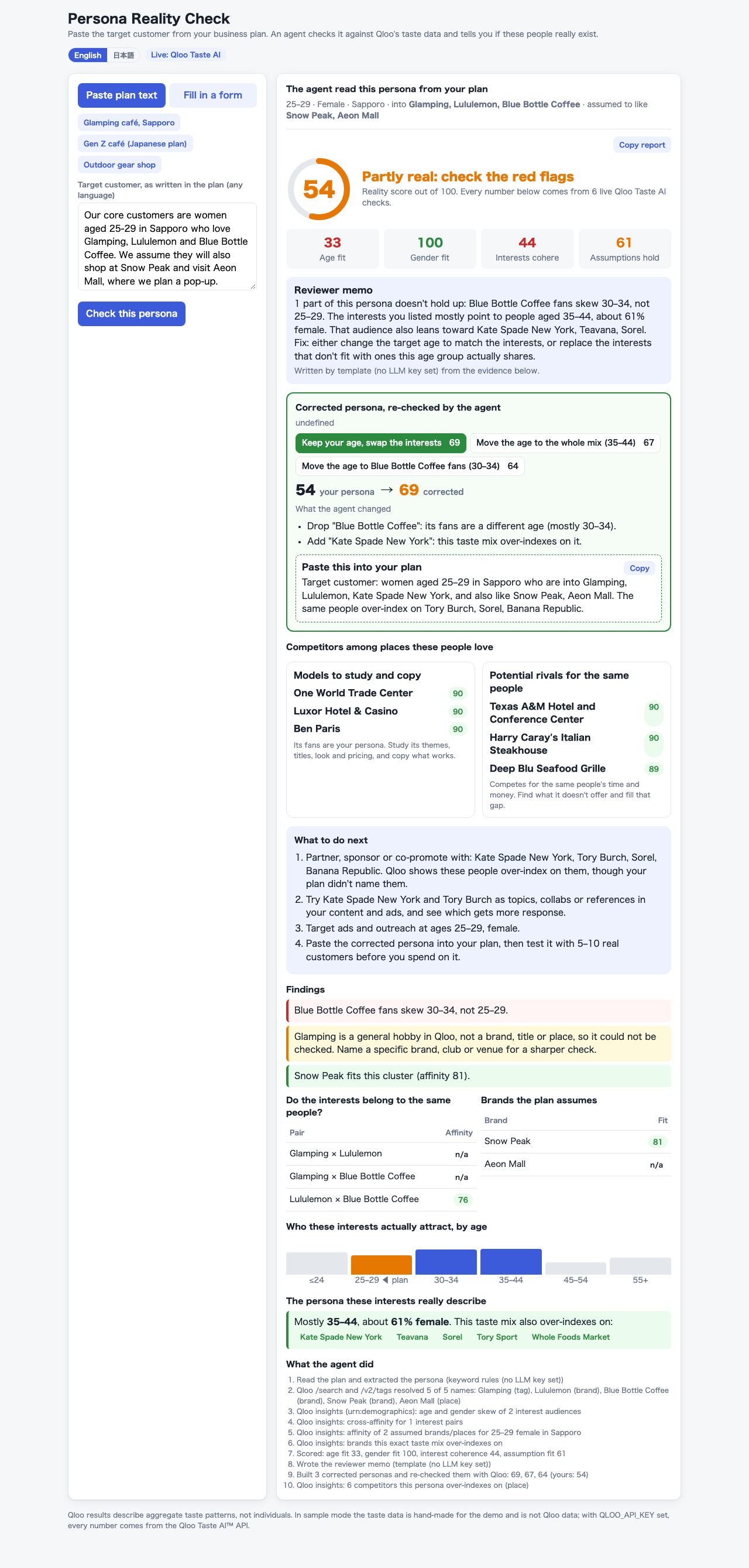
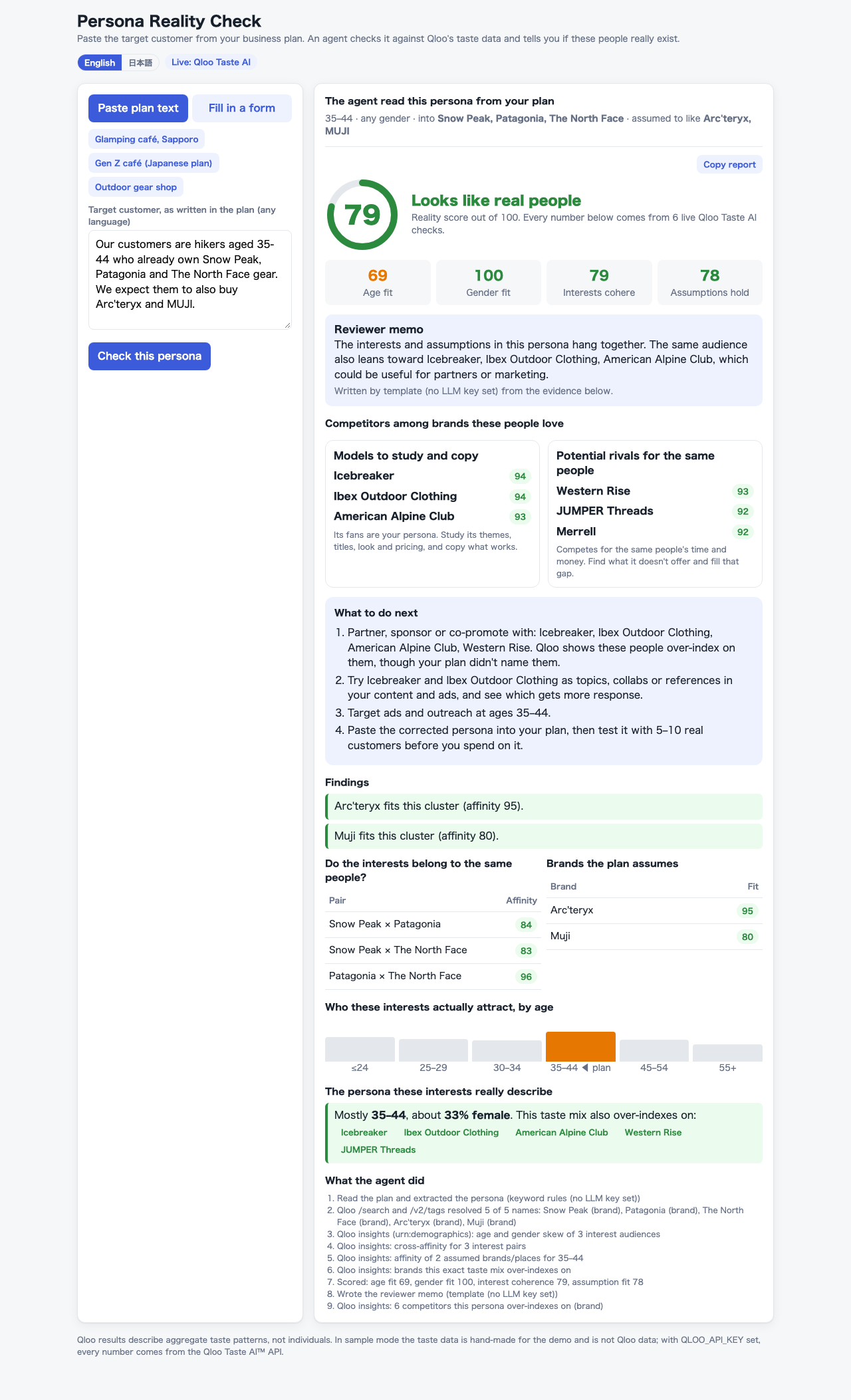
Paste the persona paragraph. The agent extracts age, gender, location, interests and the brands the plan assumes, then uses Qloo to check four things: whether the interests share an audience, whether that audience matches the claimed age and gender, whether the assumed brands fit this persona in this location, and who the real audience is. It returns a score, red/amber/green findings, an age chart with the plan's claim marked, and a short reviewer memo with one concrete fix.
Then the agent fixes it. It builds up to three corrected personas (keep the plan's age and swap the interests that don't fit, or move the age to the audience Qloo actually sees), re-checks each one with Qloo, and lets the user pick by score. For the chosen one it gives a paste-ready target-customer sentence and next steps built only from what Qloo found and the plan didn't name (partners, content hooks, ad targeting). It also lists competitors this persona already loves in the plan's own category (podcasts and channels for a YouTube channel, brands for a product): models to study and copy, and rivals for the same people's time. The results page can be read in English or Japanese.
How we built it
- Qloo
/searchto resolve names, and/v2/insightsfor demographics (urn:demographics), cross-affinity (signal.interests.entities+filter.results.entities), persona-conditioned affinity (signal.demographics.age/gender,signal.location.query) and open recommendations. - Reading the plan and writing the memo is done by keyword rules (English and Japanese) and a template in the public demo. An LLM can be plugged in for both through any OpenAI-compatible API, but it is optional and off in the demo. All numbers come from Qloo either way.
- Plain Node.js, no dependencies. The key stays on the server. An offline test runs the live code path against a mock Qloo server.
Challenges
- Turning affinities into findings a non-analyst trusts: every flag cites the Qloo number behind it, and the agent's steps are shown.
- Keeping the claims honest: Qloo describes aggregate patterns, so the app says "this combination is rare", never "this person doesn't exist".
What we learned
The most useful taste question for a small business isn't "what should I recommend?" but "is the customer I'm planning for real?"
What's next
- A Japanese UI and a PDF report for chamber-of-commerce advisors.
- Checking every persona in a batch of grant applications.
- Suggesting a corrected persona and re-checking it.
Known limitations
- Qloo describes aggregate taste patterns; a low score means "this combination is rare in Qloo's data", never a claim about any individual.
- General hobbies (e.g. "Golf") resolve to Qloo tags, which have no audience demographics, so they are reported as "could not be checked" rather than scored.
- Thresholds were calibrated on six personas (table in the README); they are a first pass.
Built With
- css
- html
- javascript
- node.js
- qloo
- render
