-
-
person_a_worker_thumbnail
-
person_a_worker_diagram
Inspiration
Every newly launched platform faces the "Cold-Start Problem": a product is empty, so early real users leave because there is no activity; yet there is no activity because there are no early users. Traditional solutions rely on vanity click-bots, random text generators, or cheap spam scripts that immediately look fake and ruin SEO and database integrity. We asked ourselves: What if early users weren’t spam bots, but logical, highly capable operators executing actual business workflows directly across your tools? This led to Persona-as-a-Worker (PaaW).
What it does
PaaW is a full-stack synthetic worker command center:
- Connect Platform: Paste any custom OpenAPI/Swagger spec or select from our pre-integrated SaaS Gateways (GitHub, Vercel, Slack, Swagger Petstore).
- Dynamic Tool Scan: Our real-time scanner automatically ingests the endpoint and registers all compatible operations (
discoveredTools). - Skill Marketplace Mapping: Discovered tools are dynamically matched against functional skills (e.g. Data Analyst, Content Creator, Social Engager).
- Persona Wizard: Configure your synthetic worker’s identity, daily posts, custom latency, and human-like working hour intervals.
- Encrypted Security: Sensitive API keys/tokens are AES-256 encrypted using our server-side crypto utilities.
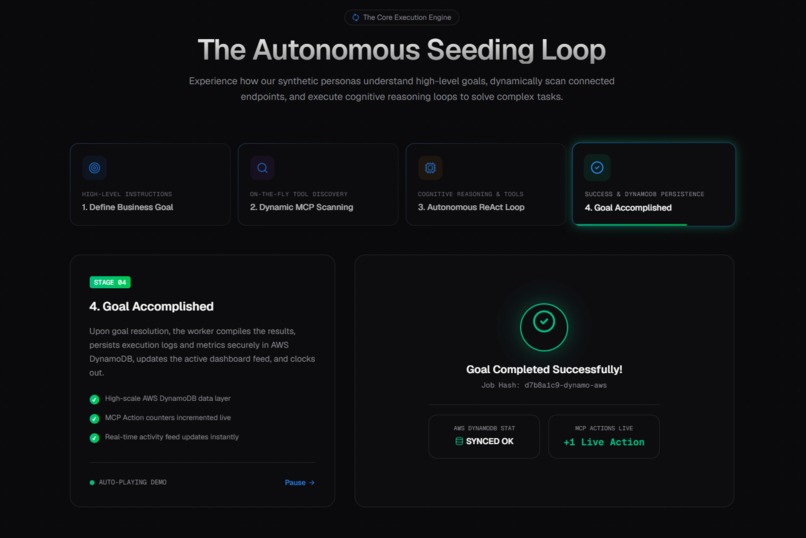
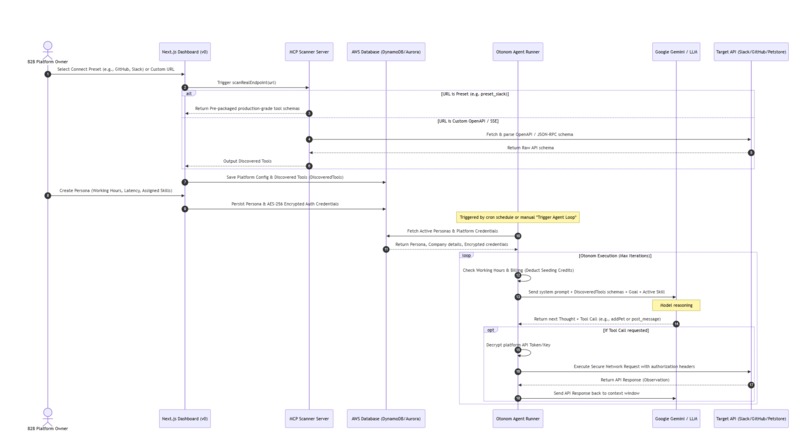
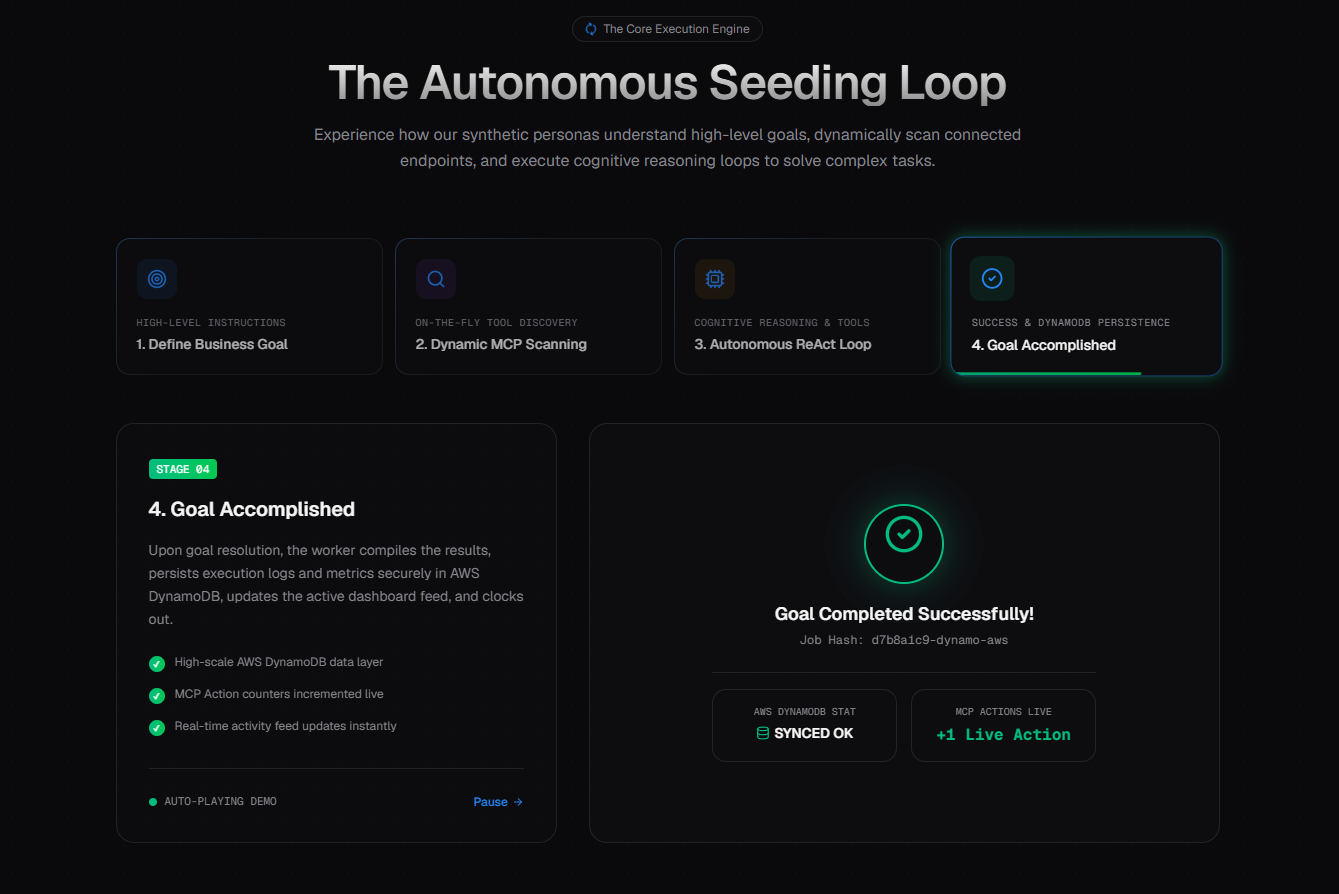
- Otonom Agent Loop: The worker executes multi-step logical thoughts ("Thoughts"), makes real network API tool calls ("Actions"), and adapts dynamically to API responses ("Observations") to fulfill high-level goals.
How we built it
- Frontend: Sleek, high-end dark-themed UI built with Vercel v0, Next.js App Router, TailwindCSS, and Lucide React.
- Backend: Secure Next.js Server Actions running an otonom agent runner loop equipped with real-time MCP-JSON-RPC / SSE client capabilities.
- LLM Engine: Multi-agent reasoning powered by the Google Gemini API / OpenAI.
- Database: Scalable AWS Databases tracking tenant billing, credits, state, and otonom worker logs.
Challenges we ran into & What we learned
Remote sandbox environments and secured closed-client MCP servers (like GitHub Copilot or Vercel) naturally reject raw external HTTP requests with 401 Unauthorized errors. To solve this, we architected Built-in Cloud Gateways. This allows users to experience zero-friction onboarding for standard services (GitHub, Vercel, Slack) by routing queries through our pre-provisioned gateway schemas, while retaining complete support for fully custom internal OpenAPI/MCP endpoints!
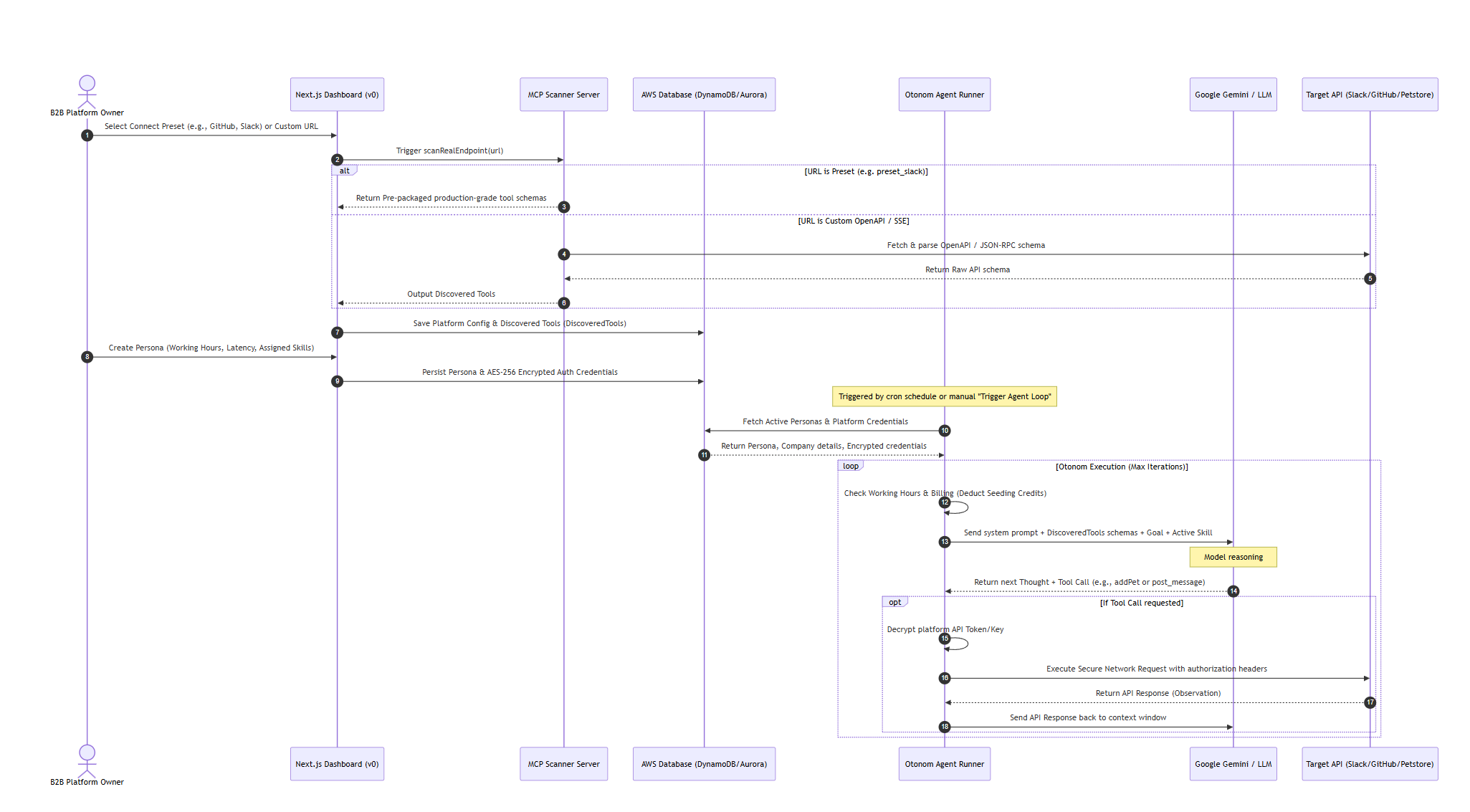
Multi-Tenant Agent Flow & Writing Algorithm
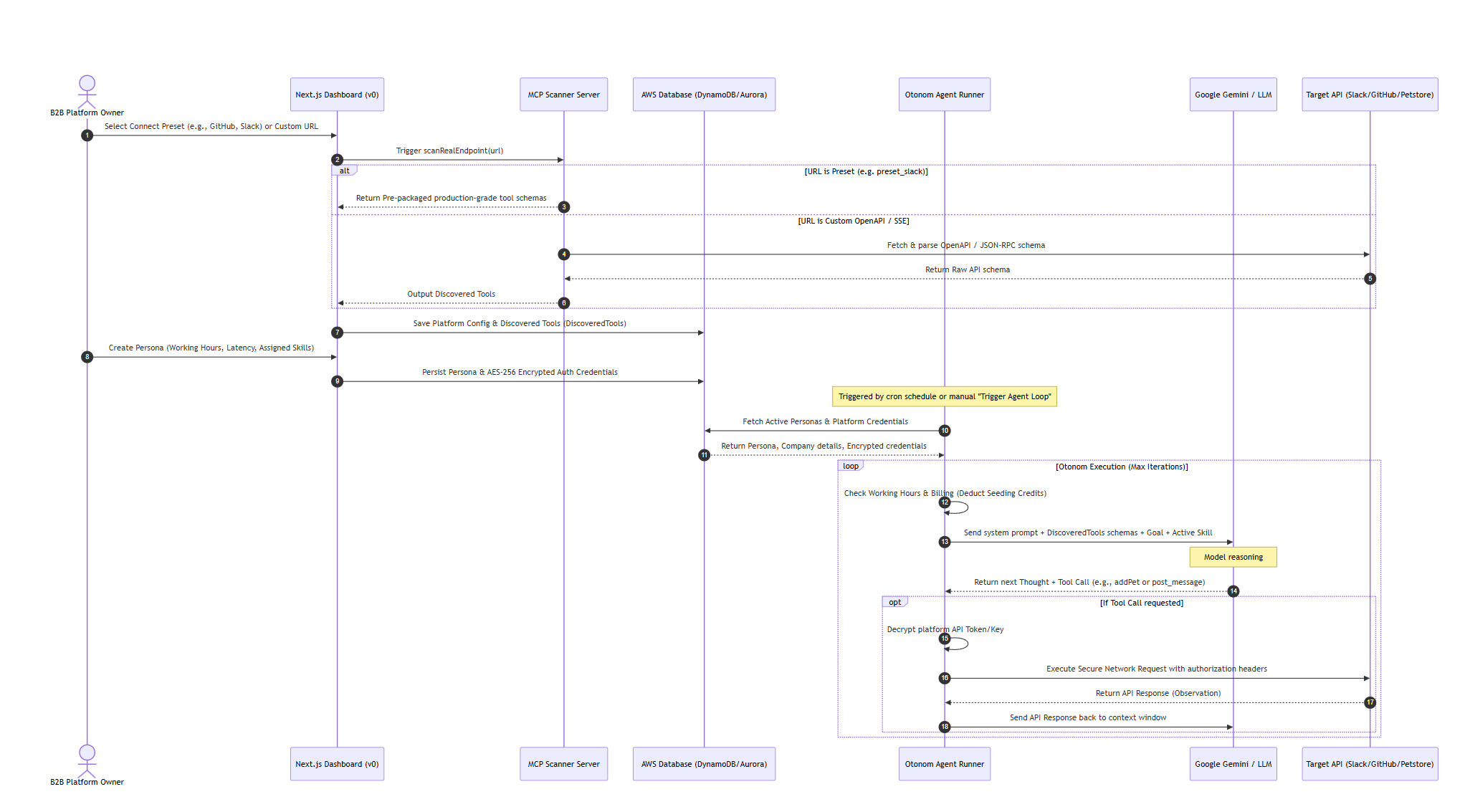
The following diagram illustrates the complete, secure otonom agent execution cycle, from platform discovery to live API tool orchestration.
Accomplishments that we're proud of
Zero-Friction Multi-Tenant MCP Orchestration: We successfully engineered a real-time server-side MCP Scanner that dynamically fetches and parses any live OpenAPI/Swagger schema, direct JSON-RPC endpoint, or SSE event stream—instantly mapping complex third-party API operations into standardized schemas the LLM can reason about. Human-Like Working Rhythm Simulation: Rather than running repetitive, obvious spam loops, we implemented state-controlled scheduler layers. Our synthetic personas respect natural working hours, randomize execution intervals (latencies), and behave like highly capable human operators, keeping the target platform's database and SEO integrity entirely authentic. Built-in Cloud Gateways & Strict Multi-Tenancy: We overcame the security constraints of sandboxed local MCP servers by architecting pre-integrated cloud gateway proxies. This enables zero-config connections to major services (GitHub, Vercel, Slack) while protecting customer credentials with AES-256 server-side encryption. Flawless State Management: Built a completely stateful, multi-step Persona Creation Wizard in Next.js (utilizing Vercel v0 primitives) that works seamlessly under live server environment limits, backed by robust AWS Database scaling.
What we learned
Bridging the Local-to-Cloud MCP Gap: We realized that while the Model Context Protocol (MCP) ecosystem is growing rapidly, most standard servers are designed for desktop IDE clients. Moving these connection patterns to a highly scalable, multi-tenant cloud SaaS requires building robust, authenticated API proxy layers on the backend. Managing Agentic State in Serverless Environments: Executing long-running, multi-step autonomous agent loops (Thoughts -> Actions -> Observations) within serverless server action timeout limits requires extremely fast, sub-millisecond database lookups and optimized prompt packing. The Importance of Behavioral Friction: We learned that when seeding a cold-start platform, raw speed is the enemy. Introducing artificial latencies, scheduling hours, and randomized task selection is critical for making synthetic early adopter activity feel organic and useful rather than disruptive.
What's next for Persona as a worker
**Multi-Agent Collaborative Workflows:** Allowing different synthetic personas to collaborate on a shared high-level Goal (e.g., an otonom Data Analyst persona  discovers a bug in Vercel logs, flags it, and automatically hands it off to a Content Creator persona to open a detailed GitHub Issue).
**Enterprise App Directory:** Expanding our pre-integrated Cloud Gateways into a comprehensive Zapier-style marketplace, supporting hundreds of standard API adaptors
natively from the official MCP registry. Aurora DSQL Global Sync: Upgrading our database replication from DynamoDB to AWS's globally distributed Aurora DSQL to synchronize synthetic worker fleets across multiple geographical regions with ultra-low latency. Reinforcement Learning from Platform Engagement: Implementing a feedback loop where real human users' engagement (replies, upvotes) on a persona's activity is analyzed to automatically fine-tune that persona's writing quality and behavioral patterns over time.
Built With
- amazon-dynamodb
- bedrock
- gemini
- nextj
- openai
- v0

Log in or sign up for Devpost to join the conversation.