-
-
persona ao
About the Project: Persona AI
Inspiration
The idea for Persona AI was born out of a desire to create a more personalized and human-like interaction experience with chatbots. We noticed that most chatbots lack the ability to remember past interactions and adapt to individual users' preferences. Our goal was to build an intelligent assistant that not only answers queries but also learns from each interaction, providing a truly personalized user experience.
What it does
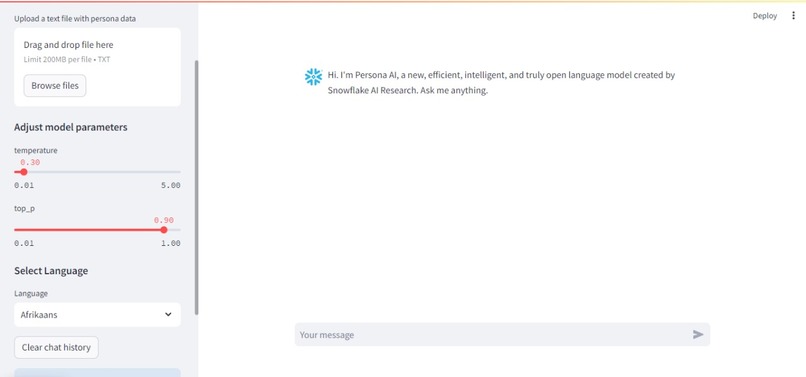
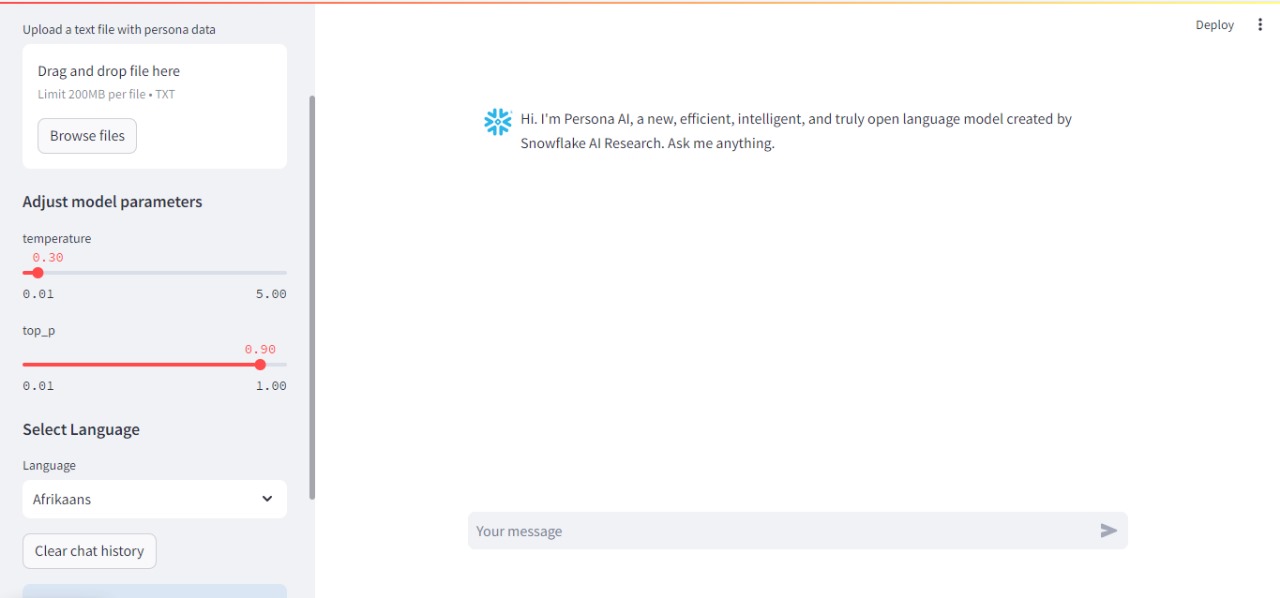
Persona AI is an intelligent, multilingual chatbot designed to offer personalized interactions. It can:
- Answer user queries accurately and contextually.
- Remember past interactions to provide consistent and personalized responses.
- Adapt to the user's language preference, offering text and speech responses in multiple languages.
- Store and retrieve user persona data to enhance future interactions.
How we built it
Persona AI was built using a combination of cutting-edge technologies and tools:
- Streamlit: For the frontend, providing an interactive web application.
- Replicate API: To utilize Snowflake's Arctic language model for generating intelligent and context-aware responses.
- SQLite: For storing user interactions and persona data.
- Transformers Library: From Hugging Face, used to tokenize prompts and manage language model interactions.
- gTTS (Google Text-to-Speech): For converting text responses into speech in various languages.
- Python: The primary programming language, leveraging its extensive libraries and frameworks for machine learning, natural language processing, and web development.
Challenges we ran into
Building Persona AI presented several challenges:
- Personalization: Ensuring the chatbot could remember and use past interactions required a robust database schema and efficient data retrieval methods.
- Multilingual Support: Implementing and fine-tuning text-to-speech and language understanding for multiple languages was complex and required extensive testing.
- Scalability: Optimizing performance to handle a growing number of users and interactions without compromising response time.
- User Interface: Designing an intuitive and user-friendly interface to accommodate persona management and language selection functionalities.
Accomplishments that we're proud of
- Successfully integrating advanced language models to provide intelligent and context-aware responses.
- Implementing robust personalization features that remember and utilize user data to enhance interactions.
- Supporting multiple languages for both text and speech responses, making the chatbot accessible to a broader audience.
- Creating an intuitive and engaging user interface that enhances the overall user experience.
What we learned
Throughout the development of Persona AI, we gained valuable insights in:
- Natural Language Processing (NLP): Deepening our understanding of language models and fine-tuning them for better performance.
- Multilingual Implementation: Overcoming challenges in supporting multiple languages for both text and speech.
- Database Management: Efficiently storing and retrieving user data to support personalization features.
- User-Centric Design: The importance of a user-friendly interface in enhancing the overall experience.
What's next for Persona AI
The future of Persona AI includes:
- Enhanced Personalization: Further improving the ability to learn from interactions and adapt to user preferences.
- Expanded Multilingual Support: Adding more languages and improving the accuracy of existing language models.
- Integration with Other Services: Connecting with other platforms and services to provide more comprehensive assistance.
- Continuous Improvement: Regularly updating the AI model with new data and feedback to enhance its capabilities and performance.


Log in or sign up for Devpost to join the conversation.