-
-
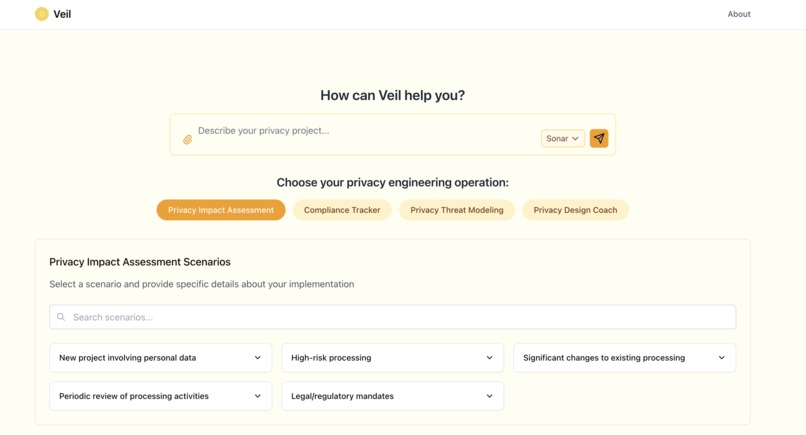
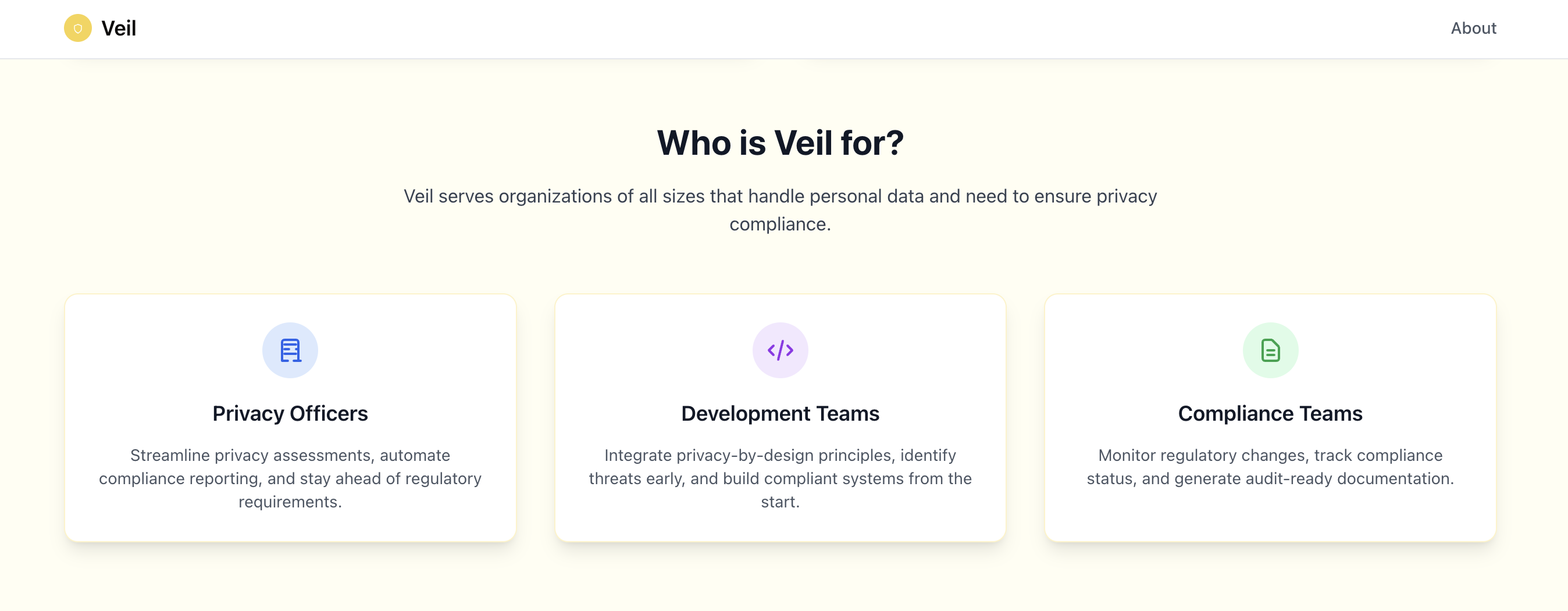
Veil Home Page
-
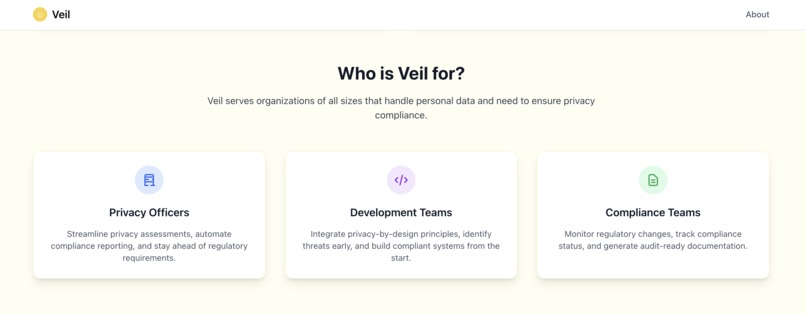
Who is Veil For
-
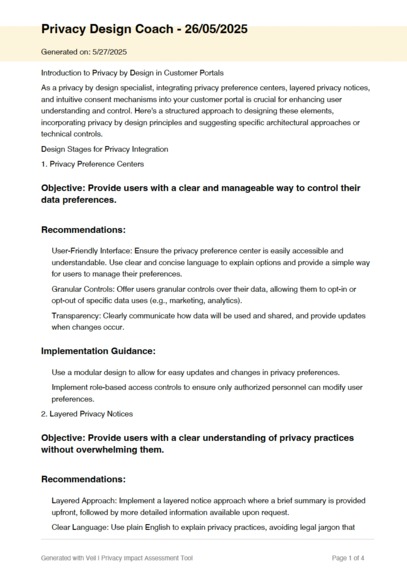
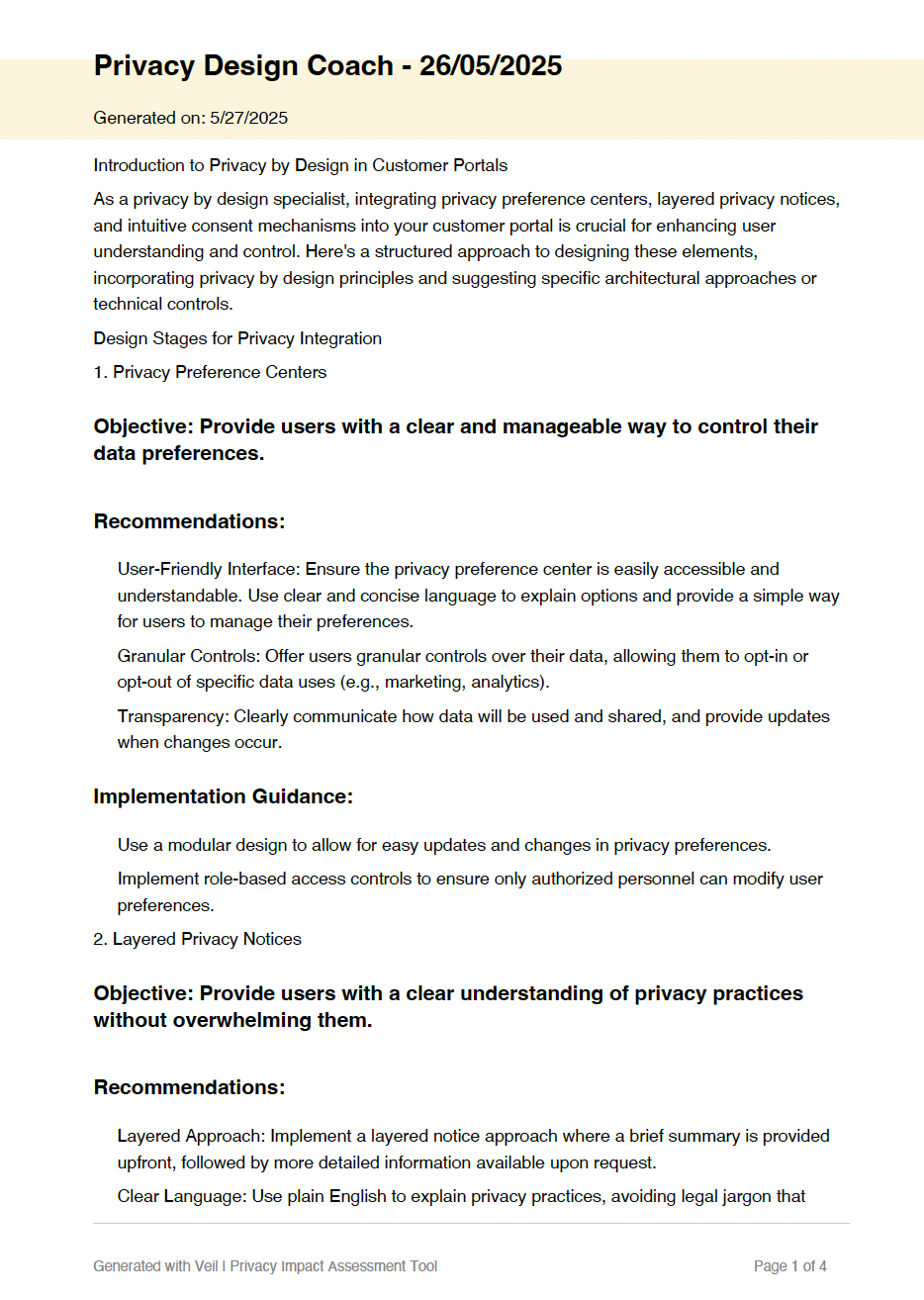
Sample PDF Generated using Veil
Inspiration
We wanted to build Veil because many companies either don’t have a dedicated privacy engineer or aren’t sure how to get started with embedding privacy into their products. Veil aims to help teams ship fast and bake privacy in from day one, providing practical guidance and hands-on tooling so that privacy isn’t an afterthought.
What it does
AI-Powered Research Taps Perplexity Sonar models—fast queries for quick compliance checks, deep-research tiers for scholarly insights—and filters results to only authoritative domains (regulator sites, peer-reviewed papers, industry-standard blogs).
Comprehensive Citations Every recommendation and data point includes in-text citations and footnotes, so you can trace guidance back to its source and preserve full audit trails.
Professional Documentation Polished PDF outputs with automatic tables of contents, branded styling, and consistent section layouts (Executive Summary, Methodology, Findings, Recommendations) make stakeholder reviews frictionless.
Scenario-Based Learning Hands-on templates—e.g., “Mobile Payments App” or “Patient Data Analytics”—walk teams through guided workflows, explanatory tooltips, and progress tracking to solidify privacy principles in context.
How we built it
We kicked off the project in a shared Replit workspace so front-end and back-end. No local setup was required. We jumped straight into building components, API routes, and database schemas.
Technology stack and architecture
Frontend
- React + TypeScript for a type-safe codebase.
- Tailwind CSS and shadcn/ui for consistent, responsive UI.
- React Hook Form powering robust form validation in our scenario inputs.
Backend
- Express.js handling API routes, file uploads, and PDF generation.
- Drizzle ORM with PostgreSQL for clean, reliable data persistence.
- Multer middleware securing file-upload endpoints.
AI Integration: Custom wrapper around the Perplexity Sonar API (tiers: Sonar, Sonar Reasoning, Deep Research).
Challenges we ran into
Balancing depth vs. speed: Ensuring thorough, authoritative privacy guidance without slowing down the user experience required fine-tuning model calls and caching strategies.
Model output consistency: Early on, different Sonar tiers returned wildly varying formats. I had to enforce a standardized response schema to keep the UI predictable.
Domain filter precision: It took iterative testing to find the right filter keywords that consistently surfaced high-quality legal and technical sources without too much noise.
Accomplishments that we're proud of
Session data lives in local storage; no user accounts required.
All API inputs are sanitized, and outputs are rendered without saving personal data on our servers. Keeping our privacy first approach.
We used layer Retrieval-Augmented Generation (RAG) which was our existing internal knowledge plus real-time Sonar lookups to get a more refined and detailed response.
What we learned
We learned to cache repeat queries (via React Query and an in-memory vector store) and tune backoff strategies, striking the right trade-off between fresh research data and fast, predictable user experiences.
Rigid prompt templates plus JSON schema enforcement prevent malformed AI responses and ensure UI consistency.
Integrating headless Chromium for on-demand PDF generation taught us how to automate professional documentation without manual formatting.
What's next for Veil - AI Privacy Engineer
Shared Workspaces: Enable teams to co-author assessments, threat models, and compliance reports in real time.
Single Sign-On (SSO): Integrate with popular identity providers (Okta, Azure AD, Google Workspace) for seamless, enterprise-grade login.
Expand Privacy Engineering Operations: Privacy policy generation, Document maintenance hub, Software Architecture review assistant.
Note: Session based storage product
Built With
- node.js
- react
- sonar
- supabase
- tailwind
- typescript

Log in or sign up for Devpost to join the conversation.