-
-
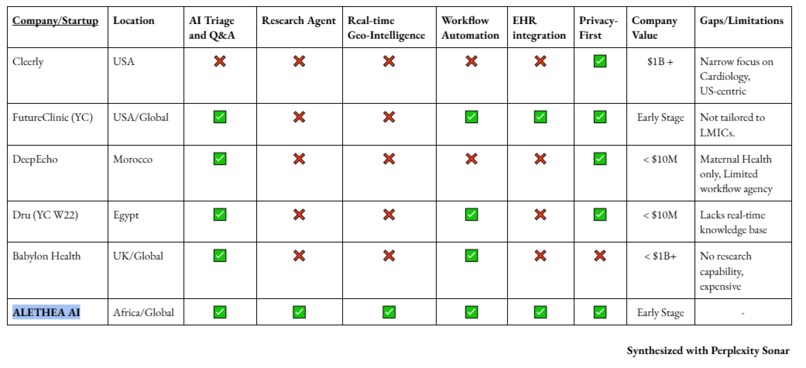
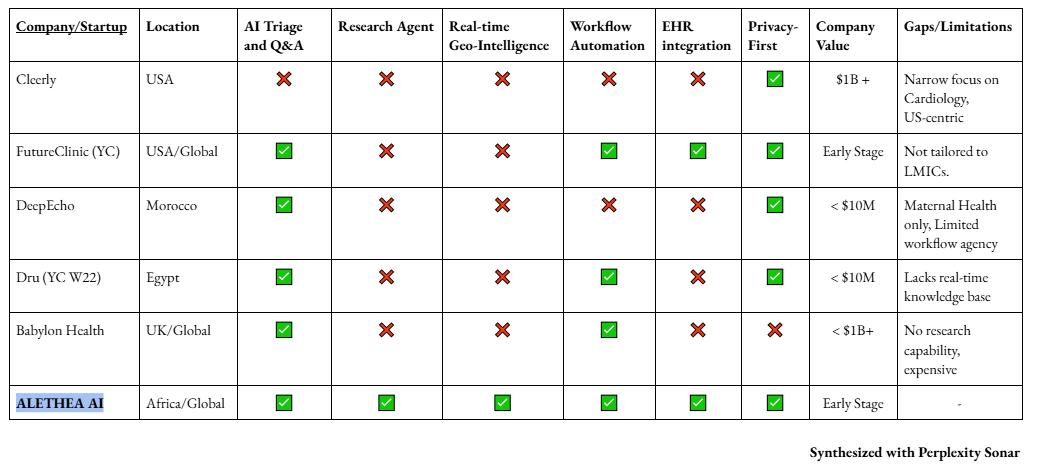
Market competitive landscape - What makes Alethea AI unique
-
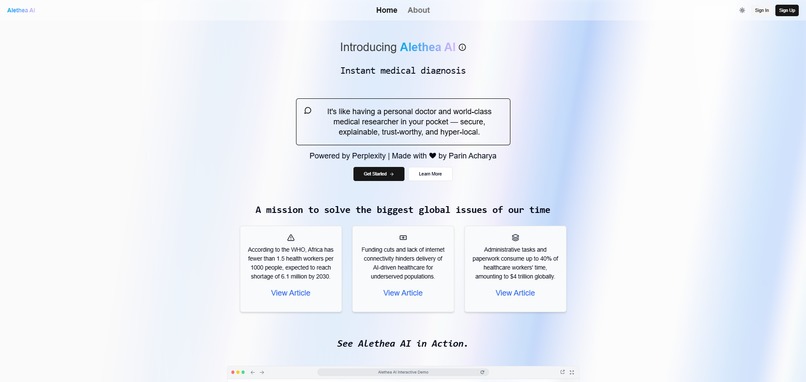
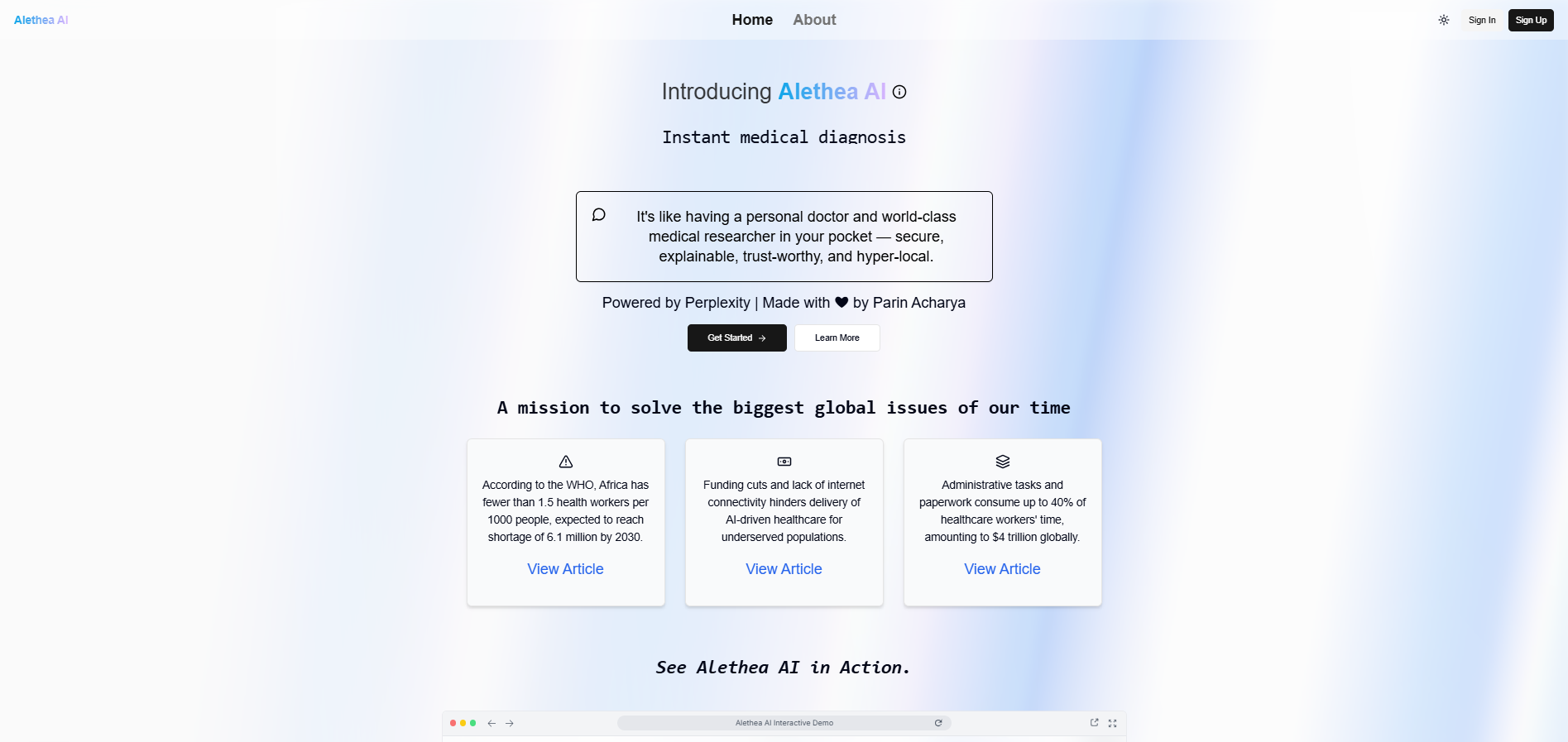
Landing Page
-
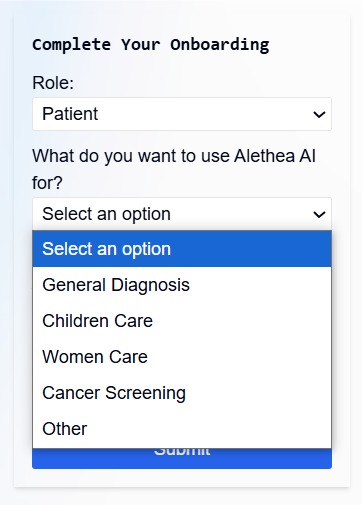
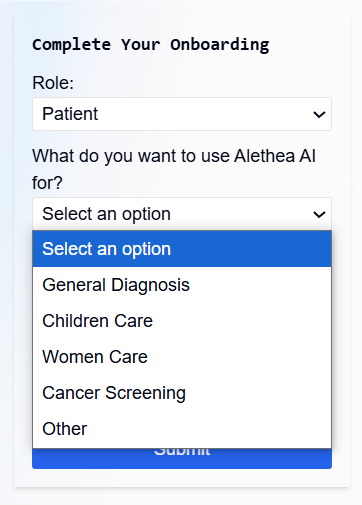
Patient use-cases
-
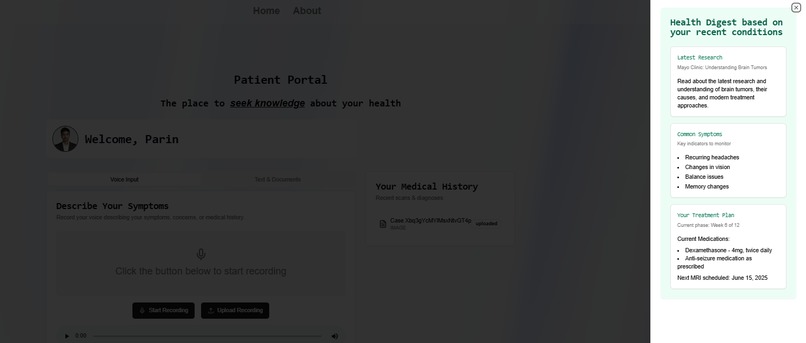
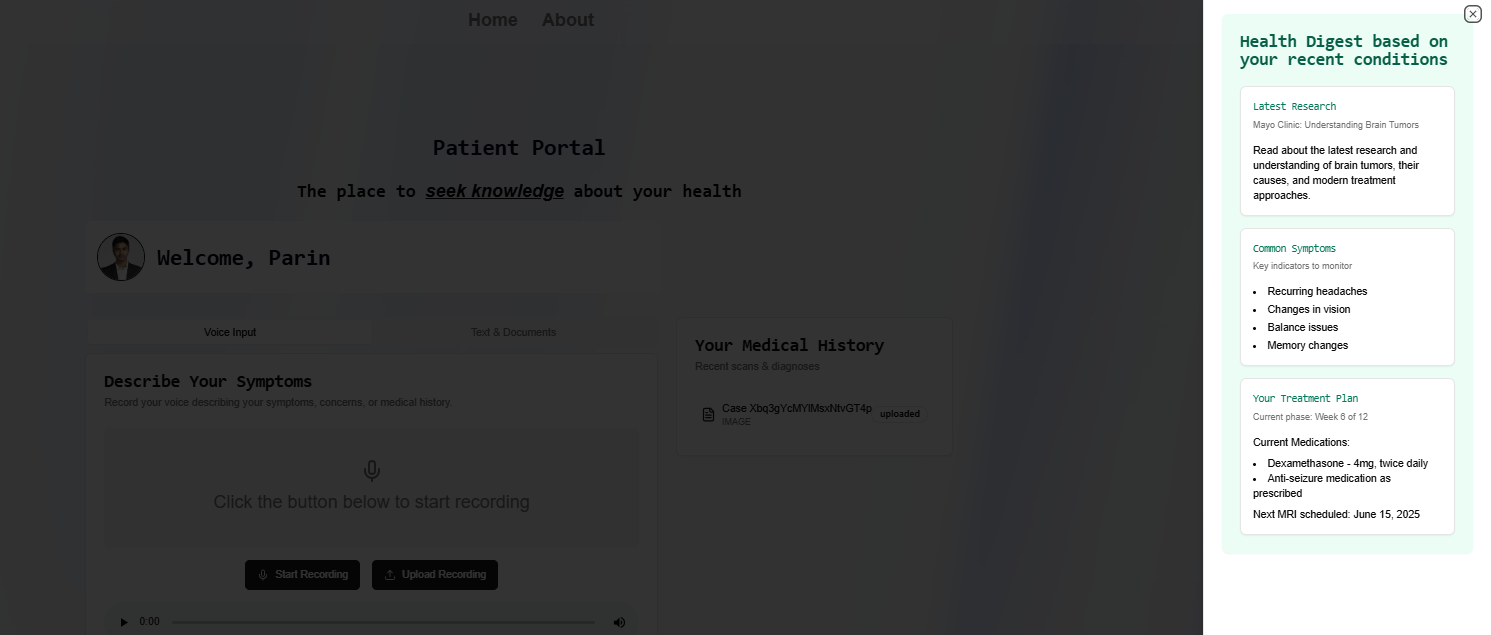
Personal Health Digest
-
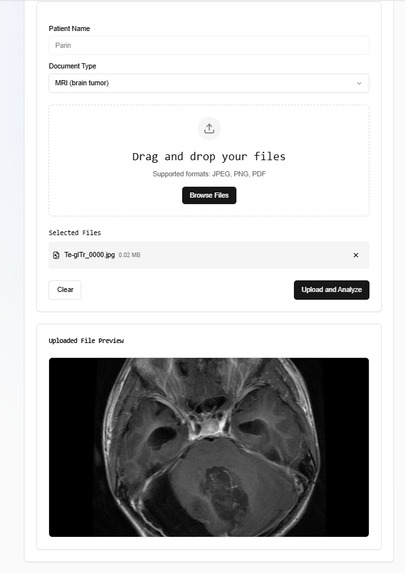
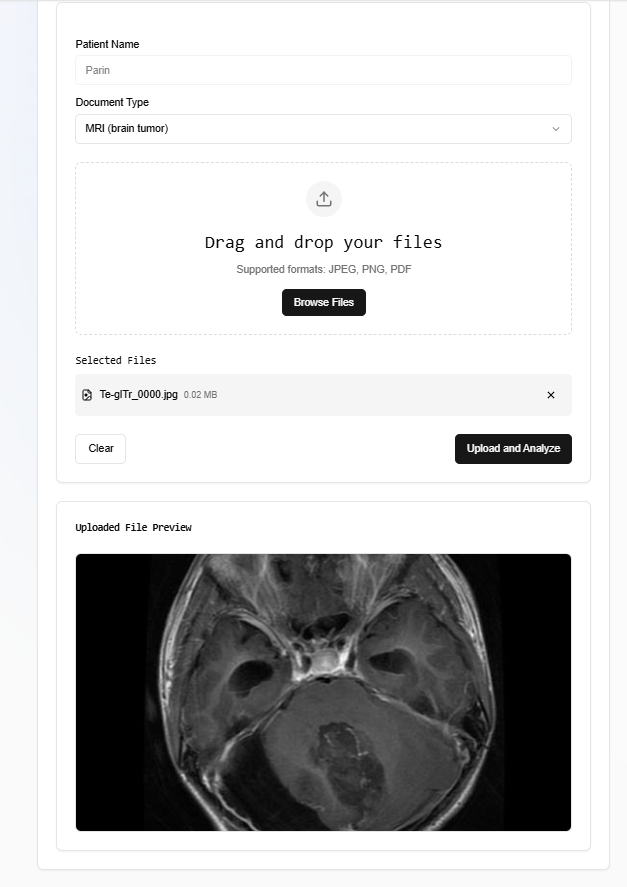
Patient Portal Document Upload Interface
-
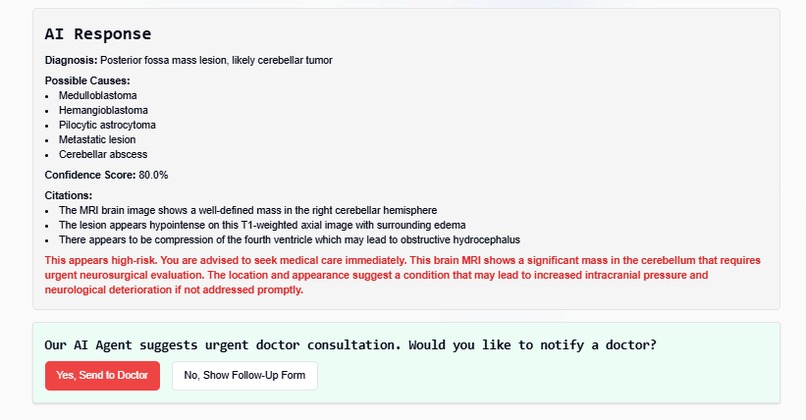
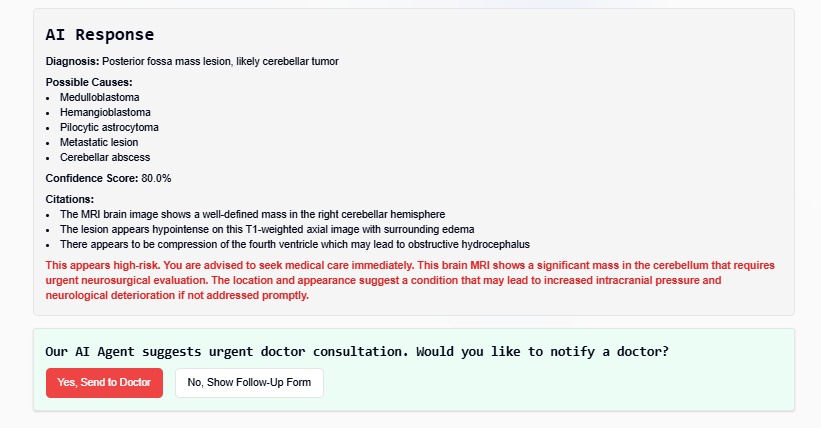
Instant, trustable medical diagnosis powered by Perplexity Sonar
-
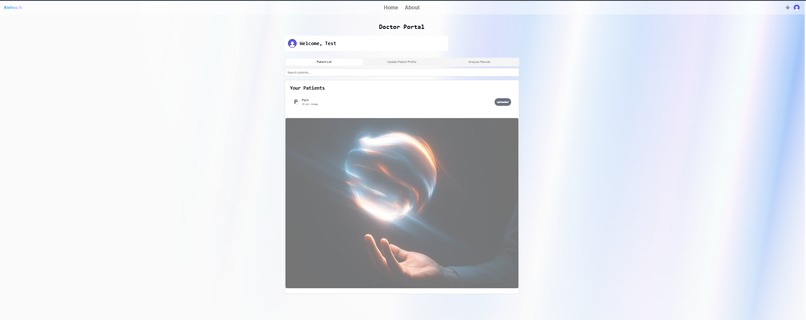
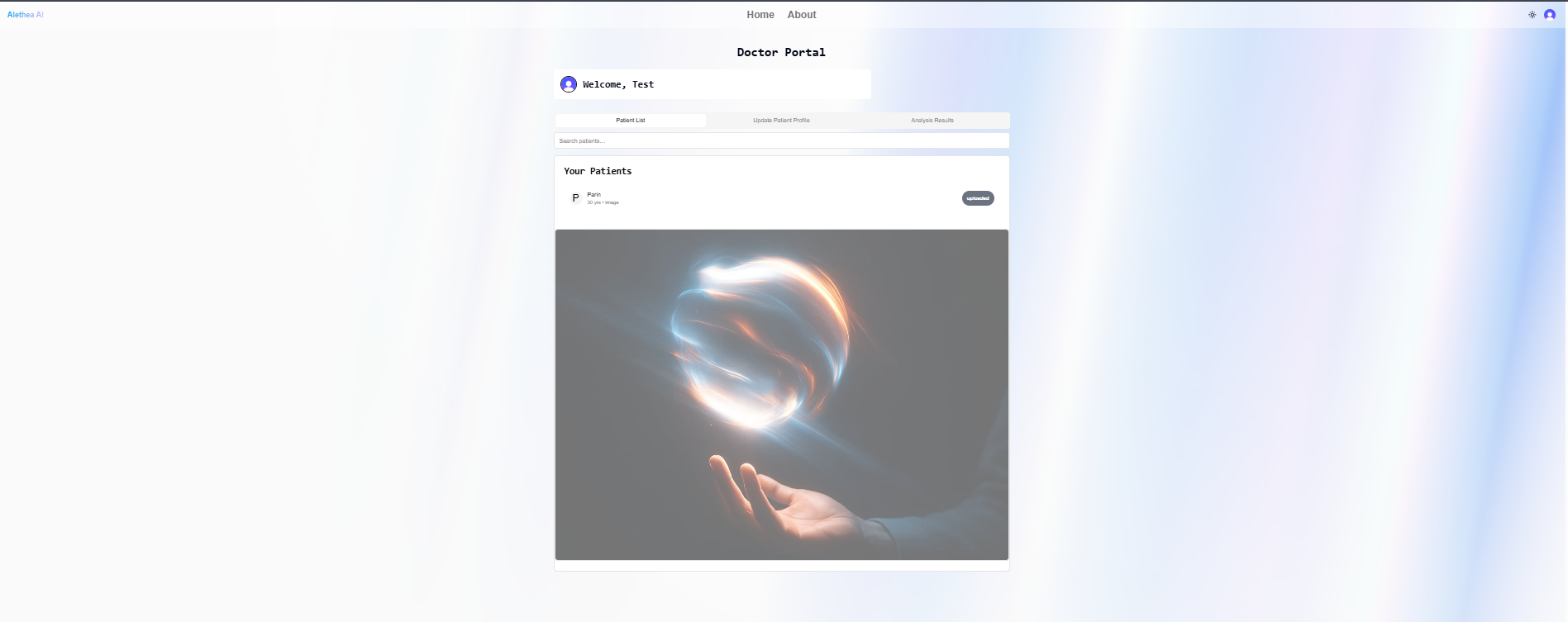
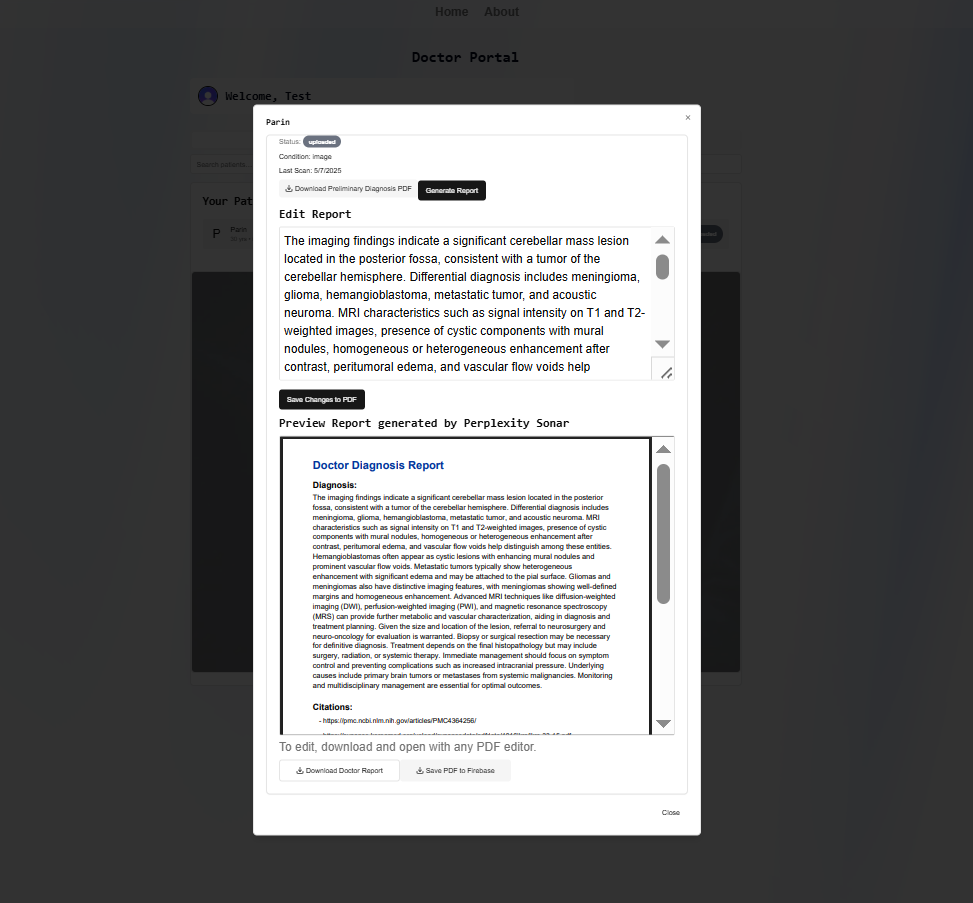
Alethea AI Doctor Dashboard
-
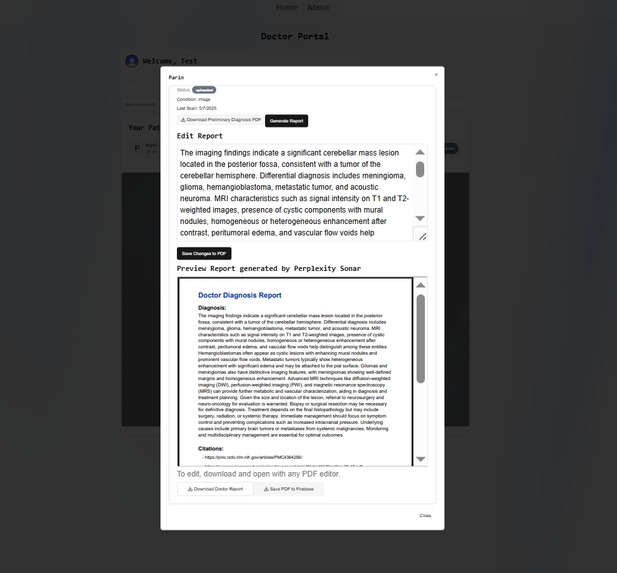
Professional Doctor Report Preview
-
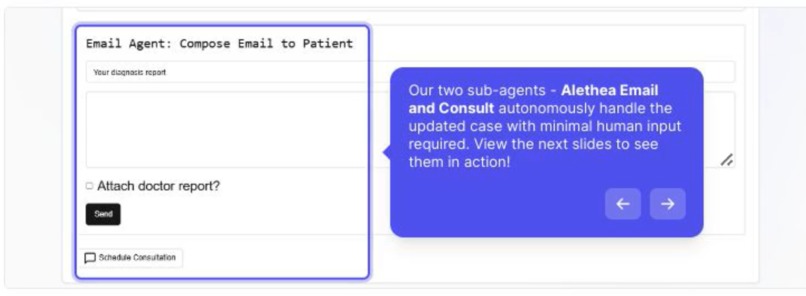
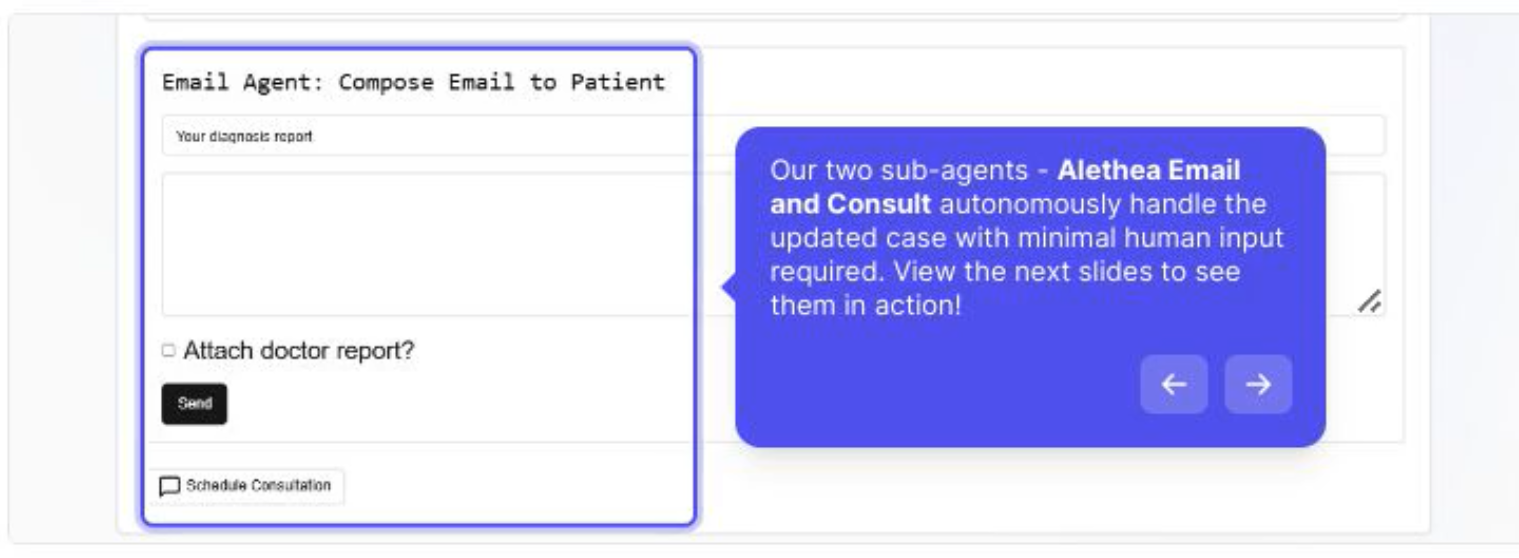
Alethea AI Email and Consult Agents
-
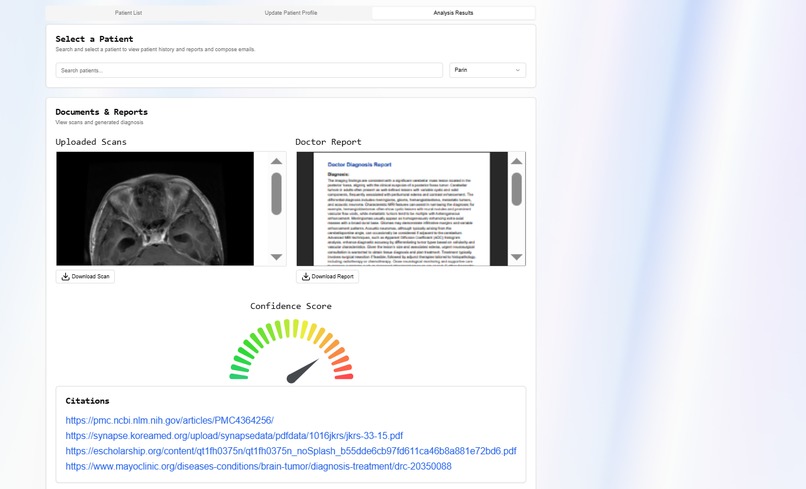
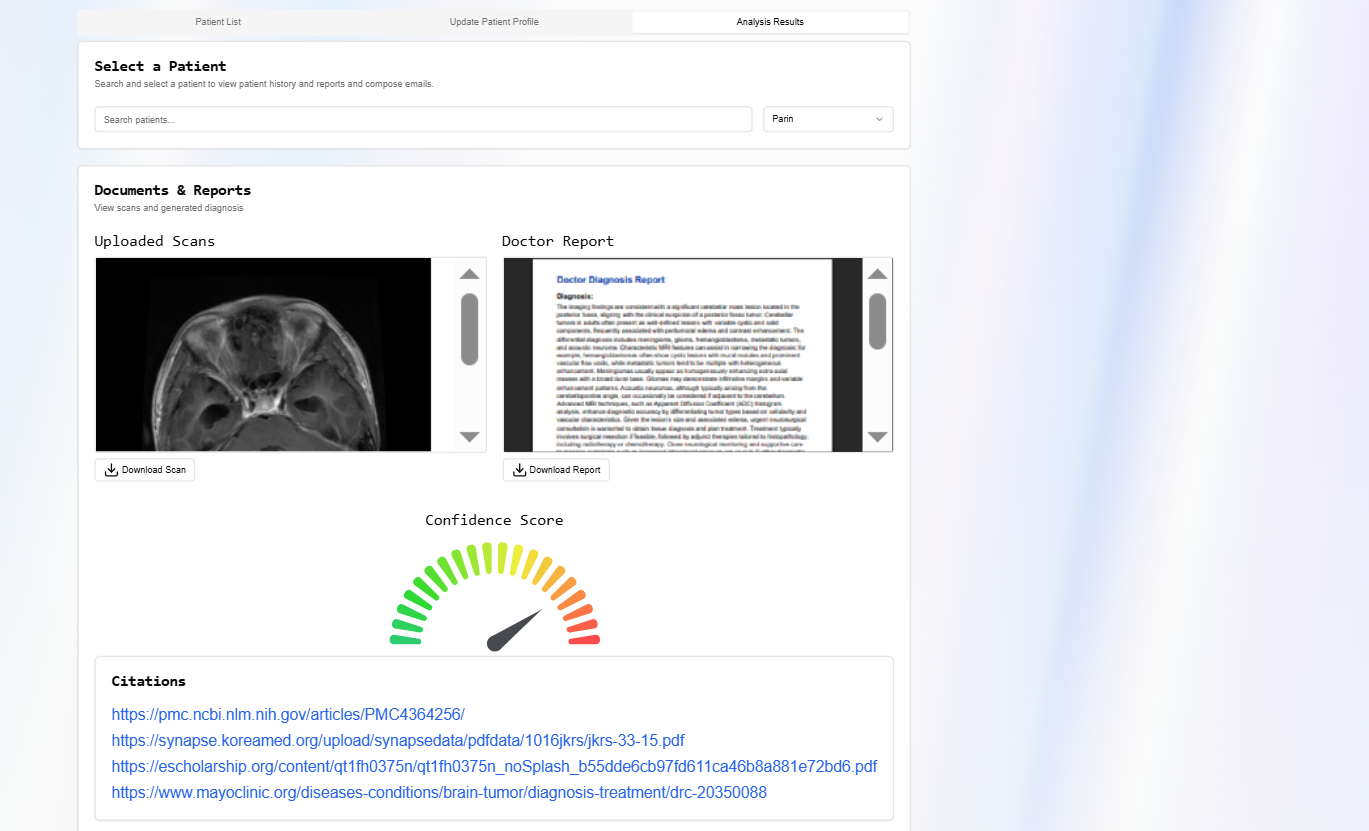
Patient History Analysis Dashboard
-
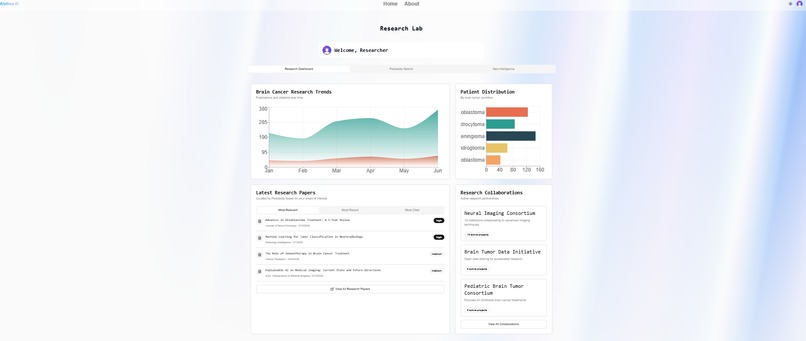
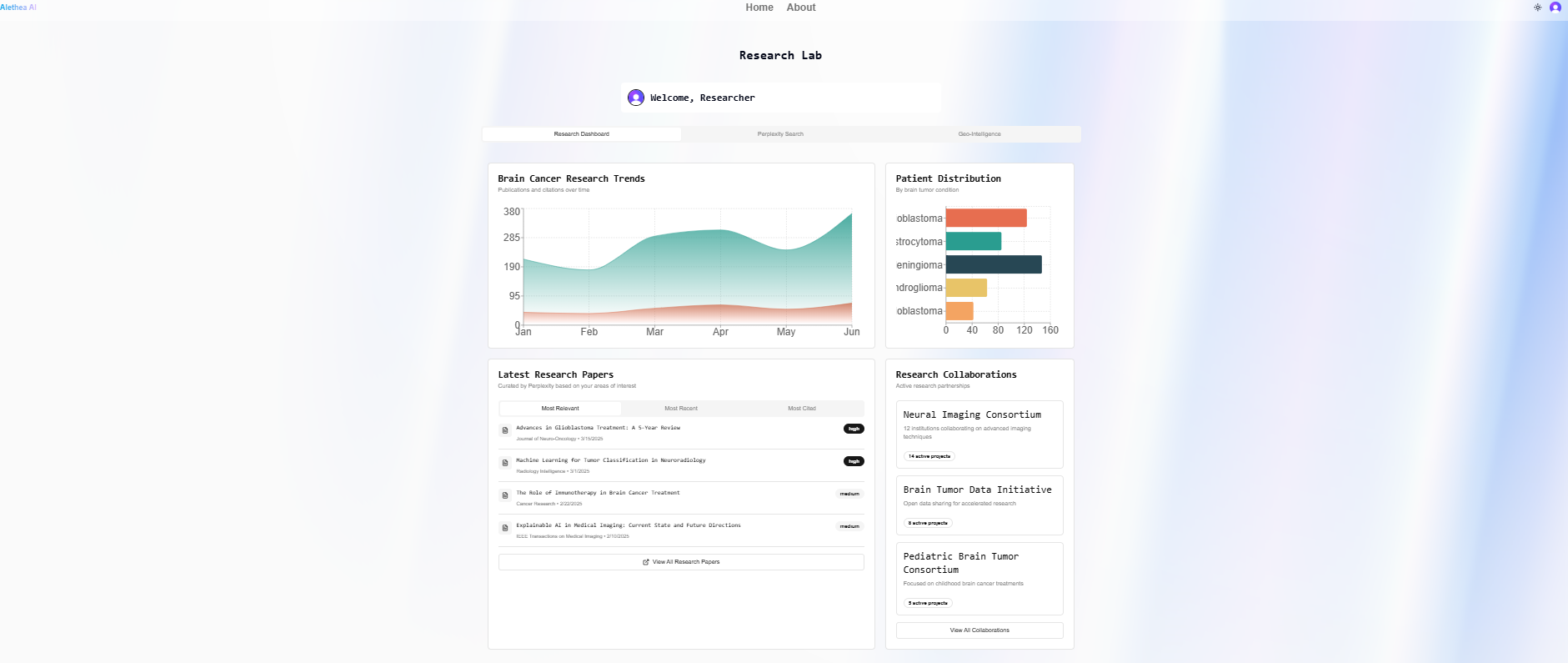
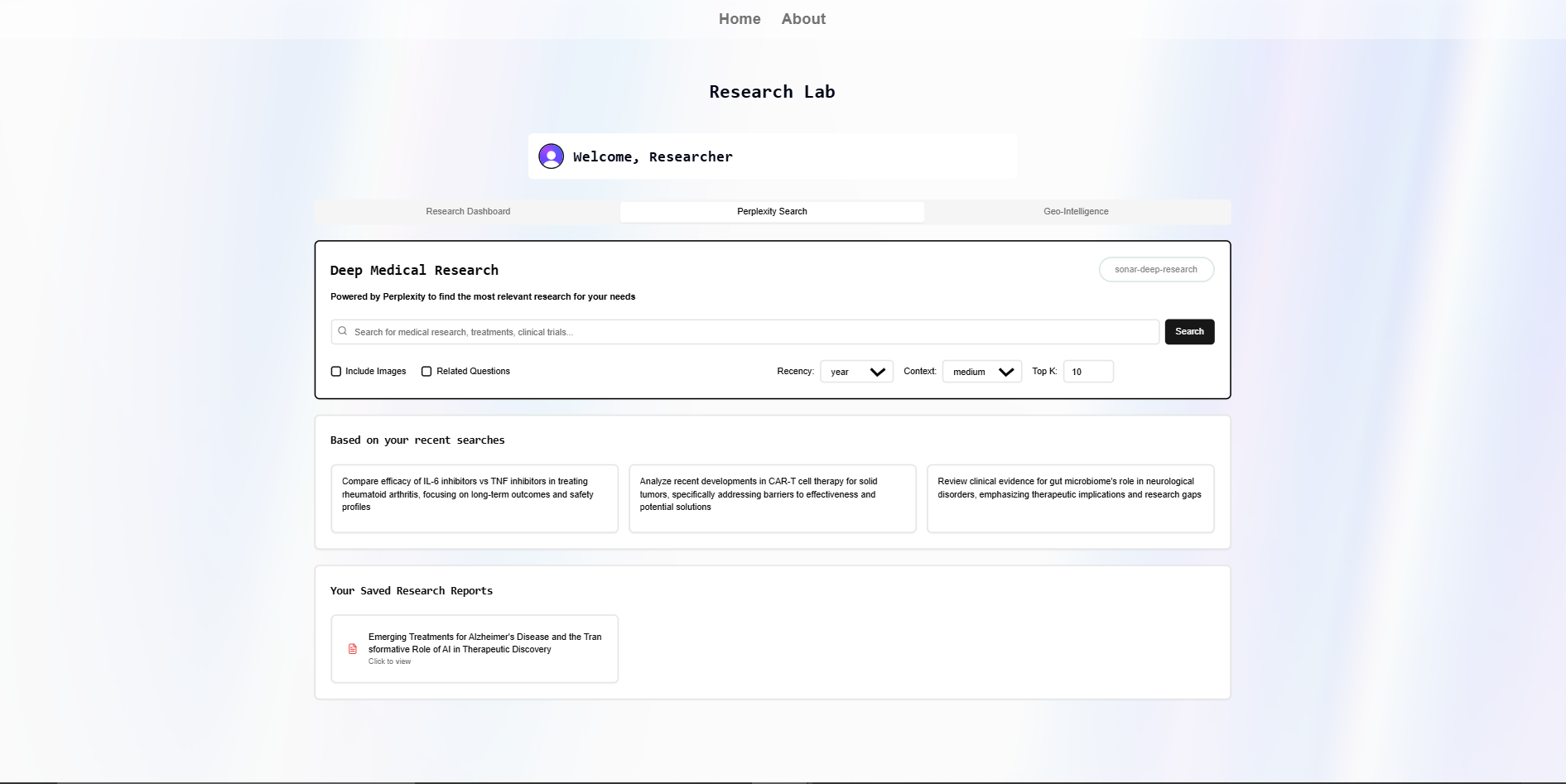
Alethea AI Research Lab Dashboard
-
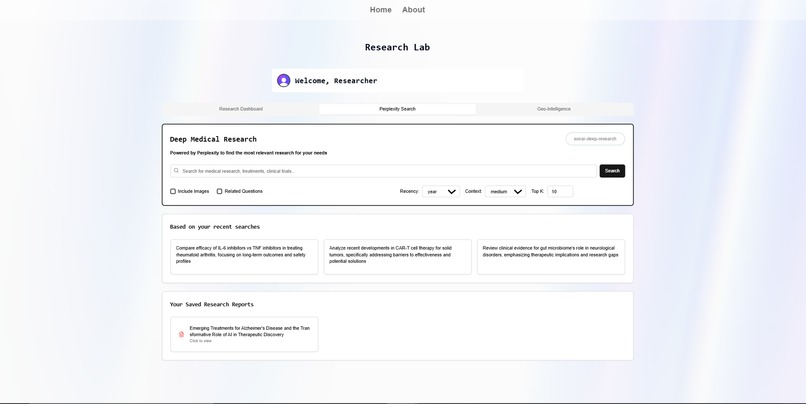
Alethea AI Research Lab Interface
-
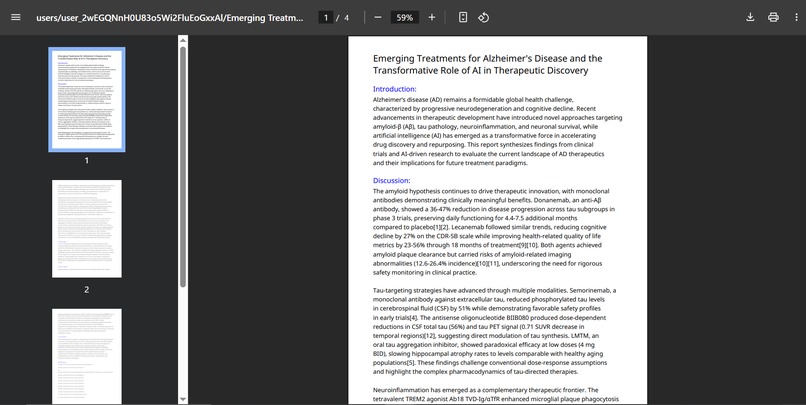
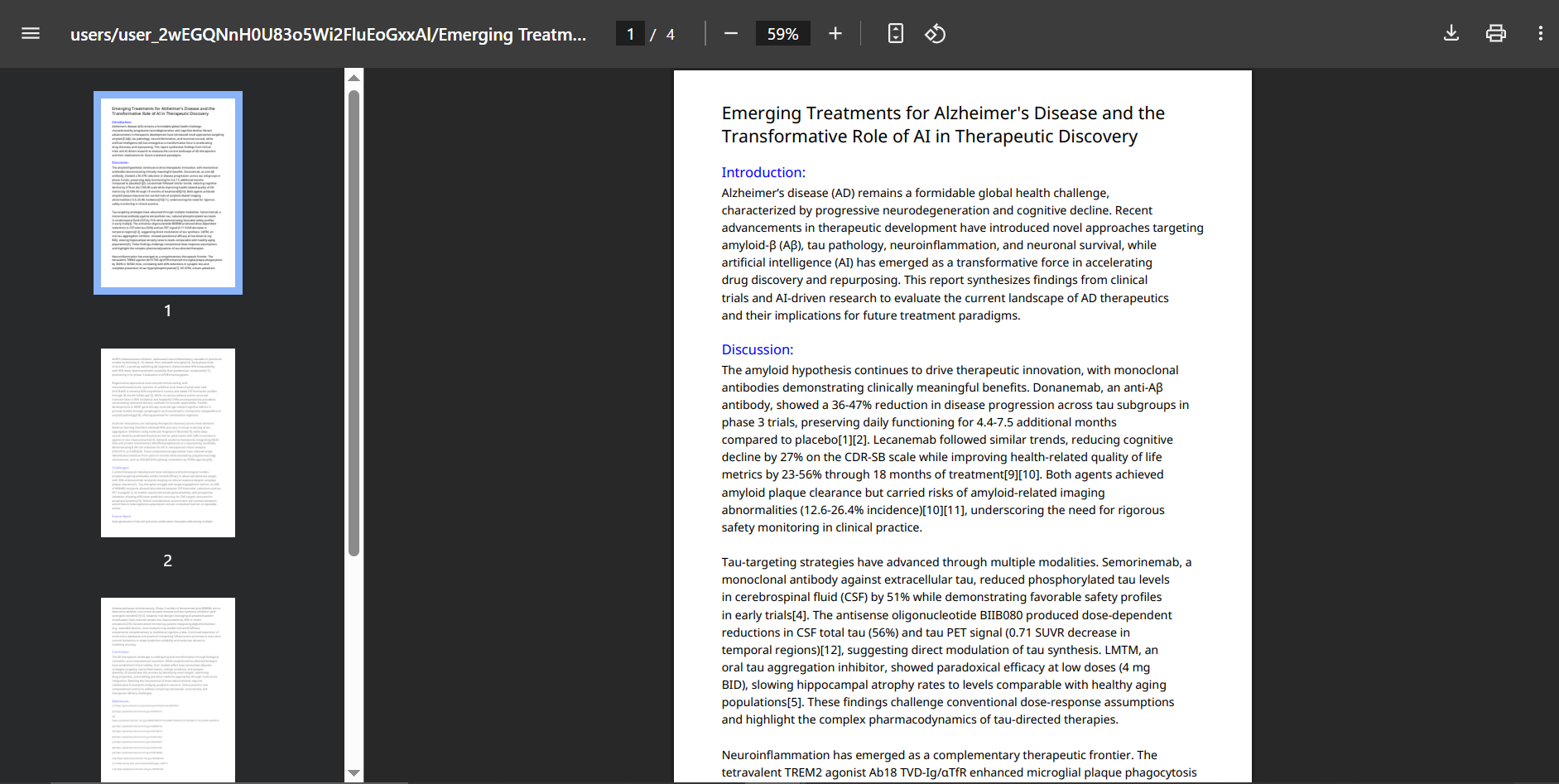
Alethea AI Research Lab Generated Report
-
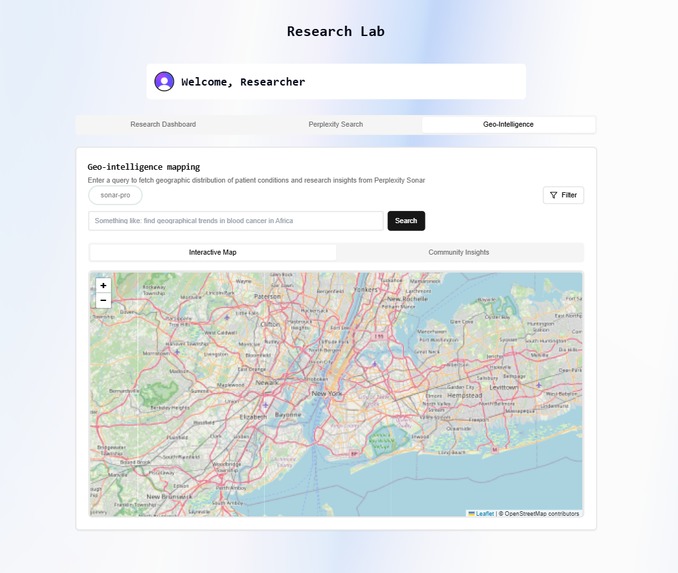
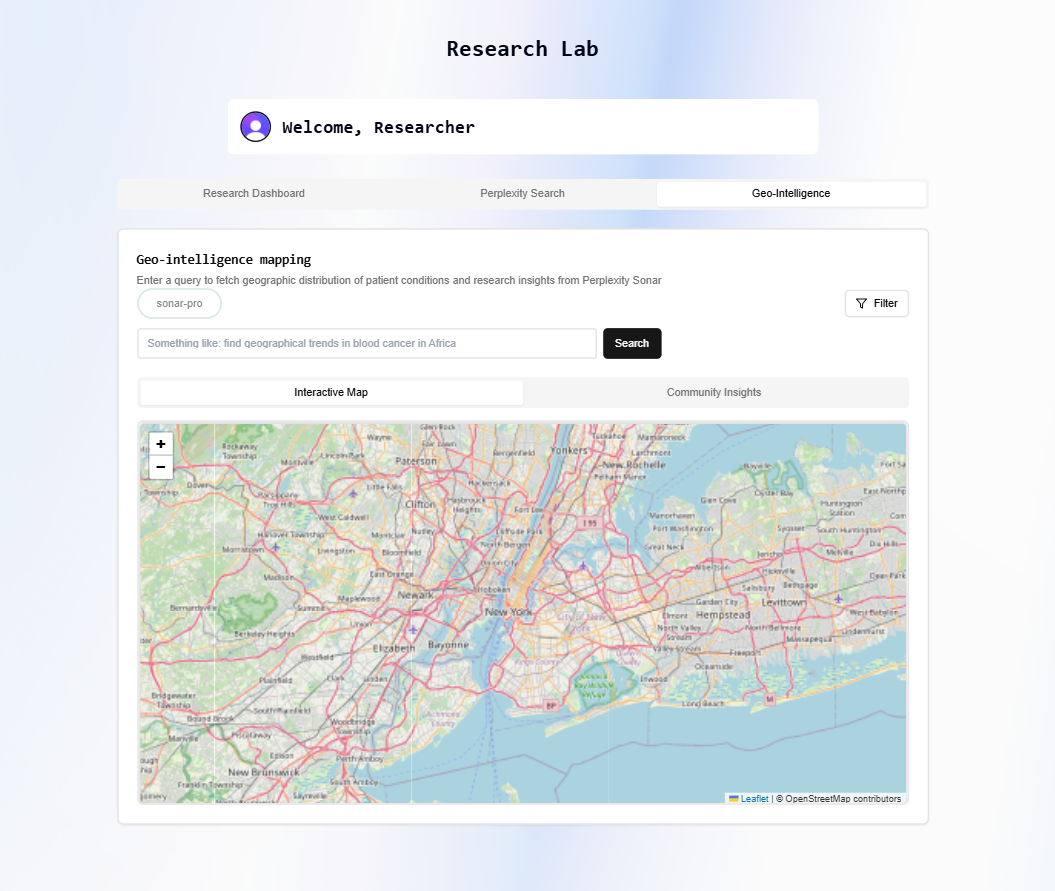
Alethea Geo-Intelligence Mapping with Leaflet.js 3D Map visualization
-
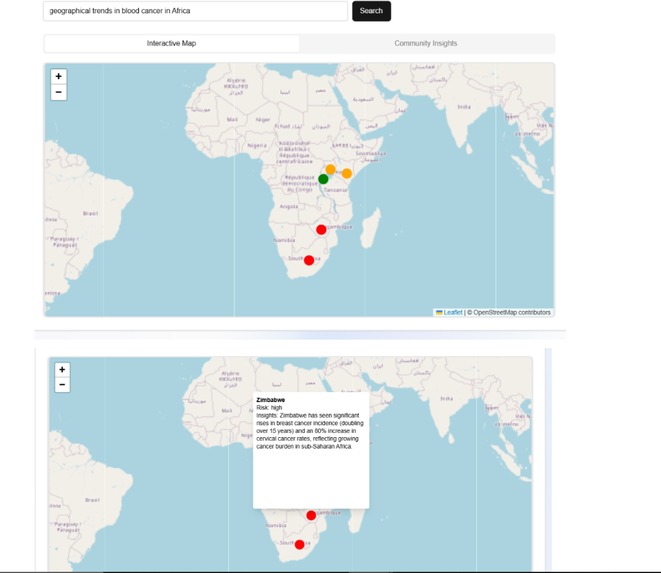
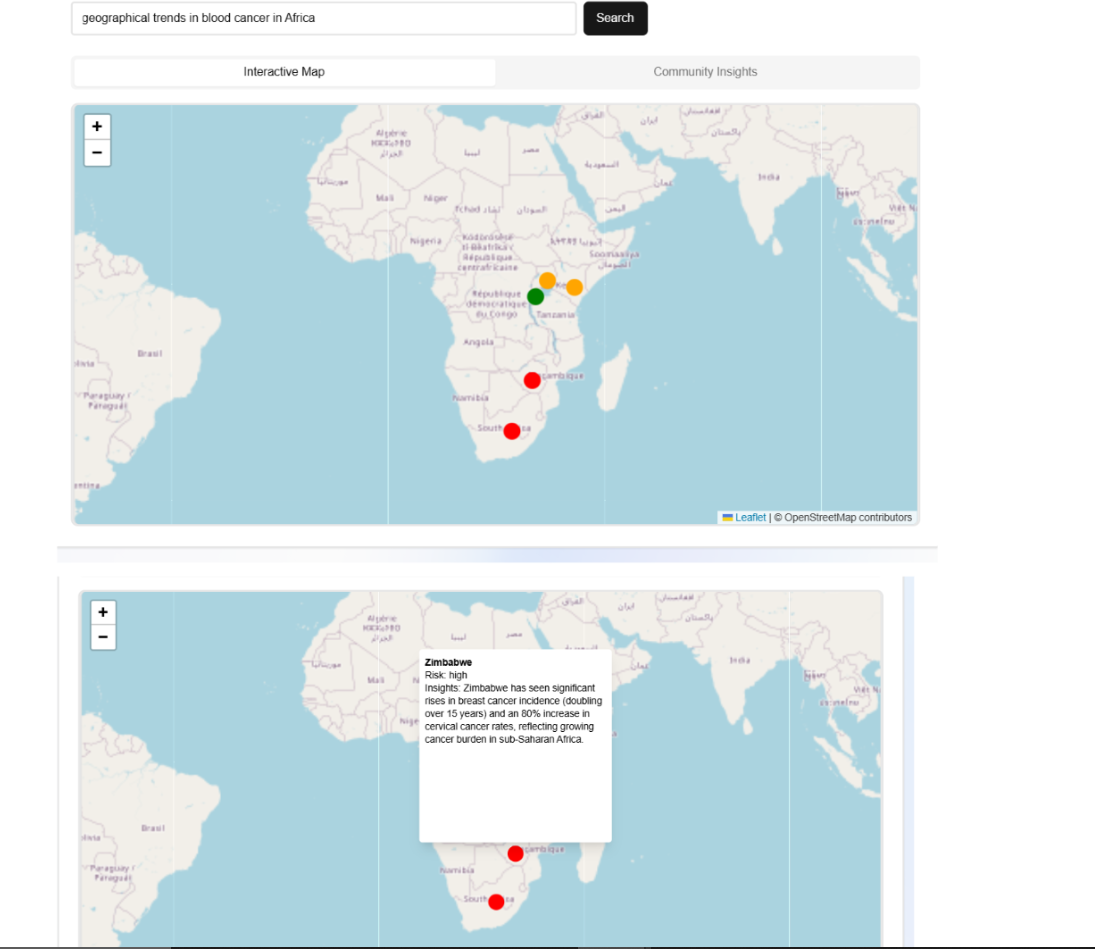
Alethea Geo-Intelligence powered by Perplexity Sonar Pro
-
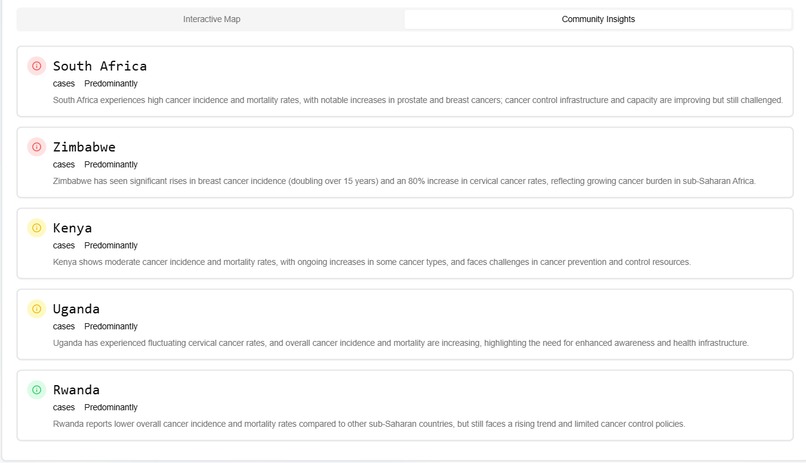
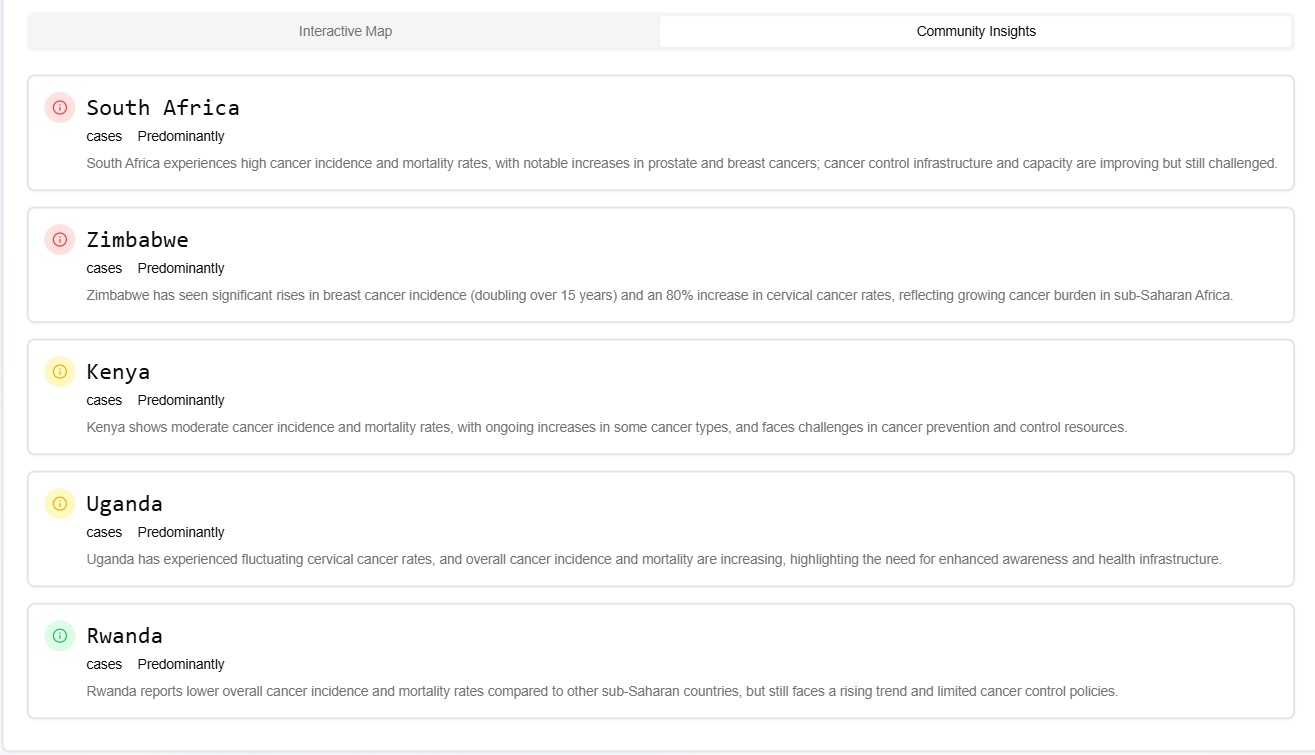
Alethea Geo-Intelligence Community Insights
-
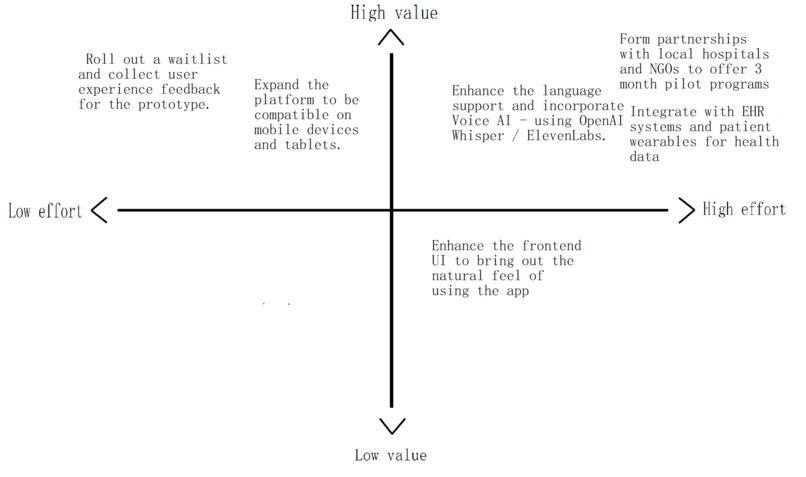
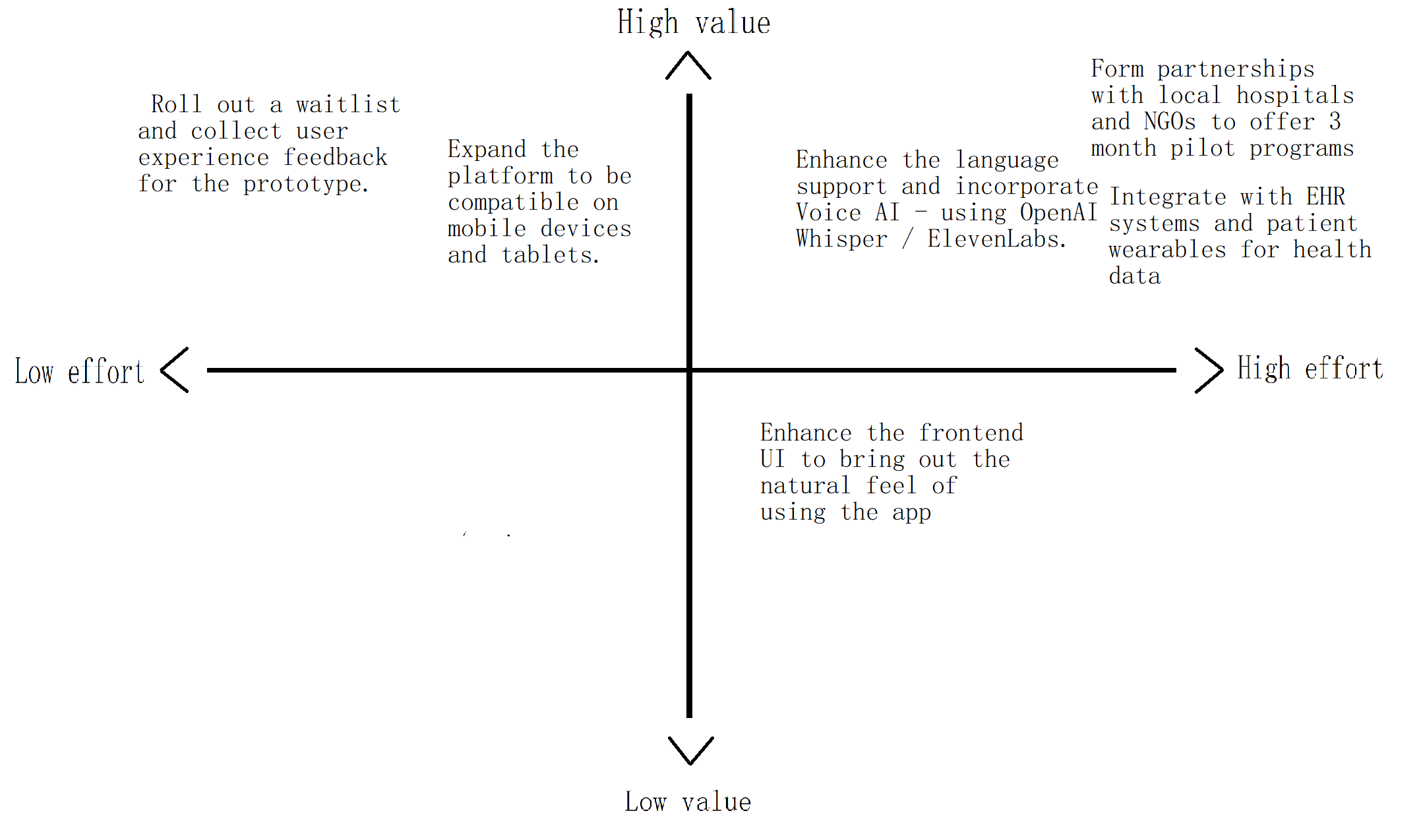
Alethea AI Feature Prioritization Matrix
-
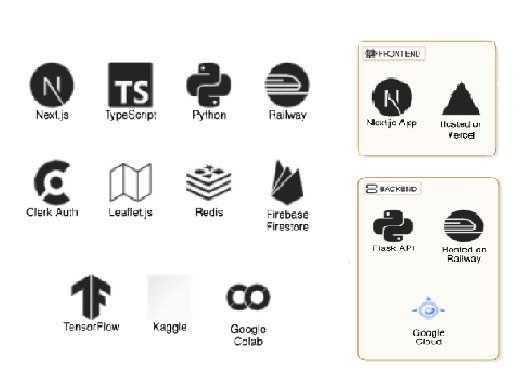
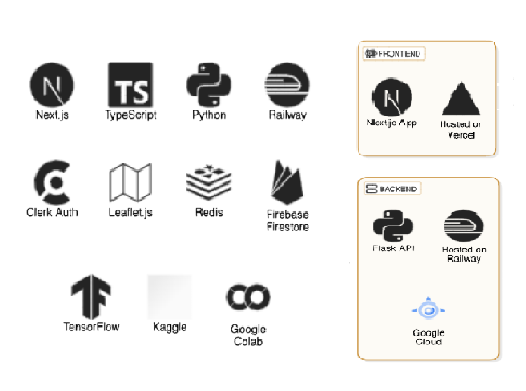
Alethea AI Tech Stack
-
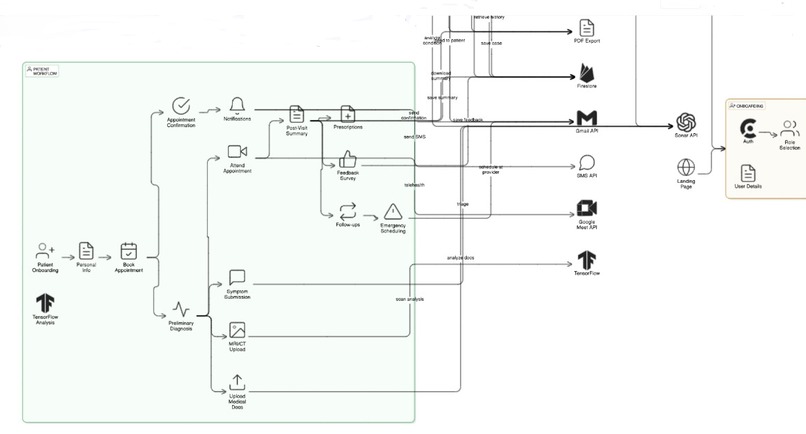
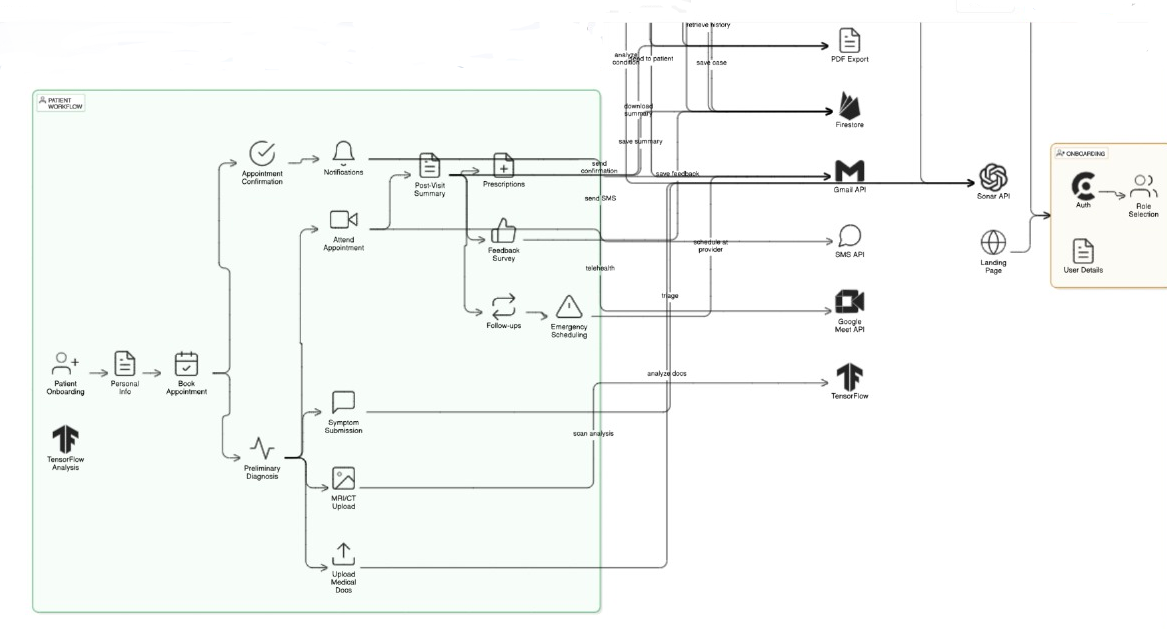
Architecture Diagram - Patient Portal
-
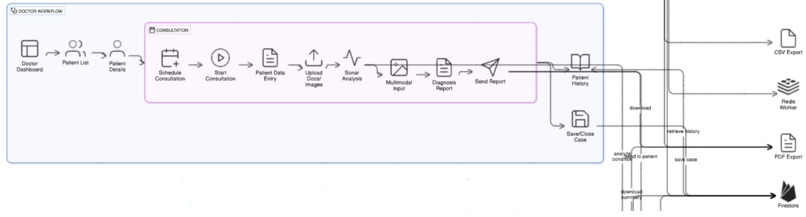
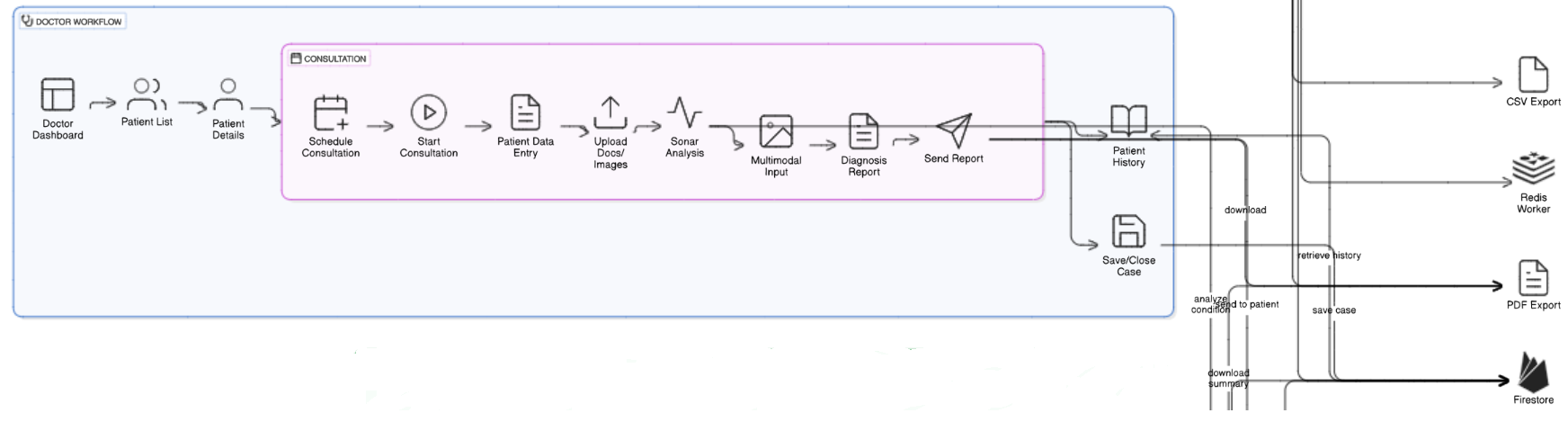
Architecture Diagram - Doctor Portal
-
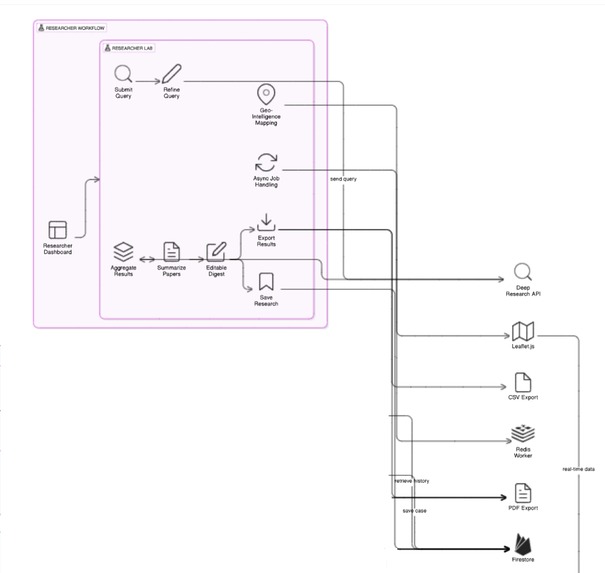
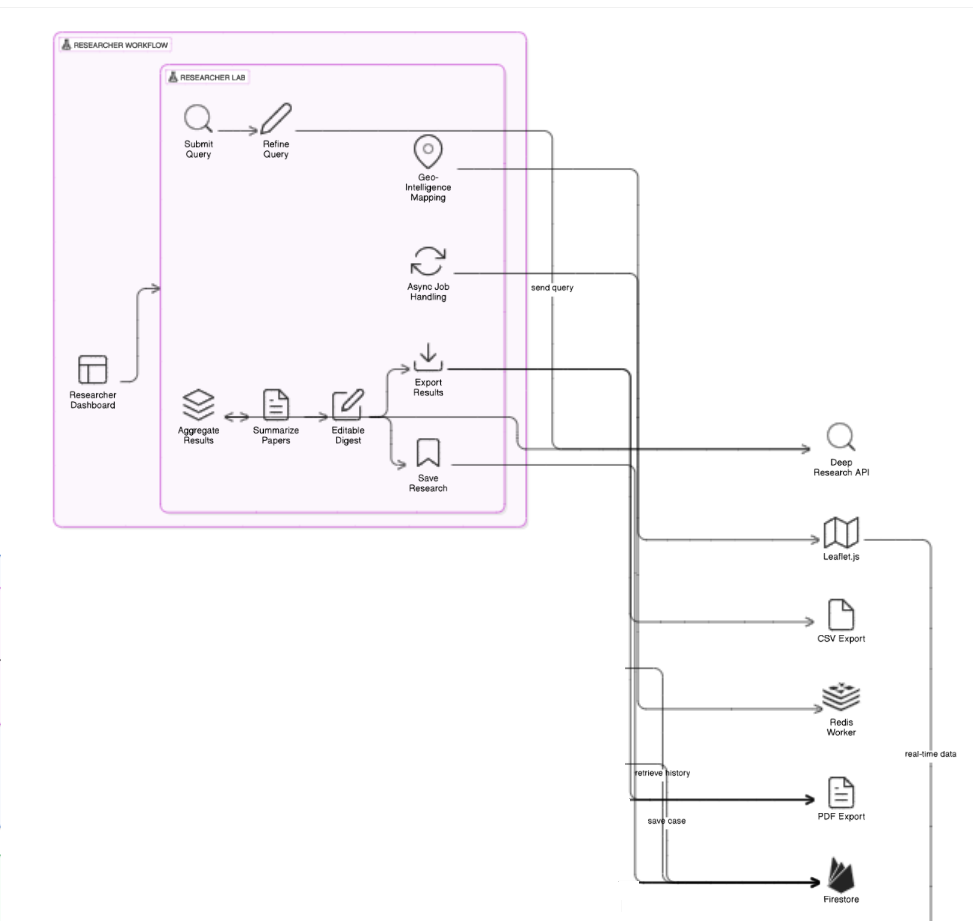
Architecture Diagram - Research Lab
This is a submission to the Health track.
Inspiration behind Alethea AI 🧠
According to the World Health Organization(WHO), most countries in Africa have fewer than 1.5 health workers per 1000 people, and this chronic shortage is expected to reach 6.1 million by 2030. In many African health clinics, administrative tasks consume up to 40% of healthcare workers’ time and medical research infrastructure is still developing.
Even searching for common symptoms on Google or Reddit often returns overwhelming walls of text and unreliable information—leaving patients more confused than informed.
Alethea AI was built to bridge this gap. Because every human life matters.
Key Features of Alethea AI - What differentiates us from the crowd ✨
| Feature | Description |
|---|---|
| Instant Expert Diagnosis powered by Perplexity Sonar | Get AI-powered, expert-reviewed medical diagnoses grounded in your patient history, in under 60 seconds — with citations you can trust. It also cuts down the cost and burden of commuting to a verified health center to nearly $0. |
| 99% AI, 1% Doctor | Automates admin tasks, clinical triage, appointment scheduling, and paperwork — allowing doctors to focus on what matters most, not bureaucracy. |
| AI Research Lab | Instantly access and summarize the latest medical research papers, journals, clinical trials, and therapies worldwide via Perplexity Deep Research. |
| Alethea Geo-Intelligence | Visualize real-time outbreaks and care gaps through dynamic 3D maps using location-aware insights powered by Perplexity Sonar. |
| Perplexity Health Digest | Personalized, trusted health summaries and reports based on patient symptoms, history, and search preferences. |
| Alethea Email and Consult Agent | Seamlessly integrates with Gmail and Google Meet for natural-language-based communication and scheduling with patients. |
| Privacy & Compliance First, Second and Third | Fully GDPR-compliant with role-based access, encrypted data handling, and patient-first consent practices. Personal Data is never used for training our machine learning models. |
| Voice AI (Coming Soon) | Multilingual voice support using Whisper and ElevenLabs for accessibility. This is not currently supported by the Perplexity Sonar API. |
Why we believe in Alethea AI making it to the global stage 🌍
1️⃣ Another project of mine - a brain tumor classifier I developed as a Software Engineering Resident at Headstarter, NYC, USA, designed to address the patient to MRI-ratio of 4:1 in Kenya, saw success when I piloted it with local radiologists at MTRH Kenya.
This showcased the power of neural networks and vision language models - cutting edge technology that African countries are yet to adopt.
2️⃣ We are not building another chatbot. Or another expensive or incompatible solution. Alethea AI reimagines the future of healthcare for our target audience - totally.
Our Unique Value Proposition (UVP) Pillars 🦾
1️⃣ Patient first. 🔮
A Swiss Army knife for all your medical use cases. Get instant expert medical diagnosis with remarkable accuracy and trustable sources. Introducing your own Perplexity Health Digest. No more queues, no more hassle with registration paperwork or travel costs. Your data moves with you.
We've even built and integrated a custom CNN using TensorFlow to classify brain MRIs, trained on over 6k+ scans in Google Colab!
2️⃣ 99% AI, 1% Doctor. 🩺
Our AI agent handles tedious tasks - diagnosis, administrative operations, appointment scheduling, back office tasks, paperwork and so much more - so that doctors can focus on what truly matters.
Alethea Email and Consult Agent integrate with common workspace tools like Google Meet and Mail to slash clinic visit times by 80%.
3️⃣ A world class medical researcher in your pocket! 🔬
Alethea AI Research Lab allows you to instantly access and summarize the latest medical research papers, clinical trials and ongoing therapies worldwide.
Alethea Geo-Intelligence integrates with 3D map visualizations to visualize outbreaks and care gaps as they happen in real time, using location based insights powered by Perplexity Sonar.
Features of the End-to-end research pipeline
- Query Refinement: Perplexity structures vague health goals into testable hypotheses in addition to providing related questions.
- Cascading prompts that build context in the memory layer.
- Enforced JSON schemas using Pydantic models to ensure structured, easily parseable research outputs.
- Cross-references multiple sources for research reproducibility.
"search_domain_filter": [
            "arxiv.org",
            "nejm.org",
            "thelancet.com",
            "jamanetwork.com",
            "nature.com",
            "sciencedirect.com",
            "bmj.com",
            "pubmed.ncbi.nlm.nih.gov"
        ]
Market Value Analysis 💵
Total Addressable Market (TAM) - $660B. The total global demand for health-tech/AI-powered solutions in clinical diagnosis, medical research and workflow automation.
Serviceable Available Market (SAM) - $300M. The part of the TAM targeted by our product's features and user profile. Sub Saharan Africa - approx. 100,000 health facilities (WHO, 2023) 50%+ lack access to essential digital tools Approx. 30,000 facilities with understaffed personnel.
Serviceable Obtainable Market (SAM) -$9M. Realistic share of the SAM that Alethea AI aims to capture within the next 1-3 years (3%)
Prototype Research, User Experience (UX) and System Architecture Design 🔍
Alethea AI attains the best user experience (UX) by prioritizing intuitive design, speed, and emotional resonance. Every feature is crafted to feel seamless—users can navigate complex tasks like seeking instant medical diagnosis to generating research reports on complex topics, all in one place.
Load times are near-instant, ensuring flow is never broken, while smart automation—with GMail and Meet—to eliminate repetitive administrative work entirely.
Beyond usability, the app fosters empathy and purpose, aligning with the message the project intends to convey - the power of AI in revolutionizing healthcare in developing countries.
The system architecture boasts technical complexity and balances security with workflow ease.
Cloud-native AI architecture ☁ - for scalability, reliability, data synchronization and Google/Vercel Analytics.
Privacy First, Second and Third 🔒 - data encryption, standards compliance, app-wide tested access controls and API best practices. We do not train our models on any patient data without explicit consent, in accordance with GDPR.
Software Engineering best practices 📐- clean, modular, commented code and error handling with graceful fallback for API failures as well as a detailed contributing guide unit tests.
Extending our impact beyond the target audience 👨👧👧
Multimodal input through voice significantly enhances the accessibility and reach of Alethea AI by enabling seamless interaction for users with limited literacy, visual impairments, or physical disabilities—barriers that are common in underserved regions.
Voice input allows users to communicate symptoms, ask health-related questions, and receive AI-driven responses without needing to navigate complex interfaces or type in text. This opens up Alethea AI to a broader demographic, including elderly patients, rural populations, and non-tech-savvy individuals. Moreover, integrating voice with local language support bridges linguistic divides, allowing the platform to extend its impact beyond English-speaking users and into communities that are often overlooked in digital health innovations.
United Nations Sustainable Development Goals (UN SDGs) addressed 🤝🏼
SDG 3: GOOD HEALTH AND WELL–BEING
SDG 9: INDUSTRY, INNOVATION AND INFRASTRUCTURE
SDG 10: REDUCED INEQUALITIES
How I built Alethea AI 🛠️
This is the modern, scalable tech stack powering Alethea AI.
| Category | Technologies |
|---|---|
| Languages & Frameworks | Next.js, TypeScript, Python, Flask |
| AI/ML Tools & APIs | Perplexity Sonar and Deep Research APIs, Kaggle, GMail API, Google Meet API, TensorFlow, Google Colab |
| Cloud & DevOps | Google Cloud Platform (GCP), Render, Upstash Redis, Vercel, GitHub |
| Databases & Authentication | Google Firebase, Firestore, Clerk Auth |
How Perplexity Sonar was used ⚙
The Perplexity Sonar API was chosen for its real-time search grounded in the latest, credible web sources, with citations surfaced directly in responses-critical for clinical trust and regulatory compliance.
Its ability to process context enables doctors and patients to receive actionable, context-aware responses that they can trust, which is crucial in resource-limited settings where diagnostic expertise is scarce.
By combining Sonar’s Q&A with patient location data, Alethea Geo-Intelligence delivers community-level insights (e.g., disease clusters, outbreak detection) in real time - something that generic LLMs or search APIs cannot perform.
The Sonar Deep Research API handles complex, multi-step research questions, aggregates and cross-validates findings from diverse sources, and powers our “world class researcher in your pocket” experience.
Not leaving out, speed and affordability make the Sonar API an unmatched trustworthy and reliable source of healthcare information in remote areas.
Expected Product Outcomes 🔼
- 4+ hours saved per medical worker, each day, totaling to 1460 hours saved every year.
- <60 seconds to receive professional diagnosis, from anywhere in the world. Serves 10x more patients each day.
- 99% Research Agent Uptime, to allow researchers to seek truthful, cited sources, all in one place.
Challenges I ran into during development 🧩
1️⃣ Web socket hang-up for deep-research tasks This required the orchestration and integration of an asynchronous Redis Upstash Worker that stores task IDs and polls the endpoint in short time intervals through a custom API route in Next.js.
2️⃣ Enforcing JSON schema Followed instructions on official Perplexity Docs on creating response validation models using the Python Pydantic Library. See the docs
3️⃣ Data privacy and security compliance Ensuring patient data privacy and regulatory compliance (WHO, GDPR, local laws) was complex, especially with multi-tenant architecture. This required integrating Firebase Storage with Clerk for robust authentication, writing custom storage rules as well as building custom middleware in Next.js to validate user roles and permissions on every API route.
Accomplishments that we're proud of 🏆
Successfully integrated complex features from the Perplexity Sonar repository on GitHub - Issue #321 through an async Redis worker polling endpoint and Issue #282 using Pydantic models.
Integrating the agentic workflow logic for each individual patient case guided by Perplexity Sonar, integrating Google Meet API, Google Firebase document storage and incorporating Sonar insights into the 3D Maps with a user-friendly research lab UI.
Getting Alethea AI v1.0.0 ready for submission and deployment, user testing and future builds.
What I learned during the process 📚
The significance of trusted sources in healthcare. I learned how to implement and fine-tune our multi-agent system built on Sonar through effective prompt engineering, especially while working with sensitive medical data in real time without data leakage.
The importance of patient data privacy. This involved validating citations and implementing guardrails, WHO standards, HIPAA, GDPR etc. while deploying information to the cloud with the users’ consent.
Working with cutting-edge AI and cloud technology in a fast-paced environment While making meaningful contributions to the health-tech space, I was able to collaborate and find answers to my questions and help others out on the Perplexity Hackathon Discord server.
Working independently on various aspects of the application fostered resilience and adaptability. Building features from scratch and navigating documentation to find solutions honed problem-solving skills and reinforced the importance of self-reliance in software development.
What's next for Alethea AI 🚀
- Apply to the Perplexity for Startups program to obtain API credits and accelerate development.
- Roll out a waitlist and conduct regular usability testing with healthcare workers and patients to ensure the current prototype meets their individual needs and is easy to navigate.
- Form partnerships with local hospitals and NGOs to offer 3 month pilot programs and custom revenue/pricing plans.
- Allow patients to turn health goals into personal experiments through Perplexity-guided protocols.
- Expand the platform to be compatible on mobile devices and tablets.
- Enhance the language support and incorporate Voice AI - using OpenAI Whisper / ElevenLabs. This feature is currently not supported natively by the Perplexity API.
- Add a new Researcher Collaboration feature in the Research Lab.
- Enhance the frontend UI to bring out the natural feel of using the app - improve the sentiment analysis.
How I aim to scale the product 📈
- Make the database rules more efficient with query optimization
- Multi-level caching for Perplexity API system prompts to further reduce response latency and improve user experience.
- Implement rate-limit layer for safety.
- Establish CI/CD pipelines with Docker with automated tests to maintain code quality during rapid growth cycles. I would also love to integrate my other GitHub PR Review Agent project too!
- Work with a co-founder for product growth, analytics and marketing support.
Frequently Asked Questions (FAQs) 🙋🏼♂️
- What is the primary goal of this healthcare application?
The application aims to enhance healthcare diagnosis and research accuracy, accessibility and quality in Kenya and Africa by leveraging Perplexity Sonar AI models.
- How does the app utilize Artificial Intelligence?
The app integrates AI to analyze patient data, predict disease risks, and offer diagnostic support. For instance, AI algorithms can assist in early detection of conditions like cervical cancer and manage non-communicable diseases among youth. See project details for more comprehensive information.
- How is patient data privacy and security ensured?
Patient data is protected through encryption and adherence to international data protection standards. The app complies with regulations like the General Data Protection Regulation (GDPR) and aligns with the World Health Organization's guidelines on AI in healthcare.
- What challenges does the app address in the African healthcare context?
The app tackles challenges such as the shortage of healthcare professionals, limited access to quality care, and inadequate health infrastructure. By providing AI-driven diagnostic tools and supporting CHWs, it enhances healthcare delivery efficiency and reach.
- Who are the intended users of the application?
The app is designed for use by healthcare professionals and researchers, including doctors and CHWs, as well as patients seeking accessible healthcare services. It supports CHWs with tools for education, diagnosis, and patient management, empowering them to deliver quality care in their communities.
- How does the app ensure cultural relevance and user-friendliness?
The application incorporates multilingual support and culturally appropriate content to cater to diverse user groups. User interfaces are designed with simplicity and clarity, ensuring ease of use for individuals with varying levels of digital literacy.
- What is the potential impact of the application beyond the target audience?
While focused on Kenya, the app's scalable architecture allows adaptation to other African countries facing similar healthcare challenges. Its success can serve as a model for integrating AI into healthcare systems across the continent, promoting improved health outcomes regionally.
- How does the app contribute to healthcare workforce development?
By providing CHWs with AI-powered tools and training resources, the app enhances their capabilities, enabling them to deliver more effective care. This empowerment contributes to building a more robust and skilled healthcare workforce in underserved areas.
- What are the future plans for Alethea AI?
Future developments include integrating more advanced AI features, expanding to additional regions, and collaborating with governmental and non-governmental organizations to further strengthen healthcare systems across Africa.
Usage Disclaimer ⚠️
Alethea AI is not a substitute for professional medical advice, diagnosis, or treatment. While our AI tools—powered by Perplexity Sonar and Deep Research—offer expert-informed insights, health digests, and research summaries, they are intended for informational purposes only. Individual results and recommendations may vary, and no AI tool can replace personalized, human clinical judgment.
Try Alethea AI today. Feel free to leave feedback in the comments, or reach out directly on LinkedIn.


Log in or sign up for Devpost to join the conversation.