-
-

Presenting PERMITTRON
-
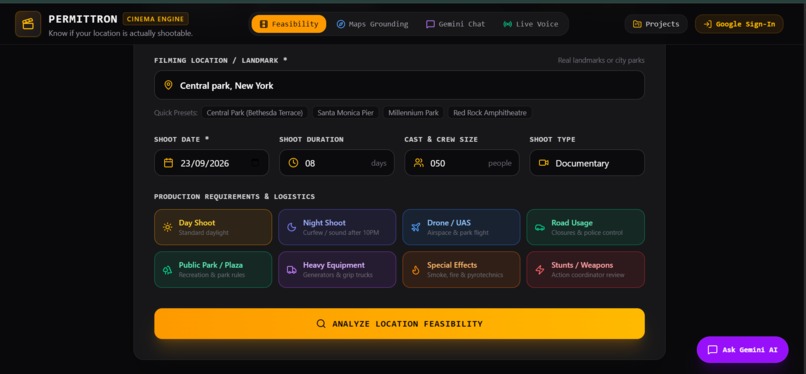
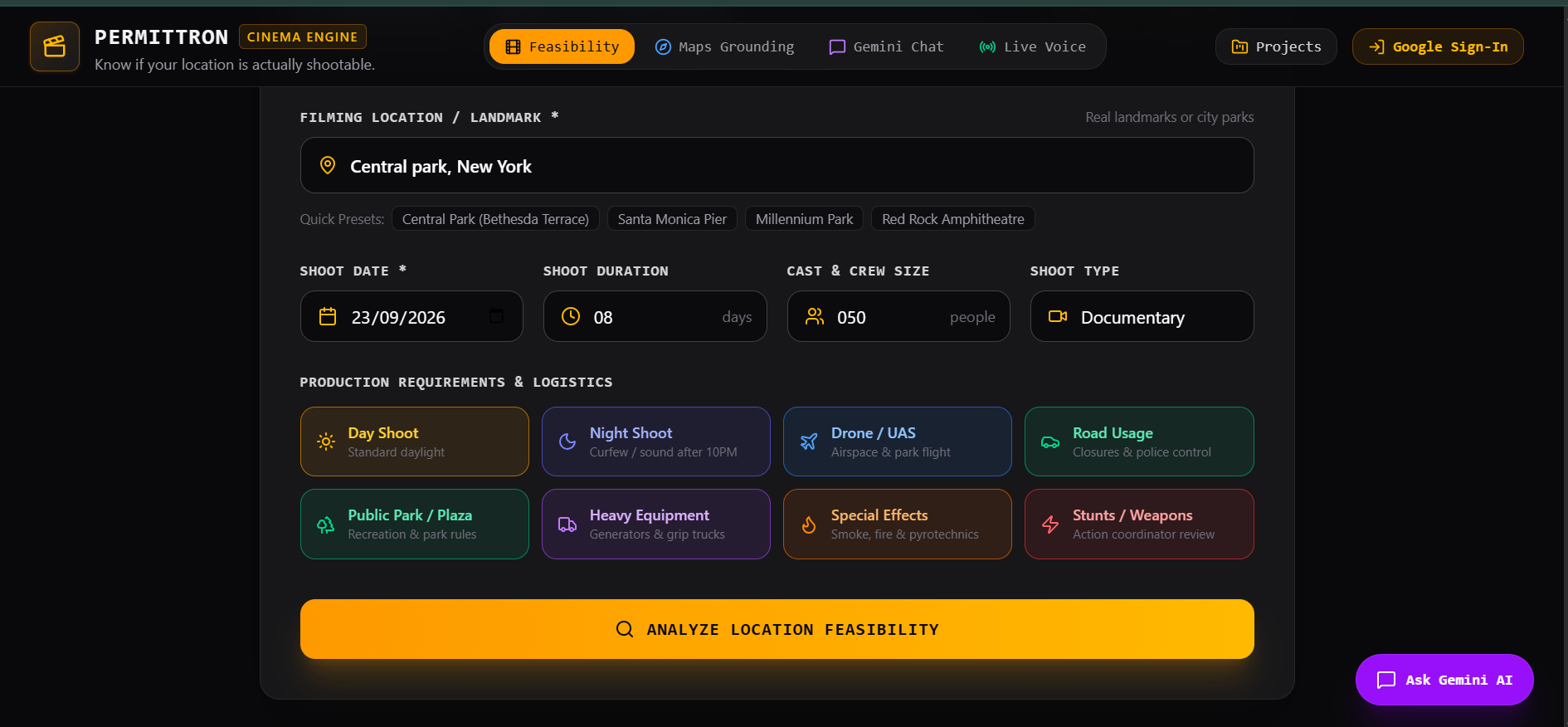
Feasibility Check
-
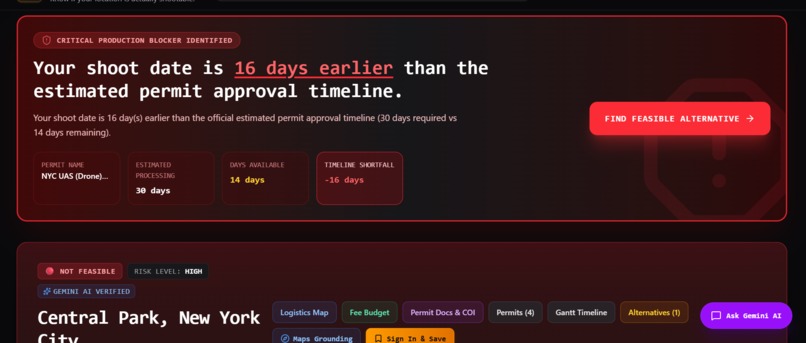
Results
-
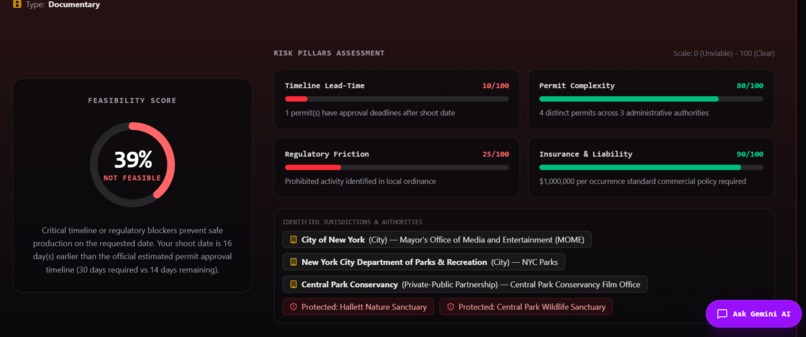
Feasibility Score
-
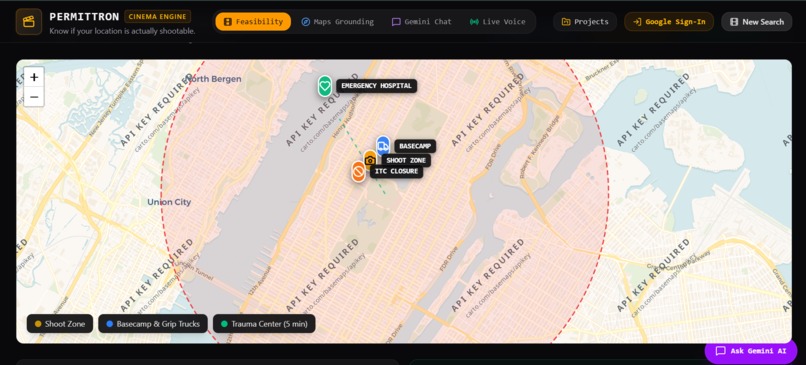
Google Map feature
-
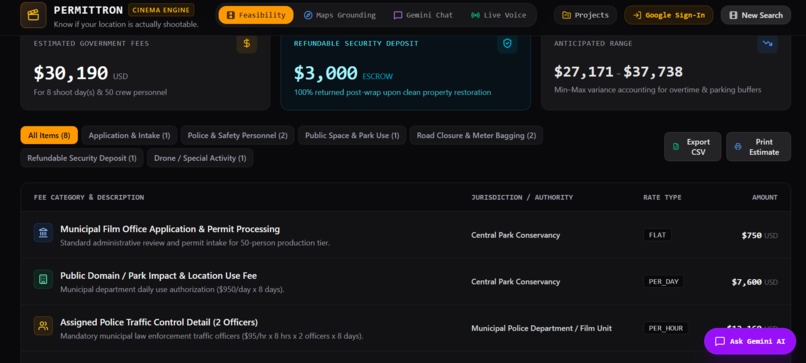
Fee Category
-
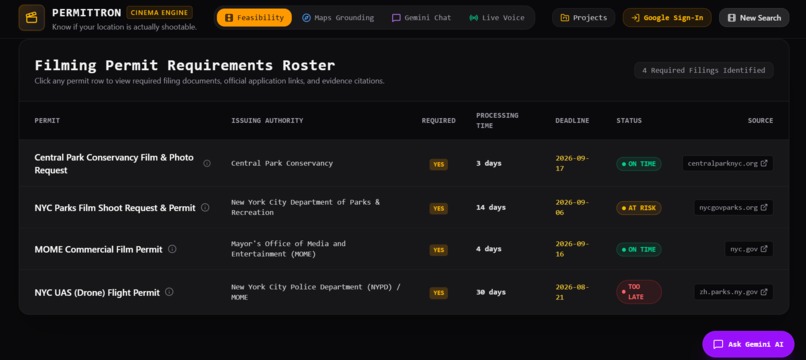
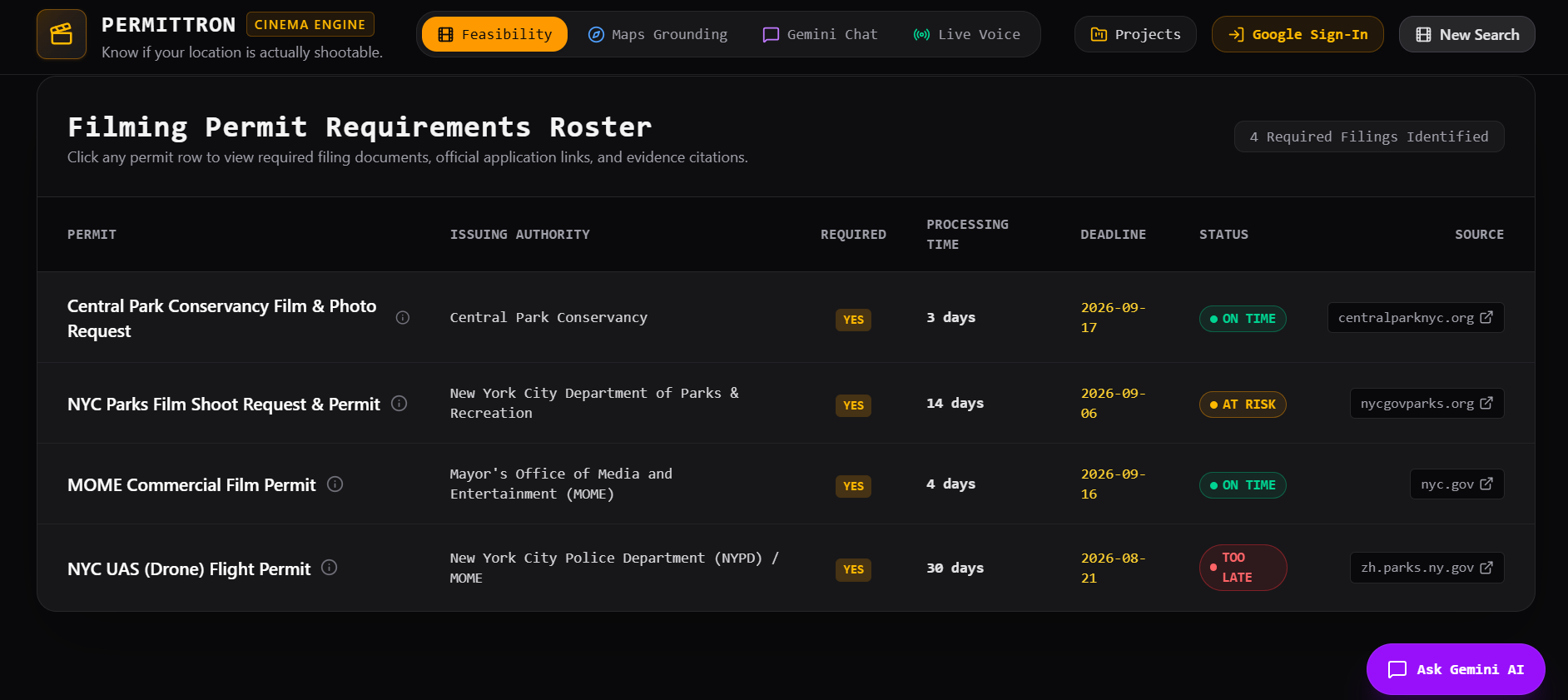
Permit Requirements
-
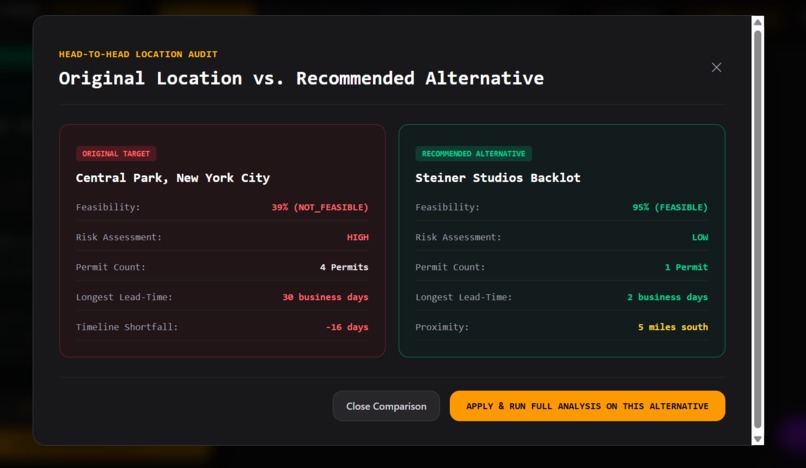
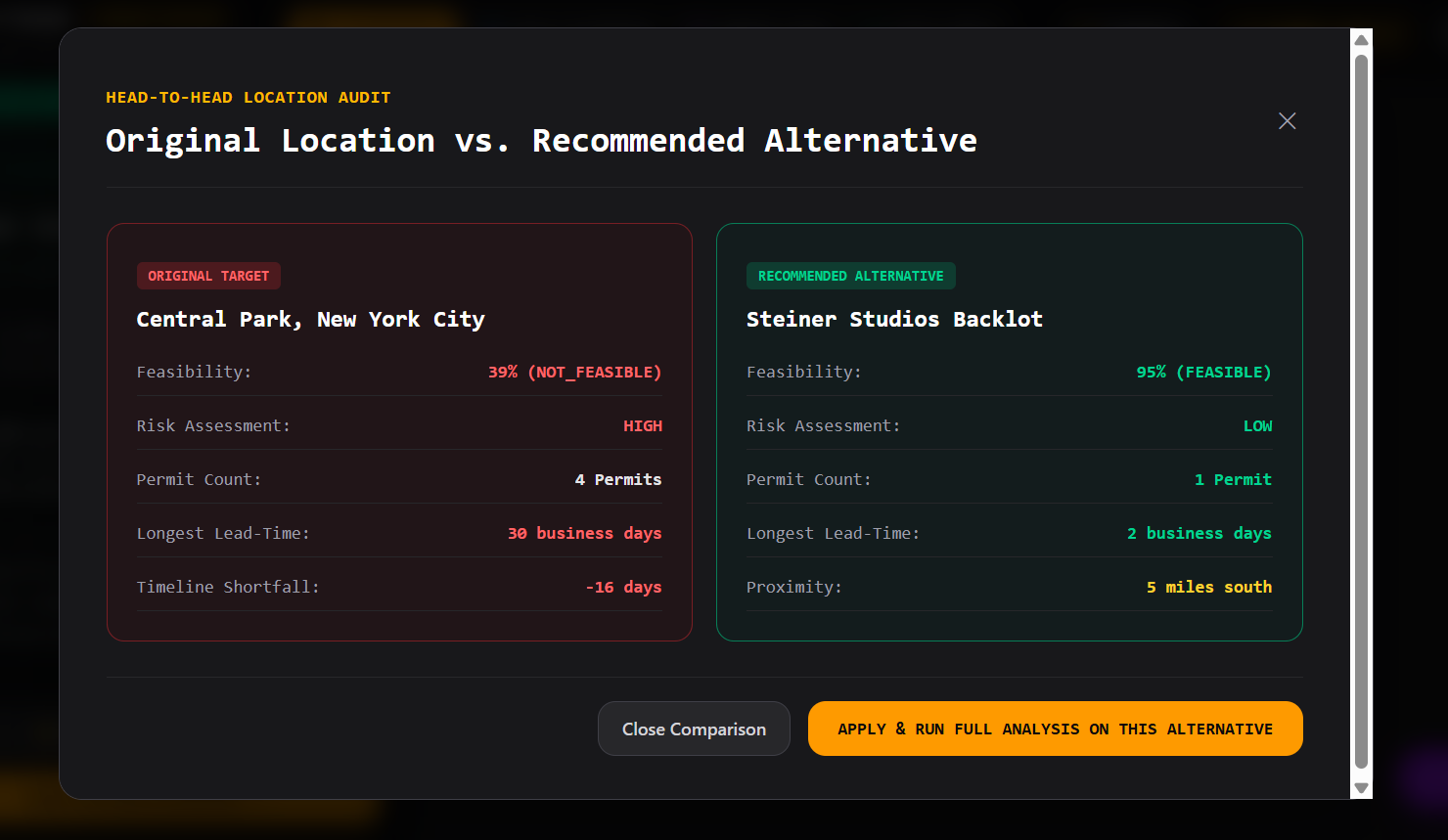
Comparative Analysis

Inspiration
Every independent filmmaker, commercial producer, and location scout has experienced the same nightmare: you scout the perfect cinematic location, hire cast and crew, lock in rental gear, and show up on shoot day—only for local authorities or the police to shut the production down because of an obscure municipal permit turnaround, an unfiled FAA drone waiver, or missing indemnification wording on a Certificate of Insurance (COI).
Navigating film permits is notoriously fragmented. Every municipality, park district, transit authority, and bridge commission maintains its own disjointed portals, archaic turnaround calendars, and strict insurance requirements. Independent filmmakers often lack the $10,000+ legal retainer or dedicated location team needed to parse city codes before committing budget.
We asked ourselves: What if an autonomous AI agent could act as your veteran Location Manager and Permitting Counsel? What if you could speak a location into your phone while scouting, and instantly know whether a site is legally, logistically, and temporally shootable before spending a single dollar?
That vision became PERMITTRON.
What It Does
PERMITTRON is an autonomous production feasibility and permitting intelligence engine:
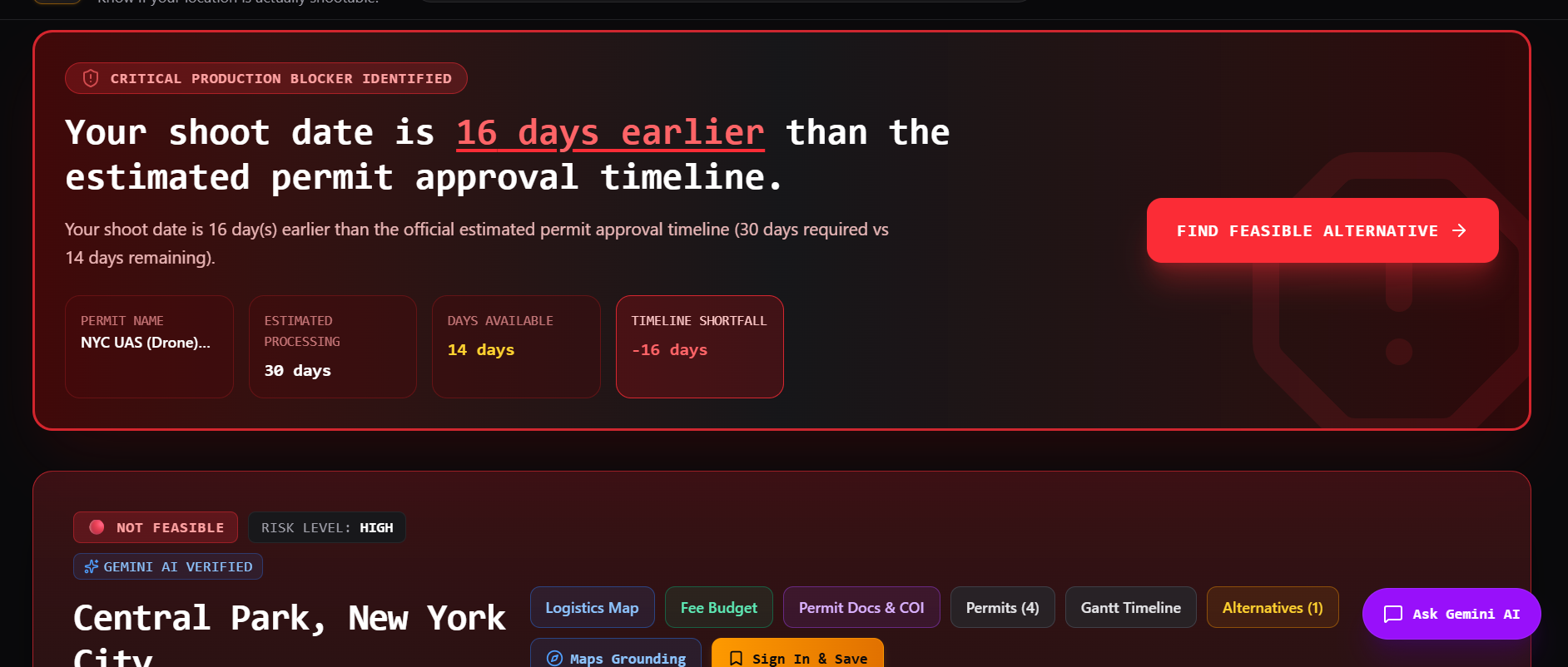
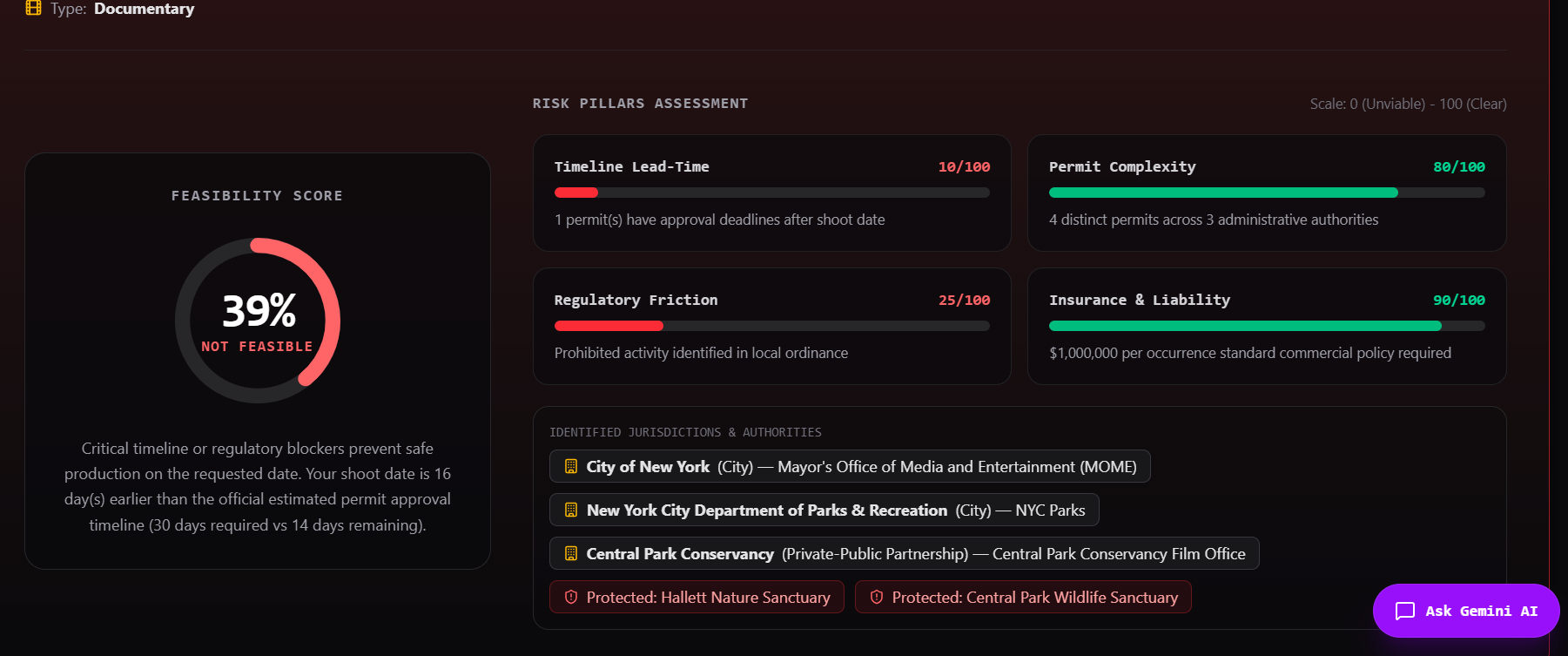
Instant Feasibility & Blocker Detection: In seconds, PERMITTRON synthesizes municipal codes, police film bureaus, and park rules to generate a comprehensive 0–100 Feasibility Score and identify critical "show-stoppers" (e.g., Insufficient turnaround time for NYC Parks, FAA Class B drone flight ceiling restriction).
Deterministic Timeline & Calendar Engine: Runs pure calendar date arithmetic against official agency processing lead times to calculate exact drop-dead filing deadlines, insurance binding dates, and community notice windows.
Automated Legal Document Rider Package: Automatically drafts four ready-to-submit legal documents:
- Official Municipal Film Permit Application Rider
- Certificate of Insurance (COI) Specification with verbatim Additional Insured and Primary & Non-Contributory clauses
- Location Safety & Emergency Action Protocol (EAP)
- 48-Hour Community Notification Notice for surrounding residents
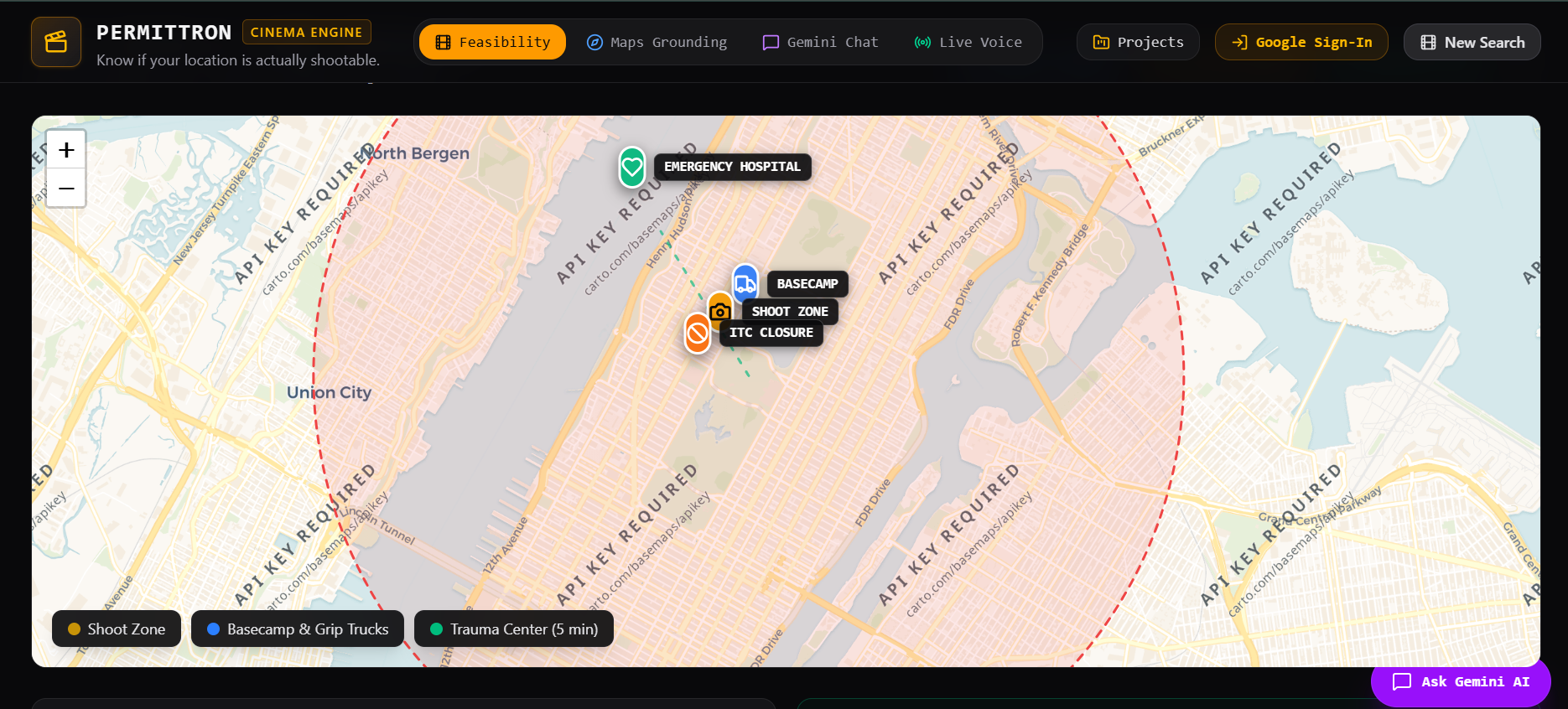
Spatial Logistics Map & Trauma Routing: Employs interactive GIS mapping to position equipment load-in zones, grip truck parking, and identify the nearest emergency hospital / Level II trauma center with drive times and direct emergency contacts.
Hands-Free Scouting with Gemini Live API: Scouts on location can use multimodal voice recording or live, bidirectional audio over WebSockets to ask questions hands-free ("Can we shoot with handheld lights past 10 PM here?") and get immediate verbal answers.
Low-Friction Alternative Locations: If a chosen location is flagged as Not Feasible or At Risk, the system recommends nearby visually comparable alternatives with faster turnaround and lower fees.
How We Built It
We engineered PERMITTRON as a full-stack, agentic system combining real-time web retrieval, deterministic calculation, and multimodal foundation models.
1. The Autonomous Agent Pipeline
- Parallel Web Search Engine: Executes concurrent municipal queries via the
parallel-webSDK across city archives, film commission portals, and administrative codes. - Unified Gemini Synthesis (
gemini-3.8-flash): Extracts administrative jurisdictions, mandatory permit forms, fees, curfews, decibel limits, and insurance tiers. - Google Maps Grounding: Integrates verified municipal film offices, police precincts, and basecamp parking facilities directly with official Google Maps links.
- Gemini Live API (
gemini-2.5-flash-native-audio-preview): Streams bidirectional 16kHz PCM audio over native WebSockets for ultra-low latency voice scouting.
2. Mathematical Feasibility Scoring Model
Rather than allowing an LLM to hallucinate risk ratings, PERMITTRON computes the overall location feasibility score \(S_{\text{feasibility}}\) deterministically using a weighted penalty model across four risk pillars:
$$ S_{\text{feasibility}} = \max\left(0, 100 - \sum_{i \in \mathcal{P}} w_i \cdot \Delta_i\right) $$
Where:
- \(\mathcal{P} = {\text{Timeline}, \text{Permits}, \text{Regulations}, \text{Insurance}}\)
- \(w_{\text{timeline}} = 0.35\)
- \(w_{\text{permits}} = 0.25\)
- \(w_{\text{regulations}} = 0.20\)
- \(w_{\text{insurance}} = 0.20\)
For timeline risk, PERMITTRON compares the calendar margin between available days \(D_{\text{avail}}\) and the agency processing requirement \(D_{\text{proc}}\):
$$ \Delta_{\text{timeline}} = \begin{cases} 0 & \text{if } D_{\text{avail}} \ge D_{\text{proc}} + 5 \ 40 & \text{if } D_{\text{proc}} \le D_{\text{avail}} < D_{\text{proc}} + 5 \ 85 & \text{if } D_{\text{avail}} < D_{\text{proc}} \text{ (Critical Blocker)} \end{cases} $$
The remaining risk pillars account for:
- Permits: Number of overlapping jurisdictional agencies and fee thresholds.
- Regulations: High-friction requirements such as drone operations, night curfew violations, and road closures.
- Insurance: General liability coverage gaps compared with municipality requirements.
3. Architecture Stack
- Frontend: React 19, TypeScript, Tailwind CSS, Motion, and Leaflet GIS mapping.
- Backend: Node.js & Express bundled into an optimized CommonJS distribution via
esbuild. - Database & Auth: Google Cloud Firestore with strict security rules (
firestore.rules) and Firebase Authentication for saving project dossiers.
Challenges We Faced
Eliminating Hallucinations in Date Calculations: Early prompts attempting to calculate business-day lead times within LLM generation occasionally produced hallucinations on leap years or holidays. We solved this by creating a Deterministic Timeline Engine in TypeScript that handles calendar math and passes structured date boundaries into the prompt context.
Handling Upstream Rate Limits & Quotas: Real-time research across multiple web endpoints and grounding tools can easily exhaust API rate limits during rapid exploration. We built an in-memory query cache and structured fallback system, ensuring the app can continue providing useful film-office information even under network constraints.
Full-Duplex Audio over WebSockets: Synchronizing the client-side Web Audio API (Float32 to Int16 PCM conversion at 16,000 Hz) with the Gemini Live API required careful buffer management to avoid audio stuttering during live, hands-free scouting sessions.
What We Learned
Hybrid AI Architectures Win: Combining deterministic mathematical algorithms for dates, distances, and liability numbers with generative AI for qualitative code interpretation and document drafting creates a more reliable production system.
Location Scouting Demands Hands-Free UI: Location scouts are on their feet, walking through active city streets, holding viewfinders or camera rigs. Building the hands-free Gemini Live voice interface demonstrated how natural voice interaction can be for this workflow.
Municipal Codes are Ripe for AI Assistance: Municipal laws are public information but are often buried within PDF forms, government portals, and obscure ordinances. Agentic search can help transform this fragmented information into actionable production intelligence.
Deterministic Logic Matters: Critical calculations such as permit deadlines should not depend entirely on an LLM. Separating deterministic calculations from generative reasoning made PERMITTRON more reliable and explainable.
What's Next for PERMITTRON
Direct Municipal API Filing: Partnering with municipal film commissions to automatically dispatch finalized permit applications through supported city e-filing APIs.
Drone Flight Path Geofencing: Integrating 3D FAA sectional aeronautical charts with real-time NOTAM (Notice to Air Missions) alerts directly into the GIS map.
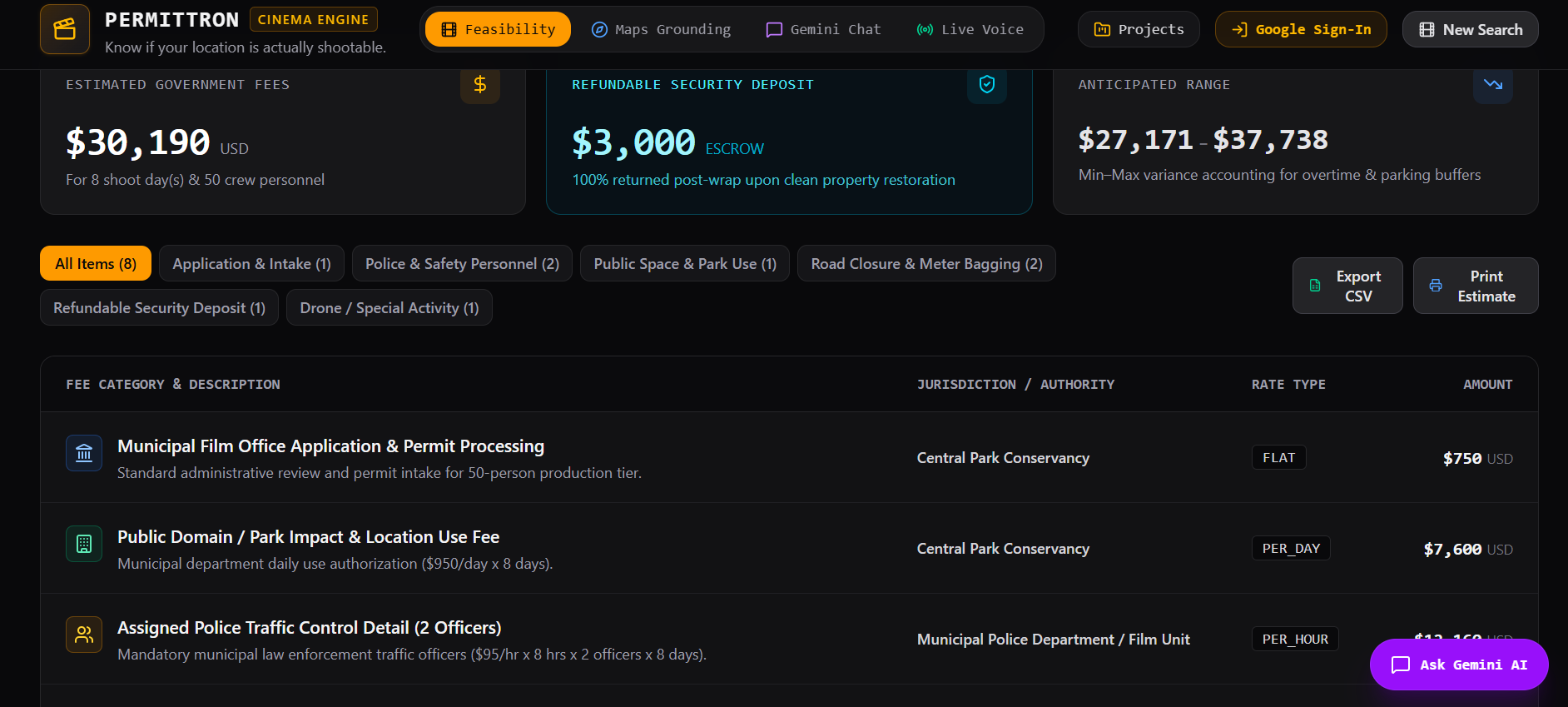
Budget Risk Forecasting: Modeling expected permit expediting fees, police detail hourly billings, parking costs, and other regulatory expenses into automated production budget line items.
Expanded Location Intelligence: Extending PERMITTRON to more cities, agencies, and production jurisdictions.
Collaborative Production Dossiers: Allowing producers, location managers, and other crew members to collaborate on the same permitting workflow.
Our Vision
PERMITTRON aims to turn one of filmmaking's most fragmented and stressful workflows into an intelligent, actionable process.
Instead of spending hours navigating government portals, permit documents, insurance requirements, and production restrictions, filmmakers can start with one simple question:
"Can we actually shoot here?"
PERMITTRON works toward giving them the information they need to answer it before the cameras start rolling.
Built With
- express.js
- firebase
- firestore
- google-gemini
- google-maps
- leaflet.js
- multimodal-ai
- node.js
- parallel-web-search
- react
- tailwindcss
- typescript
- vite
- web-sockets

Log in or sign up for Devpost to join the conversation.