-
-
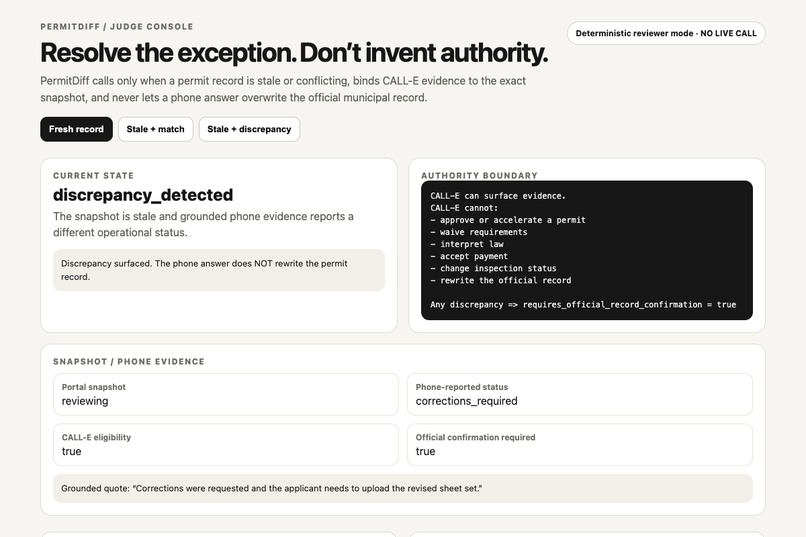
A grounded CALL-E answer creates an evidence-bound discrepancy without overwriting permit truth.
-
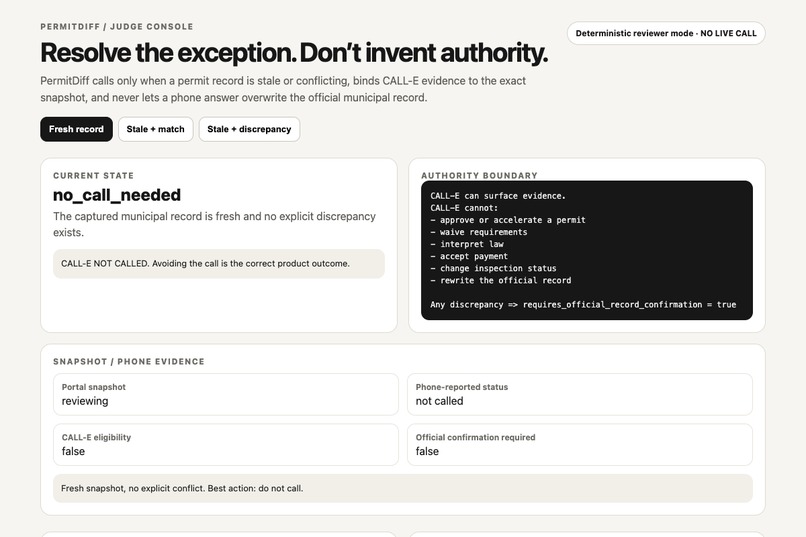
Exception-first triage: fresh records avoid calls; stale or conflicting records become eligible.
The problem
Construction teams already have permit portals. The expensive part is the exception layer: a record is stale, another communication conflicts with it, or the procedural next step is unclear. A human then stops work, calls the office, repeats the permit identifier, writes down status and missing items, and still has to decide whether anything officially changed.
PermitDiff is not a phone bot for polling government offices. It is an exception resolver.
The judge-visible outcome
The product has three states:
- Fresh record →
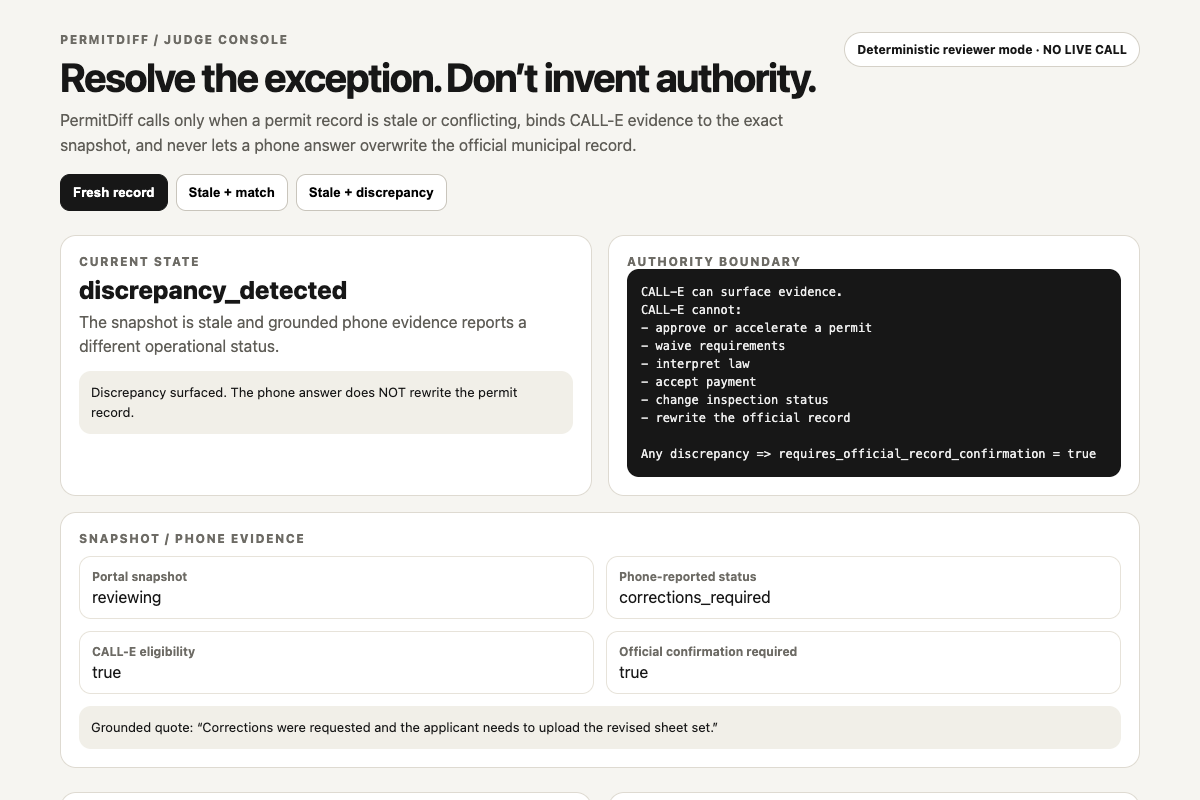
no_call_needed. CALL-E is visibly not called. - Stale + grounded match →
verified_match. - Stale + grounded discrepancy →
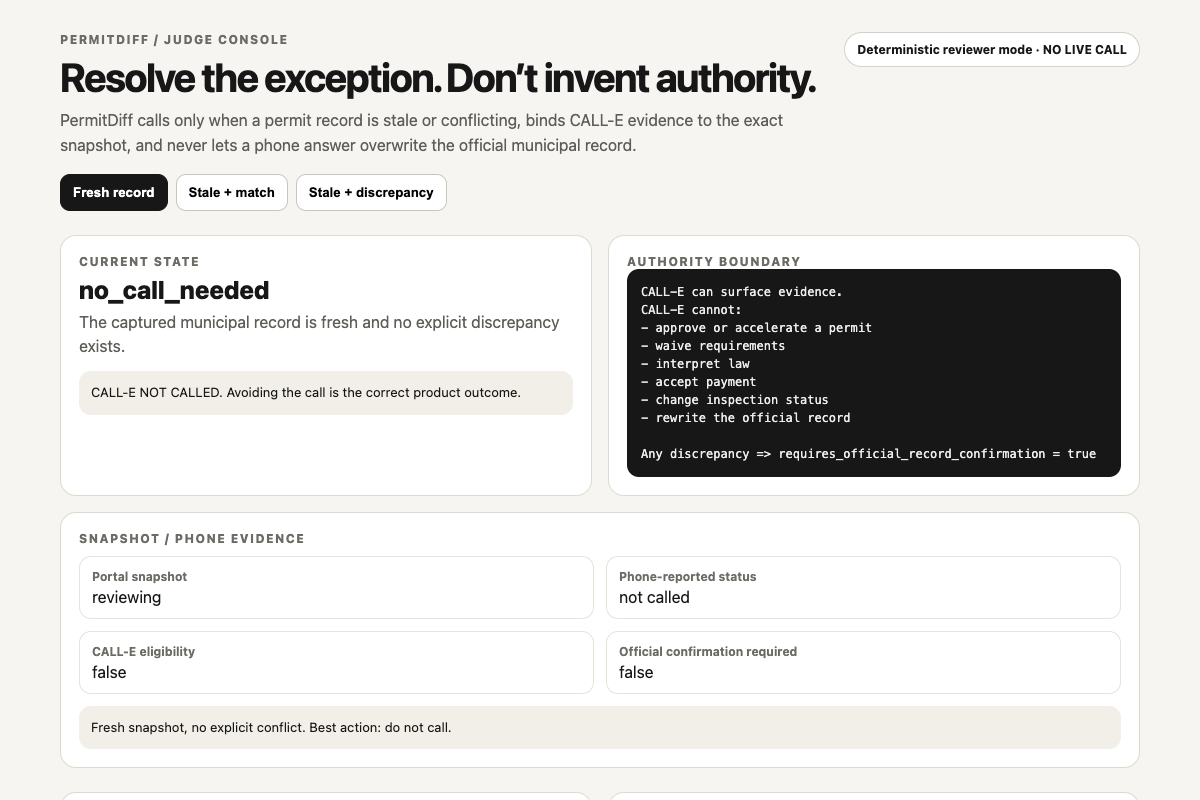
discrepancy_detected, while official confirmation remains required.
The best outcome is often doing nothing. Product value begins with calls avoided.
Demo: https://permitdiff.vercel.app
How it works
PermitDiff first evaluates a deterministic no-call gate against a frozen permit-portal snapshot. Only staleness or an explicit applicant-side conflict makes one authorized CALL-E call eligible.
For an eligible exception, CALL-E asks only for factual information tied to the exact permit ID:
- current office-reported status
- known missing items
- next procedural step
- reported inspection readiness
The call is explicitly forbidden from requesting approval, acceleration, waivers, legal interpretation, payment, inspection changes, or commitments.
The returned evidence must bind to the accepted CALL-E call ID, exact destination, jurisdiction, permit ID, snapshot hash, and recipient-side transcript quotes.
Then PermitDiff computes the diff.
Phone evidence can reveal a discrepancy. It cannot acquire administrative authority. Even if a person says “issued” on the phone, PermitDiff does not rewrite the portal or declare the permit legally effective.
Product surface
Instead of a chatbot, PermitDiff is designed around an exception queue:
- GREEN — current, no action
- STALE — call eligible
- CONFLICT — evidence required
- WAITING — official confirmation
A judge can immediately see what needs attention, what does not, and why.
Technical implementation
- Published CALL-E Python SDK on the live execution path
- Deterministic freshness/conflict gate
- SHA-256 identity for the frozen portal snapshot
- Strict structured result schema
- Exact call/destination/jurisdiction/permit/snapshot binding
- Recipient-side quote grounding
- Applicant-side authorization and exact destination allowlist
- Durable SQLite reservation before dispatch
outcome_unknownafter ambiguous provider outcomes; automatic redial blocked- Fail-closed routing for wrong permit, wrong destination, low confidence, incomplete schema, voicemail/refusal, or ungrounded evidence
PR: https://github.com/CALLE-AI/awesome-phone-call-agents/pull/199
What makes it different
A generic office caller tries to place a call successfully.
PermitDiff first asks whether a call should happen at all. Its trigger is the state of a specific frozen public record; its output is an evidence-bound diff; and downstream authority stays with the municipality or authorized human process.
Real-world validation boundary
A live pilot requires an applicant-side participant who is actually authorized for the exact permit case. The pilot should measure:
- calls avoided by the no-call gate
- calls placed
- answered / no-evidence outcomes
- discrepancies surfaced
- operator minutes displaced
- duplicate-call rate
It should not claim faster approvals or better permit outcomes without evidence.
Why it is worth building
Portals solve the normal case. PermitDiff targets the expensive exception: when the digital record and the human process no longer agree.
Built With
- call-e
- html
- javascript
- pytest
- python
- sqlite
- vercel

Log in or sign up for Devpost to join the conversation.