-
-
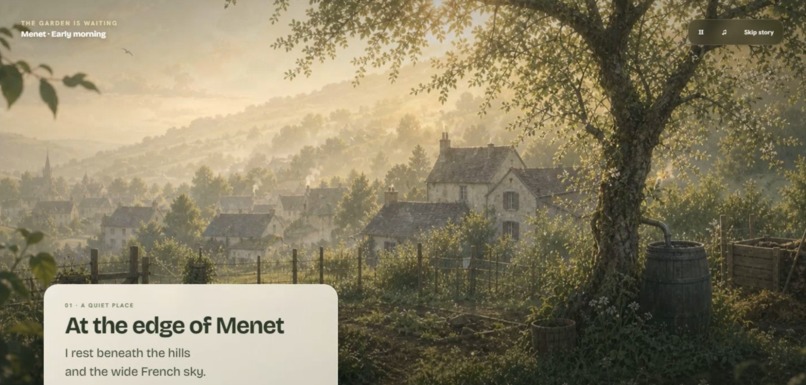
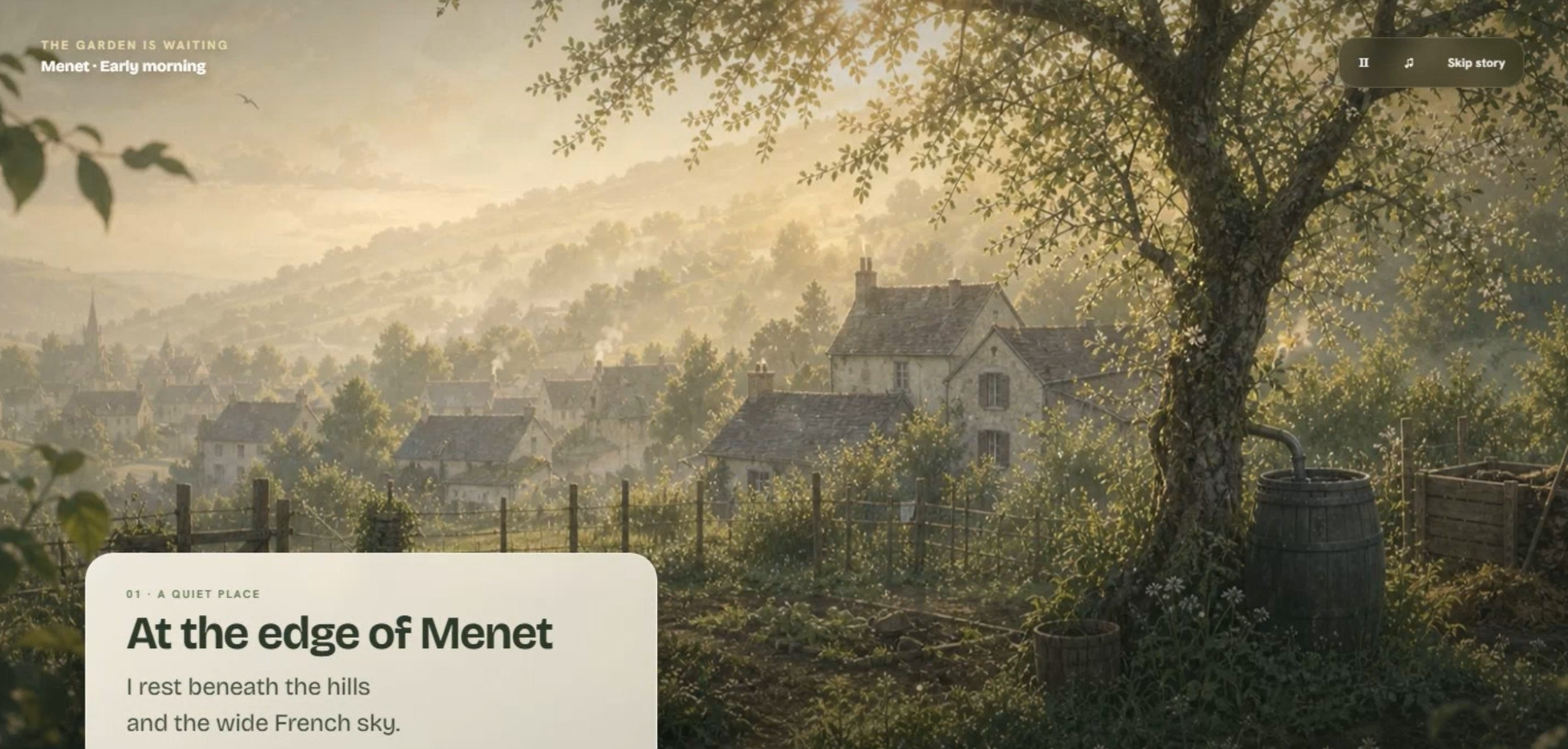
The Garden of Menet opens the story and welcomes the player.
-
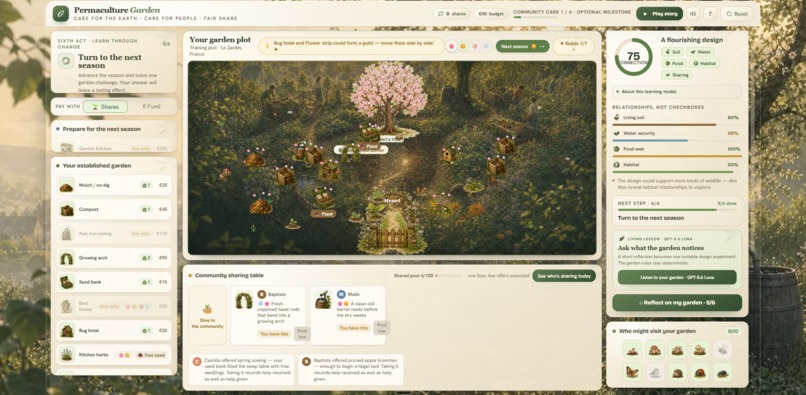
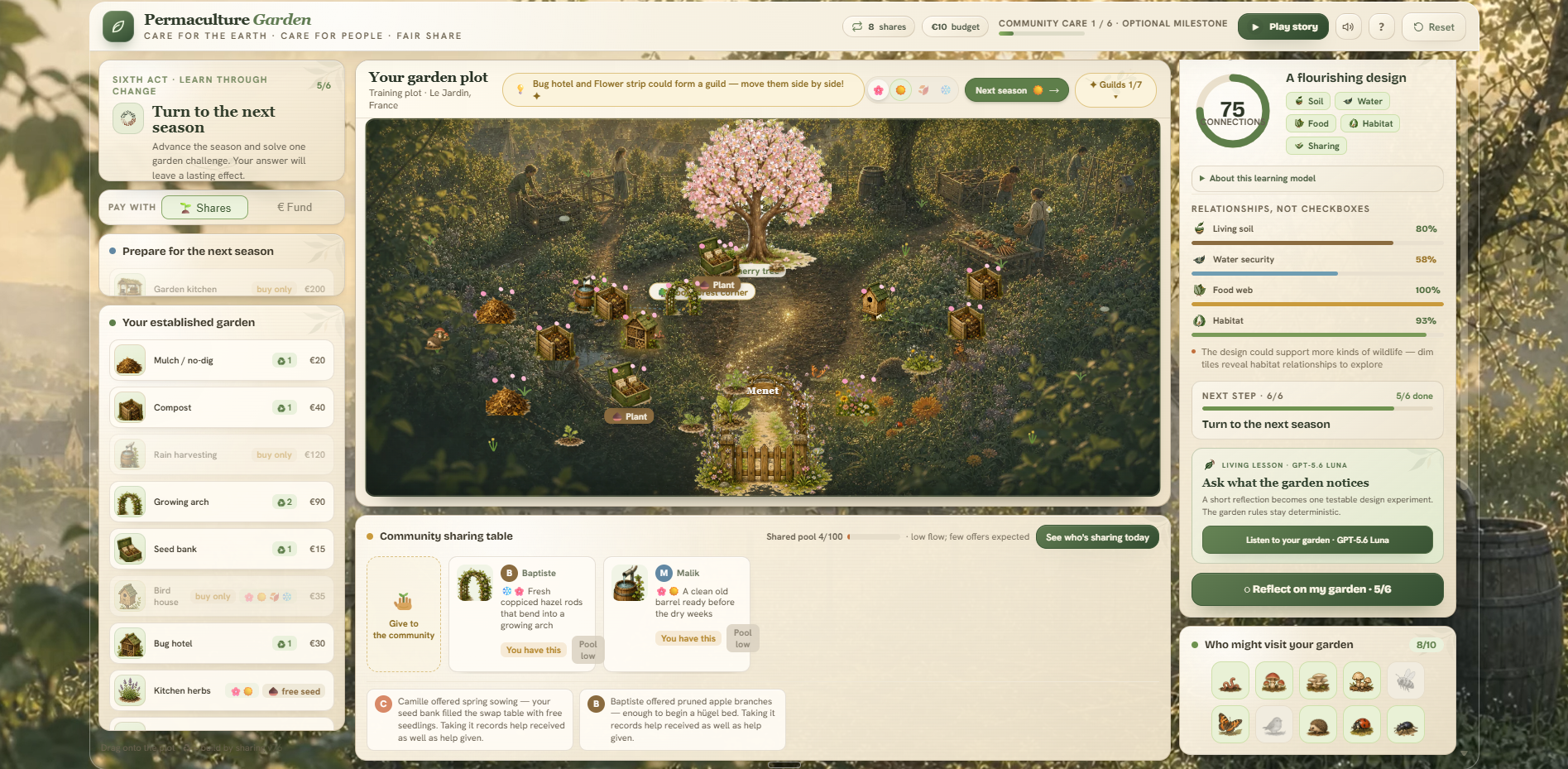
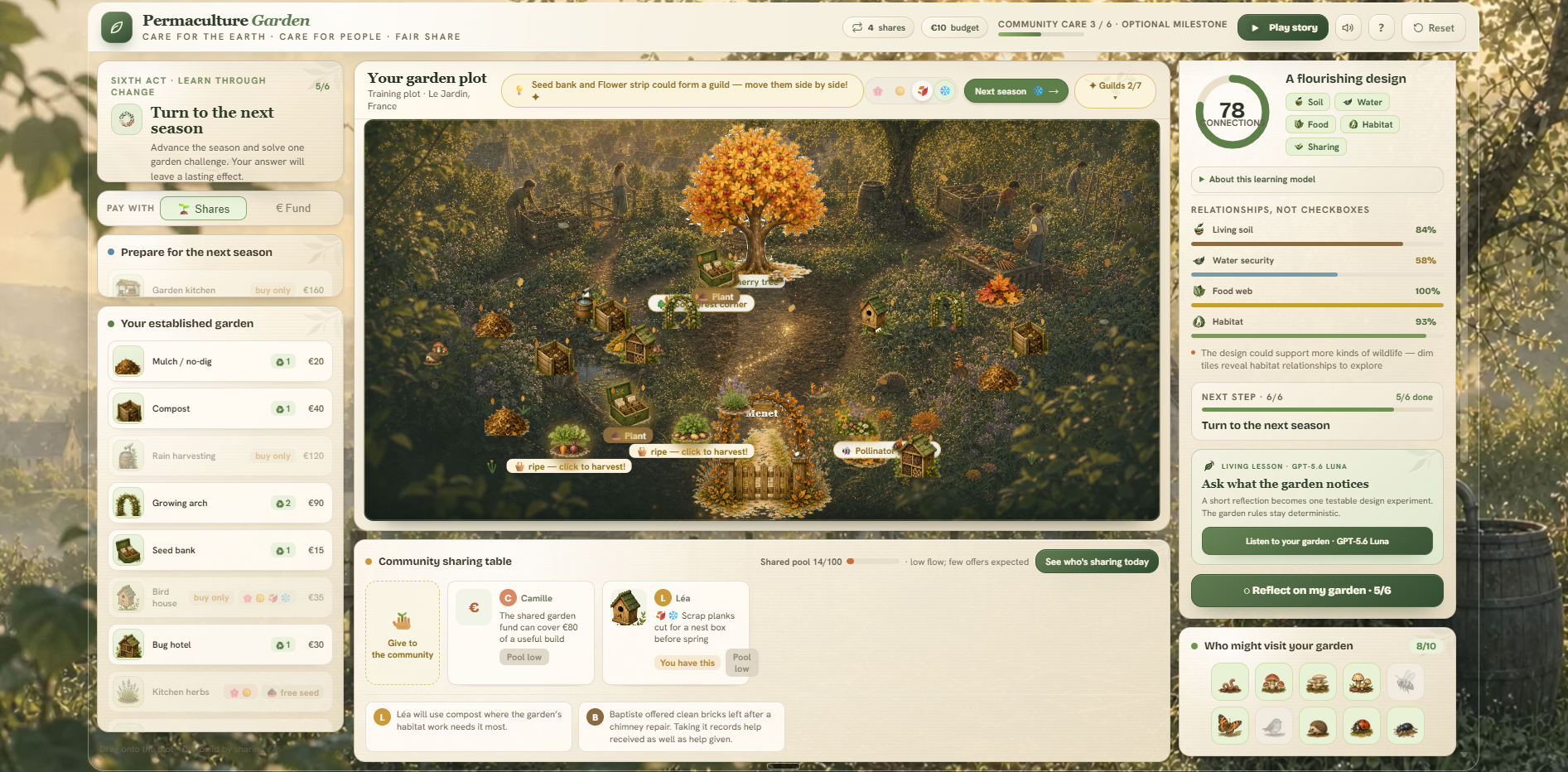
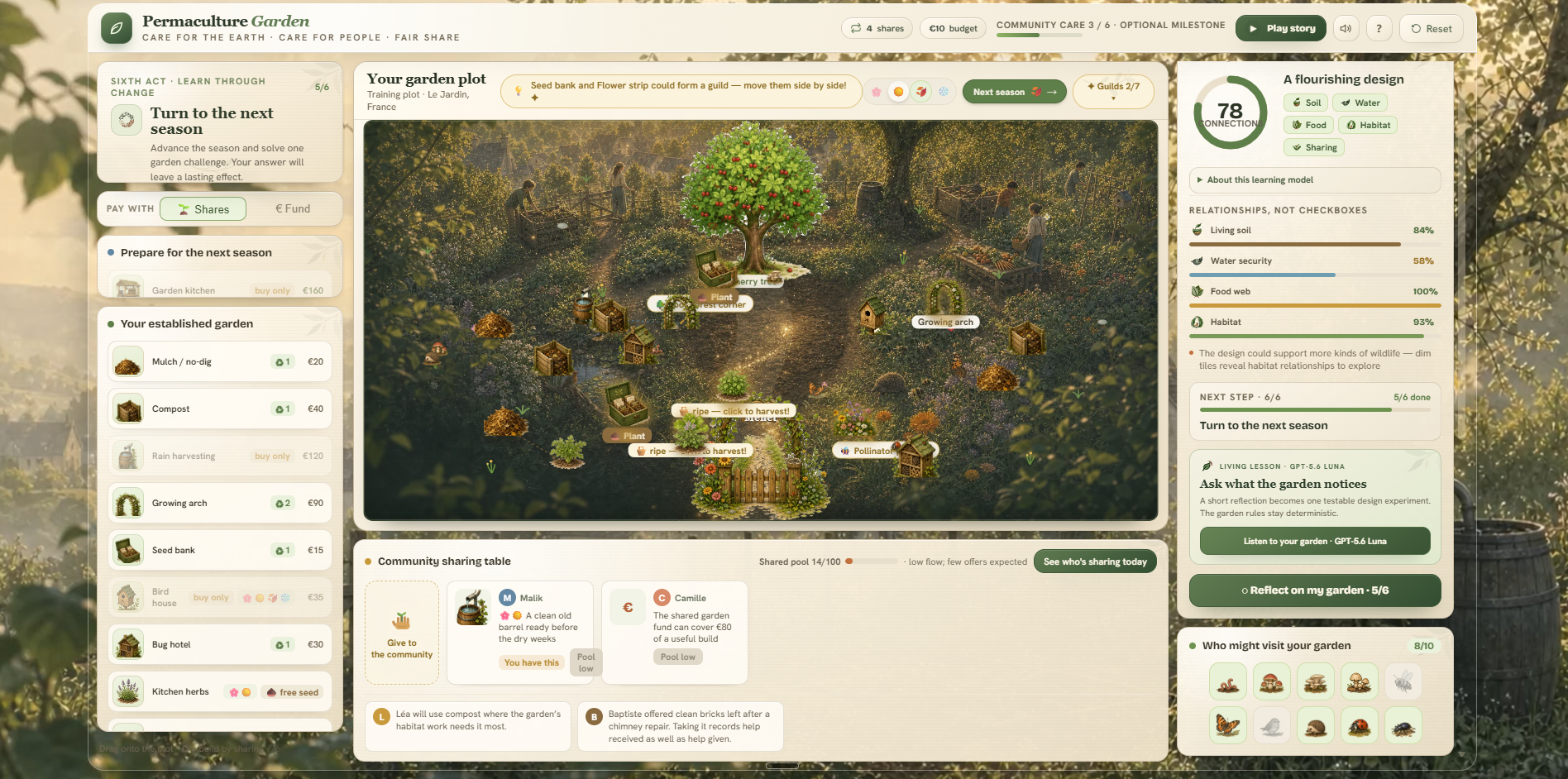
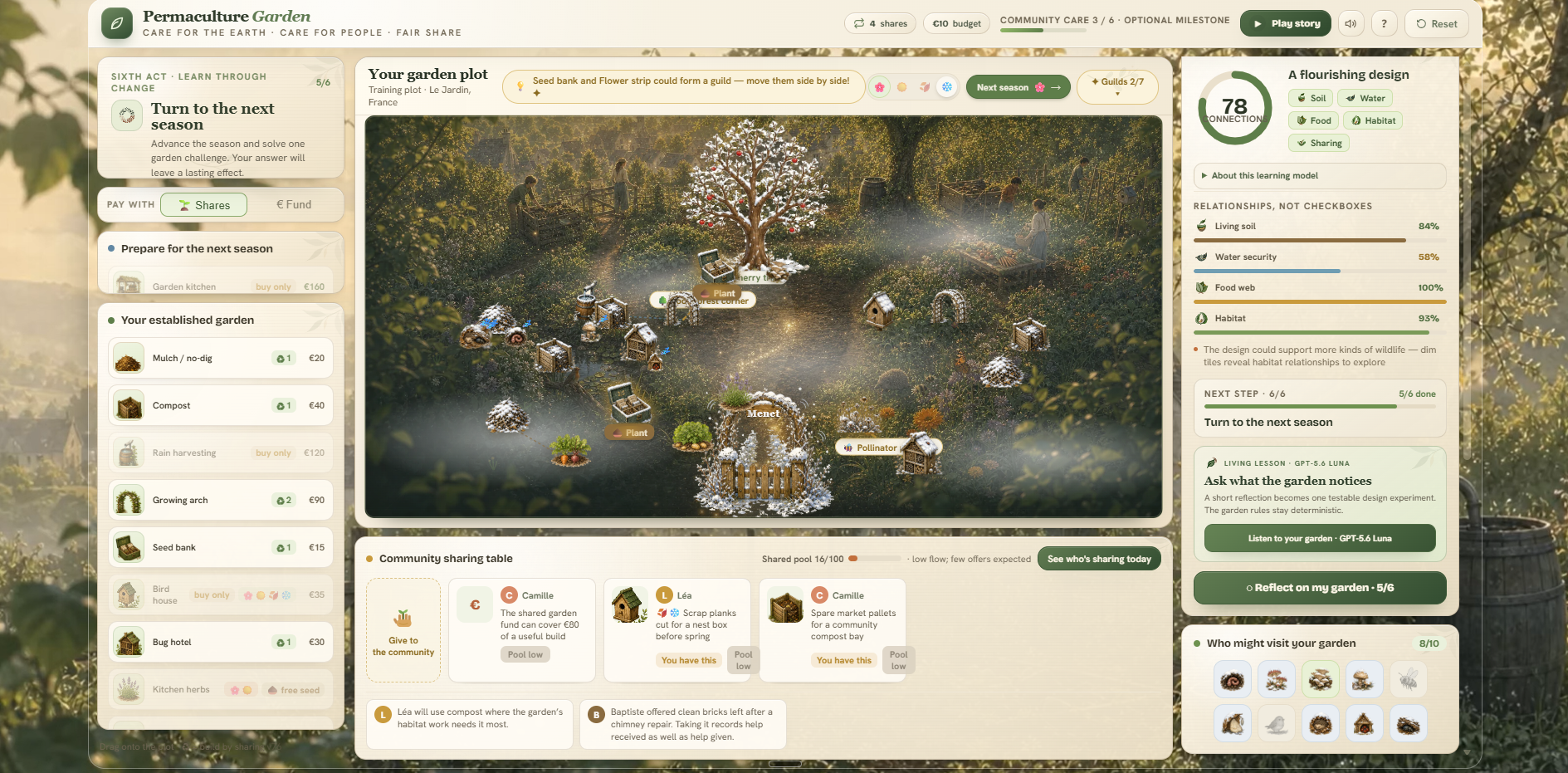
Guided garden view: seasonal systems, challenges and community sharing.
-
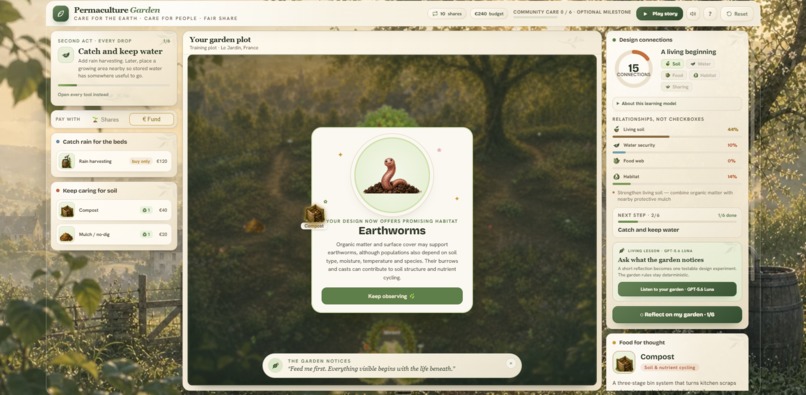
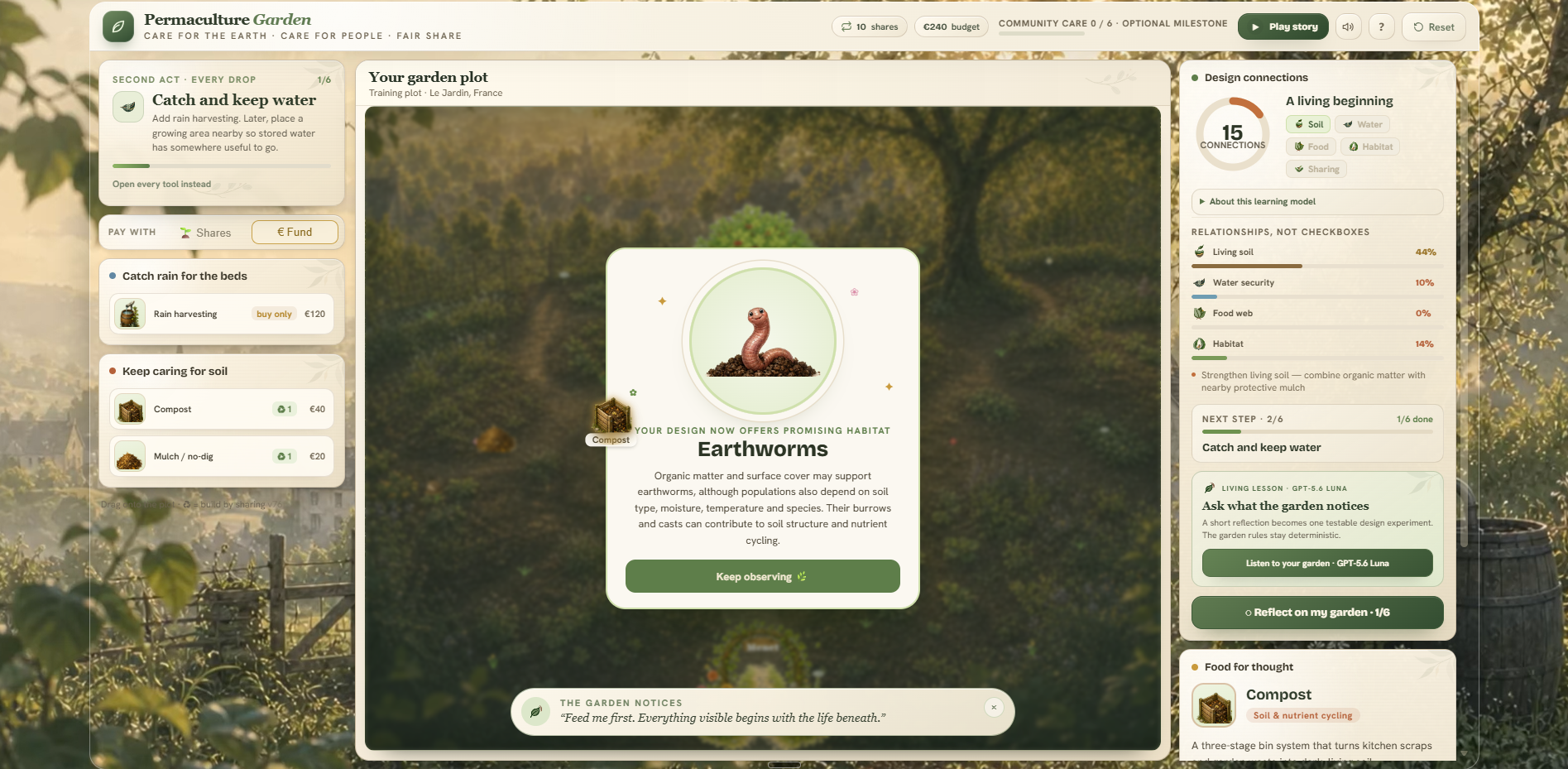
A new resident has joined the garden! :)
-
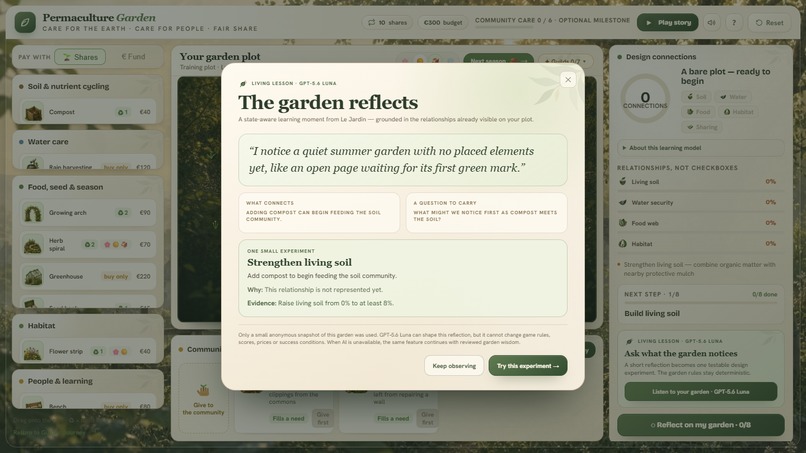
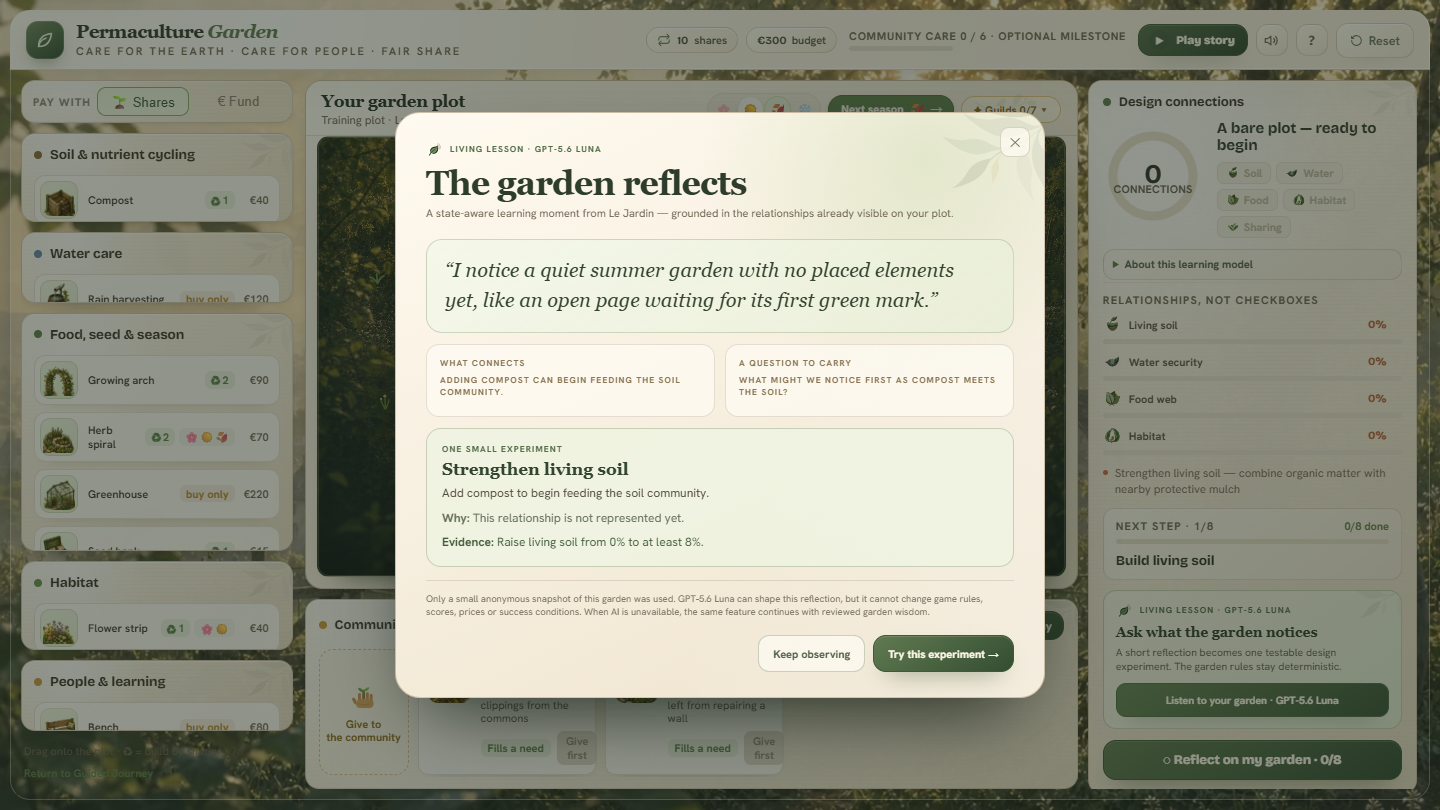
GPT-5.6 Luna turns the current garden into a measurable Living Lesson.
-
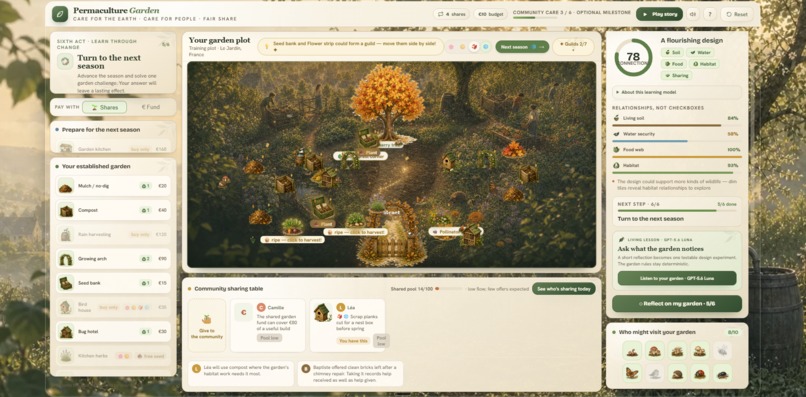
Fall in the garden.
-
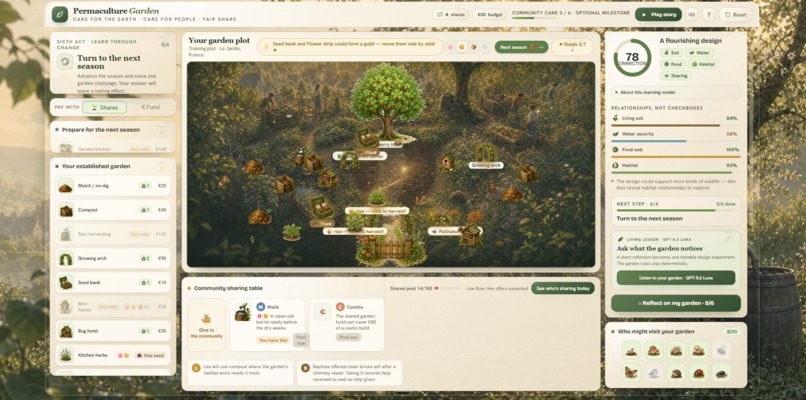
Summer in the garden.
-
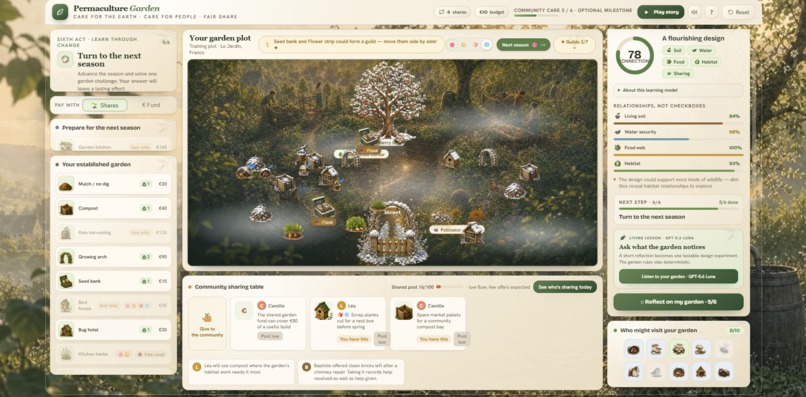
Winter in the garden.
-
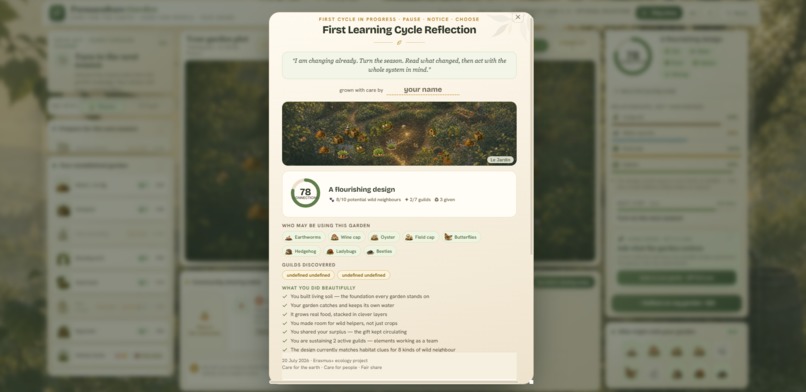
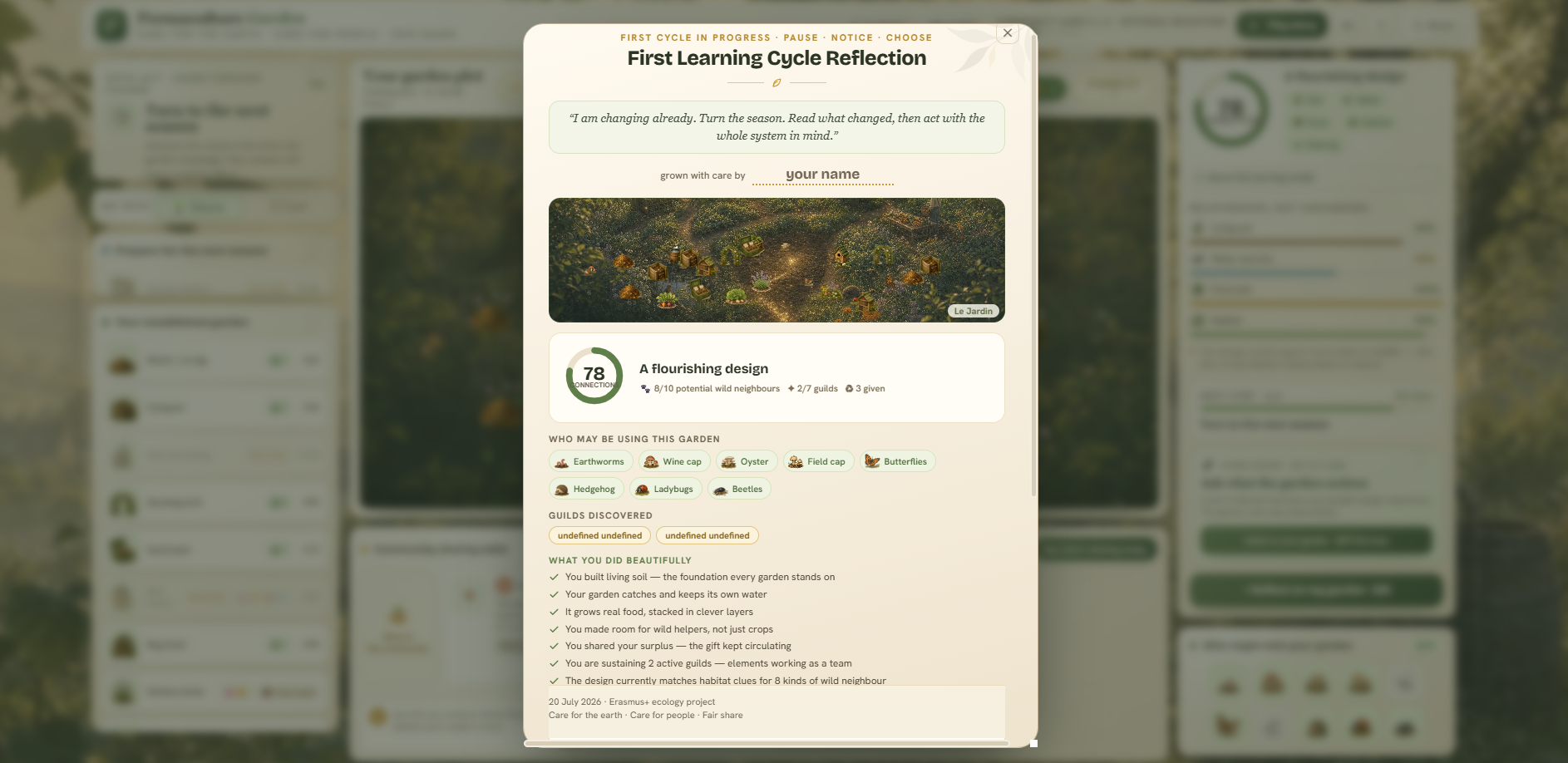
Final reflection with a certificate.
Inspiration
Permaculture Garden began with a real place. My partner Vanda joined an Erasmus+ volunteering programme in the small French village of Menet, where she and a group of young people helped care for a permaculture garden and learned about ecology by working together.
I wanted to create something for a community like theirs: not a textbook that explains permaculture from a distance, but a beautiful space where a young person can try relationships, watch seasons change, make a recoverable mistake and understand why a garden works as a system. The longer-term vision is to adapt the experience for schools, youth programmes, environmental organisations and other community projects exploring ecology and social cooperation.
What it does
The player enters through a short story narrated in the first person by the Garden of Menet. They build across soil, water, food and habitat, discover beneficial guilds, welcome wildlife, grow and preserve harvests, and share real surplus with a community table.
Four seasons change what can grow, be harvested, preserved or protected. Eleven learning challenges turn water retention, compost balance, winter shelter, seed selection and pollinator continuity into practical decisions. Wrong answers provide a useful clue and invite another attempt instead of ending the lesson.
The Garden Reflects — Living Lesson connects GPT‑5.6 Luna to the player’s current system. It observes a bounded anonymous snapshot, selects one approved experiment, explains one relationship and asks a question in the voice of the garden. If the player accepts, game logic tracks the real change and records evidence when the experiment succeeds.
How we built it
The game is a local desktop browser experience generated from an editable design component source into a static React build (phone version is planned in the future). It runs on Vercel, stores progress locally and requires no account. A Vercel Function provides the only server boundary for GPT‑5.6 Luna through Vercel AI Gateway.
Codex was my primary engineering tool collaborator during Build Week. I supplied the real-world context, learning goals, ethical boundaries, narrative direction and visual taste. With Codex I created and audited the earlier prototype, redesigned every minigame, built progression and community sharing, added cinematic onboarding and organic audio, hardened accessibility and state recovery, created automated regression journeys, and designed and verified the Living Lesson.
I wanted the AI to support the learning experience without controlling the game itself. The game first creates a small set of safe, measurable experiments. GPT‑5.6 then chooses one and explains it in a natural way, but it cannot create new rules, change the currency, give rewards, or decide whether the player succeeded. Its response is checked by the server, while the actual result is always evaluated by the game’s regular code.
The model also does not receive the player’s name, written reflections, or complete save file. Responses are cached for the same relevant garden state, with limits on requests and token usage. Authentication is handled securely through Vercel using OIDC. If the AI or credits are temporarily unavailable, the game switches to a reviewed offline lesson, so the educational experience can continue without interruption—and the player is clearly told that it is running offline.
Challenges we ran into
One of the hardest parts was making all the pieces feel like one game. The early prototype already had many ideas, but seasons, wildlife, guilds, narration, saving, resetting and the sharing system did not always work smoothly together. Codex helped me test different paths through the game and find problems that I would not have noticed on my own.
Getting the tone right was also important to me. I wanted the garden to feel warm and a little magical, but not vague or overly sentimental. Even when it speaks poetically, each Living Lesson still leads to something the player can observe, try and measure in their own garden.
Accomplishments that we’re proud of
- The player receives a reflection about their own garden, takes an action and can produce lasting evidence of learning.
- Gifts contribute to a community fund but never convert directly into personal currency.
- Eleven minigames teach through feedback and revision rather than timers or punishment.
- The experience has a coherent watercolour world, an original garden narrator, seasonal audio (made by Codex via ElevenLabs connection) and accessible subtitles.
- GPT‑5.6 Luna is embedded directly in a learning loop rather than presented as a generic chatbot.
What’s next
The next planned phase is real playtesting with young people and facilitators connected to community gardening (among them the real volunteers from the actual Menet garden project). Their feedback will guide pacing, terminology and lesson structure. We then want to add language versions, mobile version, facilitator tools and a carefully designed shared mode for groups of 10–25 players. Longer term, schools and youth organisations could adapt the learning scenarios to their own local gardens while keeping the same systems-thinking foundation.
Built With
- claude
- codex
- elevenlabs
- gpt-5.6-luna
- javascript
- react
- vercel-ai-gateway
- vercel-functions
- zod


Log in or sign up for Devpost to join the conversation.