-
-
Homepage PERIVA
Inspiration
The main reason I built Periva was my mother. As she grew older and began experiencing perimenopause and menopause, I saw how confusing and difficult it could be to understand what was happening to her body.
I care deeply about women's health, and I wanted to build something that could make this stage of life easier to understand rather than something women simply had to “push through.” I wanted Periva to be intuitive, private, and engaging — a place where women can track their symptoms, recognize patterns, learn about their bodies, and feel more prepared when talking to healthcare professionals.
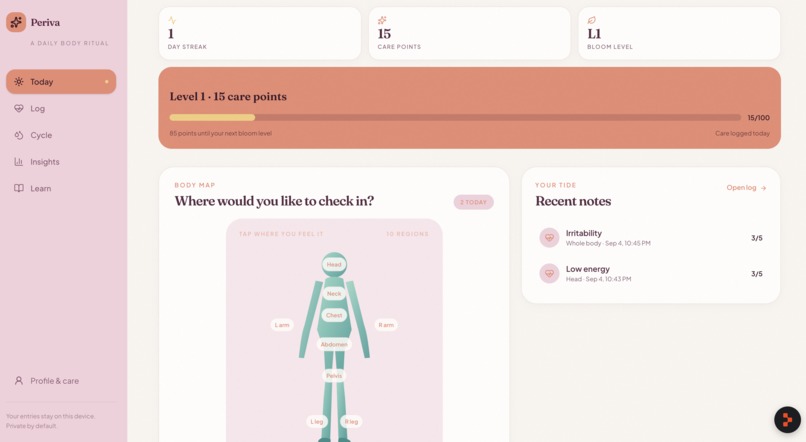
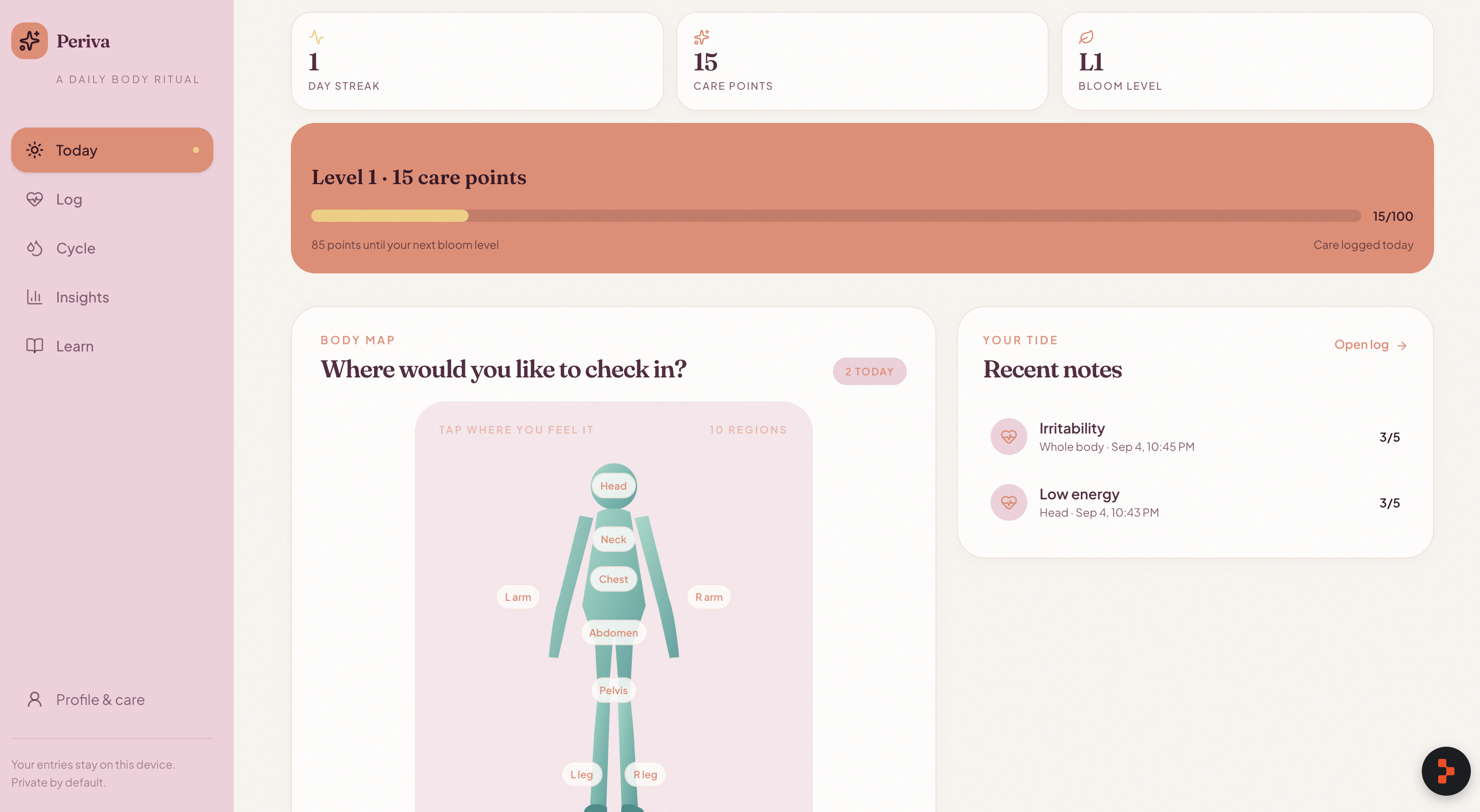
I also wanted to approach health tracking differently. Instead of creating another clinical-looking tracker, I introduced gamification through Care Points, Day Streaks, and Bloom Levels to encourage users to consistently check in with themselves.
I built Periva with the hope of turning something that can feel confusing and isolating into something women can understand, track, and take ownership of.
What it does
Periva is a daily perimenopause tracking and education app designed to help women understand the changes they experience during this stage of life.
Users can create a private account using their email and begin tracking their daily experiences through a simple 60-second check-in. They can record symptoms such as energy levels, mood, sleep, brain fog, hot flashes, night sweats, pain, stress, and more.
I also included an interactive Body Map, allowing users to identify where they are experiencing a symptom, record its intensity, add notes, and even log symptoms retrospectively.
For users who want more detail, I created a broader Symptom Library covering areas such as cognitive health, metabolic health, mood, sleep, and physical symptoms.
Users can also track their cycle, build a personal history of their experiences, and eventually use the collected information to identify patterns and have more informed conversations with healthcare professionals.
To make consistency easier, I introduced Care Points, Day Streaks, and Bloom Levels, turning daily self-care into an engaging experience.
How I built it
I built Periva around one core principle: health tracking should be simple enough to use every day, but detailed enough to actually be useful.
I designed the app with a clean, intuitive interface so that users can quickly check in without feeling overwhelmed by the amount of information they could potentially track.
I structured the experience around several key components:
- Secure account creation and login
- Today dashboard for daily tracking
- Interactive Body Map for location-based symptom tracking
- 60-second daily check-in
- Detailed Symptom Library
- Cycle tracking
- Care Points and Day Streaks
- Bloom Level progression
- Personal profile and customization
- Long-term symptom history and insights
I also based my design and feature decisions on research into perimenopause and the need for better ways for women to document symptoms over time.
Challenges I ran into
One of the biggest challenges I faced was figuring out how to balance simplicity with depth.
Perimenopause can involve a huge range of physical, emotional, cognitive, and lifestyle-related experiences. I wanted Periva to allow detailed tracking without making users feel like they were filling out a medical questionnaire every day.
Another challenge was designing gamification responsibly. I wanted streaks and points to encourage consistency without making health feel like a competition. This led me to focus on concepts such as Care Points and Bloom Levels, which frame progress around self-care rather than performance.
I also had to think carefully about privacy. Health information is deeply personal, so creating an experience where users feel that their information belongs to them was a major consideration throughout my design process.
Finally, translating a complicated health topic into an interface that someone could understand within seconds was challenging — but it was also one of the most important parts of the project.
Accomplishments I'm proud of
I'm proud that Periva goes beyond being another period-tracking application.
I created an experience specifically focused on the perimenopause journey, combining symptom tracking, cycle tracking, education, and gamification in one place.
I'm especially proud of the Body Map, because it makes symptom logging more intuitive and visual, and the 60-second check-in, because it makes consistent tracking feel achievable.
I'm also proud of creating a system where individual daily entries can eventually become a bigger picture of someone's health journey. Instead of remembering months of symptoms from memory, users can build a record over time that can help them better understand their experiences and communicate them to healthcare professionals.
Most importantly, I built Periva from a personal motivation — wanting to create something that could genuinely help my mother and other women going through the same experience.
What I learned
I learned that designing for healthcare isn't only about adding more information — it's about making the right information understandable and actionable.
I learned how important consistency is when collecting personal health data, and how good UX can make something as simple as checking in with yourself feel much easier.
I also learned that gamification can be meaningful when it is designed around encouragement rather than competition.
Most importantly, I learned that there is a huge difference between tracking data and helping someone understand their data. Periva is my attempt to bridge that gap.
What's next for Periva
My next step for Periva is to turn the information users collect into meaningful, easy-to-understand insights.
I envision interactive graphs and timelines that can help users identify changes and patterns across symptoms, cycles, sleep, mood, energy, and other areas.
I also want to expand the educational side of Periva so users can learn more about what they're experiencing and discover reliable, research-informed information in an accessible way.
Another major direction is improving the connection between users and healthcare professionals. In the future, Periva could generate clear summaries of a user's symptom history that they can choose to share during a medical appointment.
Ultimately, I want Periva to grow from a tracker into a personal health companion for the perimenopause journey — helping women track what they experience, learn about their bodies, recognize patterns, and feel more confident advocating for their health.
Built With
- coding
- lovable
- replit
- vibe


Log in or sign up for Devpost to join the conversation.