-
Poster

Inspiration
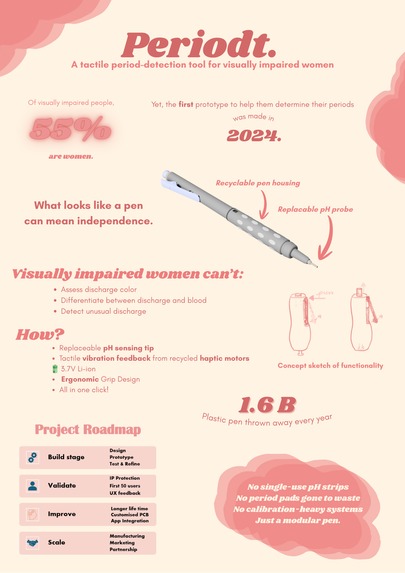
We learnt that 55% of the visually impaired population are women, and this prompted us to think about situations that all women experience - menstruation. How do they differentiate between normal discharge and blood? Further research uncovered a start-up called FlowSense, tackling a similar issue. To our surprise, this was the first and only venture aiming to solve this problem - and it was created in 2024. We realised that a gap exists in current technology: there is no way for visually impaired women to distinguish between their menstrual blood and discharge, certainly. On top of this, they have no way of telling if this is normal or abnormal.
A research study found that participants try to reduce the chance of leaking onto clothes or other surfaces by wearing a pad, or sometimes more than one at once, in advance of their period; “It might waste a few pads, but it saves the embarrassment of someone noticing.” Some also opted to wear dark clothing or two pairs of underwear in the days leading up to their period.
What it does
This project proposes a reusable, tactile assistive device designed to help visually impaired women identify menstrual blood and distinguish between normal and abnormal vaginal discharge. The device uses a contact-based pH probe to classify fluid type without relying on vision or disposable test strips. Results are communicated through intuitive haptic feedback, enabling private and independent use. Designed around circular economy principles, the probe can be washed and reused, the electronics are low-power and rechargeable via USB-C, and no single-use consumables are required. By combining proven pH sensing technology with inclusive, user-centred design, the device reduces waste, lowers long-term cost, and expands access to essential bodily health information.
How we built it
There are a lot of things in the world and it is our goal to re-use and re-purpose things rather than create new material. One large avenue of waste is through electronics. Present studies show that there is 62 million metric tonnes of e-waste generated every year. This sparked the idea of utilising coin vibration motors that are ubiquitous in smartphones to form the haptic technology of our device. For the case, we turned to the 1.6 billion plastic pens thrown away every year. By utilising the casing from these pens, we can turn end-of-life products into technology that can help women reclaim their independence surrounding such a personal topic.
Challenges we ran into
The hardest part of this designathon was choosing the topic we wanted to focus on. There are so many problems in the world that it is very easy to become indecisive, as they are all deemed important. This issue in particular was quite personal to the whole team, and so we chose it.
Accomplishments that we're proud of
We are proud of the fact that we identified this topic when it was so under-researched, and came up with a solution that is genuinely feasible. We carefully considered technical aspects such as power consumption, pH concentration, and cost per use, which further strengthened our concept.
What's next for PERIODT.
In the future, we aim to conduct user-incorporated feedback within our design and look at ways to reduce the price even further. This could be done through partnerships with factories to source raw material directly, as well as applying for grants that focus on femtech. Additionally, this device could be integrated with an app that tracks any changes in baseline discharge, to alert the user before the situation gets out of hand.
Built With
- canva
- inkscape
- inventor
- powerpoint
- smartdraw

Log in or sign up for Devpost to join the conversation.