Inspiration
Our inspiration for building Periodic Table of Elements Ultra (PTEU) arose from recognizing critical gaps in existing periodic table resources like PTable. Traditional tools often lacked accessibility for global users, struggled to make complex chemistry concepts intuitive, and failed to integrate interactive, hands-on learning features. We saw a need for a resource that would break down language barriers, transform abstract ideas (like atomic orbitals or periodic trends) into visual, engaging content, and serve the diverse needs of students, educators, and researchers—all while remaining completely free. Our goal was to create not just a reference tool, but a dynamic learning platform that makes chemistry accessible and engaging worldwide.
What it does
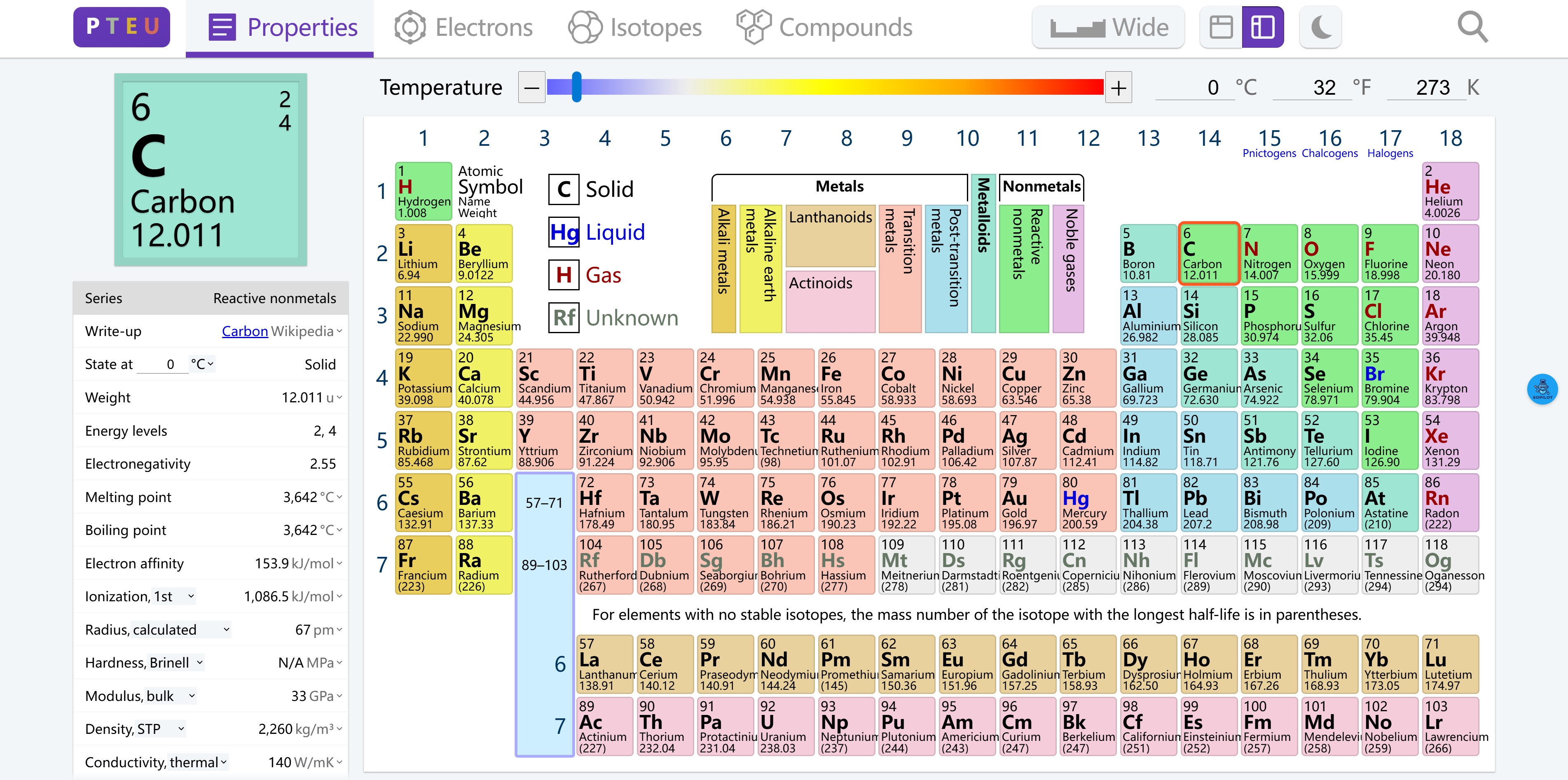
PTEU is the most comprehensive free interactive periodic table and chemistry resource, designed to empower learners and professionals across the globe. Its core functionalities include:
- Multilingual Accessibility: Offering content in 46 professionally translated, culturally adapted languages to ensure chemistry education is inclusive for users worldwide.
- Complete Element Data: Providing detailed, scientifically accurate information for all 118 elements—including physical/chemical properties, electron configurations, oxidation states, and historical context.
- Interactive Visualization Tools: Featuring 3D orbital models (to explain quantum mechanics), color-coded periodic trend charts (for electronegativity, atomic radius, etc.), and a virtual chemistry laboratory (for safe, simulated reactions).
- Advanced Research Resources: Hosting a comprehensive isotope database with half-life data, decay chains, and nuclear properties for scientific research.
- Cross-Device Access: Delivering a free web version, a PWA (Progressive Web App) for offline mobile use, and an upcoming desktop application—no registration required.
How I built it
- Data Sourcing & Validation: Partnered with chemistry educators, research institutions, and scientific databases to compile accurate data for 118 elements, their isotopes, and periodic trends. Every detail (from electron configurations to decay chains) was peer-reviewed to ensure scientific rigor.
- Multilingual Localization: Collaborated with professional translators and chemistry experts fluent in 46 languages to adapt content—avoiding literal translations and ensuring technical terms were consistent with regional educational standards.
- Development Stack: Built the platform using modern web technologies (HTML5, CSS3, JavaScript) with frameworks like React for interactivity. For 3D orbital visualization and virtual lab simulations, we integrated WebGL and physics engines to create smooth, responsive models.
- Accessibility & Cross-Device Design: Optimized the interface for all devices (desktops, smartphones, tablets) and developed a PWA to enable offline access. We also ensured compliance with accessibility standards (e.g., screen reader compatibility) for inclusive use.
- Content Structuring: Organized features into user-centric sections (element database, visualization tools, virtual lab) with intuitive navigation, making complex tools approachable for students and efficient for researchers.
Challenges I ran into
- Scientific Accuracy & Consistency: Maintaining precision across 118 elements, their isotopes, and 46 languages was daunting—discrepancies in technical terminology (e.g., "ionization energy" vs. regional equivalents) required constant alignment with global chemistry standards.
- 3D Visualization Complexity: Developing interactive 3D orbital models that were both scientifically accurate and easy to manipulate took extensive iteration—we had to balance quantum mechanics rigor with user-friendliness for students new to the concept.
- Offline Functionality (PWA): Ensuring the PWA retained full access to element data, 3D tools, and the virtual lab without internet required optimizing data storage (e.g., compressing 3D models) to avoid slow performance on mobile devices.
- Scaling for Global Users: Catering to 150+ countries meant adapting to varying internet speeds and device capabilities—we had to streamline code and prioritize loading essential features first for low-bandwidth regions.
Accomplishments that I'm proud of
- Becoming a Global Learning Hub: Gaining trust from millions of users across 150+ countries—from high school students studying for exams to researchers referencing isotope data—solidifying PTEU as a go-to alternative to paid tools like PTable.
- Industry-Leading Multilingual Support: Launching with 46 verified languages, making PTEU one of the most accessible periodic table resources worldwide and breaking down language barriers in STEM education.
- Engaging Interactive Tools: Receiving praise from educators for the 3D orbitals and virtual lab, which transform abstract chemistry into hands-on learning—many reported improved student engagement compared to traditional textbooks.
- 100% Free & Accessible: Maintaining full functionality (no paywalls, no registration) while delivering professional-grade features, ensuring chemistry education is accessible to users with limited resources.
What I learned
- The Power of User-Centric Science Education: Users (especially students) crave interactivity—abstract concepts like periodic trends become tangible when visualized. This reinforced that "showing, not just telling" is key to STEM learning.
- Localization > Translation: Literal translations of technical terms confuse users; partnering with language experts and chemists ensured content was both accurate and culturally relevant.
- Balancing Rigor & Accessibility: To serve both students and researchers, we needed to layer complexity—e.g., basic element properties for beginners, and advanced isotope data for professionals—without overwhelming either group.
- Technical Tradeoffs for Global Reach: Optimizing for offline use and low bandwidth required tough choices (e.g., compressing 3D models), but these compromises were critical to making PTEU accessible worldwide.
What's next for Periodic Table of Elements Ultra
- Launch Desktop Applications: Release native apps for Windows, macOS, and Linux with advanced features (e.g., custom trend analysis, data export for research papers) to serve professionals.
- Expand the Virtual Lab: Add more complex reactions, compound synthesis simulations, and real-time feedback (e.g., explaining why a reaction fails) to turn the lab into a full-fledged learning tool for high school and university courses.
- User-Generated Content: Introduce a community forum where educators can share lesson plans using PTEU’s tools, and students can ask questions—fostering collaboration across 150+ countries.
- AI-Powered Learning Assistants: Integrate a chatbot to help users navigate content (e.g., "Show me elements with +2 oxidation states") and explain complex concepts (e.g., "Why do atomic radii decrease across a period?") in simple terms.
- API for Educational Platforms: Develop an API to let schools, textbooks, and edtech tools embed PTEU’s element data and visualization tools directly into their curricula—expanding our impact in formal education.
Built With
- globle


Log in or sign up for Devpost to join the conversation.