-
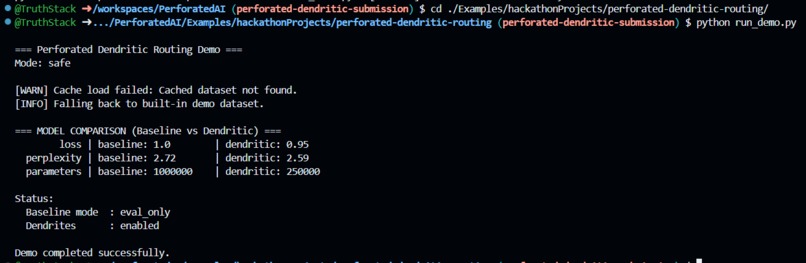
Baseline vs dendritic comparison from a single offline-safe demo run.

Inspiration
Modern neural networks apply the same computation to every input, regardless of whether all internal pathways are necessary. This is simple to implement, but inefficient and opaque.
We were inspired by biological neurons, where dendritic structures selectively route signals based on input. The question we explored was whether a similar idea could be demonstrated cleanly in PyTorch without rewriting models or relying on heavy infrastructure.
Rather than chasing scale, we focused on clarity: isolating the effect of dendritic routing itself and making it easy to reason about.
What it does
Perforated Dendritic Routing demonstrates conditional computation using a dendritic routing wrapper around an existing model.
The project runs the same data through:
- A baseline model
- The same model with dendritic routing enabled
It then compares metrics side by side to show how dendritic routing can reduce the number of active parameters while preserving overall behavior. The demo is deterministic, offline-safe, and designed to run with a single command.
How we built it
We structured the project as a small, modular pipeline:
- A dataset loader designed to be deterministic and offline-ready
- A baseline model used as an unmodified reference
- A dendritic wrapper that introduces conditional routing without changing the baseline
- A metrics viewer that compares results in a human-readable format
The key design choice was to treat dendritic routing as a drop-in mechanism rather than a new architecture. This allowed us to isolate its impact and avoid confounding factors like retraining or architectural changes.
Challenges we ran into
The main challenge was resisting scope creep.
It was tempting to add training loops, visualizations, or larger datasets, but doing so would have made it harder to isolate what dendritic routing was actually contributing. Another challenge was ensuring the demo would run reliably in constrained environments, which required careful handling of fallbacks and defaults.
Balancing simplicity with correctness was a constant trade-off.
Accomplishments that we’re proud of
- A clean baseline vs dendritic comparison with a single execution path
- A demo that runs fully offline and fails gracefully
- Clear separation of concerns between data, model, routing, and evaluation
- A submission that prioritizes reproducibility and reviewer clarity over surface complexity
Most importantly, the project shows the structural effect of dendritic routing without relying on heavy assumptions.
What we learned
We learned that demonstrating a concept clearly is often harder than building something complex.
Isolating one idea, removing distractions, and making the result easy to verify required more discipline than adding features. We also gained a deeper appreciation for how small architectural changes, like routing decisions, can have outsized effects on efficiency and interpretability.
What’s next for Perforated Dendritic Routing
Future work could explore:
- Applying the same routing mechanism to larger PyTorch blocks
- Learning routing policies rather than using fixed heuristics
- Measuring real inference-time and energy savings
- Integrating dendritic routing into production inference pipelines
This submission is intended as a clean foundation rather than a finished system.
