-
-
Dashboard
Inspiration
Tax and compliance work often depends on information that is repetitive, fragmented and difficult to chase: bank statements, dividend schedules, trust distributions, loan details and answers to “what changed this year?”
We wanted to improve the work between the adviser and the final tax decision. The goal was not to automate professional judgement, but to make the collection and preparation process more organised, transparent and easier to review.
What it does
Peregrine starts with an adviser-reviewed prior-year workbook and turns it into targeted next-year requests for every member of an Australian family group.
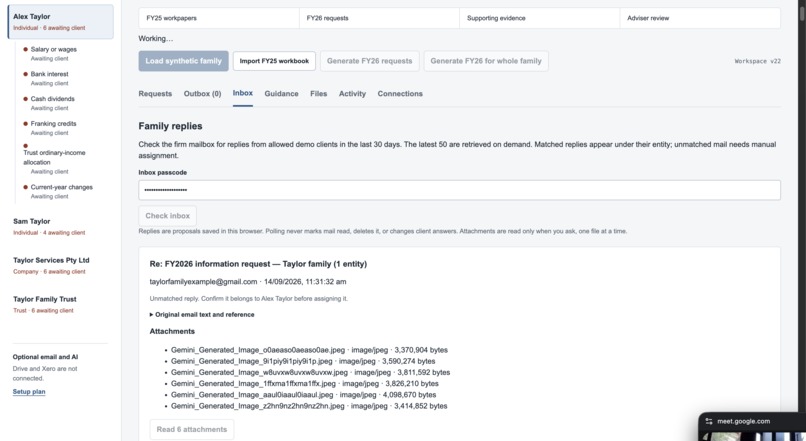
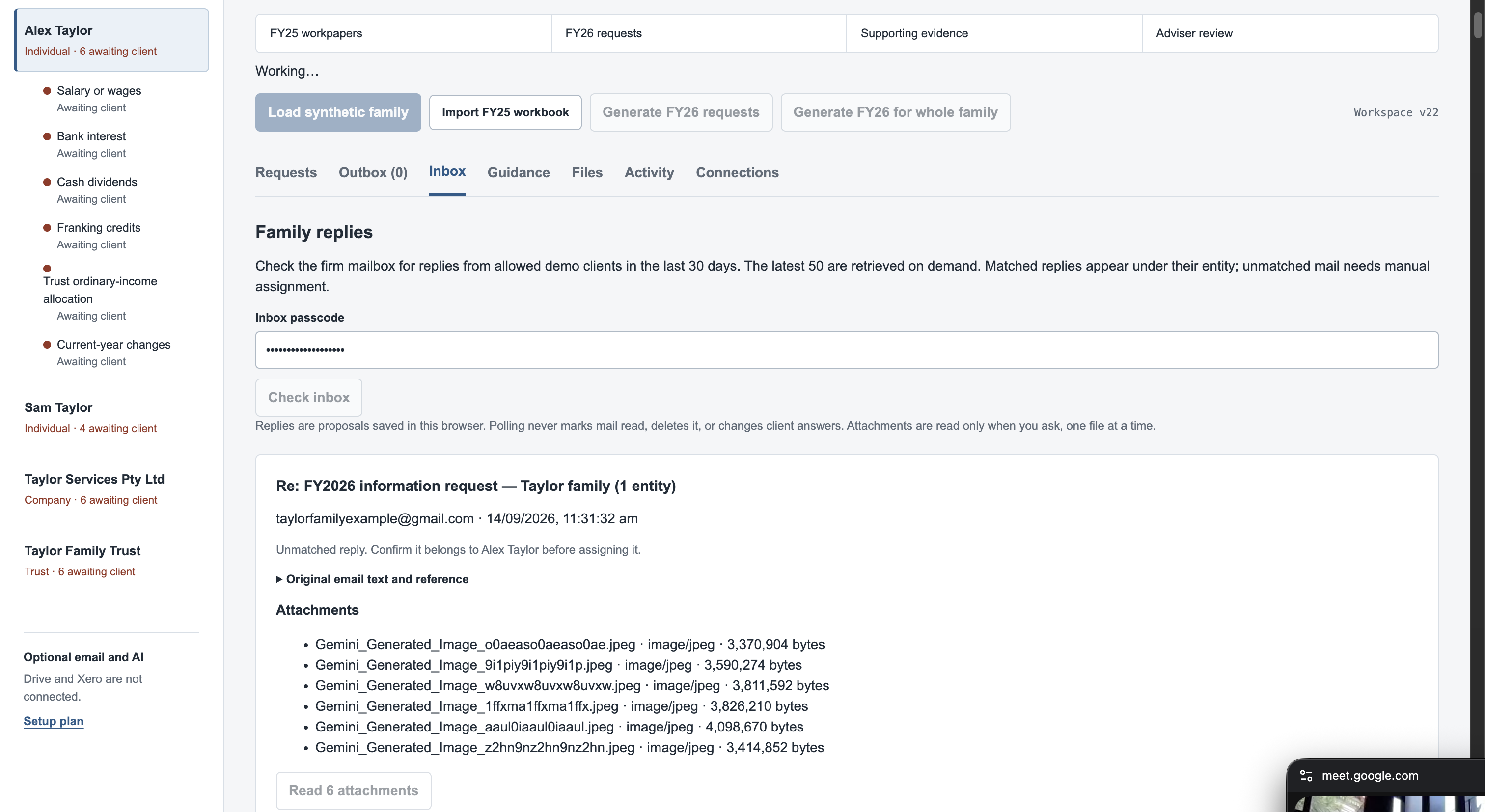
Advisers can see the whole family in one tree, generate requests, draft personalised outreach and send a single grouped email to the family liaison. As replies and documents arrive, Peregrine links evidence to the correct entity and request, identifies missing amounts and duplicates, and keeps client answers separate from financial evidence.
Advisers remain in control throughout the workflow. They review and accept evidence, record decisions and notes, and export a versioned review workbook for the next stage of compliance work.
How we built it
We built Peregrine as a browser-based Next.js application deployed on Vercel, using synthetic workpapers for four entities: two individuals, a company and a family trust.
The core workflow is separated from the interface, which allowed us to focus on reliable transitions, validation and review gates before polishing the visual layer. ExcelJS handles structured workbook import and export, while strict evidence checks validate financial year, entity, component, amount and duplicate document IDs.
We added optional, server-gated NVIDIA NIM features for proposing clearer questions, drafting follow-up wording, extracting information from pasted text and triaging reported changes. We also built optional SMTP and IMAP flows for sending outreach and reviewing family replies.
Challenges we ran into
The hardest challenge was representing real operational nuance without pretending to build a tax engine. Prior-year amounts needed to remain comparative rather than being silently carried forward. Evidence gaps, client answers, adviser decisions and follow-ups all needed distinct states.
We also had to make AI useful without making it authoritative. Model output is always treated as a proposal, with fixed entity, year and request context, and an adviser must explicitly accept it.
Reliability was another challenge. We added strict validation, duplicate detection, stale workbook protection and version checks so that a document could not quietly reconcile against the wrong request or overwrite newer work.
Accomplishments that we're proud of
We built a complete demonstrable workflow from reviewed baseline to adviser-ready review pack.
The demo can load four workbooks, generate FY26 requests, show a real evidence gap, reject wrong-year evidence, prevent duplicate counting, preserve state after reload, and safely export and re-import review decisions.
We are also proud of the family-group experience: one liaison email can cover multiple entities, while the family tree still gives the adviser detailed visibility. The optional email round trip and AI proposal flows were tested end to end, with human acceptance remaining a required step.
What we learned
We learned that the most valuable automation is often not the most dramatic automation. Clear status, good validation and a reliable handoff can remove significant friction without taking decisions away from the professional responsible for the work.
We also learned that trust has to be designed into every interaction. Users need to know what came from the prior-year workbook, what was supplied by the client, what was proposed by AI and what was actually accepted by an adviser.
Finally, we learned that a focused synthetic prototype can expose the data, workflow and safety requirements that a production system will need.
What's next for Peregrine
The next step is moving from a browser-local prototype to a secure shared application with authentication, entity-scoped access, durable evidence storage and a tamper-resistant audit trail.
We want to add carefully scoped integrations with Google Drive and read-only accounting data, improve document intake, support annual rollover from an accepted current-year pack, and introduce reviewed, versioned guidance updates.
The principle will stay the same: Peregrine should make compliance preparation clearer and more efficient while keeping tax judgement with the adviser.


Log in or sign up for Devpost to join the conversation.