Perceptle is a free browser implementation of five daily perception challenges, with unlimited practice alongside the daily puzzle. Count dots, predict a landing point, match an angle, hold a rhythm, and place a fraction on a line. No sign-up is required, and a typical game takes about two minutes.
Inspiration
Everyday judgments often happen before there is time to measure anything. A group of dots looks countable, an angle looks close enough, and a beat seems easy to remember until the sound disappears. The experience brings those judgments into short rounds with a concrete reveal afterward. Its central question is simple: how close did that confident guess actually come?
What it does
Each puzzle follows the same order: Count, Track, Angle, Tempo, and Split. The regular rounds ask players to estimate a briefly visible dot field, predict where a disappearing ball will land, drag a line to a target angle, continue tapping after a metronome stops, and mark a fraction measured from one end of a line.
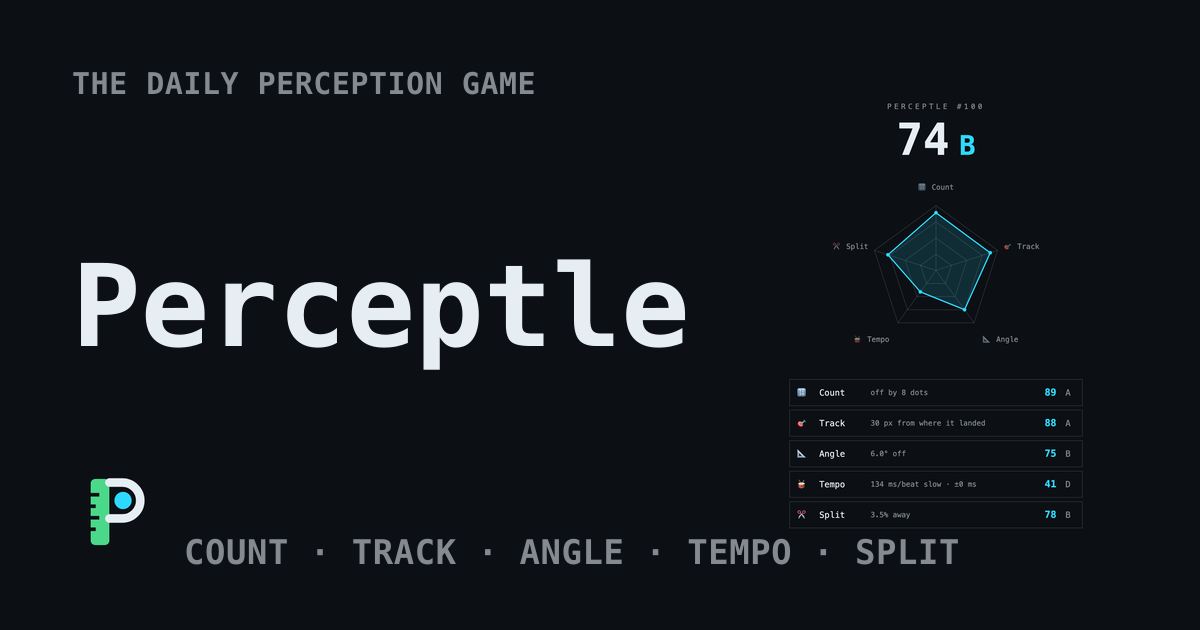
Each round accepts one answer, then reveals the target, the error, and a score out of 100. The five scores form a rounded average and a letter grade, with a radar chart showing their differences. Everyone receives the same daily puzzle, refreshed at 00:00 UTC. Daily results stay in the browser and can be shared without answers. Unlimited generates fresh practice puzzles without changing daily statistics.
How it was built
Astro generates static pages, while a Preact island handles the interactive game. Canvas draws the challenges and their reveals. TypeScript models generate targets and measure answers separately from the browser runners that collect input, animate the stage, and play audio. Storage, sharing, and analytics sit behind service interfaces, assembled by the application runtime.
For a daily puzzle, the UTC date becomes the seed. A single random number generator is created for that puzzle build, and the five models consume it in a fixed order. Unlimited supplies a random practice seed to the same generation flow. Each build has its own generator instance.
An injected clock supplies calendar time, monotonic timestamps, and timers. Web Audio schedules metronome clicks, while the Tempo measurement uses synchronized taps to estimate the player's timing phase before evaluating free taps. The public scoring and rules package contains error measurements, scoring, calendar helpers, statistics, and share formatting. The playable site is deployed through Cloudflare Workers; game input and scoring run in the browser.
Engineering challenges
Repeatable puzzles require more than keeping a seed string. Changing the order or number of random draws in one model can change later rounds. Keeping generation in ordered, pure models makes that dependency explicit and gives tests a deterministic boundary.
Rhythm introduces a different constraint: calendar time, animation frames, scheduled audio, and player input serve different purposes. The runtime keeps monotonic timing available across these boundaries. Tempo calibrates against the player's synchronized taps to reduce the effect of a constant timing offset; this does not guarantee identical behavior on every device.
State also needs clear ownership. Daily mode saves completed results for statistics and sharing. Unlimited keeps a tally for the current visit, which disappears on refresh. Mode policies keep practice from becoming a second daily record.
What works today
The site provides both modes, per-round reveals, the final radar chart, and daily statistics. Historical puzzles make demonstrations reproducible without exposing today's targets. One example is puzzle #100 from October 25, 2026: scores of 89, 88, 75, 41, and 78 produce a total of 74 and grade B. Its Angle round compares a 75-degree target with an 81-degree answer.
Vitest tests cover rules and domain behavior, while Playwright exercises browser interactions. An injected fake clock supports controlled timing checks. A separate dependency check enforces the project's layer boundaries.
Credits and scope
This is a browser reimplementation of the reference Perceptle game. The implementation work presented here centers on the Astro/Preact application, modular runtime, service boundaries, and extracted rules. The linked rules repository contains only its documented scoring and supporting modules, excluding puzzle generators, the game UI, and browser runtime. Its MIT license applies to the distributed code, without granting rights to other websites' code, artwork, or branding.
Built With
- astro.js
- cloudflare
- tailwindcss
