-
-
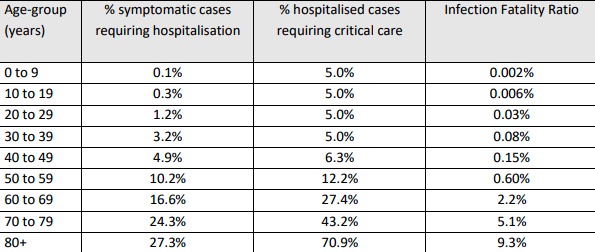
Table1-Estimates of the severity of cases
Inspiration
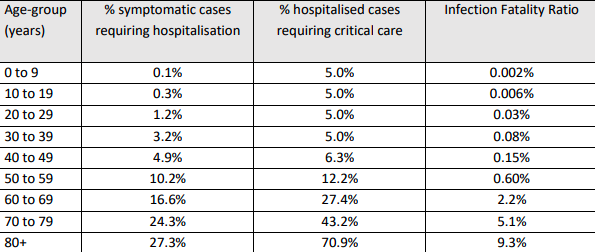
COVID-19 can affect anyone, and the disease can cause symptoms ranging from mild to very severe. Although the majority will only have mild symptoms. Some people may be more likely to have severe illness than others because they have characteristics or medical conditions that increase their risk. These are commonly called risk factors. Studies have been made to identify the risk factors article, article. Some of which are: age, gender, medical conditions, such as hypertension, diabetes, etc. Therefore severe symptoms rate is also different for each risk group, as shown in table 1.
It is possible that once we have sufficient tests to examine a larger population, we found more asymptomatic people, meaning that the severity of illness is lower than currently believed. People with risk factors may be more likely to need hospitalization or intensive care if they have COVID-19, or they may be more likely to die of the infection. Therefore, governments are warning people at high risk to be particularly careful link.
From all suppresion metrics, such as school closure, social distancing, etc, we know that the most effective one is social distancing link.
Social distancing of older individuals groups is predicted to be particularly effective at reducing severe outcomes given the strong evidence of increased risk with age. The combination of case isolation, household quarantine and social distancing of those at higher risk of severe outcomes (older individuals and those with other underlying health conditions) are the most effective policy combination for epidemic mitigation link.
What it does
After the lockdown phase, as new cases evolution decreases the phase of reopening starts, the mitigation phase. This phase consists of: (1) lifting restrictive social distance measures, (2) reopen business and schools and (3) continue to control the spread of covid19 article. Some countries have started lifting lockdown rules by opening businesses with reduced staff, opening schools for young children,etc news. Other countries have performed mass testing to identify infected people. Although being a very effective measure, testing would have to be performed frequently since we live in a very connected world and it can take time to produce enough tests to the whole world.
Given that the overall mortality rate is low, being high for risk groups and very low for others, the majority of the population will only have mild symptoms without the need for hospitalization. Therefore, by accessing the risk factors, a mapping of the risk population could be done to identify the risk individuals and the percentage of the population. Given the effectiveness of social distancing, it could be applied to the risk households, while the rest of the population could be relieved faster from these measures. So, for example, fabrics could start working normally because only healthy individuals would be working, eliminating the risk of exciding hospitals capacity.
Although more people could be relieved at once, cautious would still be necessary. Measures such use of masks and gloves, continuity with telework when possible, etc should be maintained and gradually lifted. So that when a person gets infected it does not infect others all at once, even though they do not belong to risk groups. Therefore widespread immunity in the population would be achieved, meaning that the majority of the population is immune to the disease because they’ve had it and consequently it can’t easily be transmitted to others.
With this approach, the economy can be normalized faster, as jobs that are not possible to execute from home, such as fabric workers, could start working with fewer restrictions such as the number of workers at each time.
How I built it
To identify the risk factors machine learning models could be applied link, link. Then, having a predictive model, an examination of the whole population could be done to identify the risk individuals and their households. These individuals would continue respecting restrictive social distance metrics such as continue with telework.


Log in or sign up for Devpost to join the conversation.