Tagline
A memory for the factory. Says what is known about a machine, what is not, and where it looked.
Inspiration
OT (Operational Technology) is a hot topic. Old systems have been running in the corner of the factory for 15 years and all of a sudden we need to care about them. And the people who installed them might be long gone.
Every manufacturer has a scanner export somewhere. It knows the box, the IP and the firmware. It does not know what the machine does, who fixes it or where the runbook is. That part lives in a few people, some Confluence pages from 2019 and old tickets that say "restarted by hand, do not know why it works". NIS2 asks EU manufacturers to have an asset inventory and to know their risks, so the gap is now also a compliance question.
I wanted an agent that is allowed to say "nobody knows". Most assistants fill the gap with something plausible. In a factory that is worse than nothing.
What it does
Pentti is a working demo, a Forge app for Jira, Confluence and Rovo. It runs on one fictional factory bundled inside the app. It takes the factory's machines from an anonymized scan, matches them to the factory's pages and tickets, and scores each machine on how much is known about it and how risky it is.
To try it on real data, a Jira admin can import an asset list as CSV and pick one Jira project and one Confluence space to read. That part is a proof of concept: read only, no people, no task creation, no graph, visible to Jira admins, and answers come from the import, not live. It is not for production use. Install it on a test site.
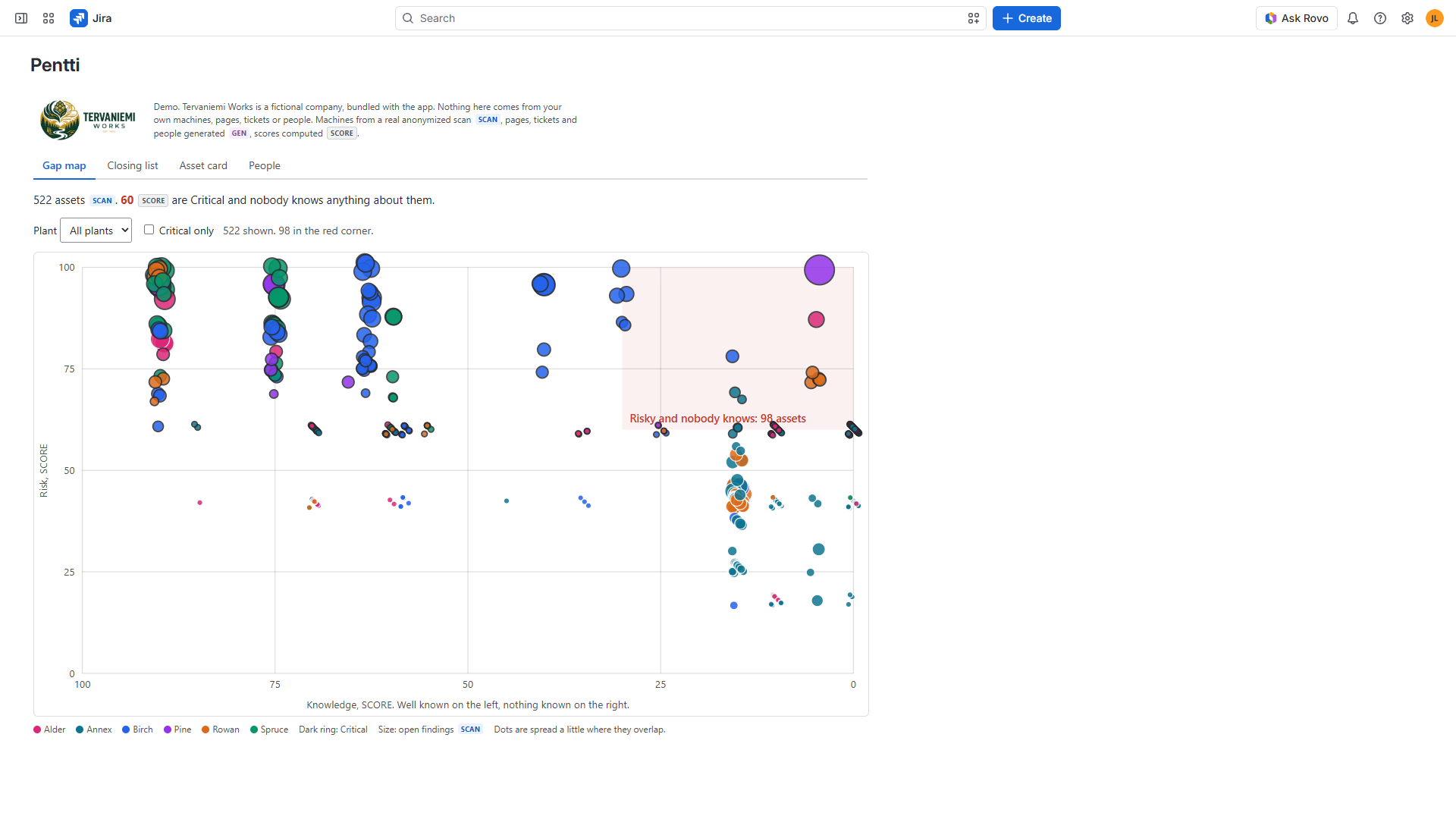
- Gap map: 522 assets, knowledge against risk. Top right is risky and nobody knows anything.
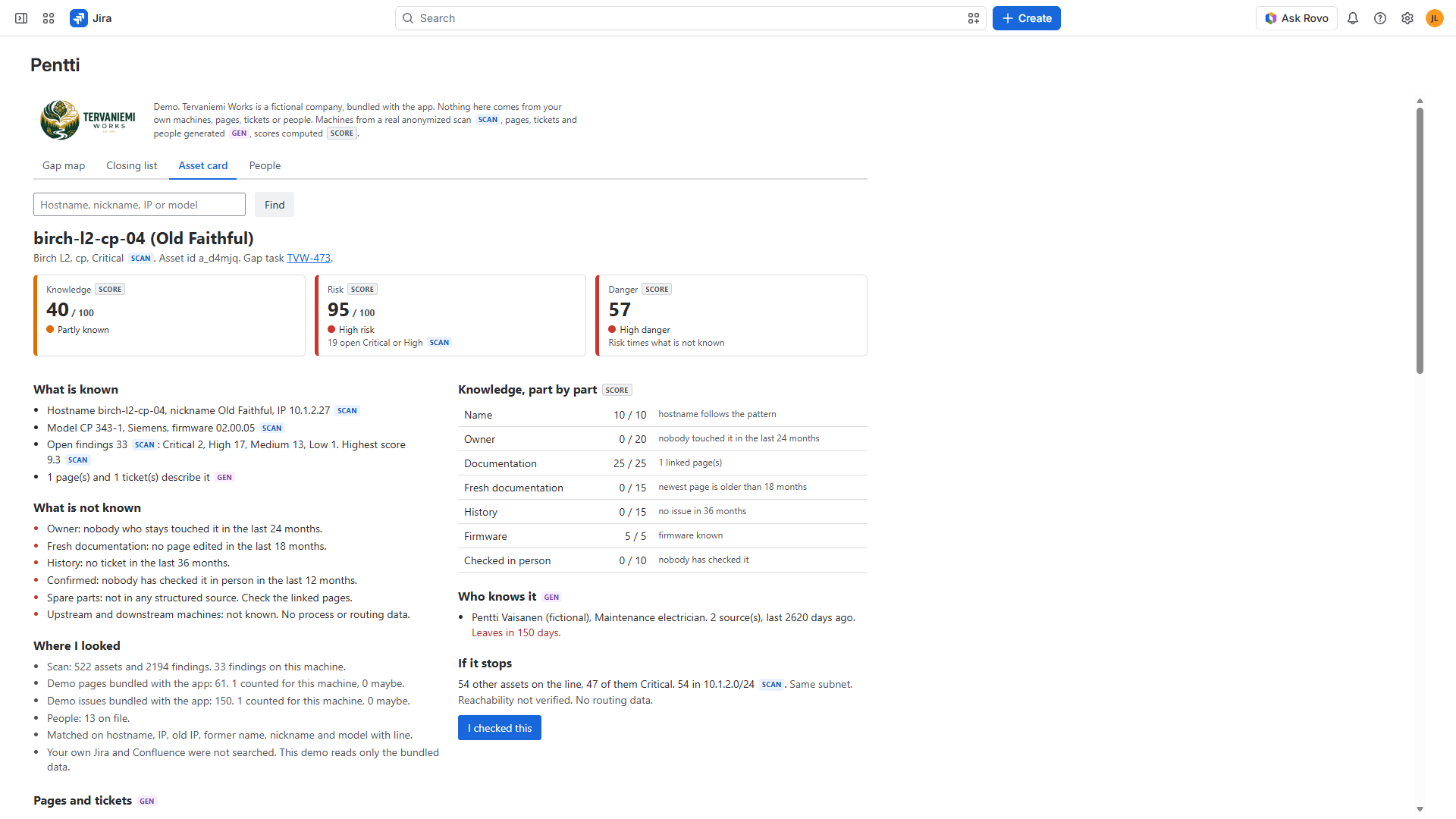
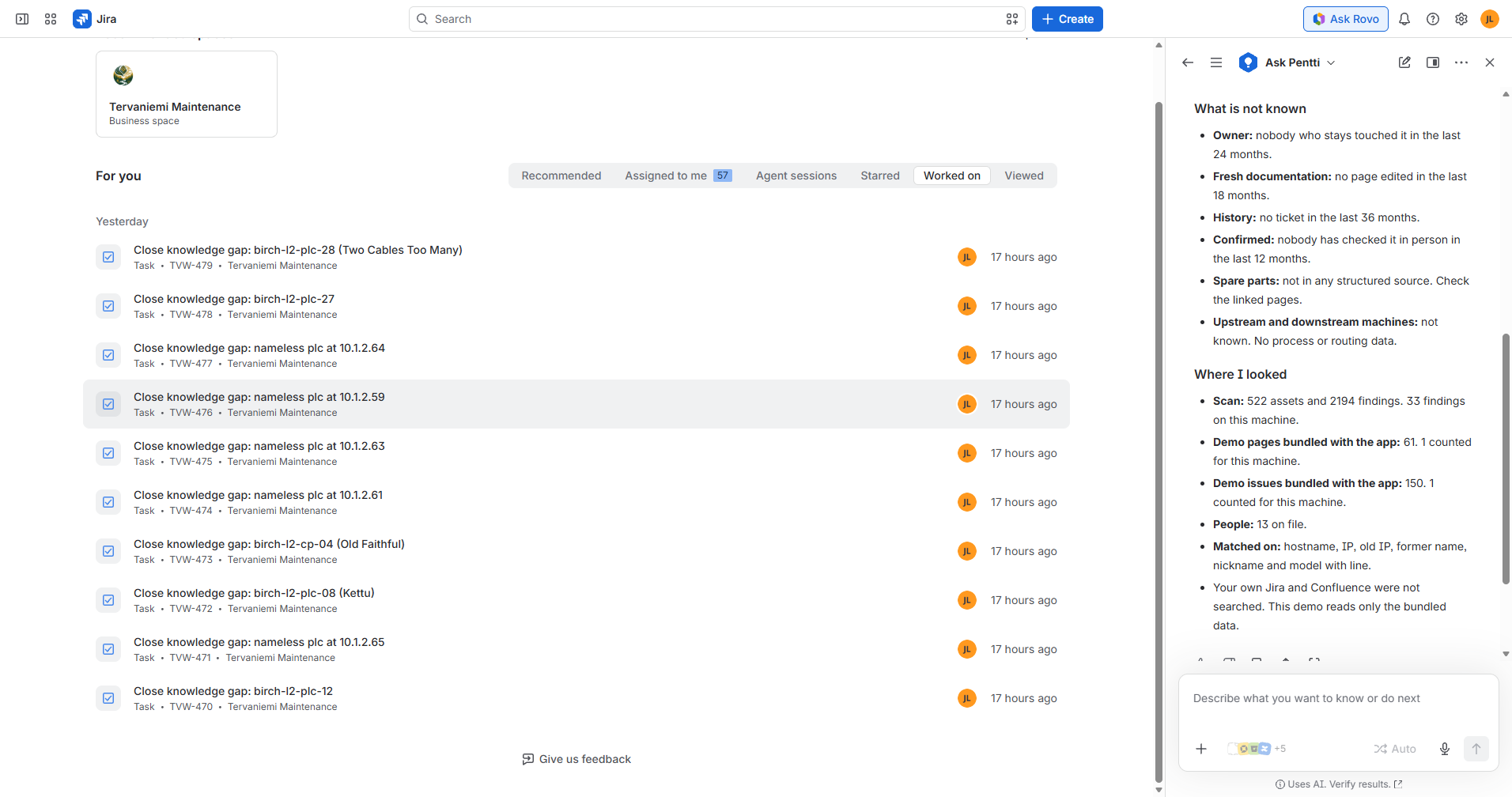
- Asset card: known, not known, where it looked. Pages and tickets with match confidence, people, findings, and a button for "I checked this".
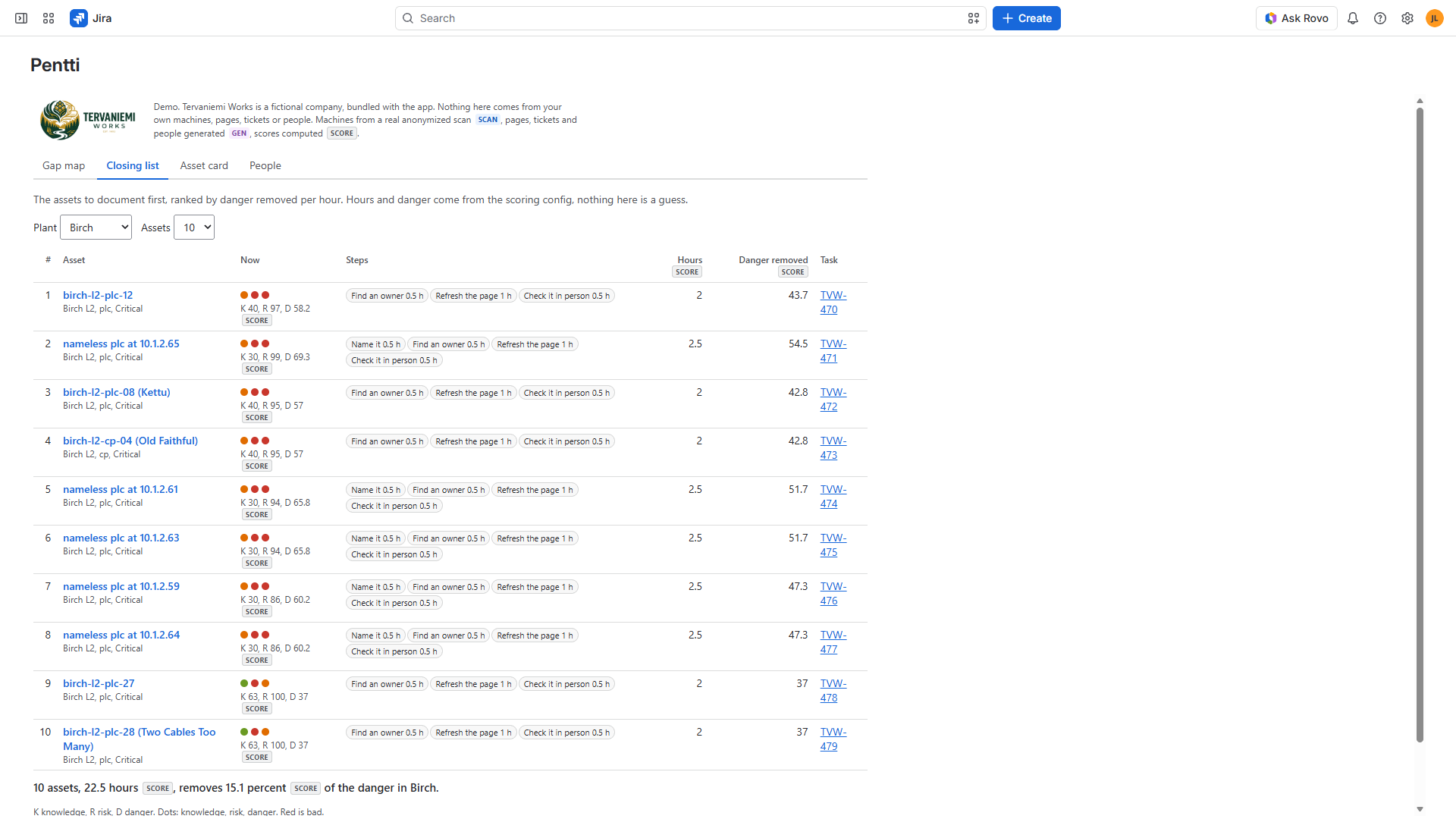
- Closing list: the assets to document first, ranked by danger removed per hour. Hours per step, total hours, percent of danger removed. One button creates the Jira tasks.
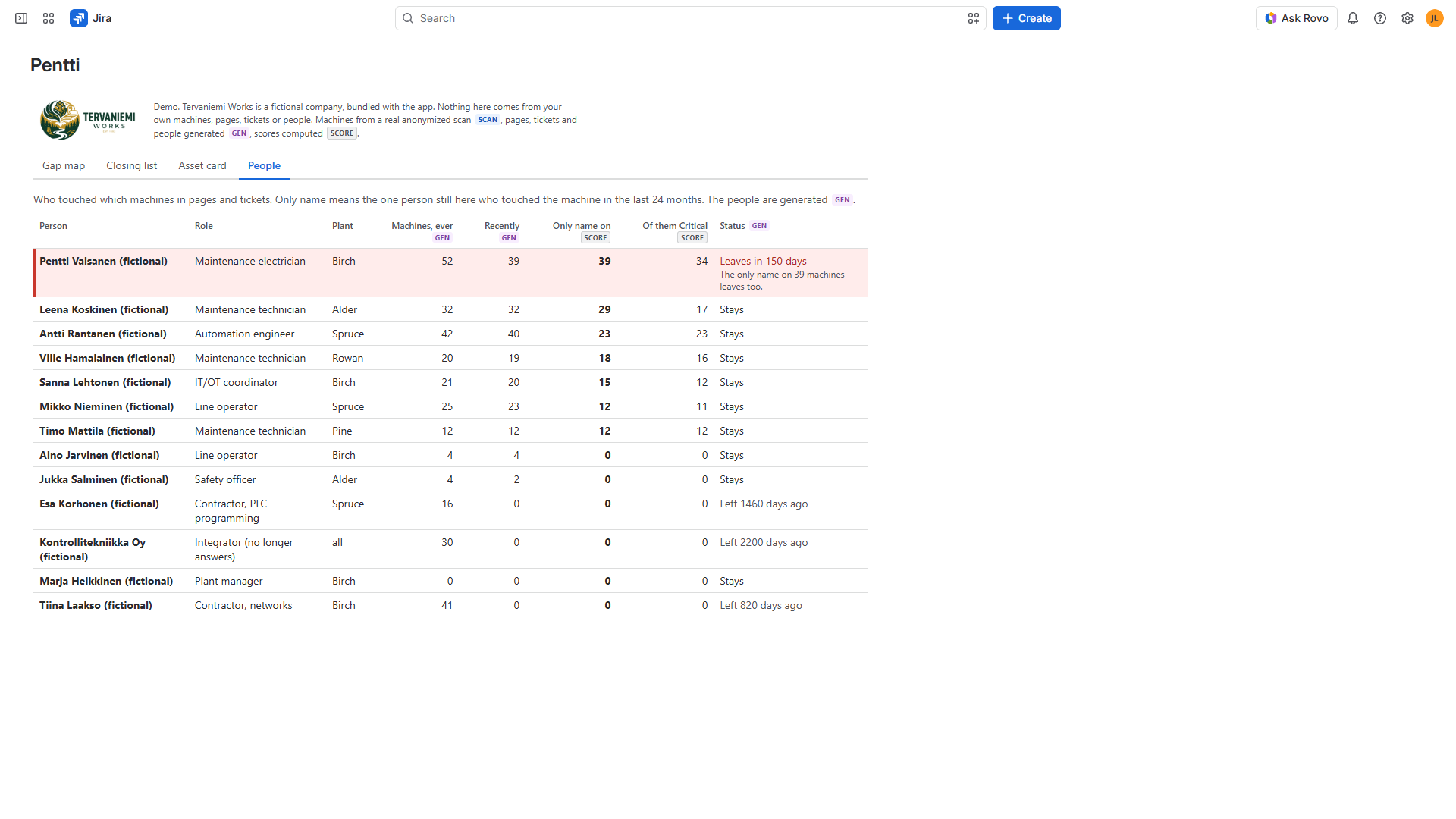
- People: who is the only name on which machines. Pentti, the maintenance electrician, leaves in 150 days and is the only name on 39 machines.
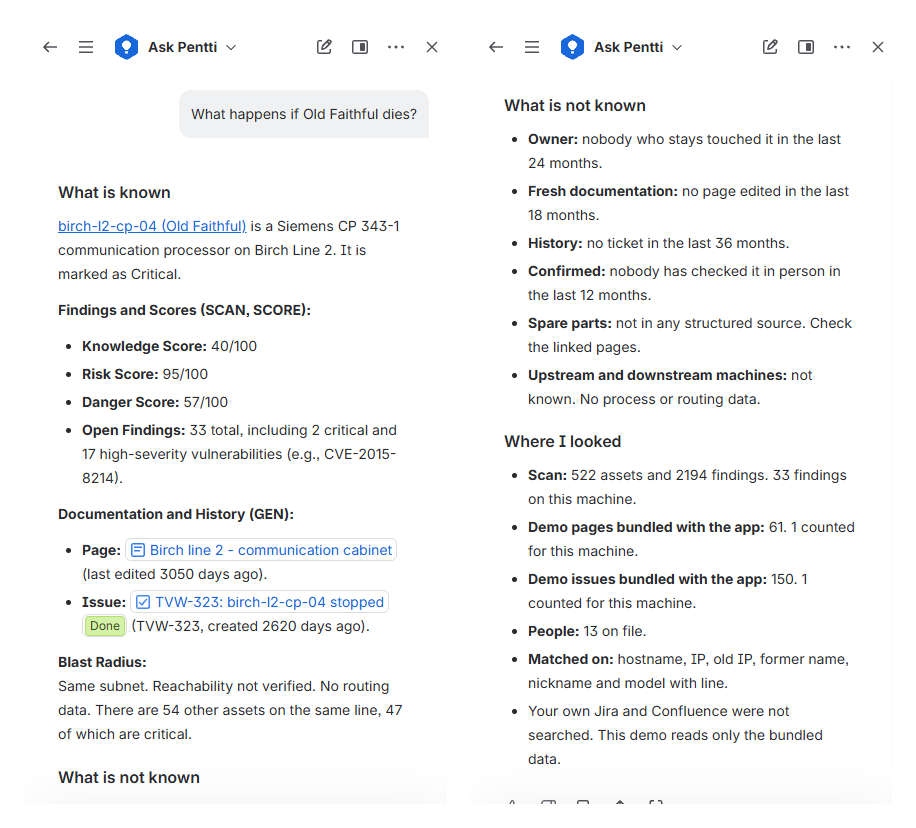
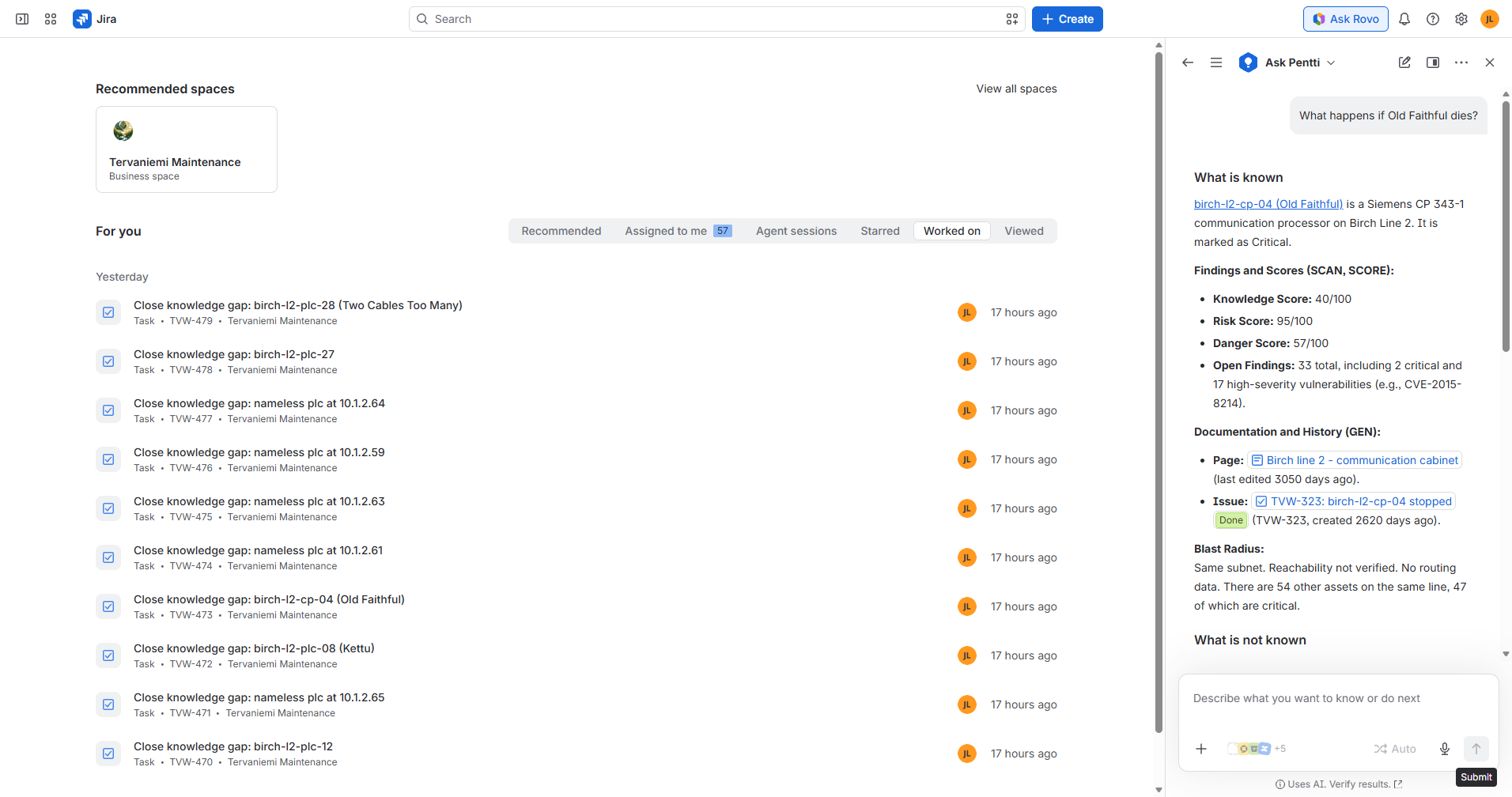
- Ask Pentti in Rovo Chat: finds a machine by any name (hostname, nickname, old IP, former name), answers in three parts, links the machine to its card, and creates tasks after a yes. If two machines have the same nickname it asks which one.
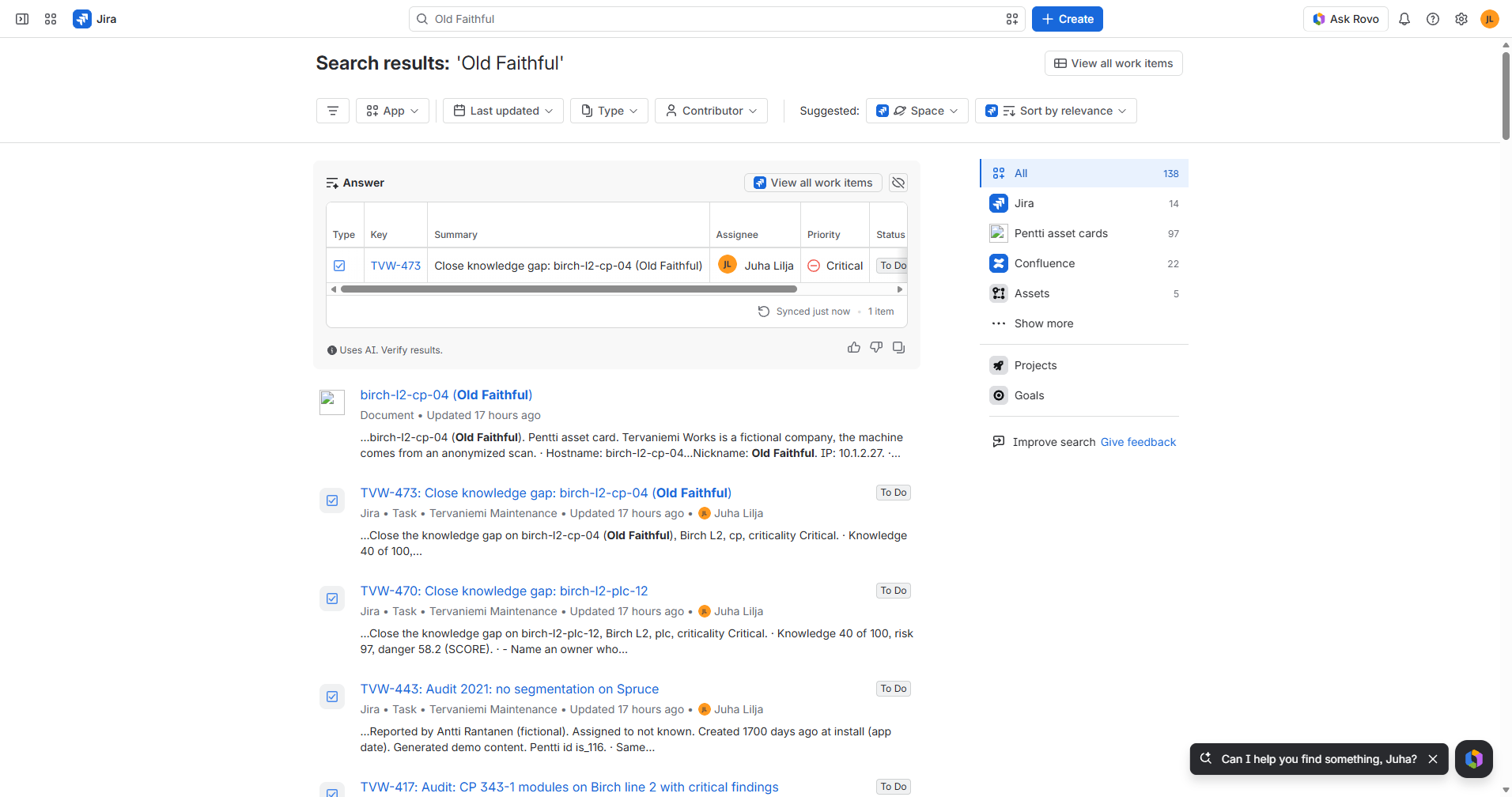
- Teamwork Graph: one asset card per machine, so Rovo Search finds Old Faithful by its nickname.
- MCP: three read-only tools for any MCP client. Tested with Claude.
The company is fictional, Tervaniemi Works. The machine mix is real, from an anonymized OT scan of a real plant [fill: say how much you can about the source, for example "a scanner export I had access to, anonymized before it left the machine"]. Every number in the app has a chip: SCAN for the scan, GEN for generated content, SCORE for computed.
How it meets the main technology requirement
The rules ask for a Forge app that integrates with at least one Atlassian product or platform capability. Pentti is a Forge app, Node 24 runtime, no external egress, data in Forge storage. It uses Jira (global page, admin page, seeded issues, gap tasks created as the user), Confluence (seeded pages), Rovo (agent rovo:agent and six action modules), Teamwork Graph (graph:connector, 522 cards) and the Atlassian MCP server (rovo:mcp, Preview).
Testing instructions for judges
Full steps with the install link are in the README: https://github.com/apn201/Pentti#install-the-demo-about-10-minutes
- You need a Jira Cloud test site with Confluence and Rovo, and an organization admin for the connector and MCP steps. Confluence has to be on the site before you install, otherwise the dialog says "Installation failed" next to Confluence.
- Short path: install, Jira settings, Apps, Pentti, pick an empty project and space, Load the factory. Rovo Chat, agent Ask Pentti: "What happens if Old Faithful dies?" Then Jira, Apps, Pentti for the page.
- The page and the agent answer from the bundled data even before the load.
- The author ran this install once on a new site. Nobody else has yet, so "about 10 minutes" is an estimate.
How I built it
Mostly with Claude Code, working slice by slice from a written spec. [fill: your own words on how that went, how much you steered, what you wrote yourself.]
- A Python generator turns the raw scan into the demo dataset. Same seed, same output byte for byte. Names, IPs and sites are remapped. A leak check runs in CI so nothing original gets committed.
- Pages and tickets were written as narrative with markup, so the ground truth of which page mentions which machine is known. That made it possible to measure the matcher: 270 of 276 exact mentions found, all 98 old names and addresses, no false positives.
- The matcher is plain code, no model. Hostname, current and old IP, former name, nickname within its plant, model with line. When two machines share an IP both get a "maybe", never a guess.
- Scores are pure functions with tests. Weights in one YAML file. The model never adds up anything, it repeats what the actions return.
- "Load the factory" on the admin page seeds 66 Confluence pages (61 of content, five for the page tree) and 150 Jira issues in steps of 10, so the sources can be read on the site. The matcher works on the bundled copy, it does not read them back. Pressing it again changes nothing, Reset removes only what it made.
- Custom UI in React. The gap map is a hand drawn SVG.
- The own data proof of concept sits beside the demo, not inside it: its own matcher, its own storage keys, GET requests only. A test freezes every bundled output, so it can not change the demo unnoticed. Real names follow no pattern, so names match as whole tokens, a name that could be a word stays a maybe, and a page naming more than 25 machines counts as a list, not as documentation. The matcher's measured numbers above are for the demo data, there are none yet for real data.
Challenges I ran into
- Neither Jira nor Confluence lets you set a created date. The app keeps its own dates and the pages say "(app date)".
- A Jira app could not call Confluence until the manifest declared multi-app compatibility. Before that every call was a 401 "scope does not match".
- Confluence v1 endpoints answer 410 to apps, while the same call with my API token works. Moved to v2.
- Confluence labels do not allow a colon.
pentti-demo:is_001becamepentti-demo-is_001. - MCP tools did not list in Claude. A community thread from the same day had the workaround: disconnect Confluence, toggle the tools, connect again.
- The graph connection did not survive changing the installation. The connector had to be added again.
- Installing on a new site before Confluence was there: "Installation failed. Try again or contact app owner" next to Confluence, no hint of why. The README says it now.
- The admin page listed no spaces on the new site and gave no error, because
type=globalleaves out the newer space types. It now asks for all current spaces except personal ones.
All of it is written down in docs/limits.md, with what was tried.
Accomplishments that I'm proud of
First I'm happy it works. It's a demo, not a full product yet, but from my work I do know the problem and this definitely would help in companies who already use Atlassian products for tracking things.
What I learned
The whole Atlassian product family has always been confusing to me. Dozens of tools loosely connected. I used Jira ant University and made a tender of it for our company a long ago, but things have evolved. It was good to come back to playing with these tools.
What's next
For me this does not directly solve the problems I have, because we do not use Atlassian tools in production, but the same principle could be used to stick to any organized or unorganized data sources, project planning tools, ticketing tools etc. for similar correlation. And this is MIT licensed public project in GitHub. anyone can take it and modify to fit their use case.
Built With
- claude
- confluence
- forge
- jira
- pytest
- python
- react
- rovo-actions
- rovo-agents
- rovo:mcp
- teamwork-graph-connector
- typescript
- vite
- vitest
