-
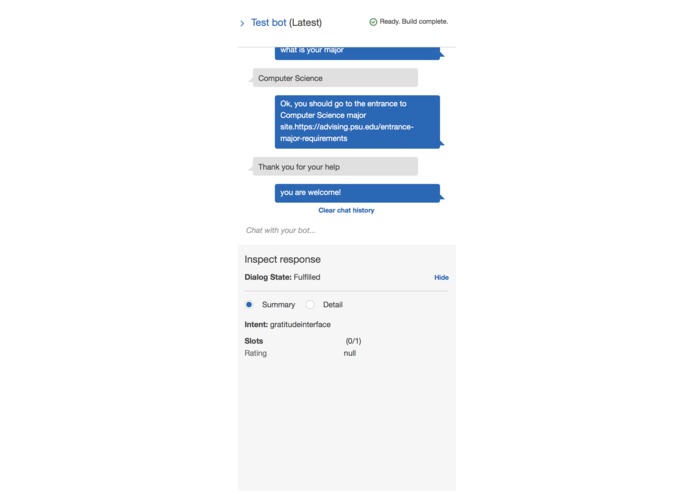
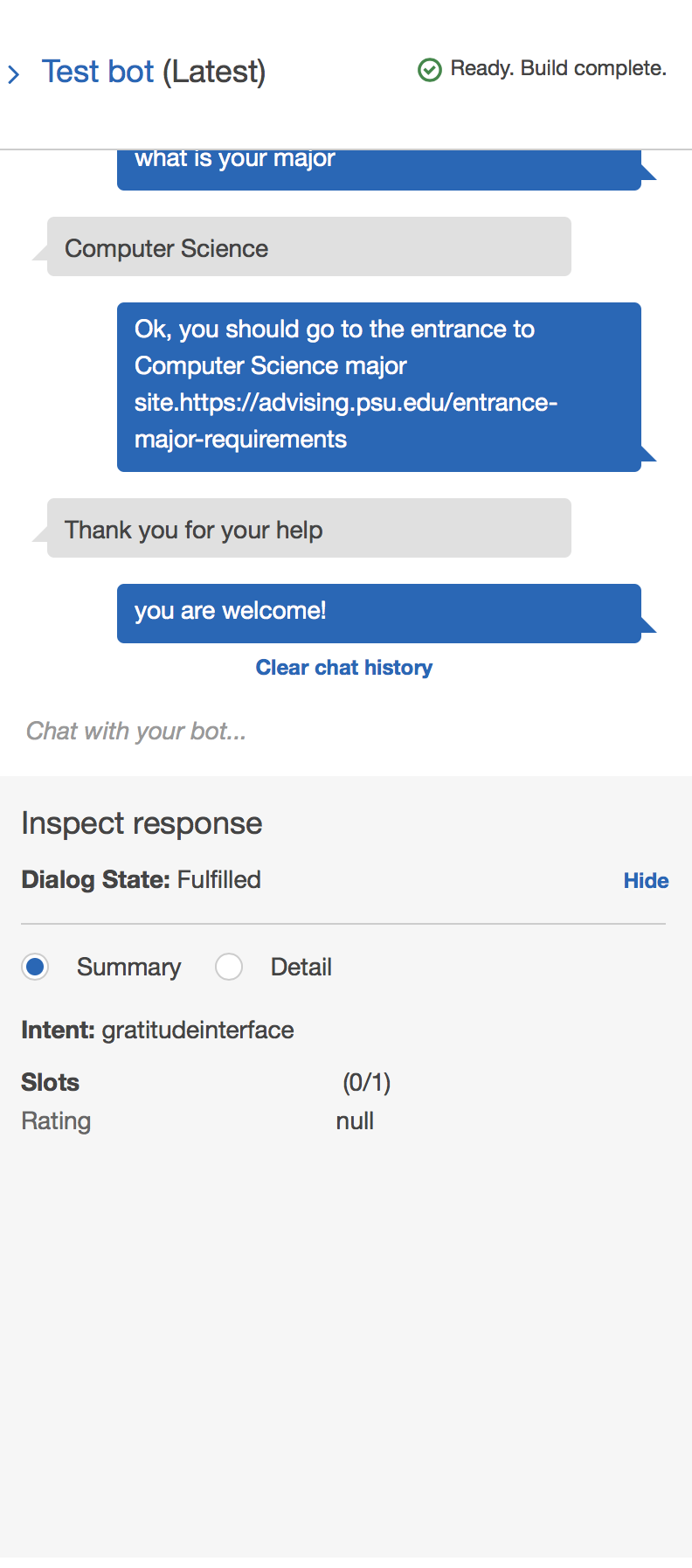
Screenshot of our chat-bot at work!
Inspiration
We were looking for a specific striking problem which is very crucial for the students and the administration of Penn State. We brainstormed ideas, looking into complications we as Penn State students faced. Academic Advising stood out to us as a recurring problem faced by not just us but a majority of our peers. Waiting in a queue for over an hour, not being able to acquire advising at our convince, scheduling an appointment according to our class schedule has always been a hassle. The advisors as well receive very similar questions or questions that are futile from the students which can get very repetitive and tiring for the advisor. We also looked into the availability of academic advisors in the Commonwealth and world campuses and discovered some commonwealth campuses having just one or two advisors per campus. We found that as a recurring problem too and made our tool accessible to them as well.
What it does
Our product is an online academic advising tool which is centered around HCI and UI. This interface takes advising to the next level by being available to students at any point of the day. As of now, our MVP is capable of answering basic questions that a student might encounter and may need answers for immediately. The regression algorithm in the backend of our tool employs machine learning to identify stress patterns in the language mechanism of a student’s response. Our ultimate goal is for the chat tool’s algorithm to populate the response directory using live human interactions between students and advisors to generate responses to any query that a student might run into.
How we built it
Using AWS Lex and AWS Lambda we developed our basic chatbot and further employed Amazon Comprehend to understand language pattern developed in the AWS platform. In creating the basic framework for our bot, we created different intents to figure out different situations that a bot might come across when a student sends in a query. For example, we created an intent for different sectors in advising such as GPA requirement, Graduation, etc. Once we perfected the different intents that we wanted our tool to implement, we came up with different utterances, i.e., different ways the student might ask the same questions to show the variability of sentence formation. For the MVP as of today, we listed out the most suitable answers providing hyperlinks to various external resources. To extend this idea, we included a regression model, by creating emotion intents that track the text that the tool receives from the student to judge his or her emotional quotient. For example, we created an intent called ‘Happiness’, and then created utterances below it such as “This was very helpful.”. Words like ‘helpful’ depict happiness and a positive response. To add on to the user interface of this feature, the bot asks for a percentile rating of their experience.
Challenges we ran into
1) It took a great deal of brainstorming to find a focus on our overall idea towards making advising more accessible to students and at the same time to save the time and effort of Penn State administrative staff. 2) We laid out a bunch of cloud platforms options available to us, such as Google Cloud Platform, Amazon Web Services and various other online software. We went ahead with AWS as it was the only platform that allowed us to format and create bots.’ 3) Developing the HCI component of the chatbot and making it more human-like took us a great deal of time as this was our first time working with the platform and also since we had to figure out various emotions of a student. 4) Being able to address different aspects of each question by writing out each of the question in different utterances (writing various questions that mean the same thing). 5) Developing different indents such as GPA requirements, graduation, etc, took us a while to figure out.
Accomplishments that we're proud of
We self-learned our way through AWS although it took some time it was fruitful at the end. Our first prototype met expectations and we can picture the near future of LionAdvisor and the possibilities it can achieve with some external additions to our current bot.
What we learned
This was our first opportunity participating in a full-fledged hackathon. We learned how to identify a real-world problem equipped with a perfect solution according to us. Being able to use our analytical and logical skills in a short duration without cracking under pressure is something that we have accomplished. A totally new concept of chatbots which none of us had experience within the past. We got the opportunity to get acquainted with Amazon Web Services (AWS), specifically Amazon Lexa. We intend to use the same tool for further advancements for this bot as well.
Next steps for LionAdvisor
We would like embed more emotions within the answers for our chatbot( i.e improves HCI)
- We also want to develop an Amazon Lamda function in order to show escalation and sensitivity within UX
- As said before, improving HCI would be one of the biggest goals
- We plan on getting a live Penn state advisor to look at the machine and check if it is doing the right thing.
- Another big thing, is we want to implement a side by side platform learning experience for the actual Penn state advisor, so every move is then checkmarked by a live advisor to check the accuracy or the closest it is to understand students. It would also plan and stop on 99%accuracy.


Log in or sign up for Devpost to join the conversation.