

Problem Statement
Efficiently managing medical inventories poses a significant and pressing challenge for healthcare institutions. This difficulty stems from the delicate task of striking a balance between ensuring the ready availability of essential medical items and the critical need to control costs effectively. Additionally, many healthcare institutions currently grapple with outdated, manual processes when it comes to tracking and recording their equipment.
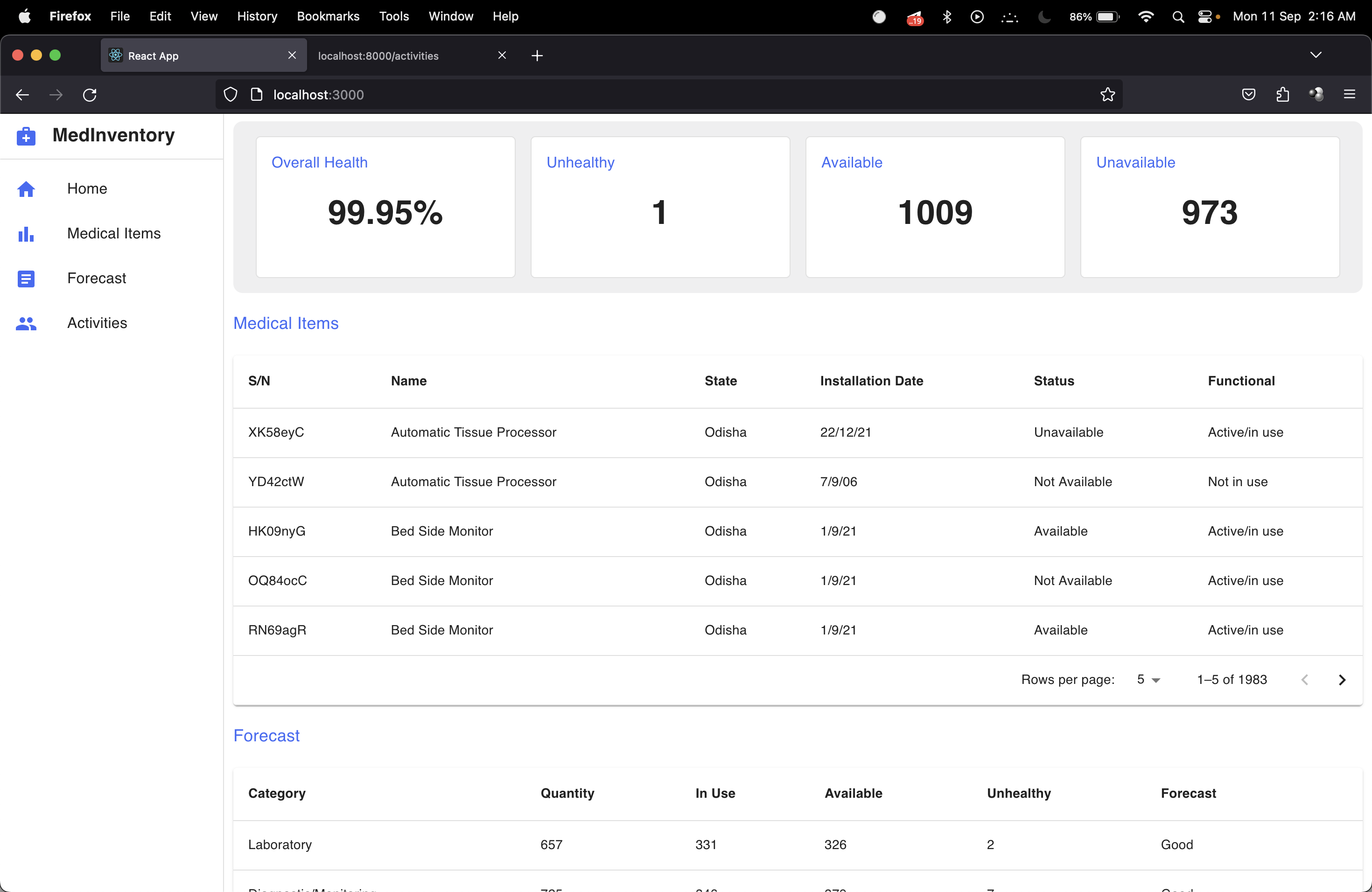
Moreover, maintaining oversight of the utilization status of medical equipment within these institutions has proven to be a formidable hurdle. To address these complexities comprehensively, we have embarked on the creation of an all-encompassing platform tailored for healthcare institutions. This platform will empower healthcare organizations to effortlessly monitor their inventories, gain real-time insights into the utilization of medical equipment, and ascertain whether their stock levels are resilient enough to withstand challenging circumstances.
What it does
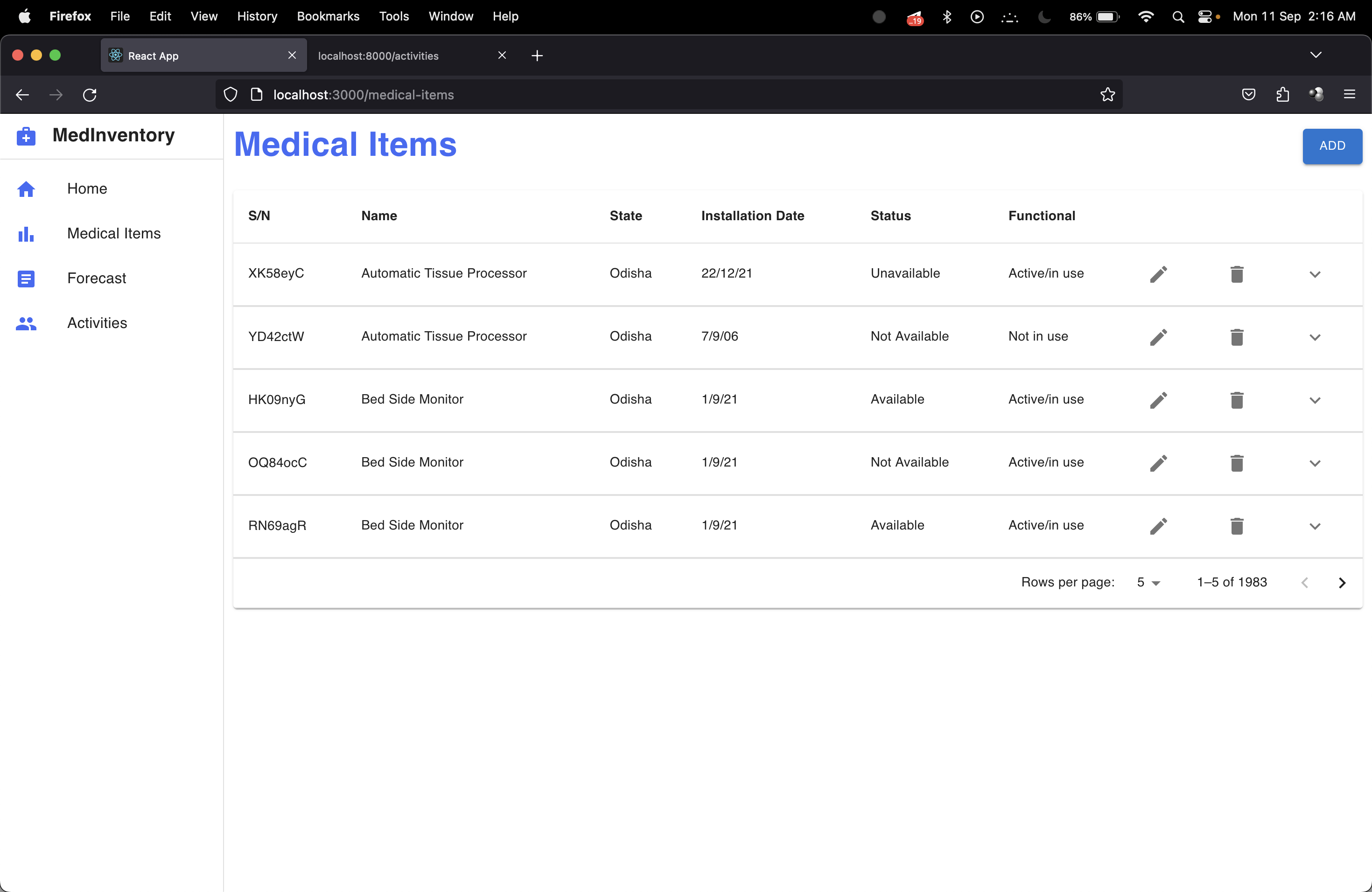
MedInventory offers a comprehensive platform comprising three distinct functionalities. The initial feature facilitates healthcare institutions in swiftly accessing, modifying, or removing entries related to their medical equipment inventory. This empowers them to maintain real-time inventory oversight efficiently.
The second functionality enables users to review, update, and manage various activities occurring within the institution, with activities defined as instances of borrowing or returning medical equipment. This aids healthcare institutions in tracking the availability and utilization status of their medical equipment assets.
The third and final feature equips healthcare institutions with the capability to forecast stock levels within each category of medical equipment. This forecasting tool assists healthcare institutions in gauging the resilience of their inventory levels, ensuring they are sufficiently prepared to navigate challenging circumstances effectively.
How we built it
For the frontend, we have used React and Typescript to create the different components and functionalities. Then, we styled it using Material-UI Library.
For the backend, we have built it using Nodejs and Typescript.
Lastly, for the ML, we have used unsupervised learning to train our data. This method of machine learning is used due to the absence of labelled data. With a mix of quantitative and qualitative data, PCA is used to simplify complex data by transforming it into a smaller set of uncorrelated variables called principal components. Afterwards, each data points is grouped into their respective clusters.
Challenges we ran into
We encountered several challenges during our project, with one notable obstacle being the integration of the frontend and backend components. This difficulty arose from our initial lack of clarity regarding the specific data structure requirements of the opposing team. As a result, we dedicated a significant amount of time to extensive discussions and subsequent implementation efforts to align the two.
What we learned
As beginner developers, we have learnt many new languages and frameworks such as Typescript and Nodejs.
What's next for Penguin Medi-hascar
In the future, we have a roadmap that extends beyond our current platform features. Some of our planned developments include:
Live Usage Tracking System: We envision implementing a dynamic system that provides real-time tracking of medical equipment usage. This feature will allow healthcare institutions to monitor the exact whereabouts and utilization status of each piece of equipment at any given moment. It will not only enhance inventory management but also contribute to more efficient resource allocation and staff coordination.
Real-time Sign-In and Sign-Out Function: Another exciting addition on our horizon is a real-time sign-in and sign-out functionality. This feature will streamline the process of logging equipment usage, making it seamless and immediate. Healthcare professionals will be able to quickly register when they take equipment from the inventory and when they return it, facilitating accurate record-keeping and improving overall operational efficiency.
User-Friendly Interface Enhancements: We're also dedicated to continuously refining the user interface and overall user experience. This includes simplifying navigation, optimizing accessibility, and incorporating user feedback to ensure our platform remains intuitive and user-friendly.
Advanced Reporting and Analytics: We intend to bolster our platform with advanced reporting and analytics tools. This will enable healthcare institutions to gain deeper insights into their inventory management, equipment utilization patterns, and forecasting needs. In turn, this data-driven approach will empower better decision-making and resource allocation.
Integration with IoT Devices: As technology evolves, we plan to explore opportunities for integrating IoT (Internet of Things) devices to enhance equipment tracking and management. This could involve incorporating sensor data to monitor equipment conditions, such as temperature and humidity, ensuring equipment is always in optimal working condition.


Log in or sign up for Devpost to join the conversation.