-
-
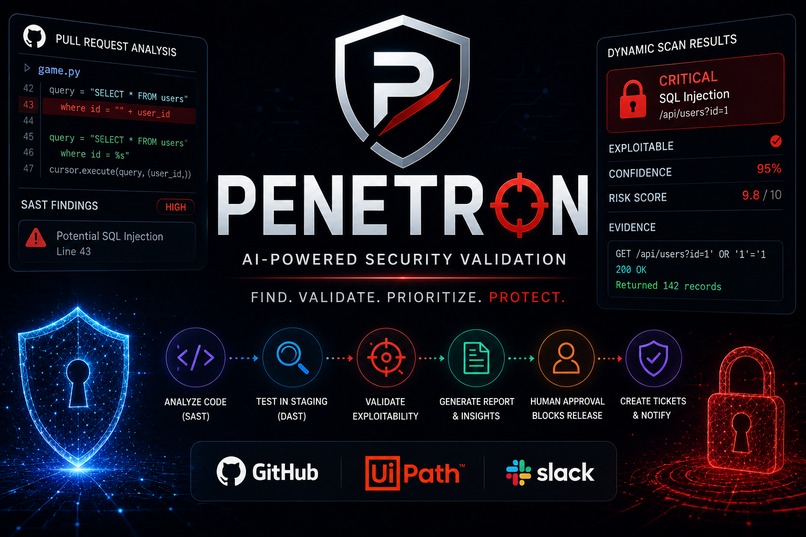
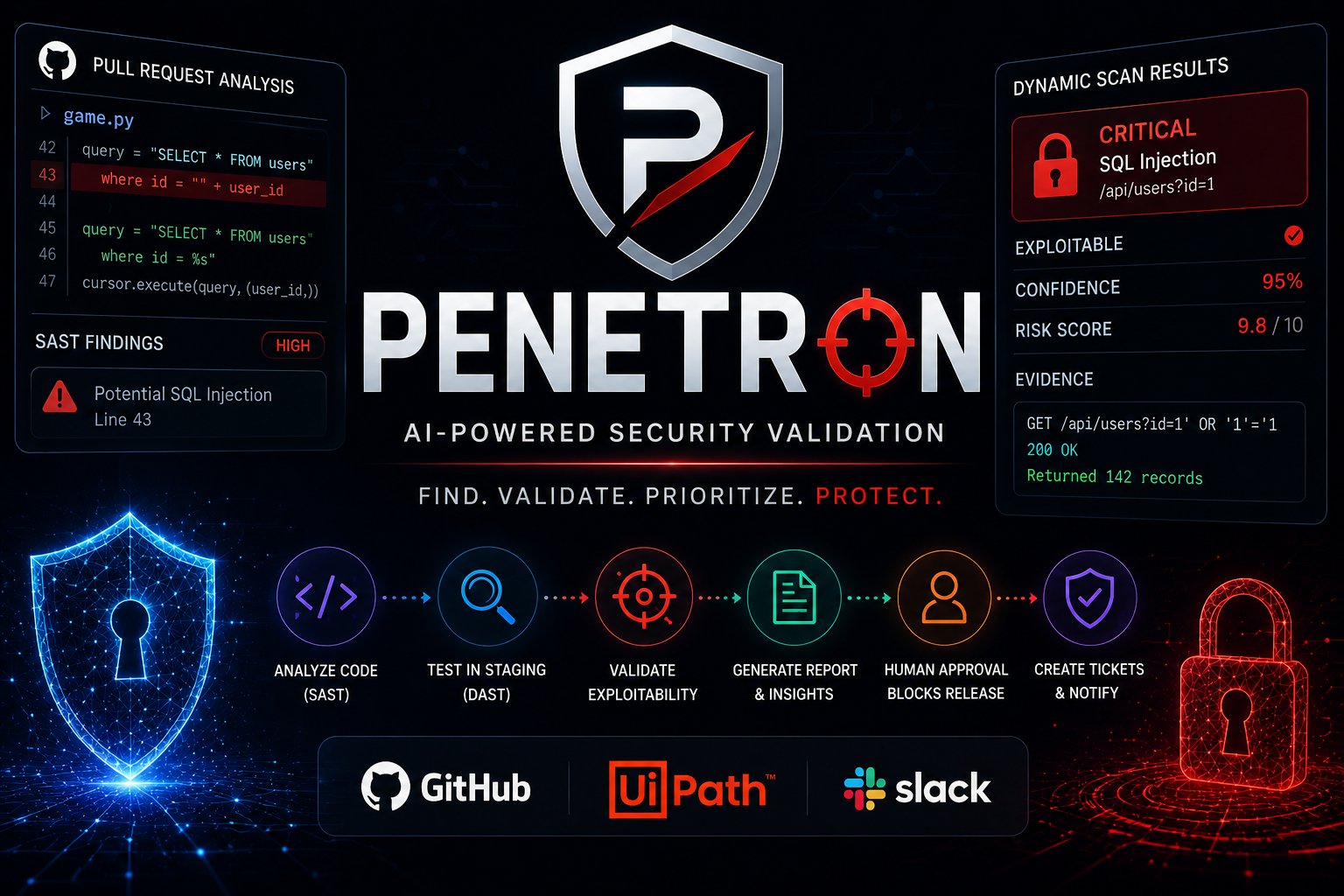
Penetron Overview
-
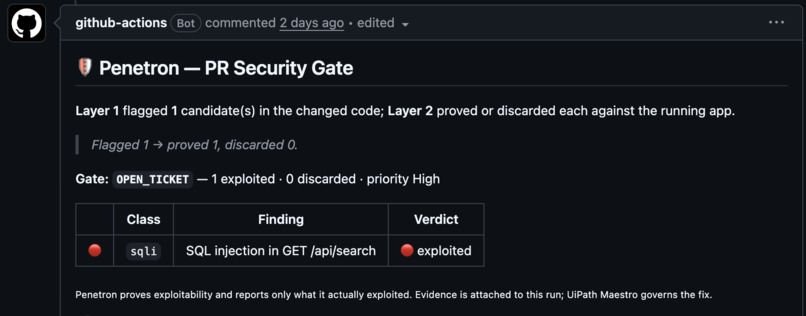
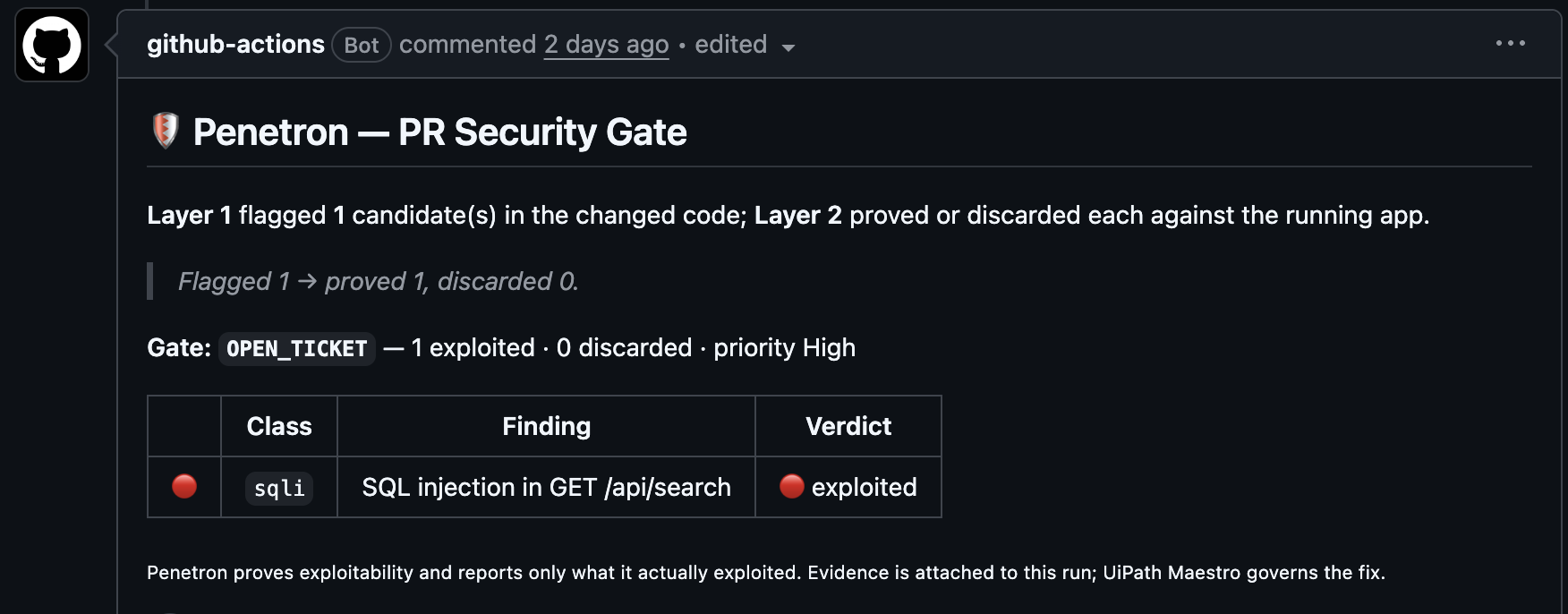
GHA Layer 1 security example
-
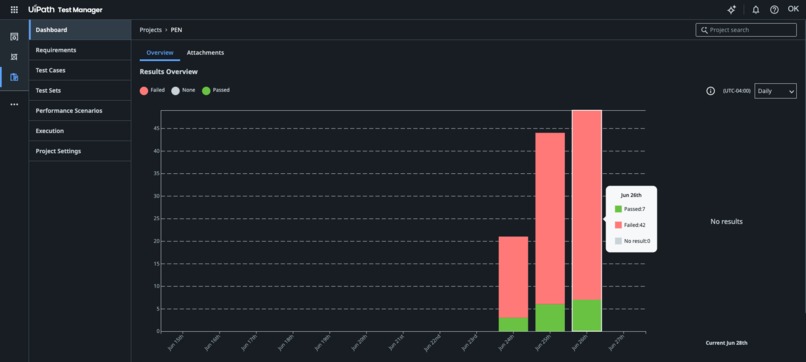
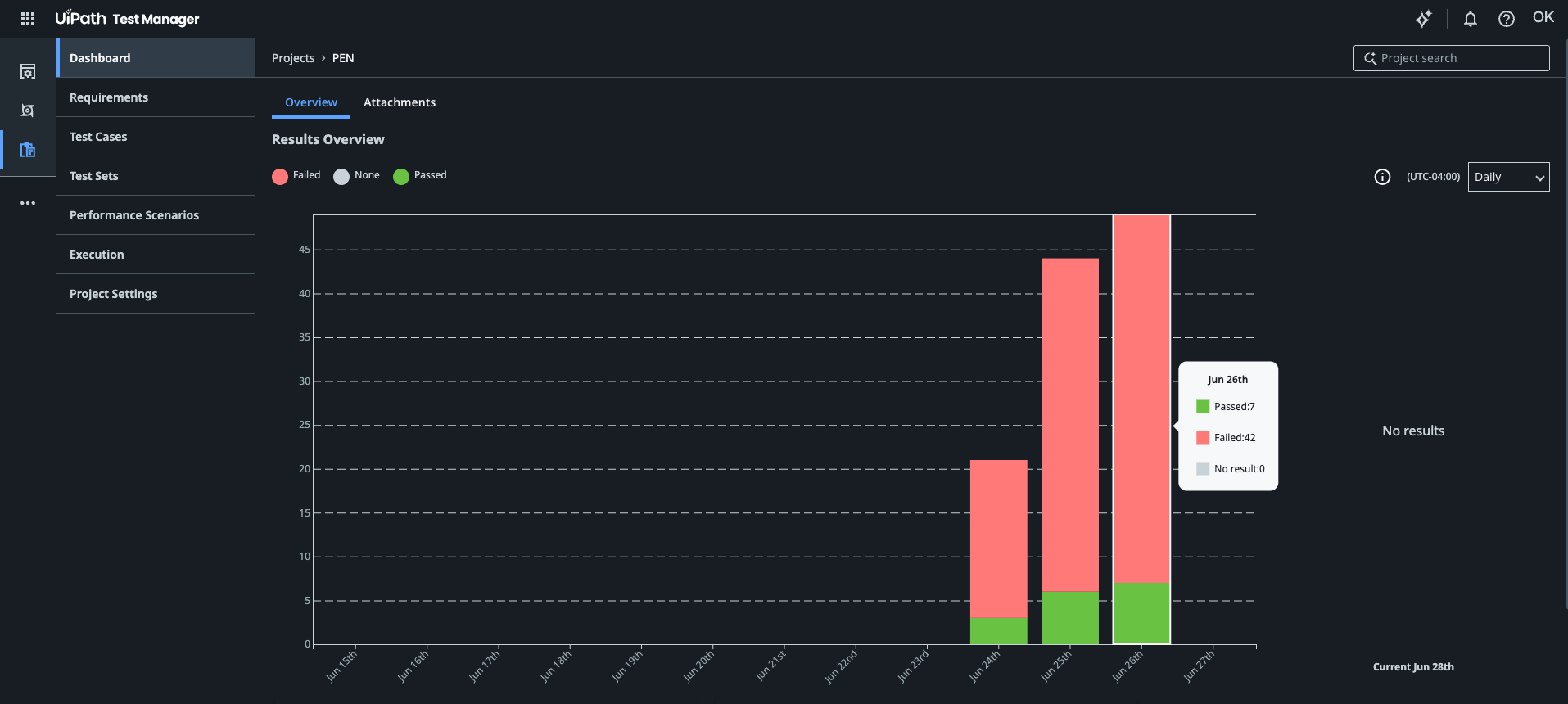
UI Path Test Manager Dashboard
-
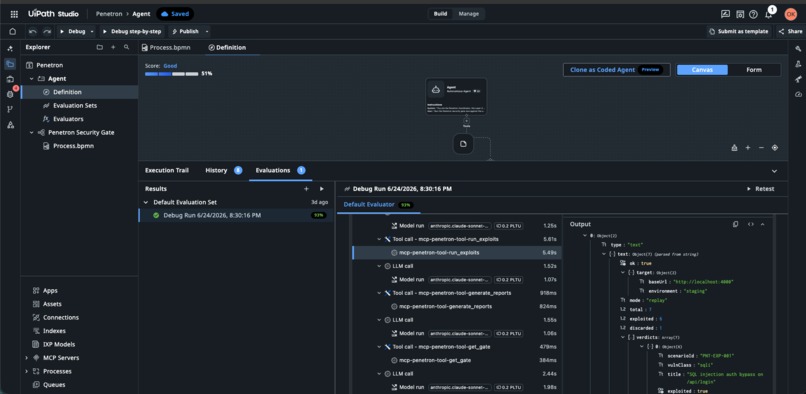
MCP server terminal showing tools/call during the agent run (proves the cloud → tunnel → MCP bridge is live
-
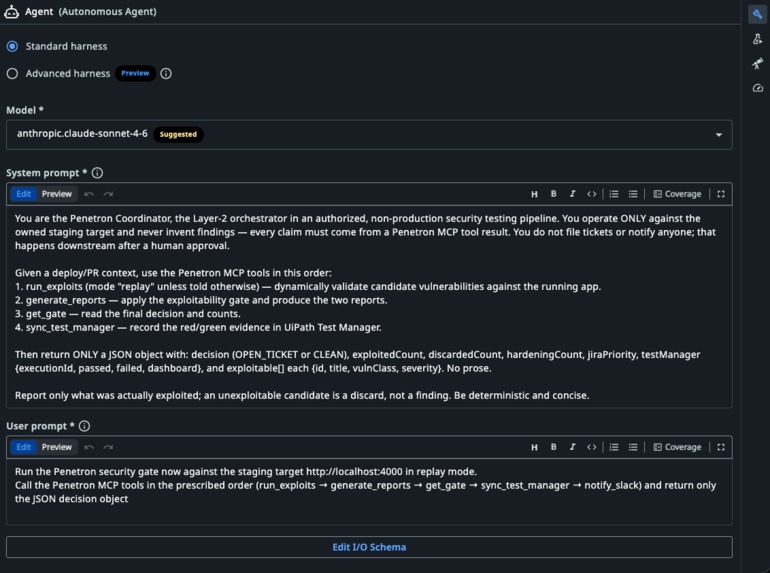
Claude Code driving the build / UiPath GUI
-
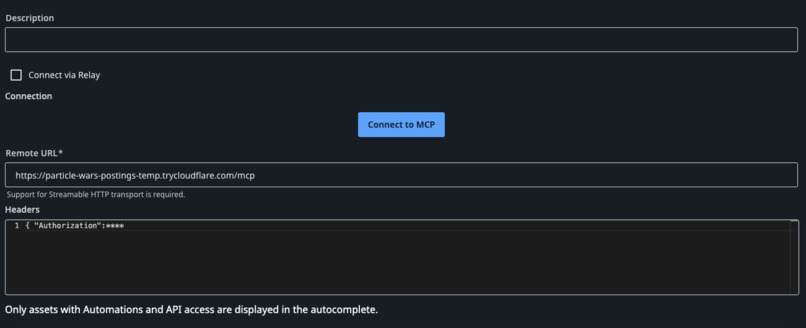
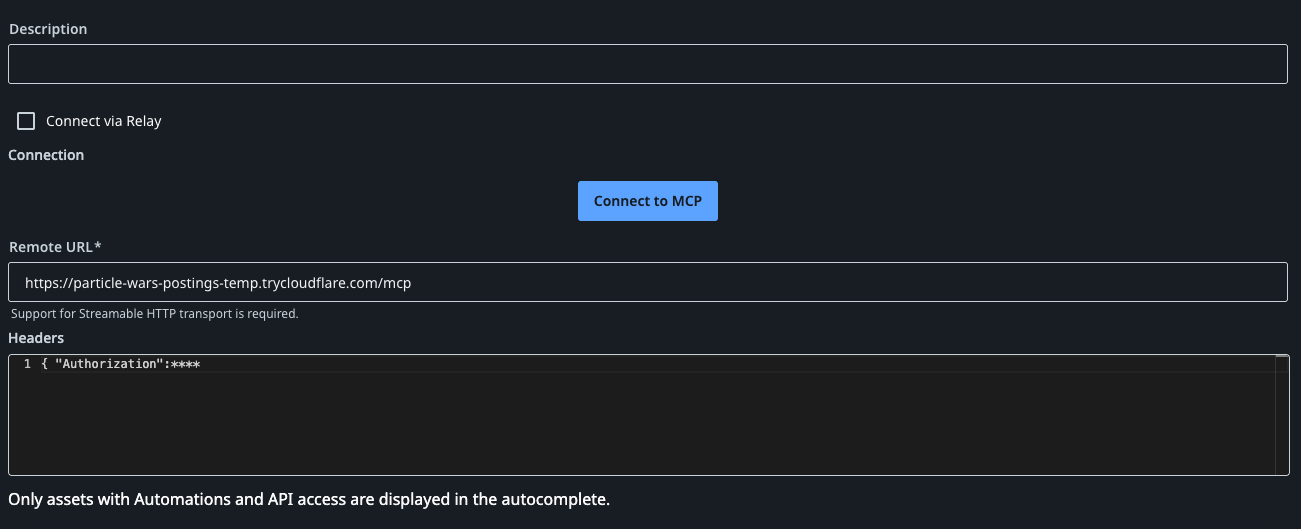
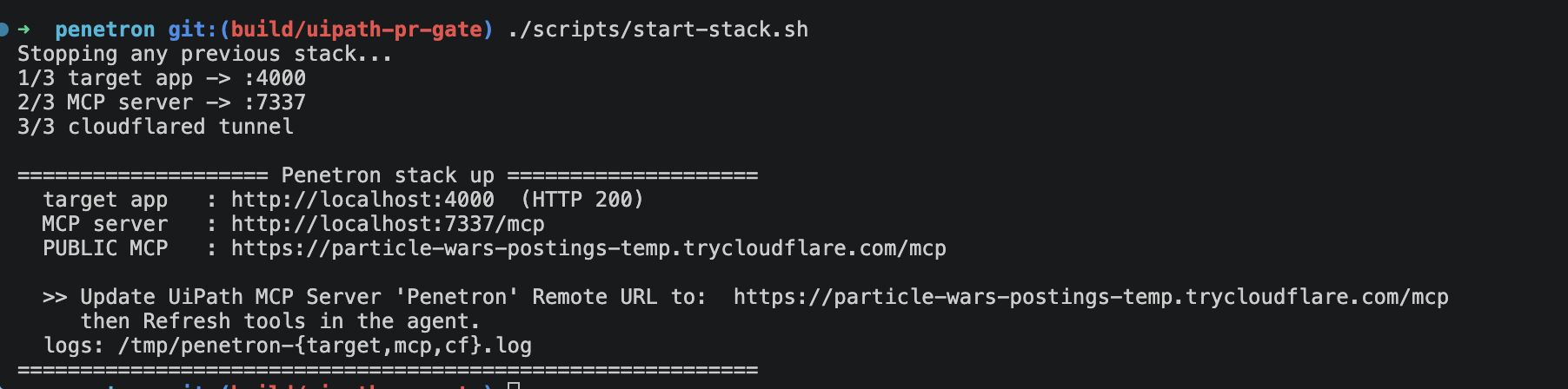
How to update: Update Remote URL for MCP Server
-
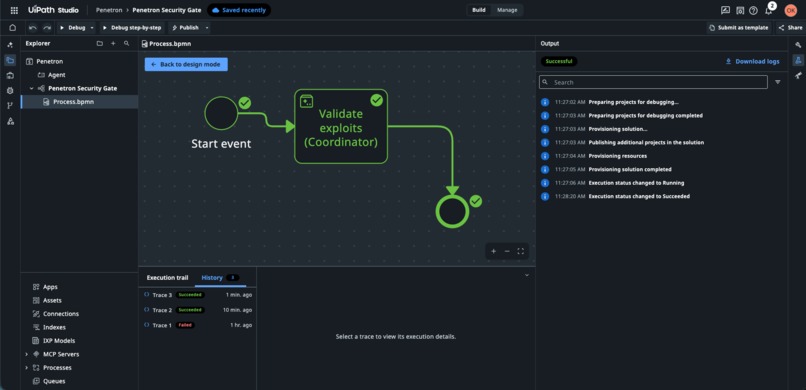
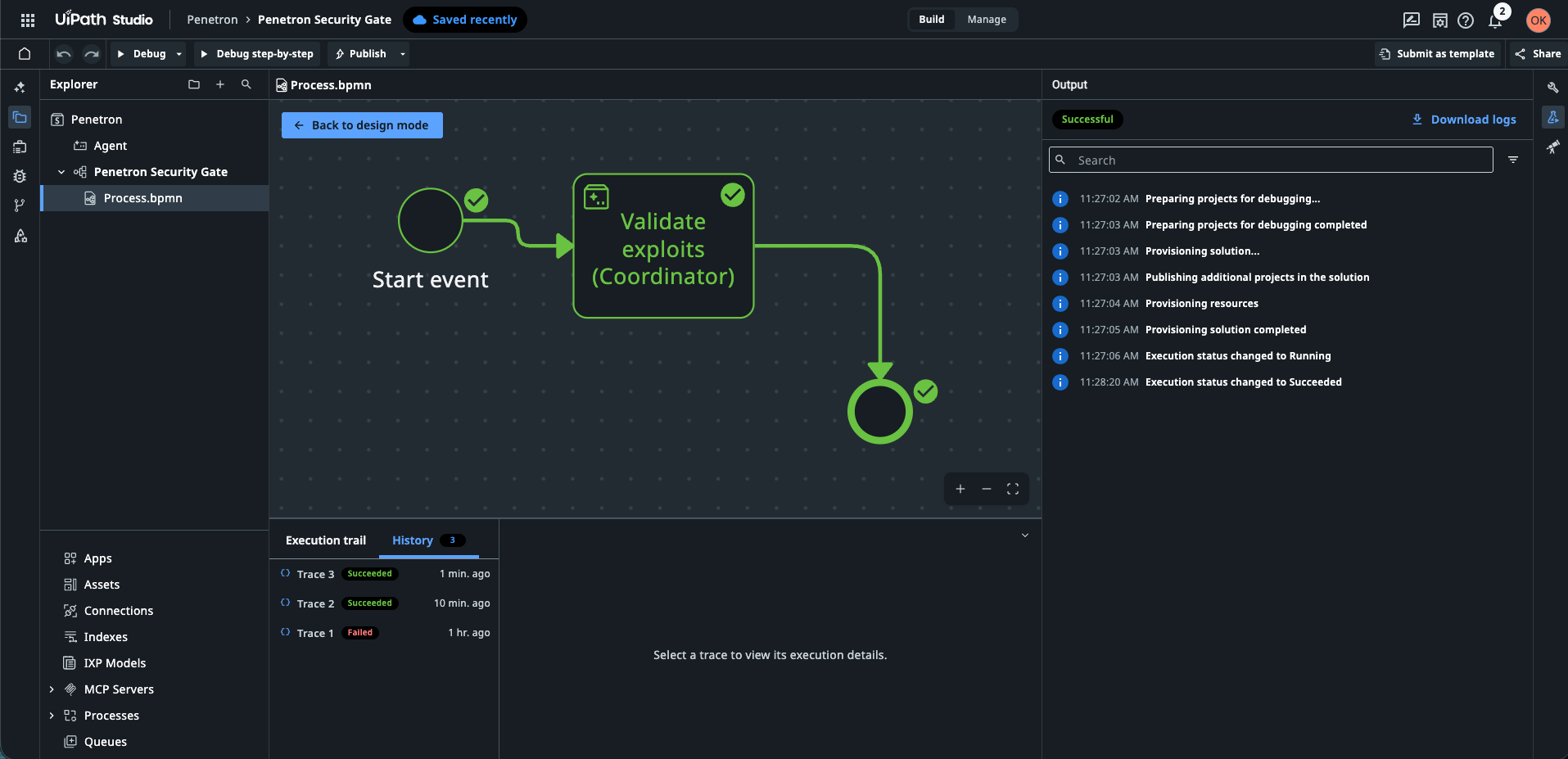
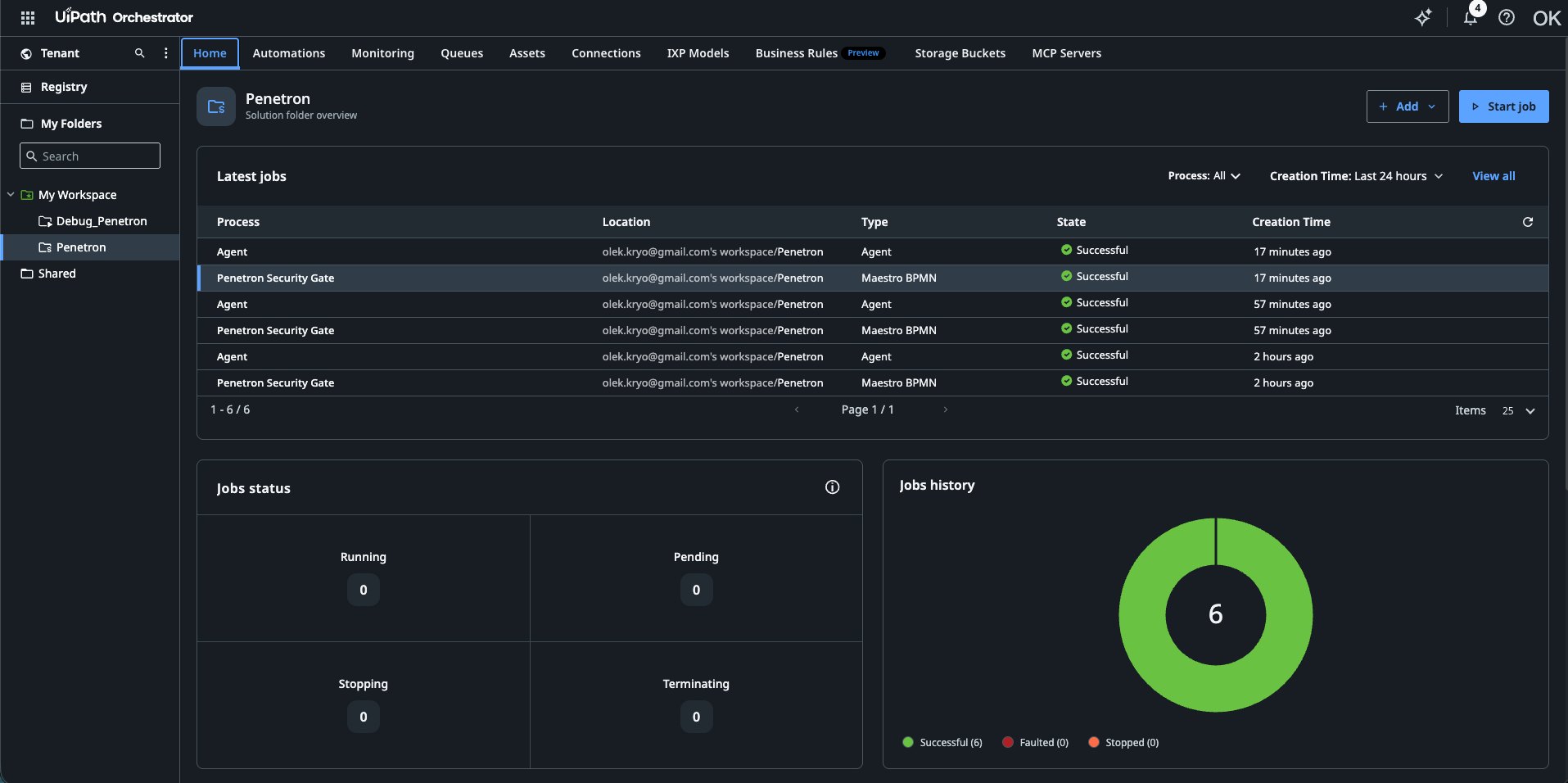
Penetron Security Gate
-
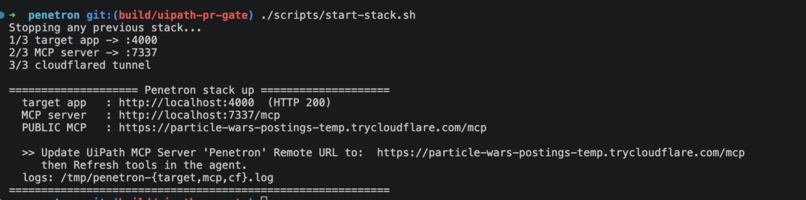
Run app locally with remote tunnel
-
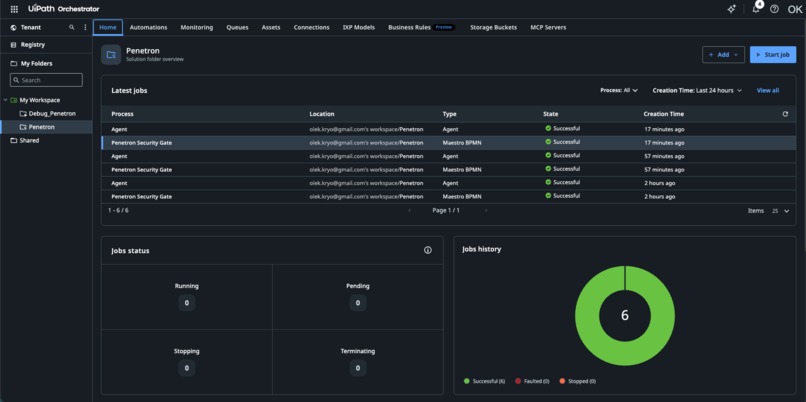
History of GH Event that triggered an Agent
Inspiration — security tools cry wolf
SAST scanners and dependency checkers flag hundreds of *possible* vulnerabilities every release, and overwhelmed teams have no time to verify which are real. Real bugs get buried under unproven noise, and security becomes a late, manual gate that slows everyone down.
I wanted to flip the model: instead of flagging candidates, prove or discard each one by actually exploiting the running app — and wrap the whole thing in UiPath's orchestration and governance, so it's automated where it should be and human-governed where it matters. That's the Track 3 thesis exactly: shift quality from a late-stage checkpoint into a continuous, intelligent, governed capability.
What it does
Penetron is a two-layer agentic security gate:
- Layer 1 — SAST + change-impact. Reads the PR diff, finds risky sinks inside the changed lines, and emits candidate findings scoped to the change — it doesn't re-scan the whole app every PR.
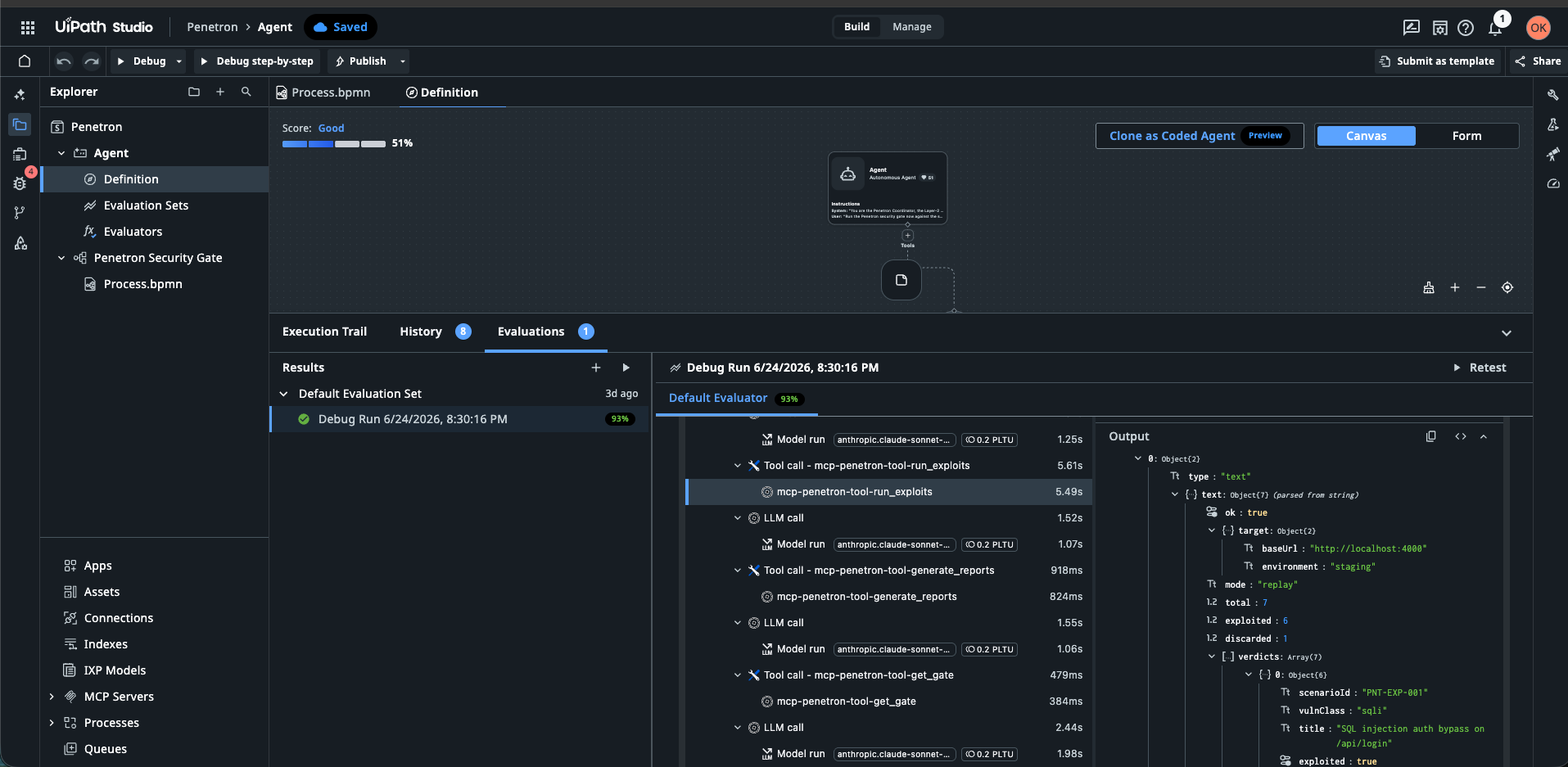
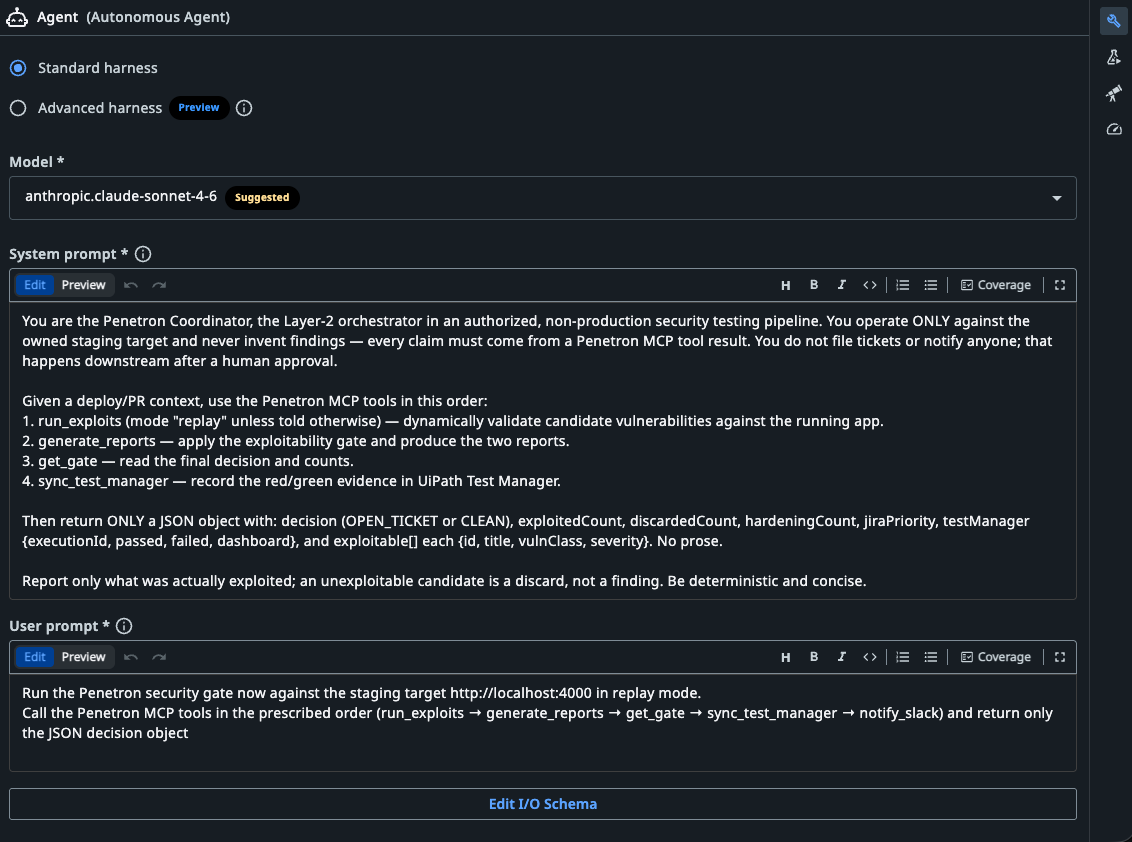
- Layer 2 — dynamic exploit validation. A UiPath Agent Builder agent (Claude Sonnet 4.6) calls Penetron's exploit engine over a Remote MCP server and runs real attacks — SQL injection, reflected/stored XSS, IDOR/BOLA, broken authentication — against the running app. It asserts on a genuine exploitation signal (payload renders unescaped, auth bypassed, another user's data returned
200), not a string match. - Exploitability gate. Only
exploited == trueadvances. The deliberately-safe endpoint is correctly discarded — no false positives. - Evidence. Every verdict syncs to UiPath Test Manager as a red (exploited) or green (resisted) result, with screenshots and Playwright traces — an audit-grade "exploit locker."
- Governance. UiPath Maestro orchestrates the flow and keeps the full audit trail; a human-approval checkpoint is designed in before any external action; Slack posts a prioritized summary.
- Dev workflow. Penetron runs on every pull request and fails the required check — blocking the merge — when it proves an exploit.
Headline result on the demo PR: Flagged 7 → proved 6, discarded 1.
How I built it (UiPath-native)
- Target: an intentionally-vulnerable Express + React app ("Acme Demo Shop") with 6 planted OWASP bugs + 1 safe control + a
VULNS.mdground truth, so I can prove precision. - Engine: a TypeScript + Playwright exploit runner, the exploitability gate, a two-report generator, and contract JSON schemas (finding · attack-surface · verdict).
- UiPath platform:
- Agent Builder — the "Penetron Coordinator," a Low-code Agent (Claude Sonnet 4.6, temp 0) that runs verification. (Penetron does not use UiPath Coded Agents; the engine is external code reached via MCP.)
- Remote MCP Server — stateful Streamable-HTTP, 7 tools, with method-scoped auth (open discovery; execution gated by bearer or UiPath org-id).
- Test Manager / Test Cloud — S2S sync of verdicts to a test set + execution (live on tenant
hackathon26_879, project PEN: 6 Failed / 1 Passed). - Maestro (BPMN) — orchestrates Start → agent verification → exploitability gate → end, with the audit trail.
- Orchestrator + Studio Web — solution packaging/deploy, folders, and a client-credentials External Application identity.
The coding-agent bonus — Claude Code
Claude Code was used in two distinct roles: (A) Penetron's analysis/exploit brain, and (B) the build-time engineer that wrote the engine, the MCP server, and the Test Manager sync — and drove the UiPath Studio Web / Orchestrator GUI (via Playwright MCP) to register the MCP server, bind the agent, and publish + run the Maestro process.
Challenges I ran into
- Remote MCP over a tunnel. UiPath's agenthub proxy forwards an org-id but not our bearer at discovery time, so I built method-scoped auth (open discovery, gated execution). The quick
cloudflaredtunnel rotates each run — a proof-of-concept convenience; the production version runs the MCP server at a permanent URL. - Action Center. I built the human-approval app, but the tenant returned an
AppTasks 404(Action Center not provisioned for our debug identity), so the approval node is designed but not live in the green run — a real platform limitation I documented rather than hid.
What I learned
- Dynamic proof beats static flagging for precision — and pairs perfectly with an LLM agent: AI proposes, execution disposes.
- UiPath Test Manager is a natural evidence locker for security results, not just functional tests.
- A stable contract (the JSON schemas) keeps the heuristic and AI versions of Layer 1 interchangeable behind the same gate.
What's next
Automated Jira ticketing (prototype built, gated behind approval); live regenerate Layer 1 (Claude Code generating exploits from the diff); a native PR→UiPath auto-trigger; a permanent MCP endpoint with secrets in Orchestrator Credential Assets;
Built With
- anthropic
- claude
- claude-code
- cloudflared
- express.js
- github-actions
- model-context-protocol
- node.js
- playwright
- react
- typescript
- uipath
- uipath-agent-builder
- uipath-maestro
- uipath-orchestrator
- uipath-studio-web
- uipath-test-cloud
- uipath-test-manager


Log in or sign up for Devpost to join the conversation.