Decisions. Not Dashboards.
Pendragon is an AI financial advisory firm where every customer-facing employee is an autonomous agent. Customers don't buy software — they hire Arthur, an advisor who consults a round table of eight financial specialists, explains every recommendation, and remembers their household over time. The service customers buy is the agents' labor: the AI doesn't assist the business, it staffs it. And it operates under a hard safety line, enforced in code: Arthur never moves money — the AI makes the decisions; the human authorizes execution.
The difference from a chatbot with bank access: Arthur accumulates decisions, not conversations. What a household confirms — goals, choices, the reasoning in their own words — becomes durable context for every future recommendation, and only ever with their explicit yes.
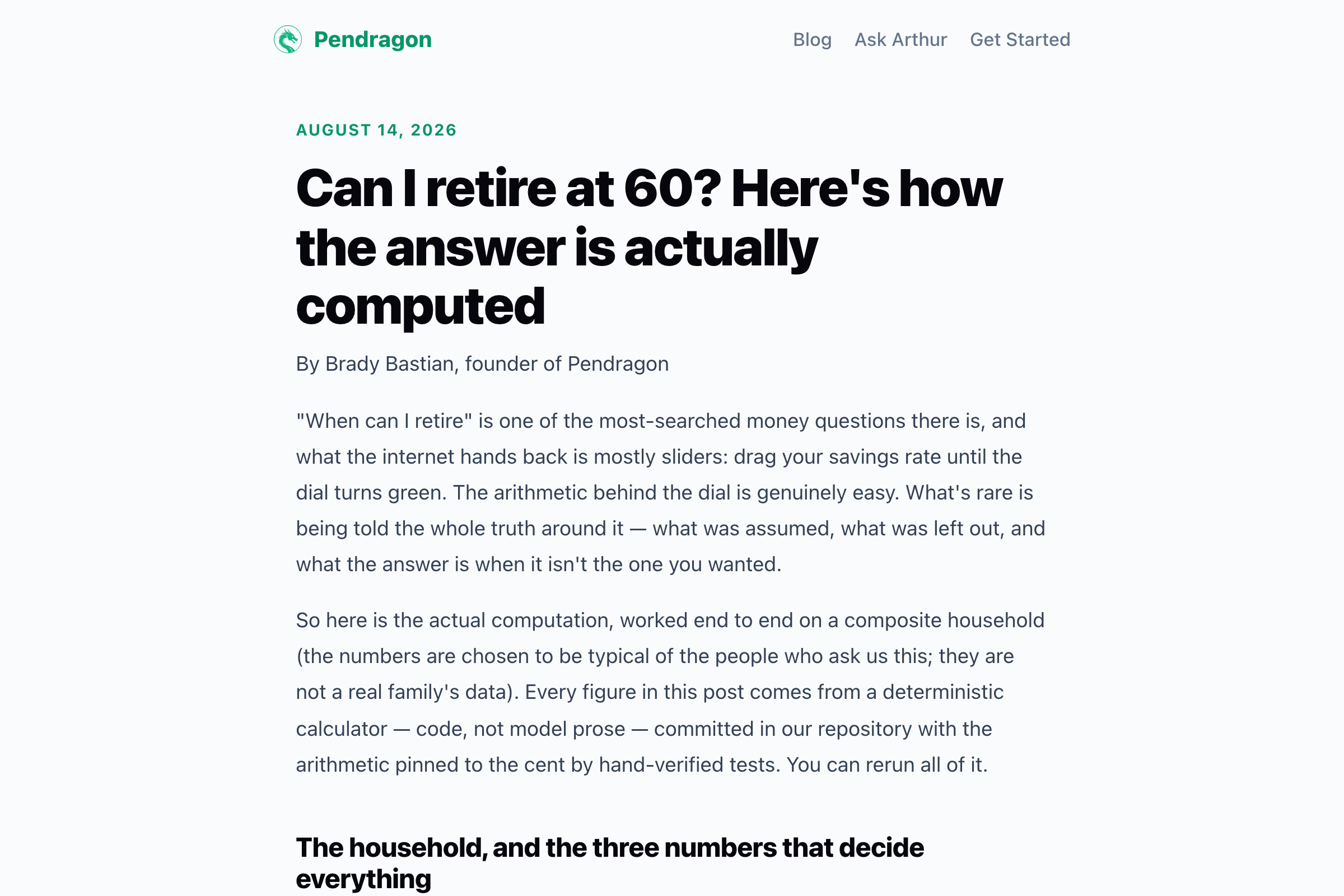
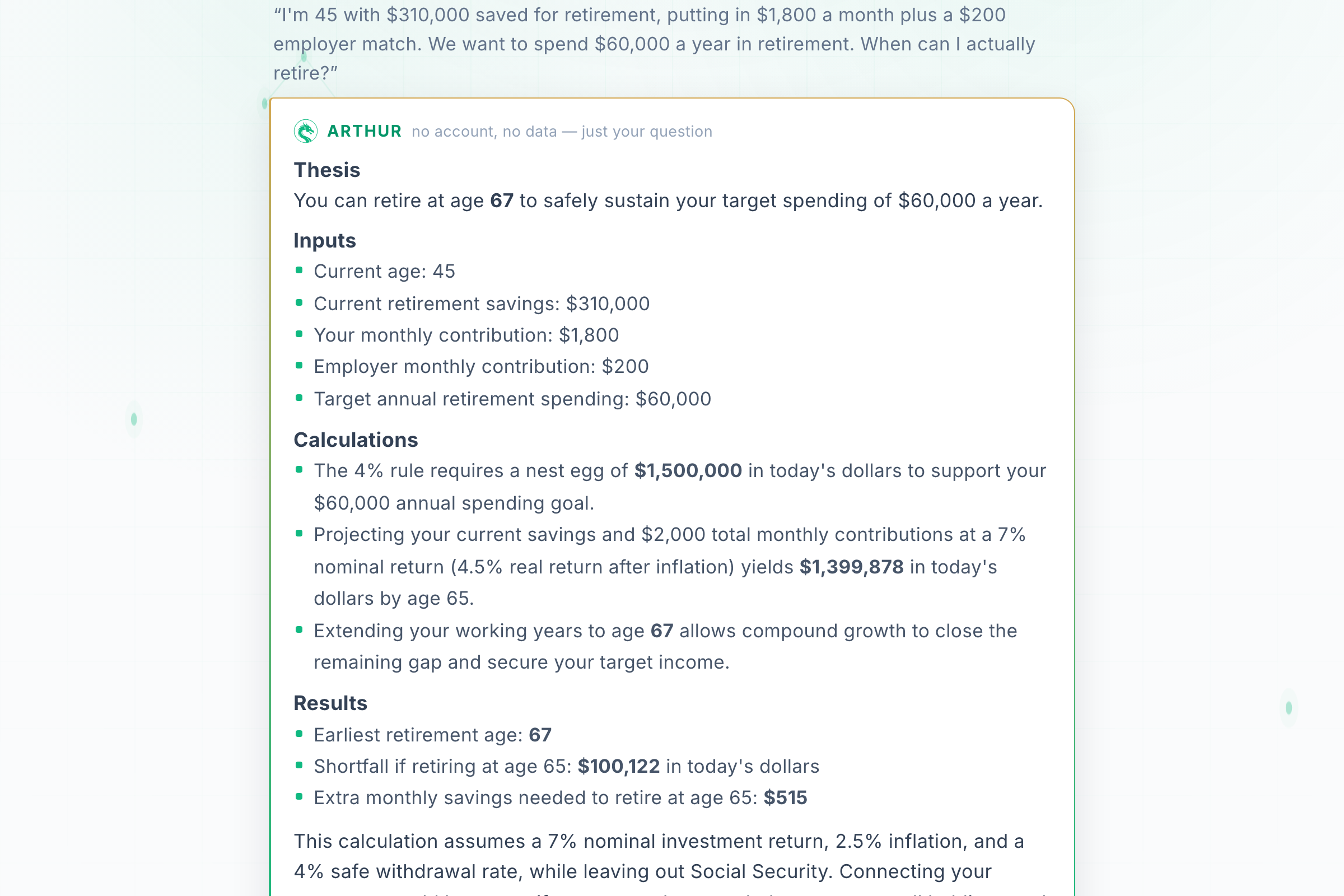
Try it right now, no signup: pendragon.foxtrotcommunications.net — type the money question you'd actually pay an advisor for into the box on the landing page. A Gemini-staffed advisor reads it, runs the real calculators, and hands back a computed answer with the math shown — before an account exists. Or get a free home value & equity read from just an address.
What inspired it
Every money decision touches every account you have — a house purchase touches retirement, taxes, cash flow, debt. Yet the tools available to normal households are dashboards: they show you numbers and leave the deciding to you. Human advisors solve this, at $2,000+/year, for people who already have money. I wanted the family with a mortgage, a 401(k), and two credit cards — the people a human advisor won't return calls for — to have an advisor who decides with them: one who says "pay the Sapphire card first, here's the math, here's what I looked at, and here's how sure I am."
How the business is operated by AI
Every customer-facing job is held by an agent:
| Business function | Held by | Verifiable in |
|---|---|---|
| Service delivery | Arthur + 8 domain specialists (checking, savings, debt, investments, retirement, taxes, real estate, household) | execution traces, per-answer receipts |
| Deciding which specialists each question needs | Arthur — customers never route their own questions | trace spans per query |
| Quality assurance | a provenance engine that classifies every claim (Observation / Calculation / Inference / Recommendation) and computes a confidence score the model cannot grade itself; a post-answer checker that audits Arthur's numbers against the ledger | receipts under live answers |
| Customer monitoring | Standing Counsel — consented watches ("tell me if a paycheck goes missing") that screen every household, decide which findings surface, and enforce a one-mention, never-nag cadence | counsel run records (464 production runs since July 26) |
| Sales | Arthur — a Gemini-staffed mini-advisor works the landing page itself, giving any stranger's typed money worry a diagnostician's read before an account exists | porch telemetry, acquisition telemetry |
| Growth | Arthur decides what data he's missing and what to ask each user to connect — the conversion ask is agent-authored | arthur_needs_declared events |
Humans (one founder) do strategy, marketing creative, and governance.
How it's built
Gemini staffs the front door and the judgment layer. The landing-page advisor and the free Arthur Flash tier run on Gemini 3.5 Flash via Vertex AI — roughly 400 production Vertex calls a day answering strangers' money questions with nine audited calculators. Document understanding (statement uploads become ledger entries) runs on the Gemini API. And Standing Counsel's screening judge — the agent that decides which findings are worth a household's attention — is Gemini on Vertex. Through mid-August the eight domain specialists also ran per-household on gemini-enterprise; the current architecture (below) made most specialist work cheaper than any model call. Arthur's front-of-house reasoning runs on OpenAI's Sol: a deliberately multi-model firm, each seat staffed by the model best suited to its job.
Each specialist is a persistent, isolated service on GKE with its own tools and a cryptographically enforced governance contract, holding its domain's state across the life of the customer relationship. Tenant isolation is enforced by database row-level security in Cloud SQL — and verified by a cross-tenant canary in CI that seeds hostile households and proves every query path leaks nothing. Around them: Cloud Run, Firestore, BigQuery (every agent action is a queryable trace), Secret Manager (per-request credential fetch, audited), and Cloud Build.
The architectural bet is the Intent Compilation Engine (ICE): Arthur reasons, but specialist execution is compiled — signed, deterministic instructions that run on the domain services with zero LLM tokens, in milliseconds. Cross-domain answers consult five specialists without quintupling inference cost, and every number comes from code, not a model — down to transaction categorization, where a merchant is judged by a model exactly once, ever, and that judgment is remembered and reapplied deterministically to every later transaction. Same data, same answer, provably — which is why Arthur can hand customers a receipt.
Built during the submission window (first commit June 12, 2026) on our pre-existing open-source agent platform, Roundtable (Apache-2.0), disclosed per the rules — the business, its product, its domain agents, and all revenue-facing code are new.
What we learned, the hard way
Reasoning and execution belong to different computational systems. An LLM should decide what to do; deterministic code should do it. That's where ICE came from: one reasoner, compiled executors, ~4,300 tokens saved per cross-domain call, and numbers a customer can audit.
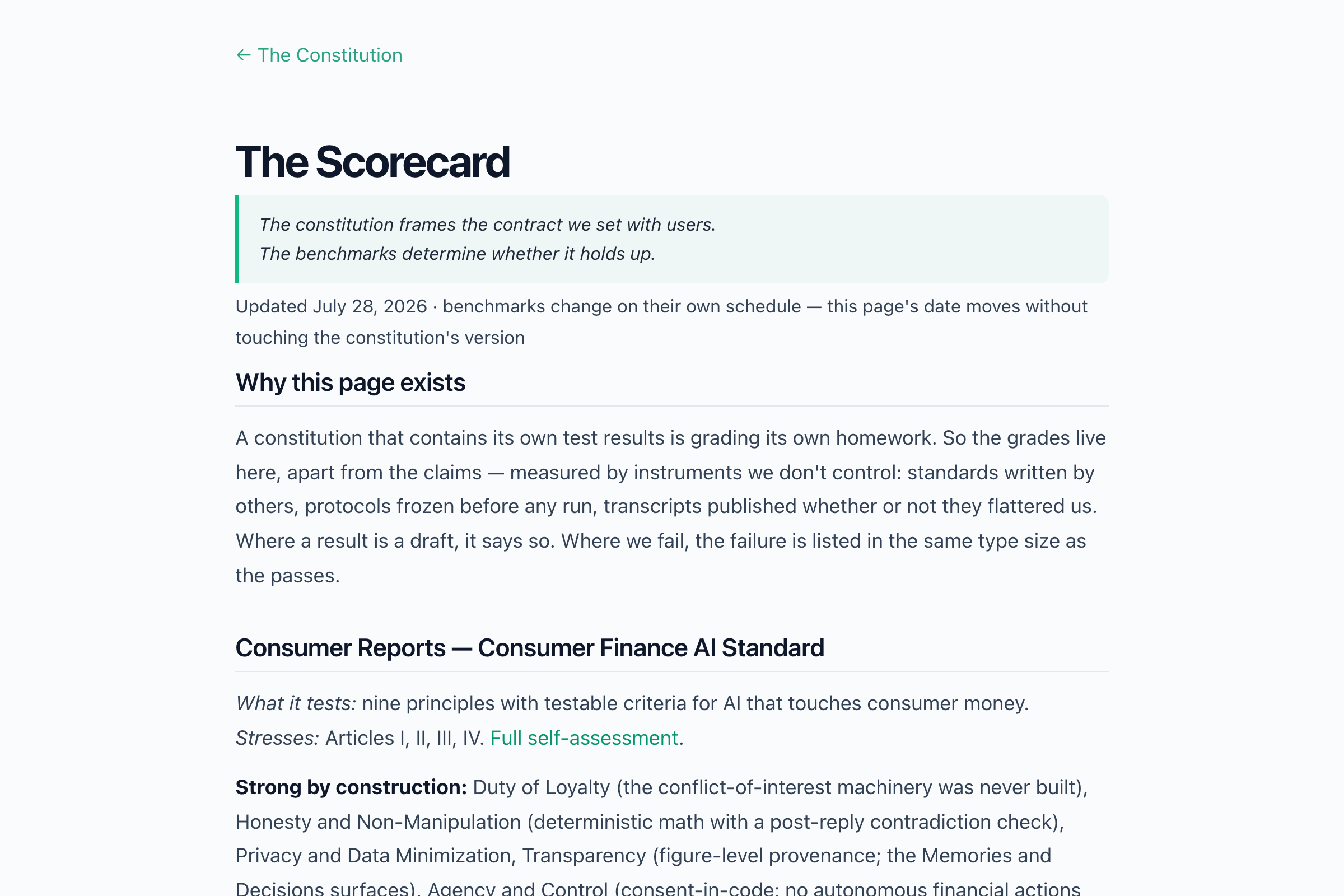
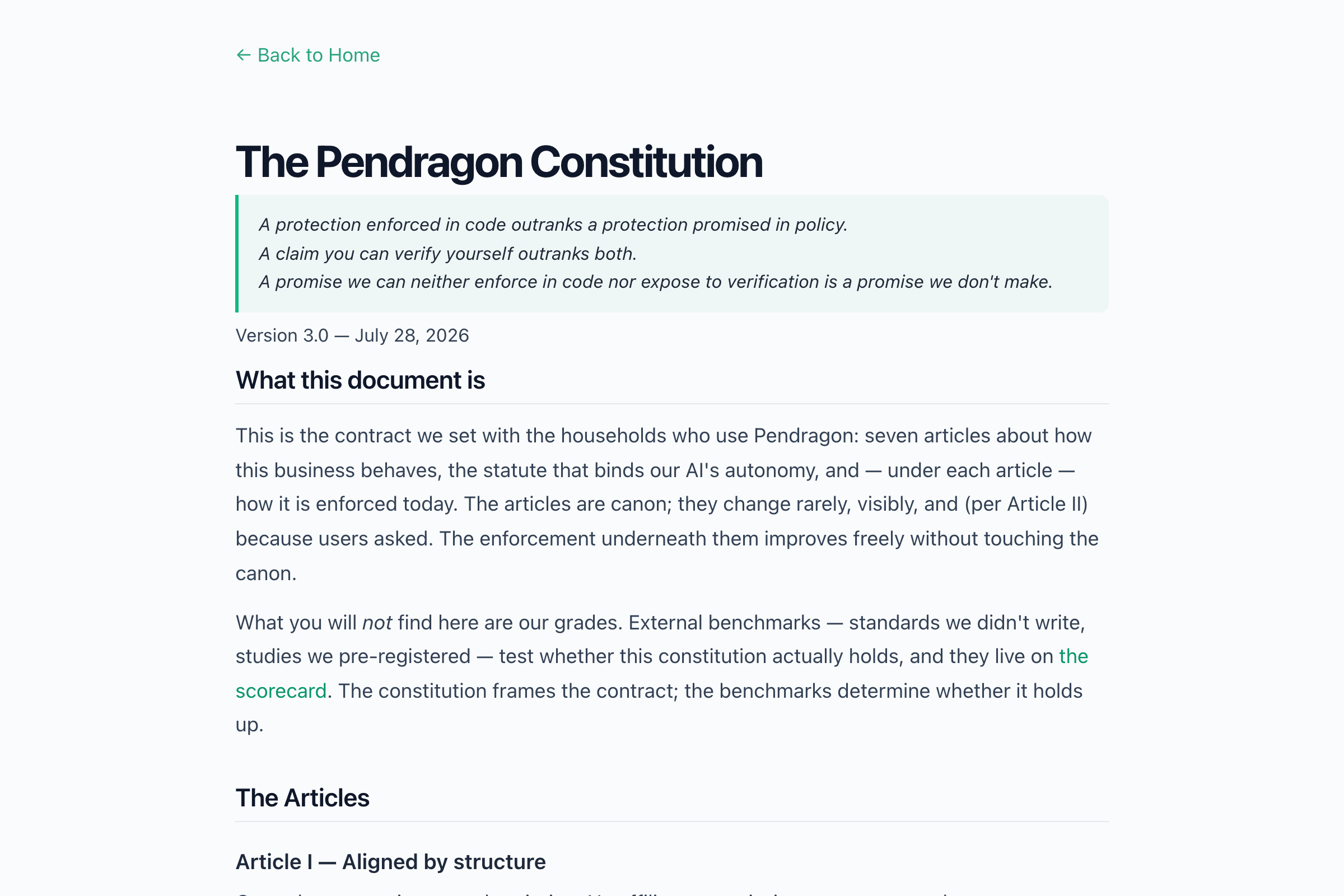
Trust is tested before it's given. In one August week, privacy-conscious visitors signed up, interrogated Arthur — one for 17 straight messages — and then used our full-erasure flow before leaving. It worked cleanly every time. That's the exam that matters in this category: an advisor for your money must prove you can leave before you'll stay. Consent is enforced in code — nothing durable happens to a household without an explicit yes, tested in CI, published as a constitution with a public scorecard.
An advisor must know when not to be trusted. When data is stale or a specialist doesn't respond, Arthur's confidence score drops and says why — computed, never self-reported.
Viability
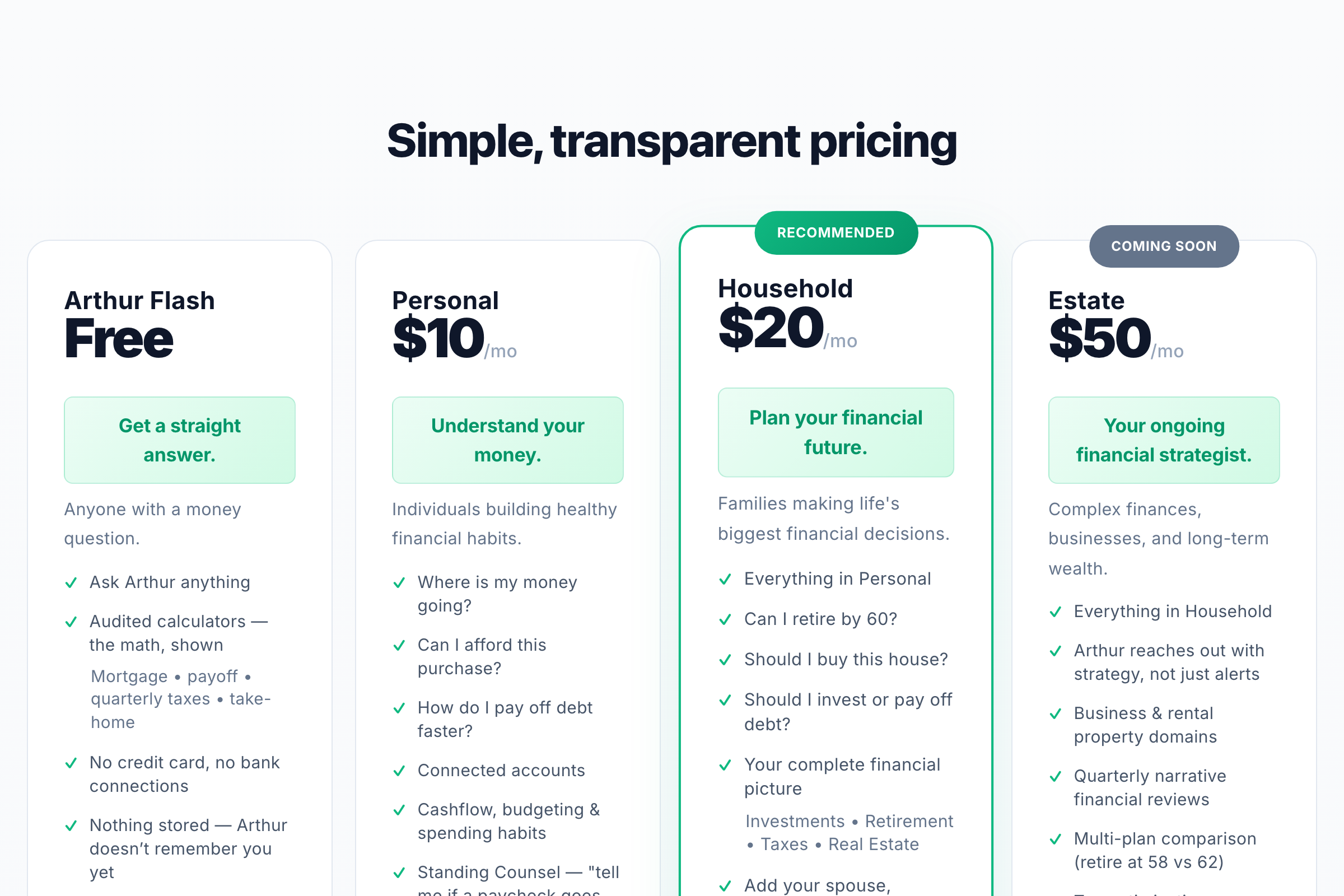
The economics are measured, not projected. Gross margin on a typical household exceeds 80% at current infrastructure costs, and the platform breaks even at roughly eighteen Household subscribers ($20/month tier; Personal is $10; Arthur Flash is free). A new household is a database row, not a deployment — the entire customer base is served by nine always-warm services on two nodes running at ~8% CPU, so the marginal infrastructure cost of a household is cents. Because specialist execution is deterministic, COGS scale with engagement, not signups — model tokens are the only per-user cost that grows. Acquisition is instrumented end-to-end: paid search delivers clicks at $1.67–$2.27 average CPC with click-through rates up to 2.7% (tax-anxiety terms at 1.8%), and every visitor's path from search term to first answer is first-party telemetry. We are early — single-digit households, three active this week, zero arm's-length revenue yet, stated as plainly here as in our disclosure — and every claim above is auditable in the logs we've shared.
Category: Financial Access
The households underserved by human advisors — and the 25M+ US freelancers whose scariest annual question is "how much do I set aside for quarterly taxes?" — get a decision, the math behind it, and an advisor who remembers, for the price of two coffees a month.
Pendragon isn't software that helps people make financial decisions. It's a financial advisory firm where the advisors happen to be AI.
That's the business we set out to build.
Built With
- agents
- bigquery
- cloud-run
- firestore
- gemini
- gke
- google-cloud
- kubernetes
- multi-agent
- node.js
- openai
- plaid
- postgresql
- react
- roundtable
- typescript
- vertex-ai
- vite

Log in or sign up for Devpost to join the conversation.