Inspiration
Iceland is an incredibly efficient country in terms of renewable energy, being a spearhead for global efforts to produce most, if not all, energy through renewable resources. Although renewable technology has been integrated into their society, their fishing industry still relies solely on fossil fuels. 20% of the country's CO2 emission comes from their fishing vessels, a significant amount for only a single industry. By focusing on reducing the amount of fossil fuel consumption within this industry, the idea to add Peltier plates to preexisting fishing vessels to capture excess heat seemed to be an efficient way to minimize Iceland's carbon emission while being minimally invasive to the environment.
What it does
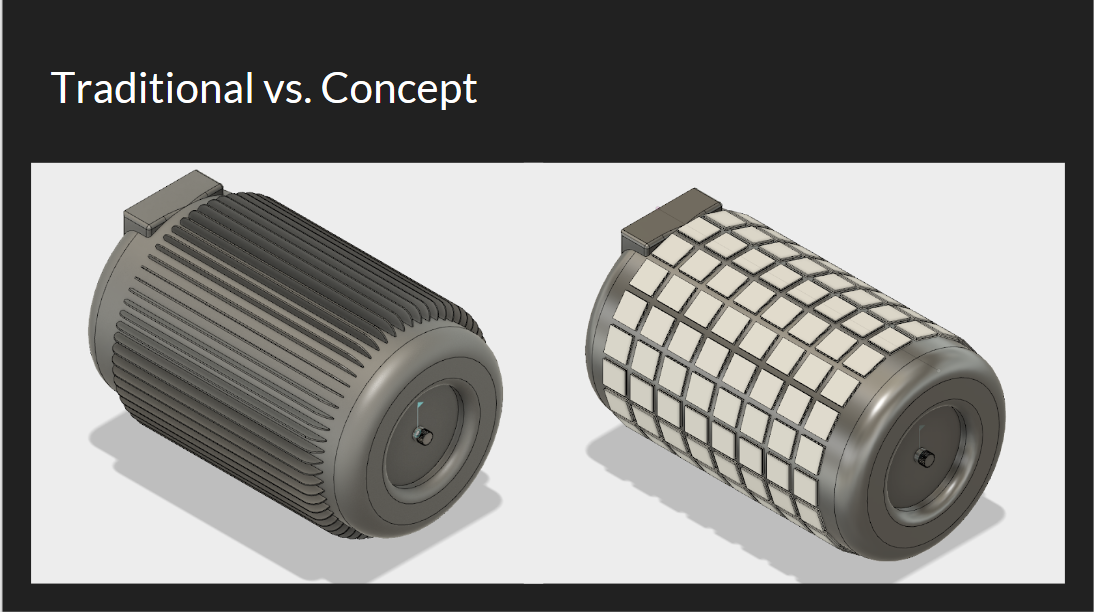
By adding Peltier plates to the fishing vessel's engine, we are able to capture the excess heat from the engine and convert it into energy. With this energy, the Peltier plates are able to power a series of L.E.D. lights throughout the ship, decreasing the amount of fossil fuels needed for the fishing vessel to function.
Challenges we ran into
When we first started to get into the idea of using Peltier plates to utilize excess heat energy, we tried to create a proof of concept using diodes in place of Peltier plates to produce voltage. At first, the multimeter jumped up to a voltage of about 40 when a soldering iron was placed near the diode to heat it up. However, the results were not consistent and seemed to fluctuate greatly thereafter, so we attempted to first measure the voltage using Arduino, which did not show significant enough voltage either. In one last attempt, we used an open flame to heat the diode in order to eliminate any possibility of an electric field that the soldering iron may have been generating.
After neither of those adjustments worked, we began to research whether or not the concept was feasible in the first place, and discovered that what we had been looking for was a thermal diode, a technology not yet developed. We then took a step back and began looking at major contributors to Iceland's fossil fuel use, and saw that 87% of all oil consumption was by transportation and Iceland's fishing industry. We wanted to create another proof of concept to show how Peltier plates may work in conjunction with joule thieves to produce enough electricity to power the ship's motor. After several hours of research and attempting to create a tangible proof of concept, we settled on creating a 3D model using Fusion 360 to illustrate our idea, and decided to direct the energy towards powering L.E.D. lights on the vessel since they require much less voltage.
What's next for B.O.A.T.
The core principles behind the energy harvesting of B.O.A.T., capturing wasted heat with Peltier tiles, are ones that can be expanded and applied across many forms of electrical generation and electromechanical movement. As the world becomes increasingly powered by electricity as a opposed to fossil fuels, excess heat capture will not fade. Electromagnetic induction inherently produces eddy currents in the metal housing of the core of the magnet and motor or generator housing. These eddy currents will form circuits in the metal that will create resistance and in turn, heat. Additionally, mechanical friction of electric motors and generators will produce excess heat that can be captured.
Peltier tile generation will be able to be used in larger scale electrical generation as well. Much of our modern day means of electricity generation depend on using generators to transfer kinetic rotational energy into electrical energy. These generators will all lose energy to heats through the methods mentioned above leaving opportunity for peltier tiles to recover this lost energy. Excess heat will continue to be available for harvesting even as electrification continues making the implementation of Peltier tiles into electromechanical devices an important option for our future to improve the efficiency of generation.


Log in or sign up for Devpost to join the conversation.