Inspiration
Having experienced febrile seizures frequently throughout my own childhood—a condition that also ran in my family—I know firsthand how frightening and overwhelming high fevers can be for parents and caregivers. Rapid decision-making and clear triage guidance are critical when a child's fever escalates suddenly. I built PediaGuard AI to transform this deeply personal challenge into an instant, data-driven clinical decision-support tool that empowers families and healthcare providers when every second counts.
What it does
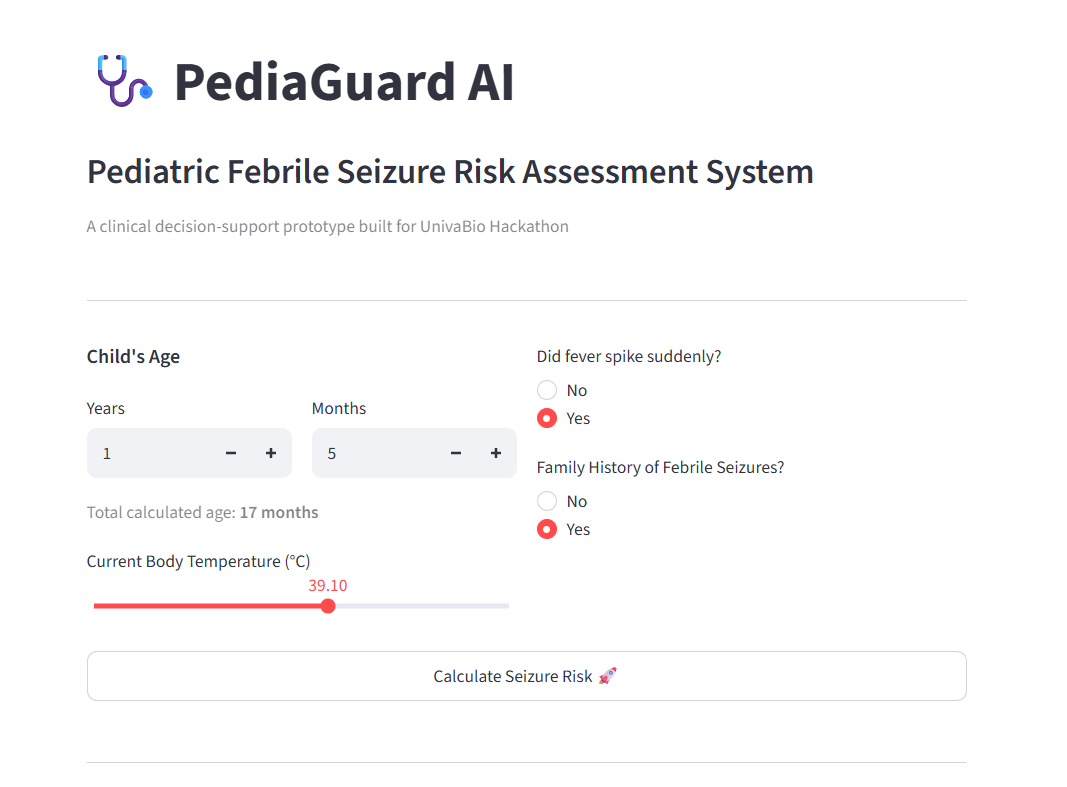
PediaGuard AI is an AI-powered clinical decision-support application that predicts the probability of pediatric febrile seizures in real-time based on key clinical parameters:
- Age: Precision input handling both Years and Months tailored for pediatric ranges (6–60 months).
- Peak Body Temperature (°C): Body temperature at fever onset.
- Rate of Fever Increase: Sudden vs. gradual temperature spikes.
- Family History: Genetic predisposition to febrile seizures.
The application generates an instant risk score percentage alongside actionable triage recommendations categorized into Low, Moderate, or High Risk.
How we built it
- Machine Learning Core: Trained a Random Forest Classifier using
scikit-learnto accurately model non-linear interactions between age, fever velocity, and family history. - User Interface: Developed an intuitive clinical dashboard with
Streamlit, tailored for instant clinical decision support. - Deployment: Continuous delivery via
Streamlit Cloudlinked directly to our GitHub repository.
Challenges we ran into
- Handling pediatric age representation accurately (balancing raw months vs. combined years and months UI controls) without breaking model feature compatibility.
- Ensuring the machine learning risk outputs translate into clear, non-alarmist, yet actionable clinical guidance for worried caregivers.
Accomplishments that we're proud of
- Built a fully functional end-to-end medical ML prototype in a single hackathon sprint.
- Achieved real-time risk scoring and seamless cloud deployment with zero latency.
What we learned
- The critical importance of UI/UX feature alignment with backend ML model expectations in pediatric digital health applications.
What's next for PediaGuard AI
- Integrating smart Bluetooth wearable thermometers for continuous real-time monitoring and predictive fever trend alerts.
- Multi-language support and direct emergency hotline dispatch capabilities.
Built With
- github
- python
- scikit-learn
- streamlit

Log in or sign up for Devpost to join the conversation.