Inspiration
When walking to school every day, we often find that the music playlists we've made usually don't match the emotion or the rhythm of our walk. On some days, our steps would be bright and energetic, while shuffling a playlist would often lead us to off-beat, melancholic songs.
This observation sparked an idea: What if there was a way to bridge this gap? To create a seamless blend of movement and music, where one could influence the other? From this, "Pedal to the Metal" was born. It isn't just about syncing steps with songs; it's about capturing the essence of a moment, the emotion behind each stride, and translating it into a musical experience.
This project was inspired by the simple belief that our movements, both conscious and subconscious, are a reflection of our emotions. And what better way to amplify those emotions than with the perfect soundtrack! Every step and every emotion has its unique melody, making every journey, no matter how mundane, a rhythmic adventure.
What it does
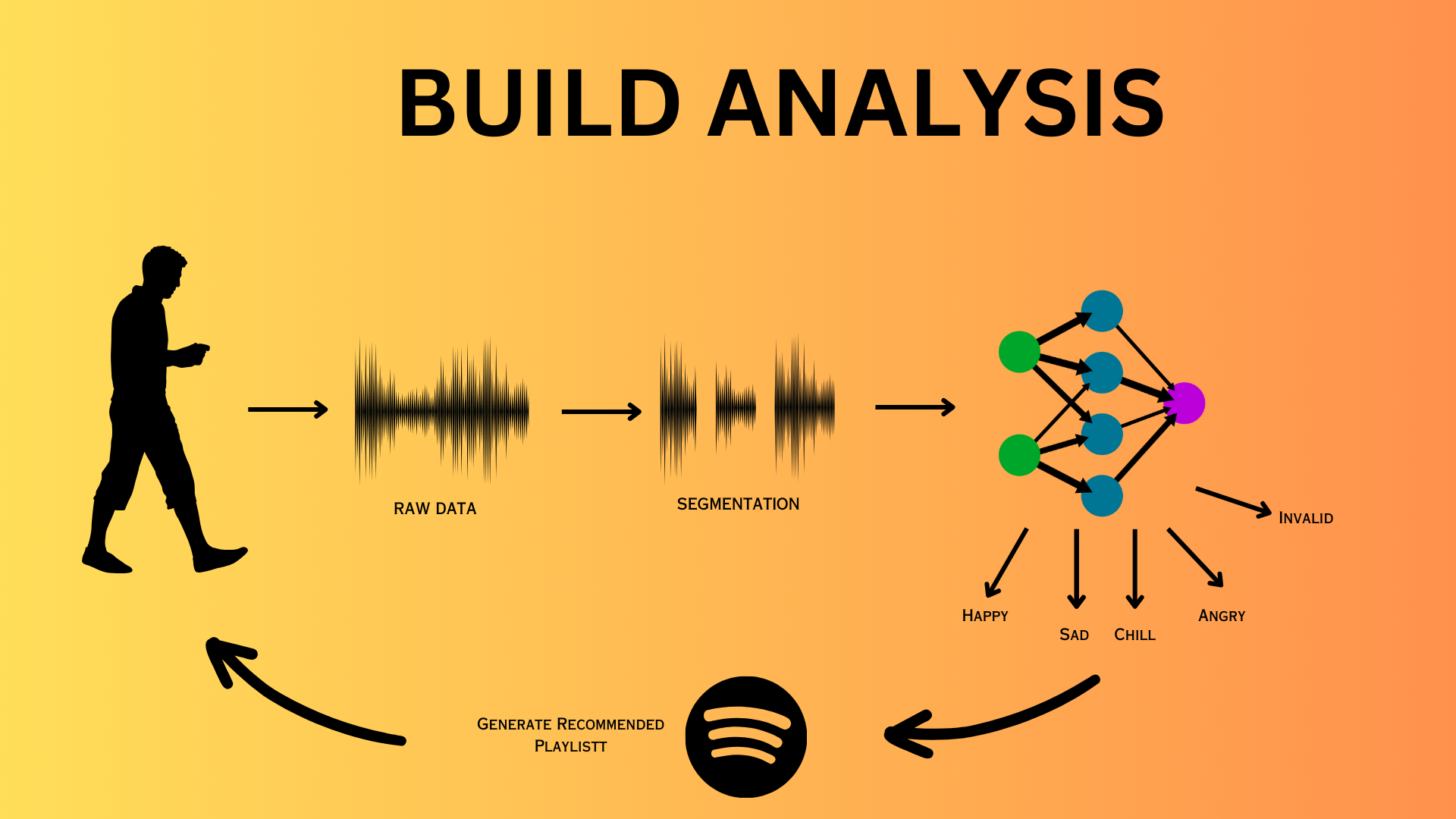
"Pedal to the Metal" is an application that utilizes a device's accelerometer data to perform gait analysis and recommend music based on that data. Initially, raw data is collected as a device is in a user's pocket while walking. From there, the raw data is segmented and classified into one of four emotions: Happy, Sad, Chill, and Angry. Each emotion is associated with 5 genres of music (for example, Happy = ['acoustic', 'bossanova', 'disco', 'funk', 'reggae'] ). After receiving this data, Spotify's API recommends music correlated to those genres. All of this is brought together via the Android application!
How we built it
To go about creating this product, we begin by feeding segmented smartphone accelerometer data to a model. This model then evaluates the given data using a three-layer neural network to classify it into one of the four main emotions: Happy, Sad, Chill, and Angry. Each emotion is correlated to 5 genres on Spotify's list of genres. We then connected to the Spotify API to generate song recommendations. Lastly, the Android application serves as a front end to provide a sleek interface for the user.
Challenges we ran into
We ran into many challenges when implementing this project mainly because most of the information online was theoretical and not implemented in code. Thus, simple tasks like segmenting the raw data and figuring out how to handle the data transfer from the phone to the server were mainly done through trial and error. Although this was the case, we would eventually find great solutions to the many obstacles faced throughout this development!
Accomplishments that we're proud of
Accelerometer Data - Accessing accelerometer data was a great moment for us since it was our first obstacle and it shed a bit of light on how we would handle the data throughout the process.
Creating our data - Generating a data set through walking was not only a fun experience, but we also had a fun time exploring the UWaterloo campus while also being productive.
Using the Spotify API - It was very fun to explore the Spotify API documentation and see how the recommendation system worked.
Android Development - Android development felt like extraterrestrial land to us. None of us knew how to develop applications, yet we were able to figure out how to get one up and running within about 15 hours.
What we learned
During these 36 hours, we learned so much! We learned how to work with RNNs, deep-learning technology, app development, problem-solving techniques, and more.
What's Next for Pedal To The Metal
Gait analysis as a concept has a bright future ahead. Similarly, Pedal to the Metal has many opportunities for feature implementations. An example of such features includes a way to connect to a Spotify account to provide a more refined recommendation system.


Log in or sign up for Devpost to join the conversation.