-
-
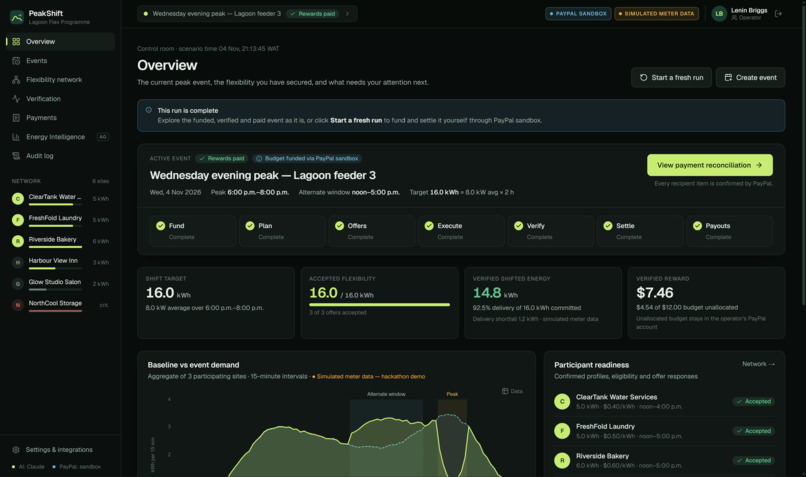
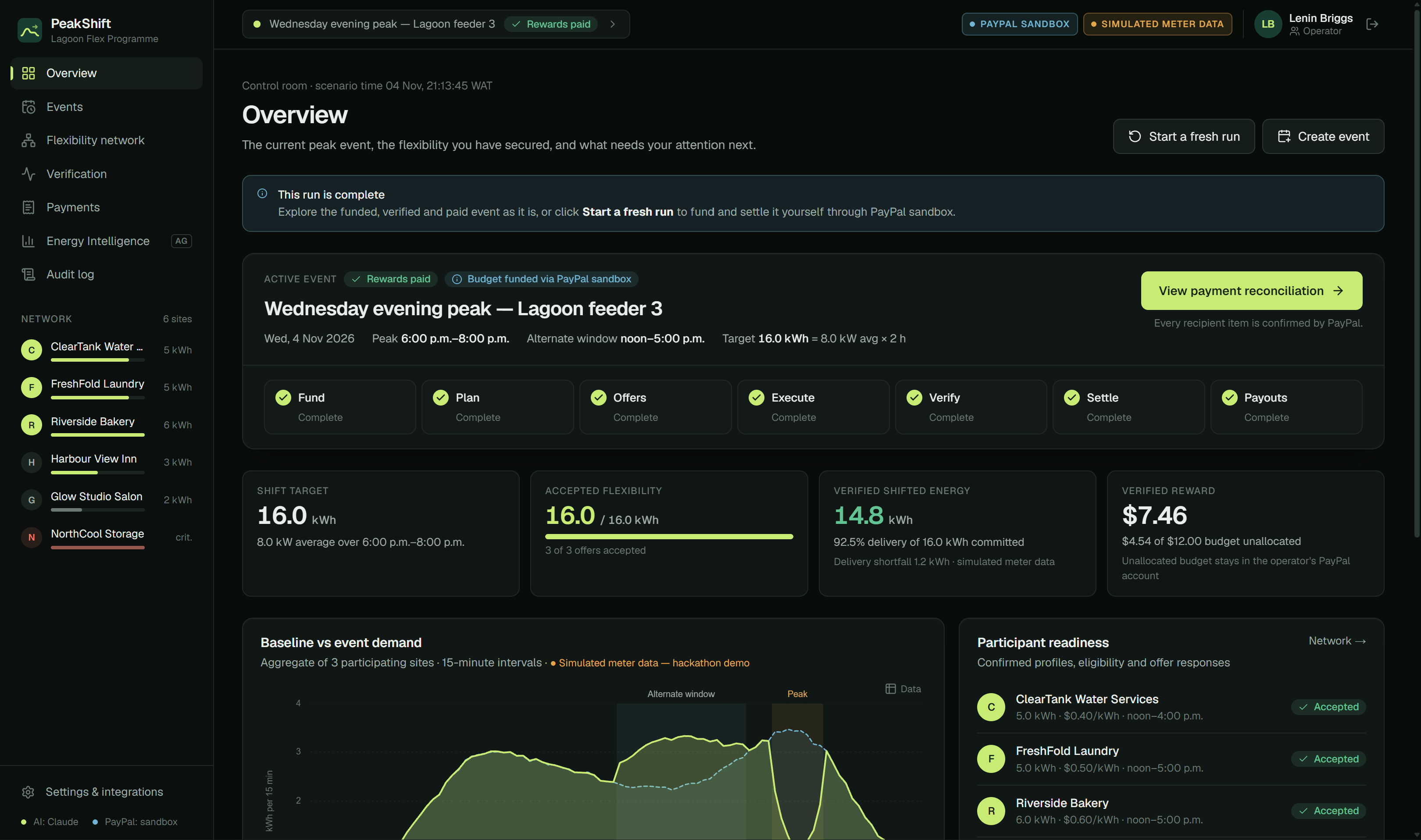
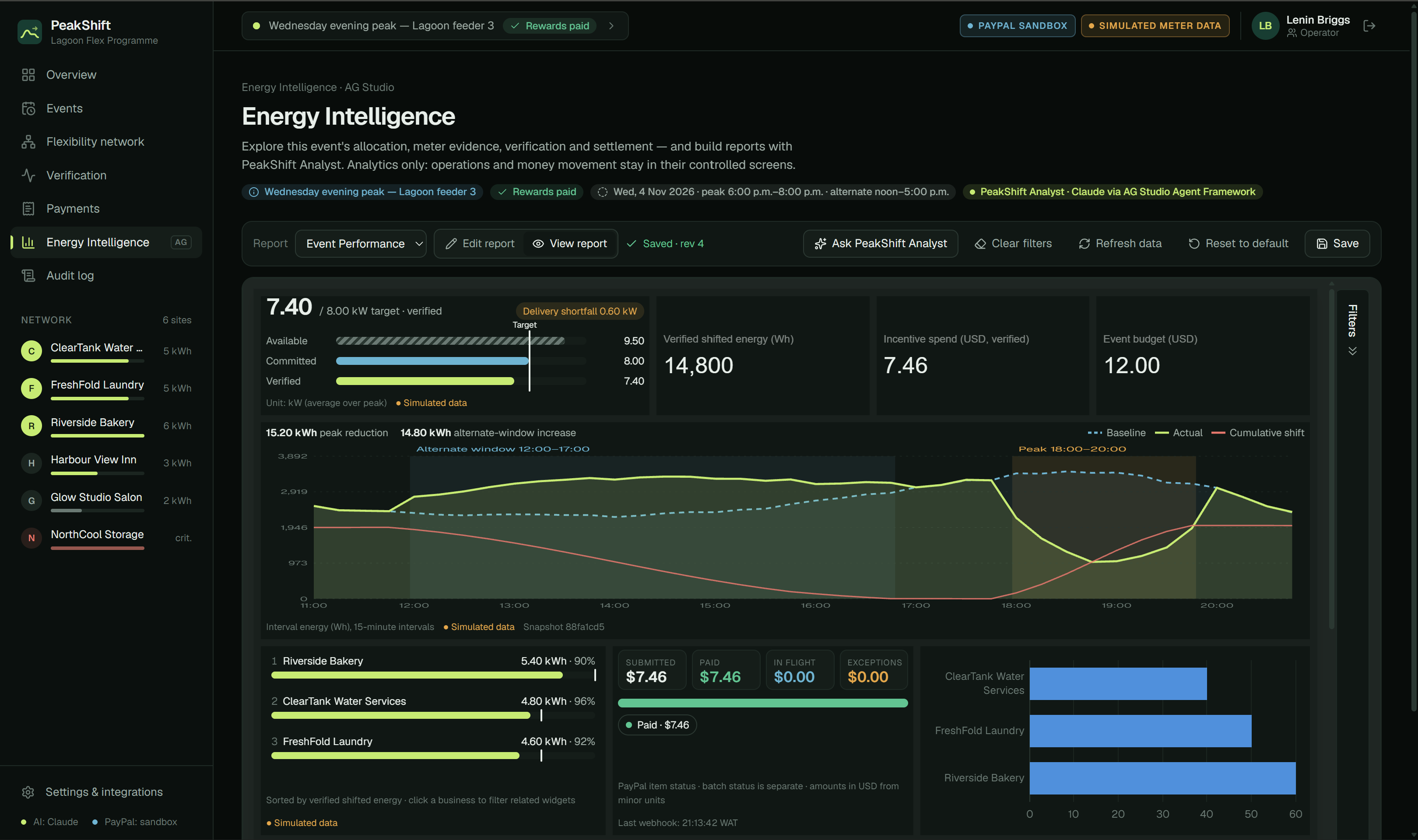
One view of the entire operation: the electricity-shifting target, accepted business commitments, verified delivery, and rewards paid.
-
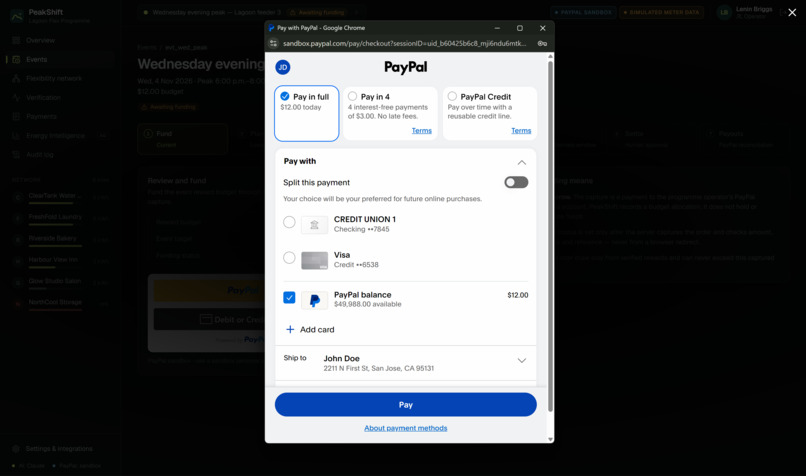
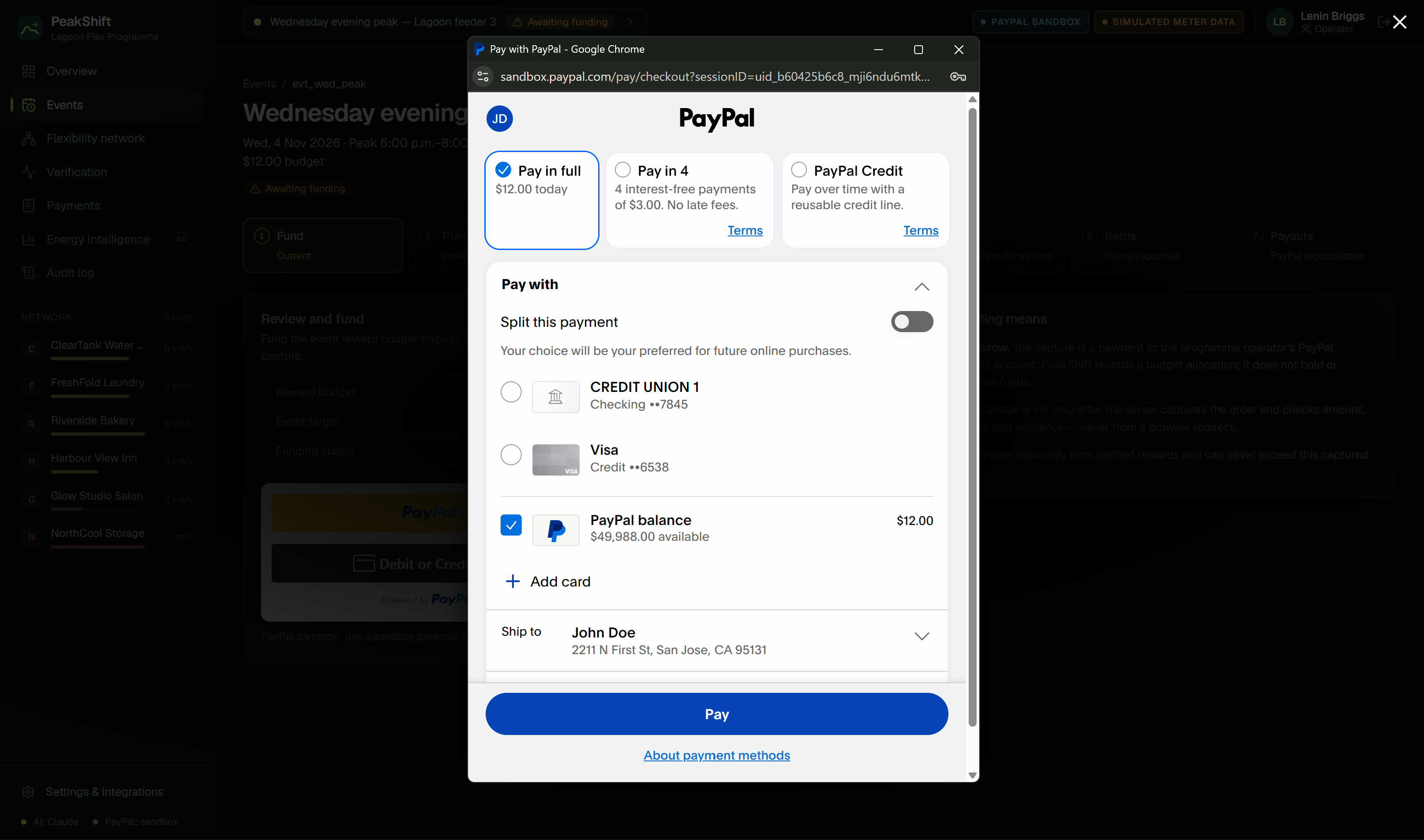
Operators fund each event's reward budget through PayPal Checkout.
-
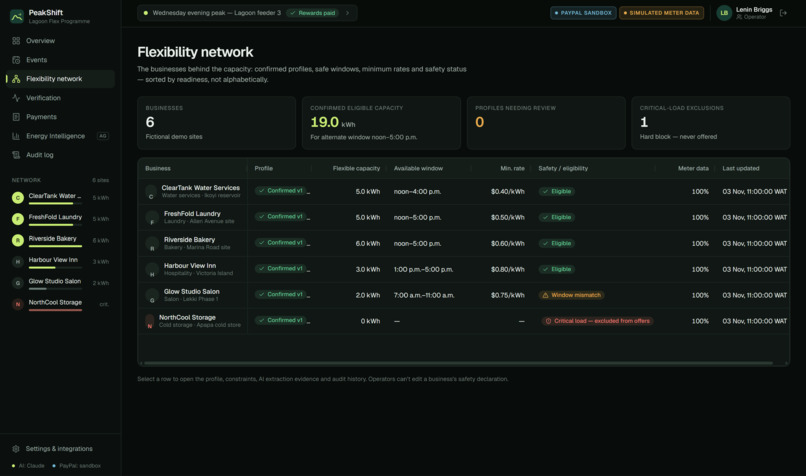
PeakShift evaluates business differences before selecting participants.
-
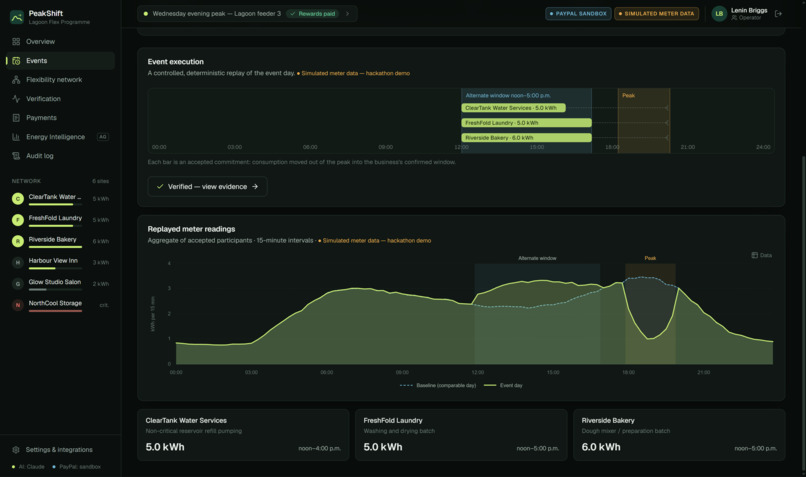
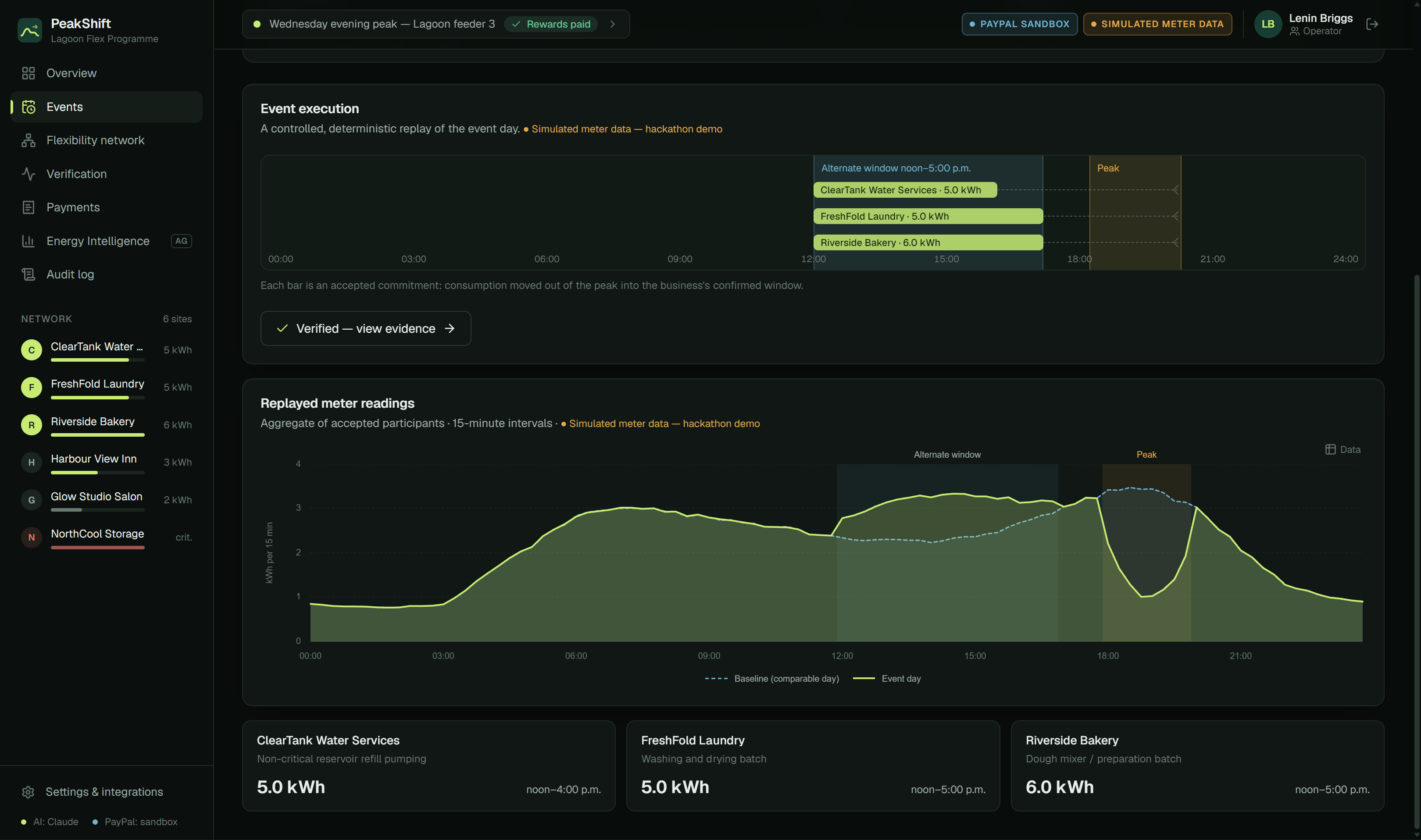
Accepted business commitments become a coordinated schedule, moving flexible electricity usage into quieter hours
-
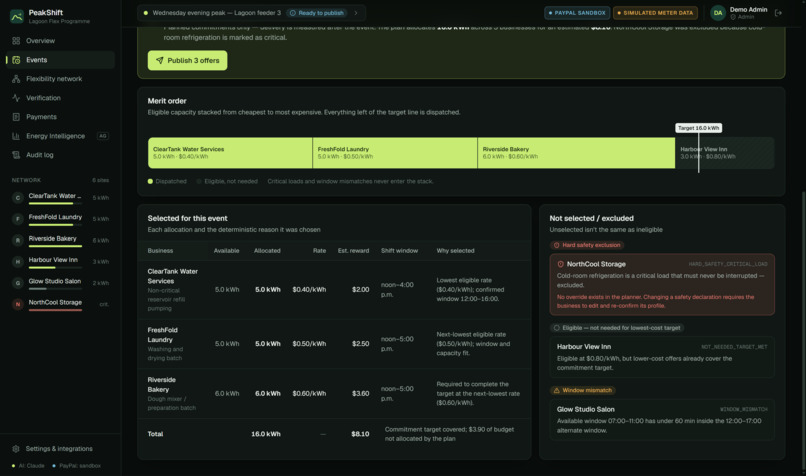
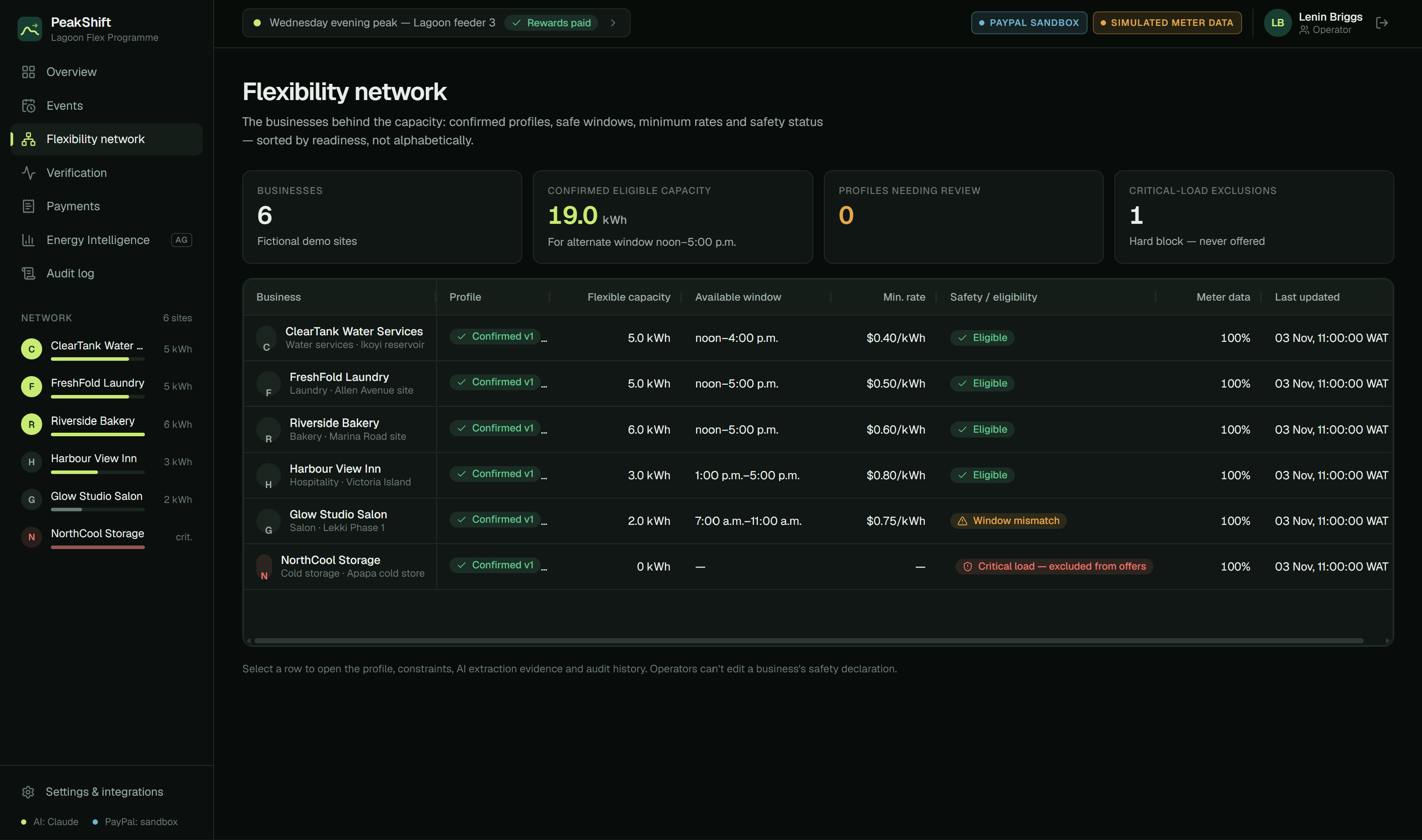
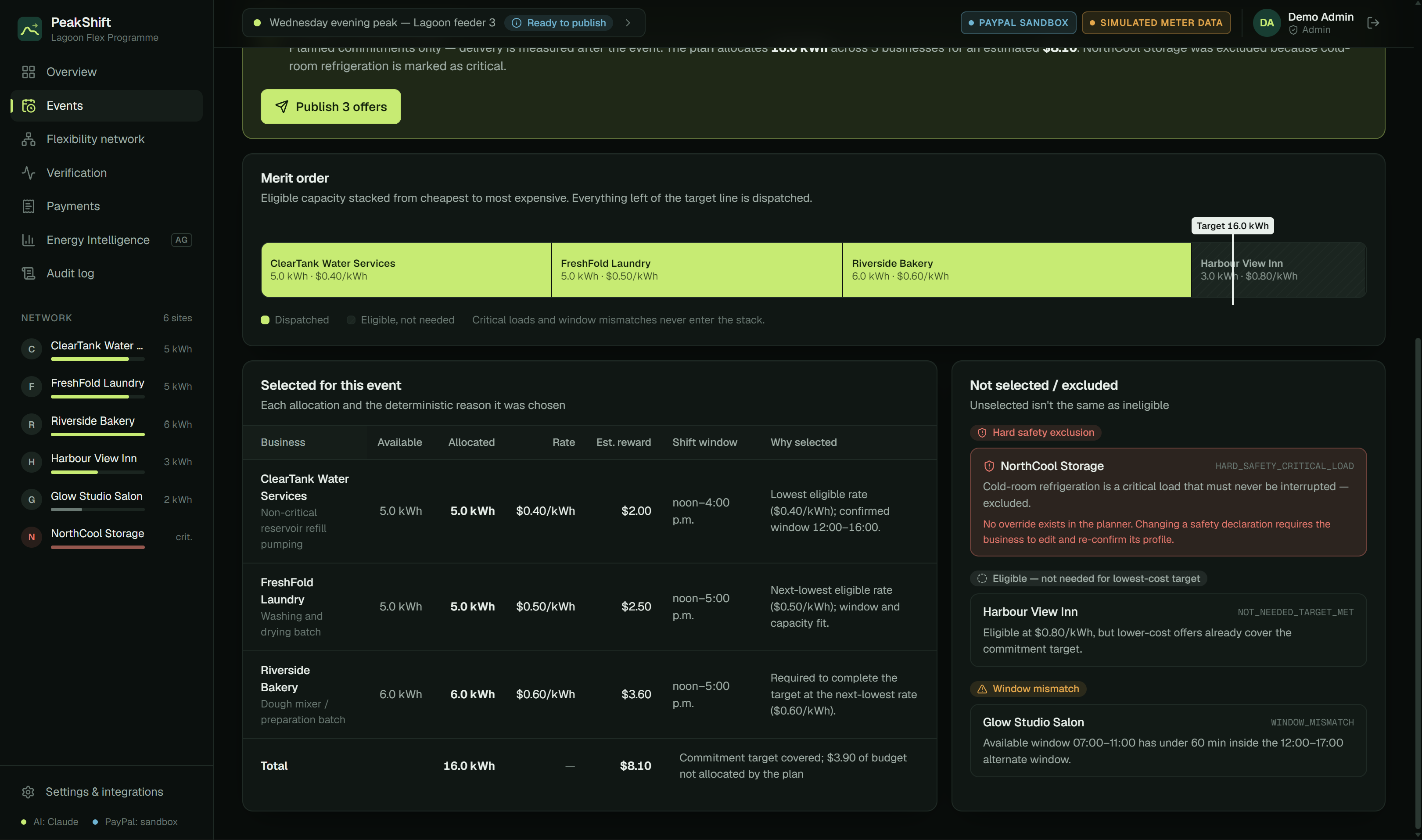
PeakShift ranks eligible businesses by incentive cost and availability, then selects the combination needed to meet the energy target.
-
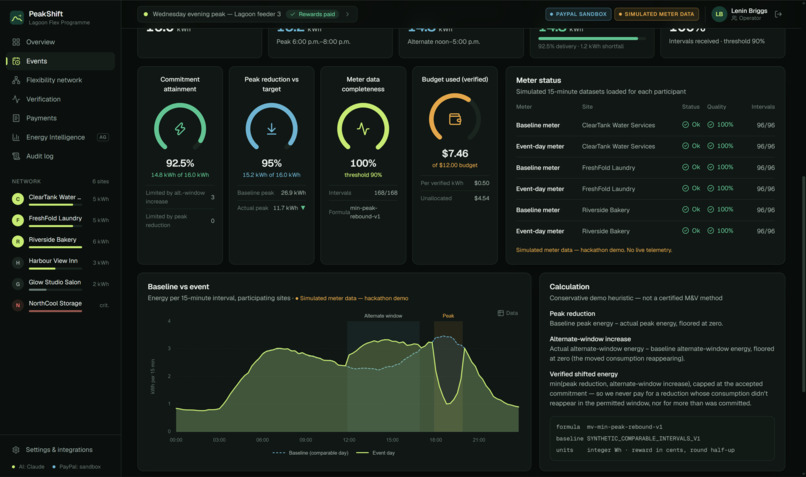
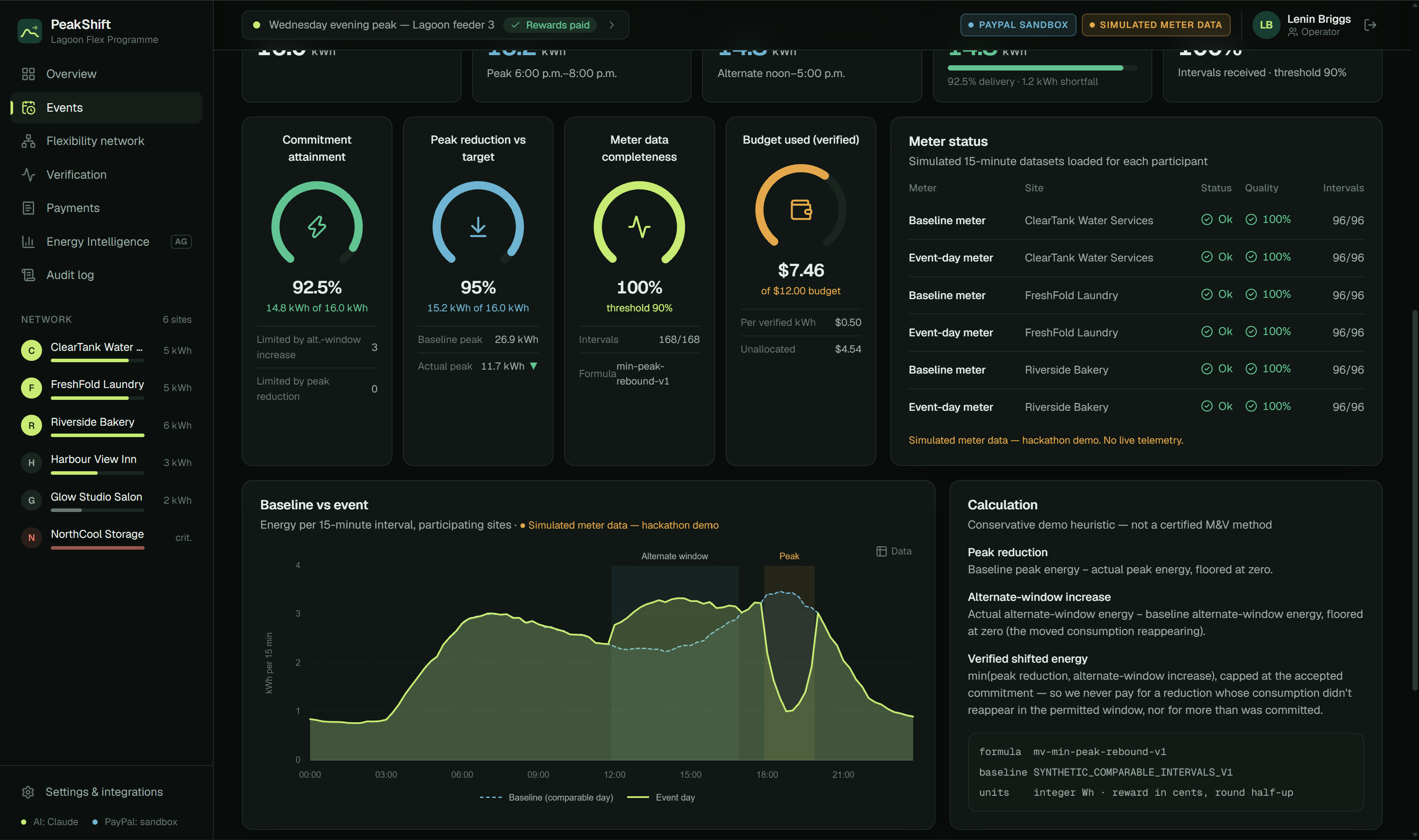
PeakShift compares expected and actual electricity usage across peak and alternative time windows.
-
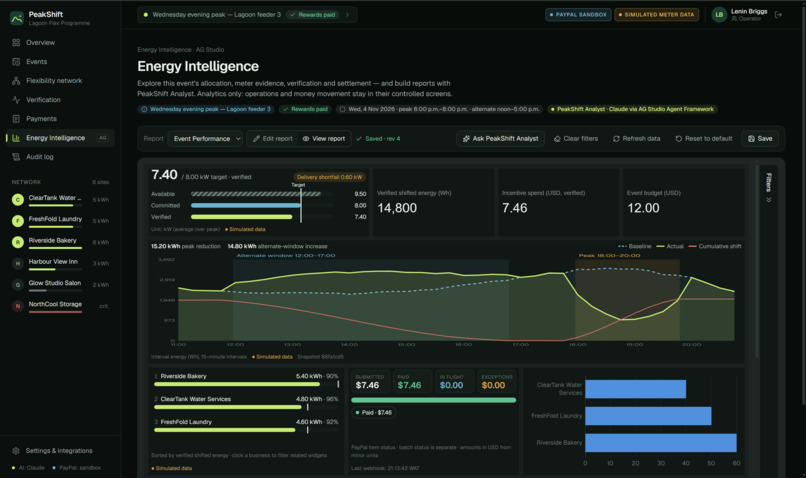
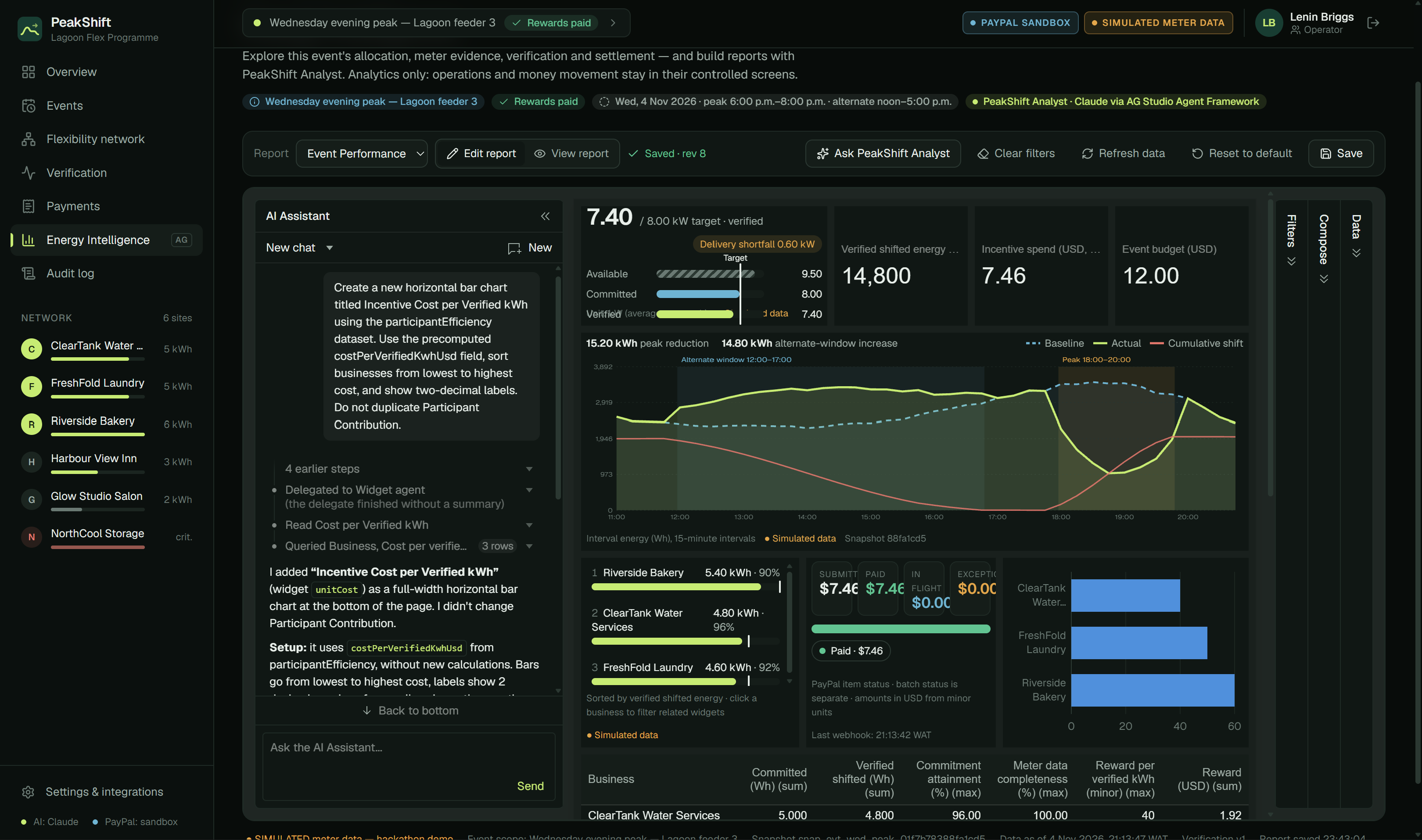
AG Studio brings energy delivery, participant contributions, incentive spending, and payment performance into an interactive analytics space
-
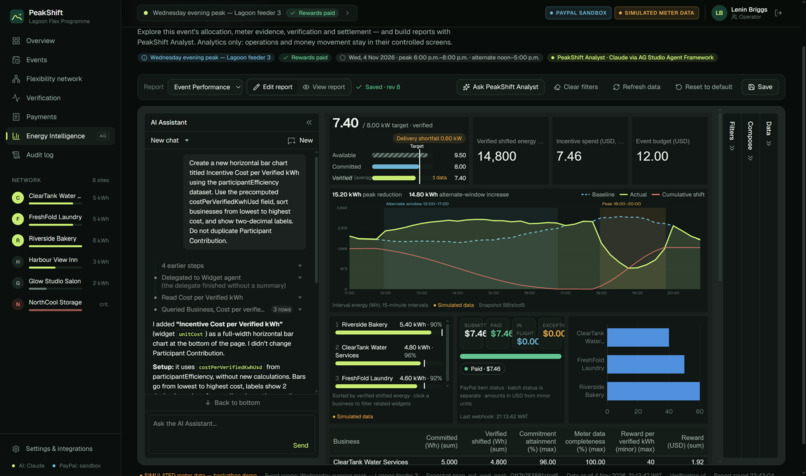
PeakShift Analyst lets operators investigate event performance using natural-language questions.
-
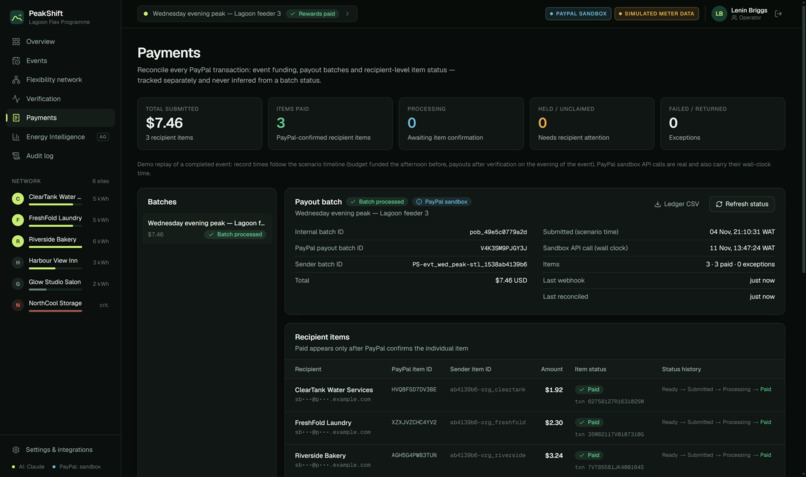
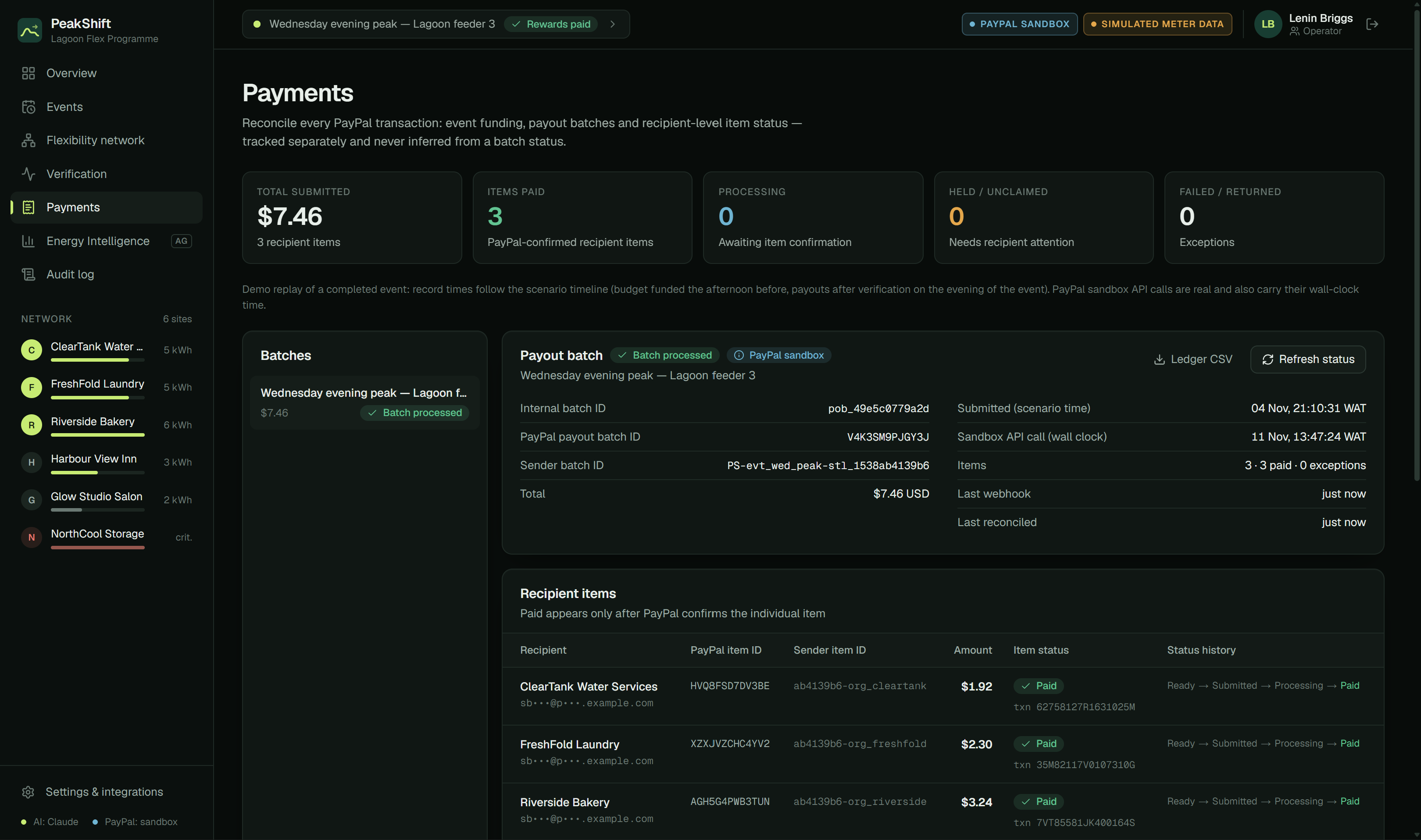
PeakShift tracks every business's payout separately. PayPal confirms the individual payments, and webhooks keep their statuses reconciled.
-
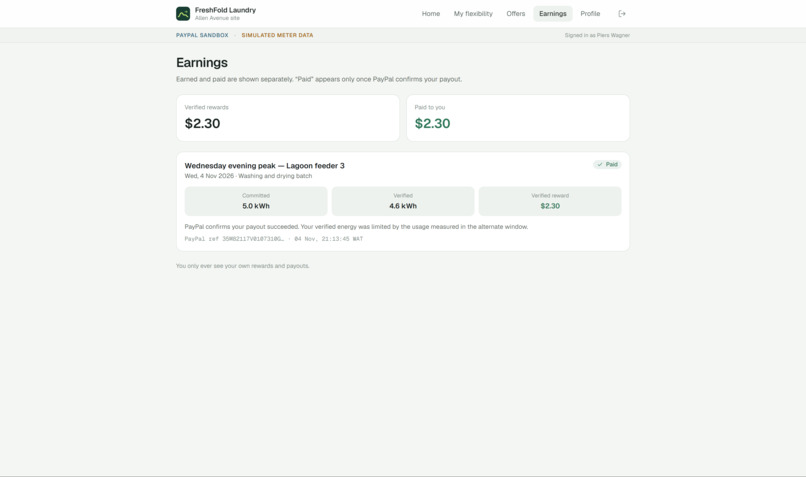
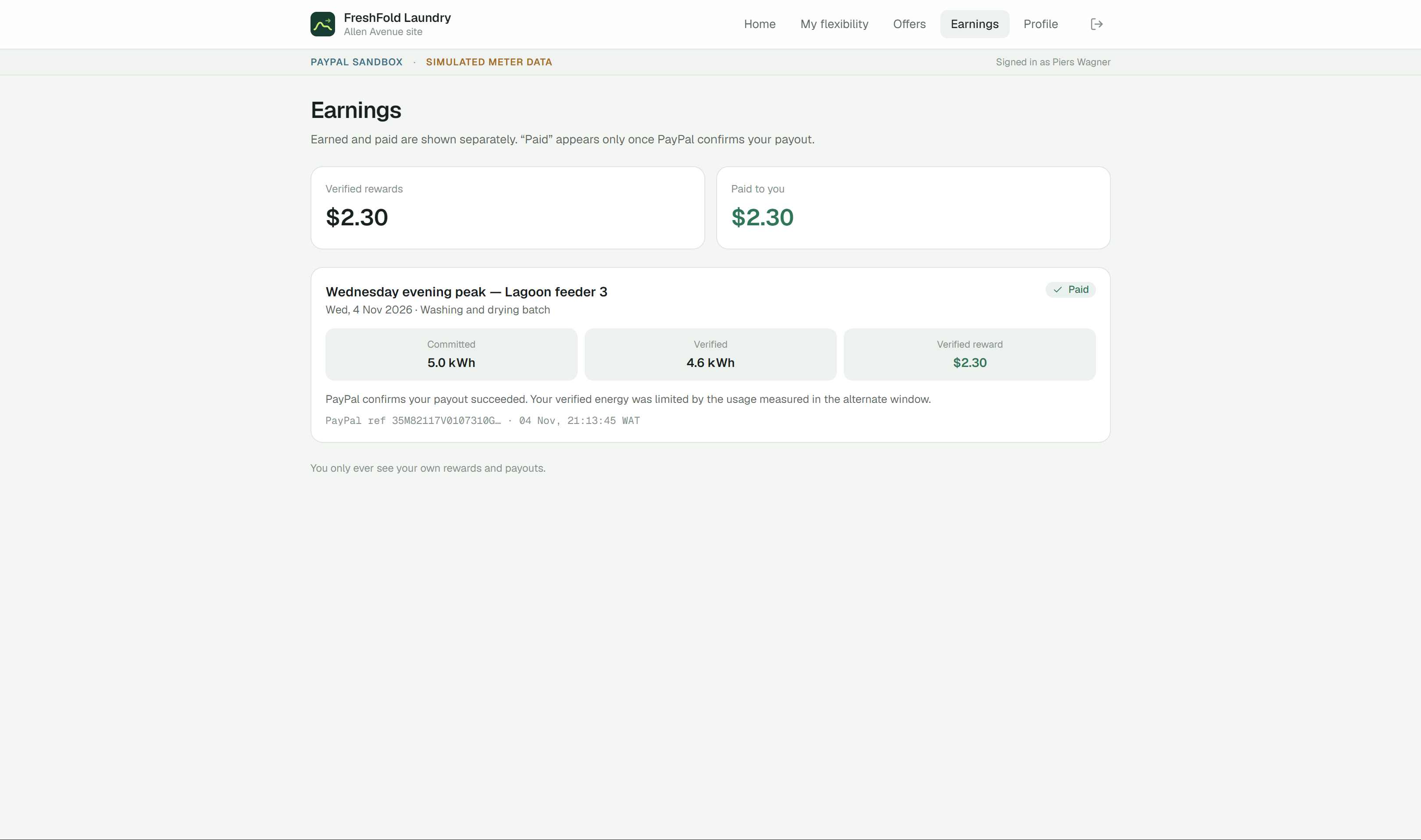
Businesses can see what they committed, what PeakShift verified, and what they've actually been paid.
Inspiration
Electricity demand isn't constant. At certain times of the day, especially in the evening, demand can rise sharply and put additional pressure on electricity networks.
Yet many businesses have some flexibility in when they use electricity. A laundry could run some washing cycles earlier. A water business could pump water before the evening rush. A bakery could move some flexible production to a quieter period.
Individually, these businesses may seem too small to make a meaningful difference. But when coordinated, their combined flexibility could help reduce electricity demand during busy periods.
The challenge is making that coordination possible. Someone needs to find suitable businesses, understand what they can safely change, agree on incentives, verify that the change actually happened, and ensure they are rewarded fairly.
I built PeakShift around one simple idea: what if small businesses could be coordinated and rewarded for moving electricity usage away from peak-demand periods?
What it does
PeakShift is a platform that helps energy operators coordinate small businesses to shift electricity usage away from busy hours.
Here's how it works:
Create and fund an event: An operator identifies a period of high electricity demand, sets an energy-shifting target, and funds the reward budget through PayPal Checkout.
Find suitable businesses: Businesses indicate how much electricity usage they can move, when they are available, and what operational constraints must be respected.
Build an allocation plan: PeakShift evaluates available businesses and selects a combination that can meet the target while considering capacity, availability, incentive costs, and safety.
Get businesses on board: Selected businesses receive offers they can review and voluntarily accept.
Verify what happened: After the event, PeakShift compares meter readings against expected consumption to calculate how much electricity usage was genuinely shifted.
Reward actual delivery: An operator reviews and approves the calculated rewards. PayPal Payouts distributes payments to participating businesses, while PayPal webhooks help track individual payment statuses.
The important distinction is that businesses are rewarded for what they actually deliver, not simply what they promise.
How I built it
I built PeakShift around three connected parts: coordination, intelligence, and payments.
Coordination and optimisation: PeakShift uses constraint-aware application logic to evaluate participating businesses and build a cost-effective allocation plan. It accounts for available capacity, operating windows, incentive requirements, and safety restrictions. Businesses with critical operational requirements, such as refrigeration, can be excluded from an event.
Analytics and AI: I integrated AG Grid and AG Studio to give operators an embedded workspace for understanding event performance. The Studio Agent Framework and Claude power the natural-language analytics experience through PeakShift Analyst, allowing operators to ask questions about their data and explore results without manually digging through records.
Payments and accountability: I integrated PayPal Checkout for event funding and PayPal Payouts for participant rewards. PayPal webhooks provide recipient-level payment status updates. Funding and payouts are subject to server-side verification, with a human operator retaining approval authority.
I was intentional about separating these responsibilities: AI helps people understand the data, PeakShift's application logic handles allocation and verification, people approve payments, and PayPal processes them.
Challenges I ran into
One of my biggest challenges was distinguishing between what a business commits to deliver and what it actually delivers.
A business accepting an offer doesn't guarantee that the expected electricity usage was shifted. I needed a way to compare actual consumption against an estimate of normal consumption, while also checking that usage wasn't simply moved back into another period.
Safety was another important consideration. Not every business can freely change when it uses electricity. Critical operations, such as refrigeration, must be protected. This meant treating operational constraints as an essential part of participant selection rather than an afterthought.
I also had to make several independent systems work together: event funding, participant selection, voluntary acceptance, meter-data verification, reward calculations, payment approval, and PayPal reconciliation. Making these feel like one coherent workflow required careful thinking about the transitions and responsibilities at each stage.
Accomplishments that I'm proud of
I'm proud of turning a relatively complex energy coordination idea into a working, interactive prototype with a clear end-to-end workflow.
Some of the things I've built include:
- A business network where participants have different capacities, availability windows, incentive requirements, and operational constraints.
- An optimisation engine that selects suitable businesses to meet an energy-shifting target while respecting those constraints.
- A verification process that distinguishes committed electricity usage from actual delivery.
- A PayPal-powered funding and reward workflow using Checkout, Payouts, and webhooks.
- An embedded AG Studio analytics experience with an AI-powered assistant for exploring event performance.
In my demonstration scenario, three businesses commit to shifting 16 kWh of electricity usage. Using simulated meter readings, PeakShift verifies 14.8 kWh, representing 92.5% of the target. Rewards are then calculated from verified delivery rather than the original commitment.
I'm particularly proud of the distinction between promising flexibility and proving it was delivered. That is central to making the incentive model accountable.
What I learned
I learned that coordinating energy flexibility is about much more than finding businesses willing to reduce electricity consumption.
The real challenge is understanding what each business can safely change, coordinating those changes around a shared target, measuring the outcome, and creating a trustworthy way to reward participation.
I also learned that AI is most useful when it has a clearly defined role. Rather than handing operational decisions or payments to an AI agent, I used AI to make complex event data easier to explore and understand, while keeping allocation, verification, and financial approval within controlled application workflows.
Most importantly, I learned how much value comes from connecting systems that are often treated separately. Coordination, measurement, analytics, and payments become considerably more useful when they work together.
What's next for PeakShift
PeakShift is currently a working prototype demonstrating the coordination and payment workflow with simulated meter data and PayPal Sandbox transactions. It is not yet connected to a live electricity network or controlling participating businesses' equipment.
My next step is to move beyond the prototype.
I want to explore real metering integrations, validate the coordination model with businesses and energy operators, and investigate how PeakShift could connect with existing demand-response programmes.
I also want to expand the network of participating businesses, improve forecasting and optimisation, and make it easier for operators to understand the value and performance of every event.
I believe small businesses should have a way to participate in a more flexible electricity system, without needing to become energy experts or compromise their operations.
PeakShift makes that possible by turning flexible electricity usage into something that can be coordinated, measured, and rewarded.
Built With
- ag-charts
- ag-grid
- ag-studio
- anthropic
- claude
- next.js
- node.js
- paypal
- paypal-checkout
- paypal-payouts
- paypal-webhooks
- postgresql
- react
- supabase
- tailwindcss
- typescript
- vercel
- zod


