-
-
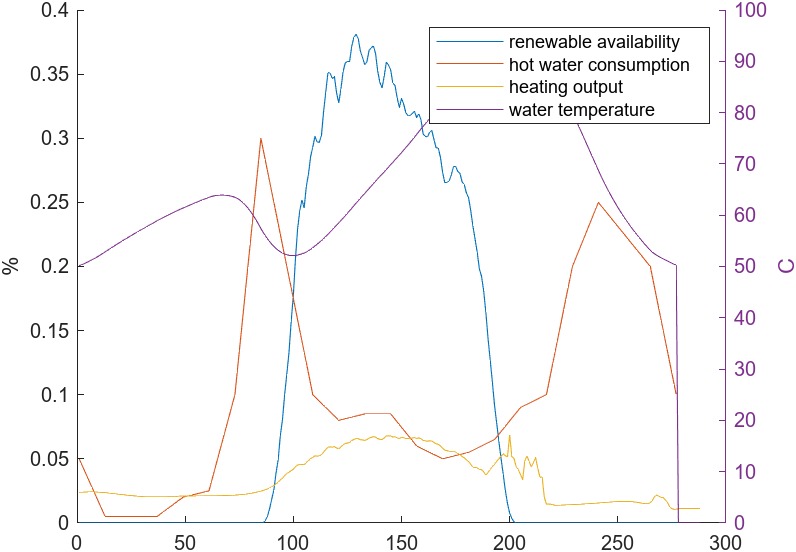
The PeakShift algorithm drawing additional power when renewables are available!
What is it?
PeakShift is a low-cost, scalable grid energy storage that is significantly cheaper and has more capacity than traditional battery technologies. Instead of storing excess renewable energy as electricity, PeakShift stores energy as heat! This allows a standard water heater to store up to four times as much energy as a lithium ion battery cell does per kilogram.
About 9 million water heaters are sold per year, meaning this system can be installed at up to 90 GWhr per year, saturating at 400 GWhr of total grid energy storage. Considering a 50gal water heater stores about 10kWh and is ~$500 dollars, that means this system costs $50/kWh, a third of the cost of traditional batteries!
How does it work?
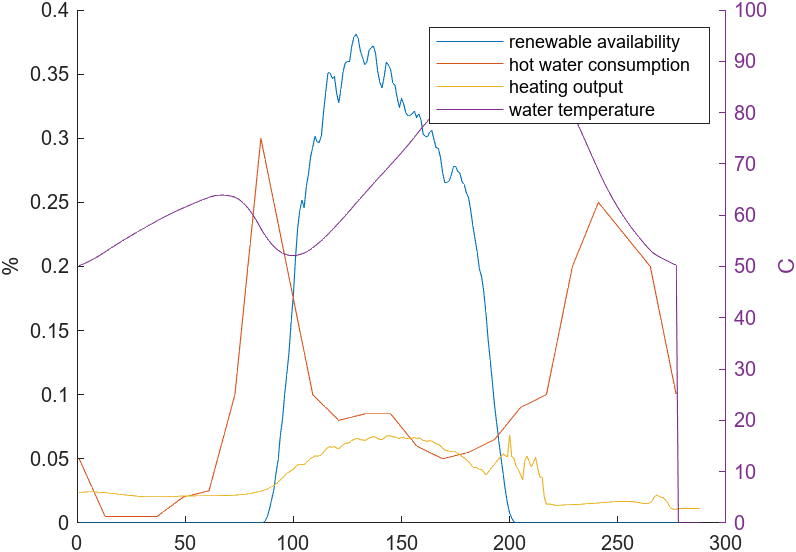
As a proof-of-concept, I built a discretized simulation of a water heater using MATLAB and used the numerical optimization toolkit to produce a simple control algorithm that operates by minimizing a loss function over a 24-hour window. The inputs to the system are renewable energy supply and hot water demand, and the system outputs a heating power level.
Challenges
- Numeric stability: Due to the discretized nature of the simulation, the simulation had a tendency to oscillate if the timestep was too large.
- Time crunch: I wasn't expecting the simulation to take as long as it actually did. Who knew modelling a system would be so hard?
Accomplishments
- This is my first project in MATLAB that I've done outside of school!
What's next
I'd love to see this in real hardware, so moving forward I'd love to actually build the water heater instead of just simulating it!
Built With
- matlab
- optimization

Log in or sign up for Devpost to join the conversation.