


PeakMind: Transforming Education Through Deep Gamification
💡 Inspiration
Today, Generation Z and Alpha students are immersed in an environment saturated with short-form digital stimuli, social media algorithms (such as TikTok and Reels), and instant gratification loops. This constant exposure has led to a reduced tolerance for frustration and growing difficulties in sustaining attention during traditional classroom instruction, where static, plain-text materials and conventional LMS platforms often fail to engage learners.
Rather than fighting the presence of mobile devices in the classroom, PeakMind integrates the psychological and behavioral mechanisms that make video games and social media engaging, redirecting them toward active pedagogy. The platform is anchored in established educational and cognitive frameworks:
- Self-Determination Theory (Deci & Ryan): Fostering learner autonomy, competence, and social relatedness through adaptive challenges and classroom leaderboards.
- Flow Theory (Csikszentmihalyi): Designing balanced game loops and mini-games that sustain high levels of focus and immersion.
- Positive Reinforcement and Constructivism: Rewarding consistent daily study habits to turn learning into an intrinsically rewarding routine.
⚙️ How We Built It
PeakMind was built on a decoupled, scalable, and responsive client-server architecture designed to enable seamless, real-time interactions between teachers and students:
- Frontend: Developed with React Native, TypeScript, Expo Go, and Axios for REST API integration. The UI prioritizes universal design and accessibility by incorporating the OpenDyslexic and Feather Bold typefaces, alongside a high-contrast color palette (
#9169CA,#63B100,#EF4444). - Backend: Engineered in Java utilizing the Spring Boot framework, supported by a custom in-house SDK to modularize endpoints, room sessions, and core game logic.
- Database: Powered by PostgreSQL for relational and transactional persistence of classrooms, player inventories, curriculum progression, and rankings.
- Artificial Intelligence: Integrated via OpenRouter to connect with large language models. This pipeline allows teachers to upload standard PDF course materials, which the system processes, summarizes, and automatically structures into playable JSON formats for each mini-game.
- Economy and Payments: Configured with Mercado Pago and direct card checkout for microtransactions involving premium gems.
- Infrastructure: Deployed on a dedicated self-hosted server containerized with Docker, using custom domains for both API traffic and the landing page.
Game Mechanics and Educational Modes
The application supports multiple interactive learning modes:
- Swipe: Rapid conceptual validation through True/False card swiping.
- Cascade: Timed falling-word mechanics designed to train cognitive processing speed and quick recall.
- Pairs: Visual relationship mapping and direct conceptual matching across two columns.
- Order, Complete, and Choose: Sentence reconstruction, multiple-choice, and sequencing challenges.
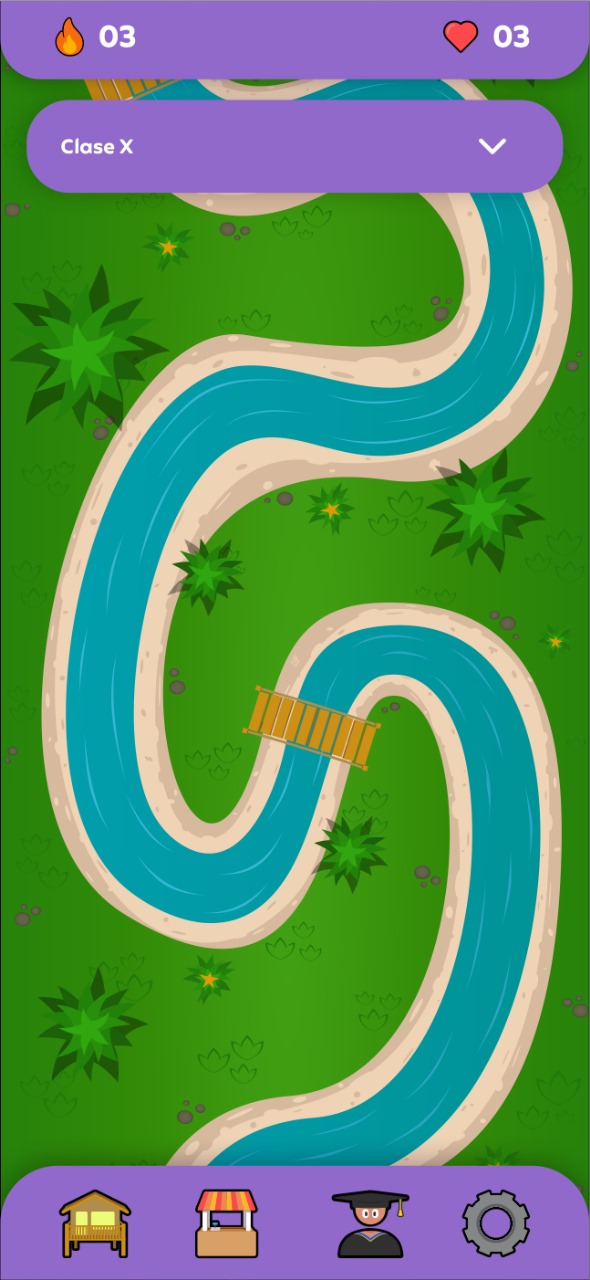
- Metagame and Customization: A dynamic level map, multi-tier rankings (weekly, monthly, all-time), daily streaks, and a character customization shop where students spend earned currencies on accessories for the official mascot, Peaky (including MLG glasses, chef hats, and thematic uniforms).
🚧 Challenges We Ran Into
- Mathematical Balancing of Progression and Scoring: Calibrating rewards to prevent score inflation while rewarding consistency. An adaptive score model $S$ was implemented to grant a scaled bonus based on the current consecutive streak $k$: $$S = S_{\text{base}} + \lfloor \alpha \cdot k \rfloor$$ where $S_{\text{base}} = 932$ and $\alpha = 3.2$, incentivizing uninterrupted focus.
- Performance and Metric Accuracy: Establishing a deterministic accuracy calculation $A$ based on correct answers $C$ and total attempts $T$: $$A = \begin{cases} \left\lfloor \left(\dfrac{C}{T}\right) \times 100 \right\rceil & \text{if } T > 0 \ 0 & \text{if } T = 0 \end{cases}$$ ensuring uniform progress metrics across summary modals and course leaderboards.
- Deterministic AI Parsing from Unstructured PDFs: Ensuring that LLMs queried through OpenRouter consistently returned valid JSON schemas matching the strict UI constraints of each mini-game (e.g., character length limits and balanced distractor options) without runtime parsing failures.
- Responsive Visual Consistency: Synchronizing dynamic vector overlays, such as responsive SVG connection lines between columns in the matching mini-game, across diverse mobile aspect ratios and tablet screen sizes.
📚 What We Learned
- Accessibility-First Design: Integrating specialized fonts like OpenDyslexic demonstrated how intentional typographic choices remove cognitive friction for neurodivergent learners.
- Production DevOps and Architecture: Setting up containerized deployments with Docker, reverse proxies, and relational databases reinforced the importance of systematic version control, fieldwork journals, and rigorous technical documentation.
- Product Feasibility and Unit Economics: Evaluating operational variables—such as API token consumption, server overhead, and freemium mechanics—taught us how to design a sustainable product ready to transition from a prototype to a viable educational service.
🏆 Accomplishments and Recognition
- Successfully presented at the Regional Fair of Education, Arts, Science, and Technology (RFEAST), qualifying for the Provincial Stage (PFEAST) in Mar de Ajó.
- Selected to showcase at national technical exhibitions and olympiads, including ONIET and Innovatec Expo.
- Designed and produced 3D-printed physical replicas of Peaky as tangible promotional material for institutional demonstrations.
Built With
- java
- react
- react-native
- springboot


Log in or sign up for Devpost to join the conversation.