

PEAK — The Digital Athletic Twin for every athlete's recovery.
Inspiration
The idea for PEAK started with a real story, not a market gap on a spreadsheet.
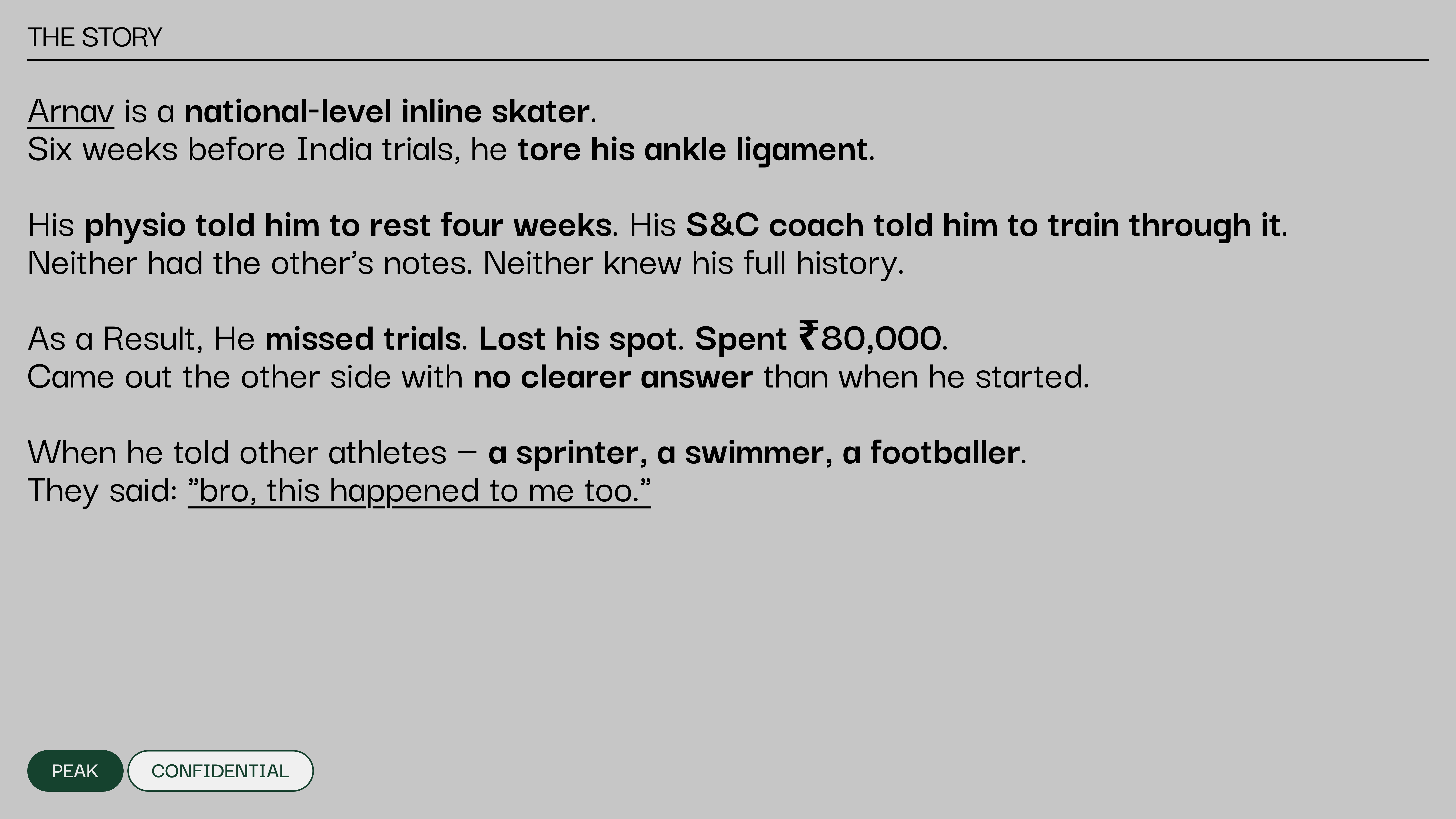
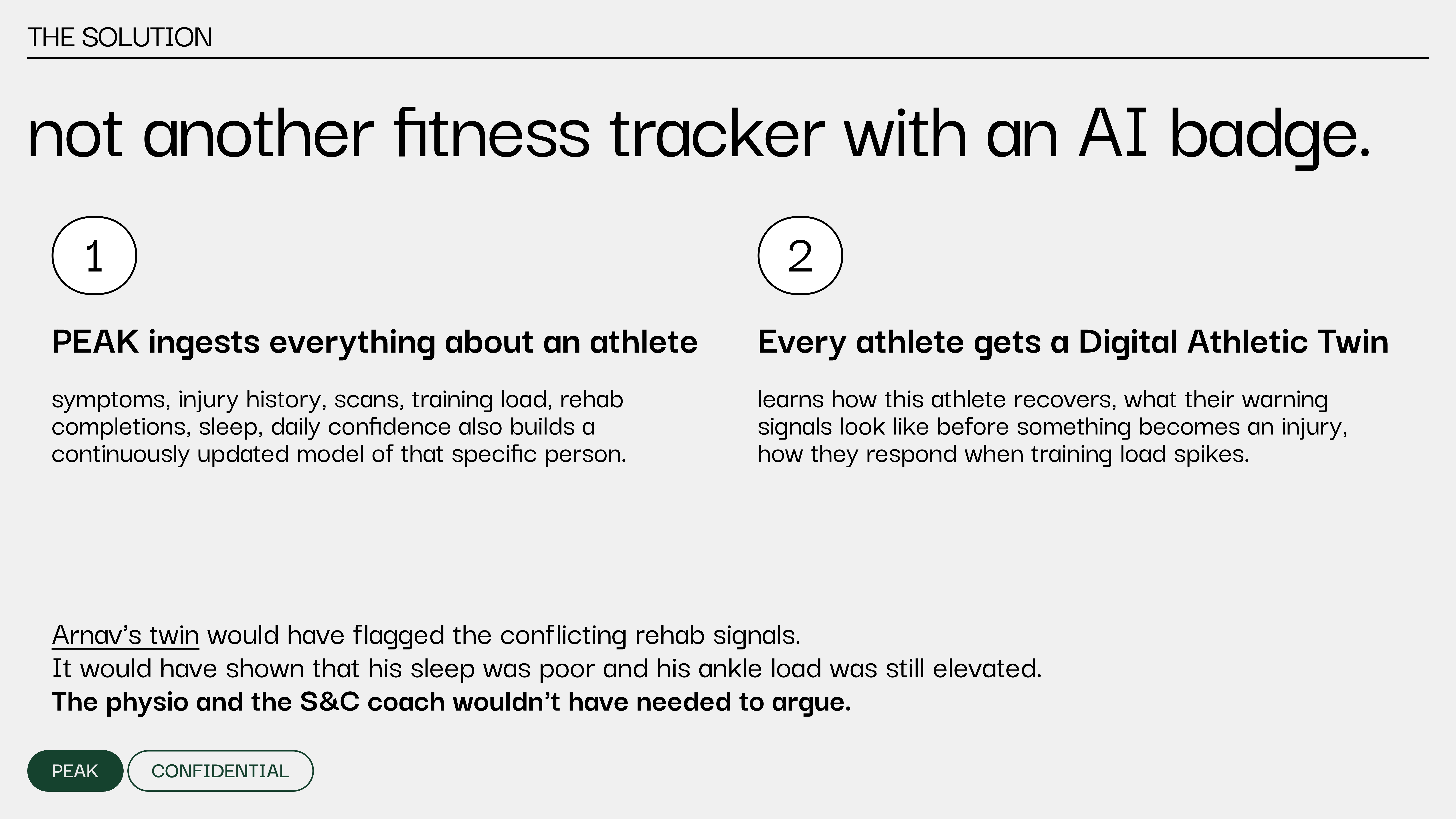
Arnav is a national-level inline skater. Six weeks before India trials, he tore an ankle ligament. His physio told him to rest for four weeks. His strength & conditioning coach told him to train through it. Neither had seen the other's notes. Neither knew his full history. He missed trials, lost his spot, spent ₹80,000 chasing an answer, and came out the other side no clearer than when he started.
What made the story worth building a company around wasn't the injury — athletes get injured, that's inevitable. It was what happened when Arnav told other athletes about it: a sprinter, a swimmer, a footballer, all said some version of "bro, this happened to me too."
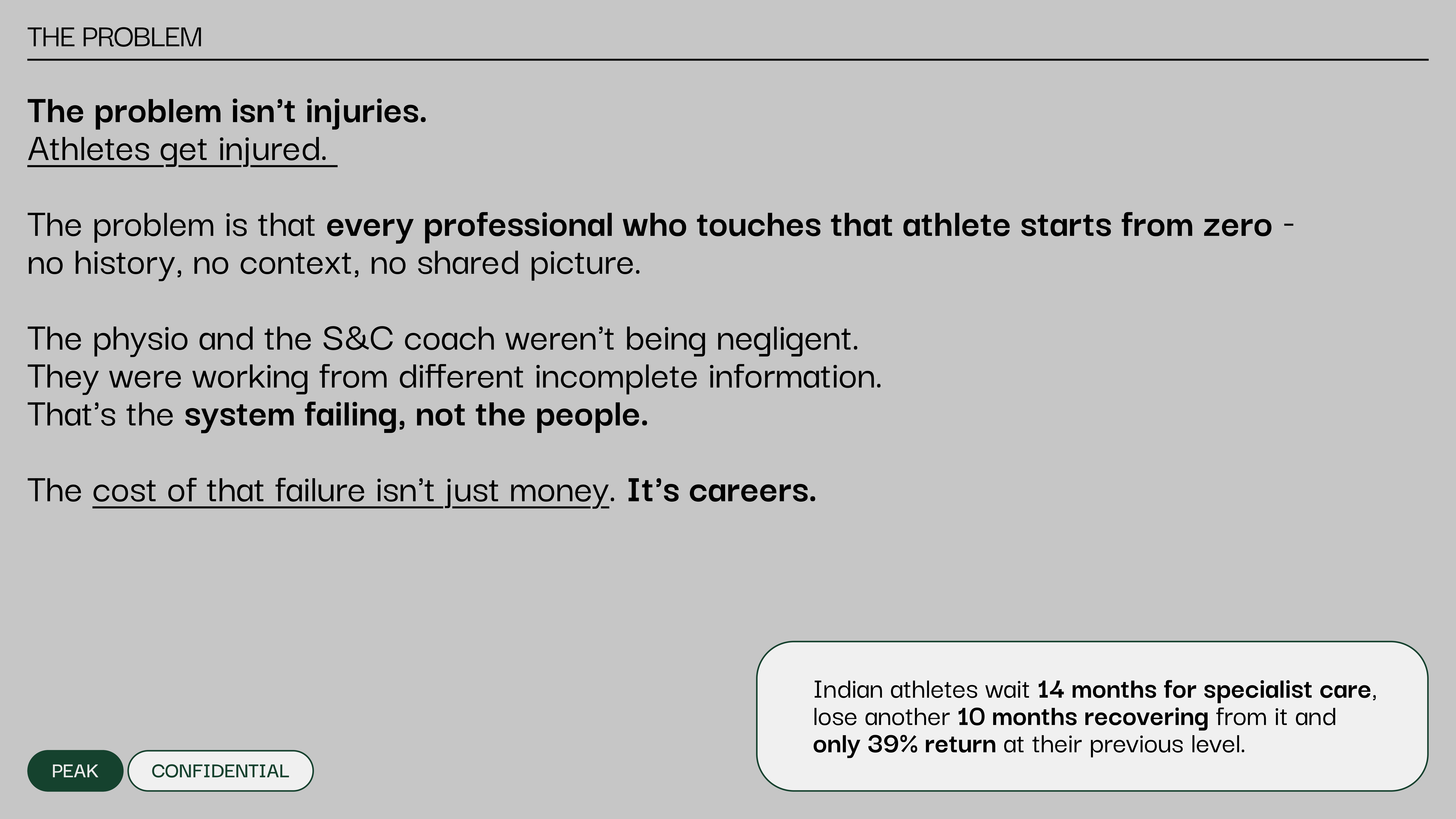
That was the moment the problem stopped looking like bad luck and started looking like a systems failure. In India, athletes wait an average of 14 months for specialist care, lose another 10 months recovering from it, and only 39% return to their previous level. The physio and the S&C coach in Arnav's story weren't negligent — they were both doing their jobs well, from two different incomplete pictures of the same person. Every professional who touched that athlete was starting from zero. We wanted to build the thing that would have stopped that: a single, continuously updated picture of an athlete that every practitioner around them could see.
What we learned
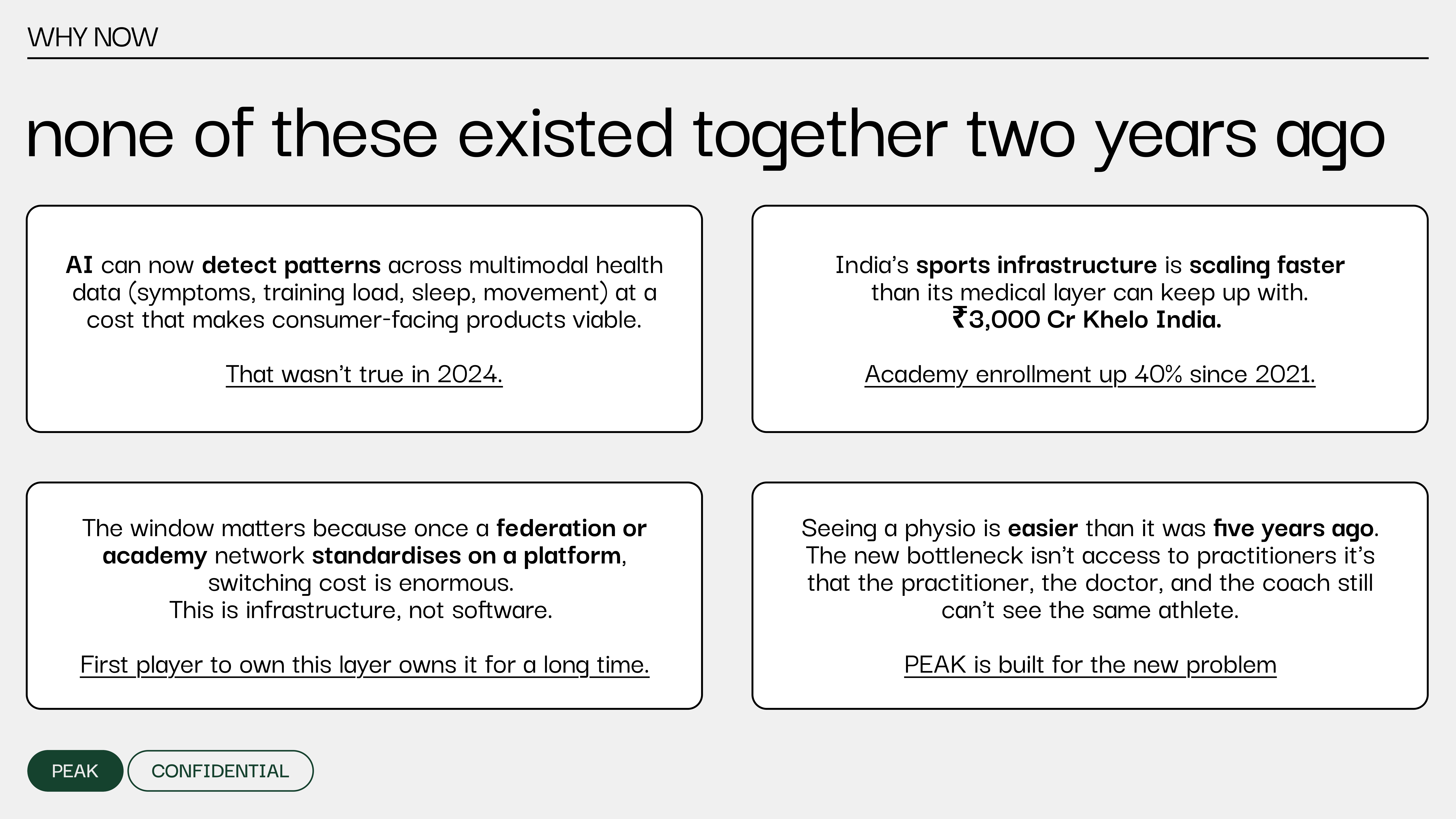
- The bottleneck isn't access anymore, it's coordination. Seeing a physio, a doctor, or a coach in India is easier today than it was five years ago. The real gap is that once you see them, none of what they learn about you travels with you to the next person.
- This is an infrastructure problem, not a fitness-app problem. A tracker that logs steps and sleep doesn't fix Arnav's problem. What fixes it is a shared, permanent, athlete-owned record that timelines injuries, rehab, scans, and training load in one place — and a model that gets smarter about that specific athlete the longer they use it.
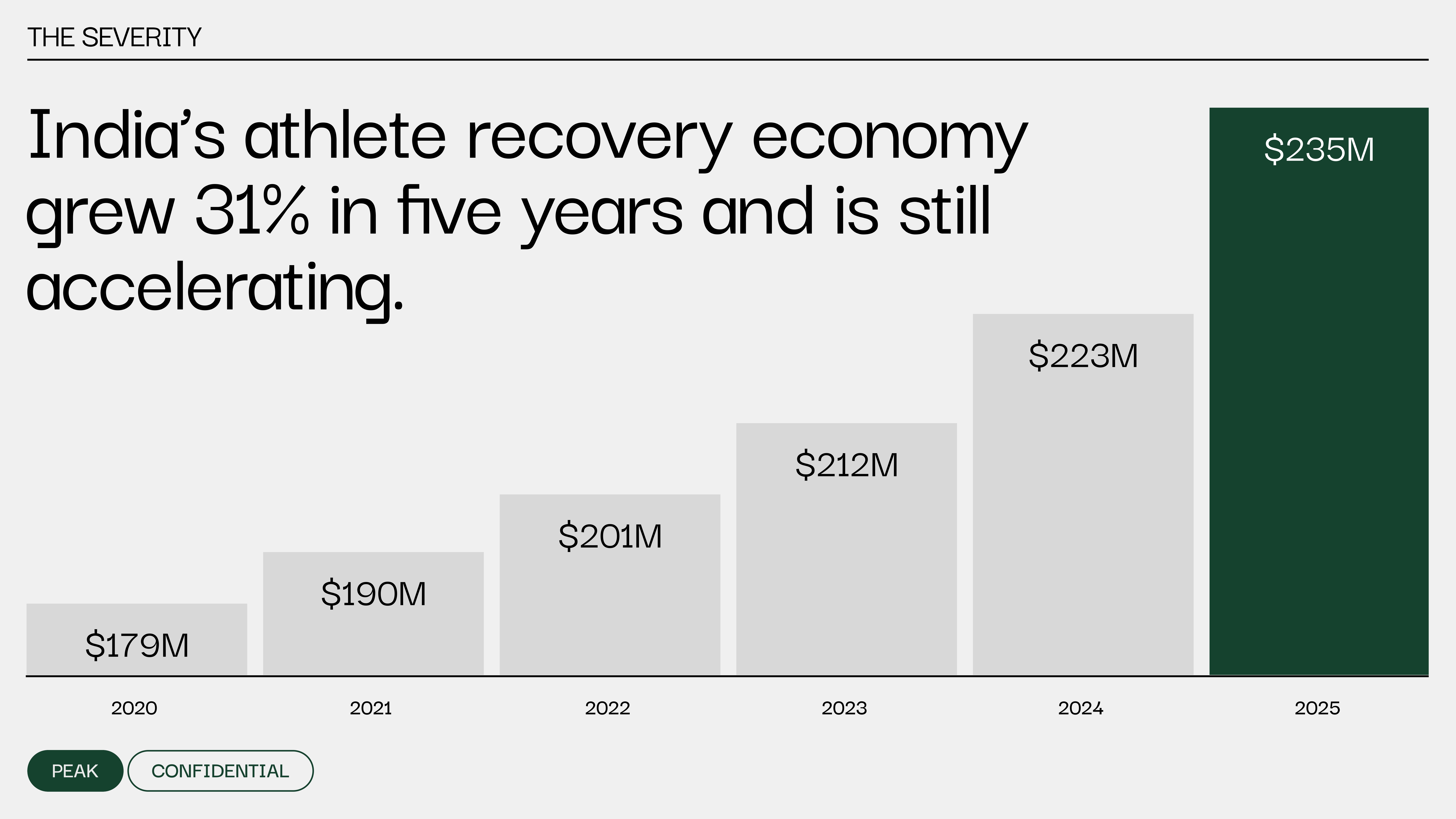
- Timing matters more than we expected. India's sports infrastructure is scaling fast — ₹3,000 Cr committed to Khelo India, academy enrollment up 40% since 2021 — but the medical and coaching layer hasn't scaled with it. At the same time, multimodal health-pattern detection (symptoms, training load, sleep, movement) only recently became cheap enough to build into a consumer-facing product. Two years ago, the pieces PEAK needed didn't all exist yet.
- Switching costs compound in infrastructure markets. Once a federation or academy standardizes on a shared athlete record, moving off it is expensive and disruptive. That told us speed to first integration mattered as much as feature completeness.
How we built it
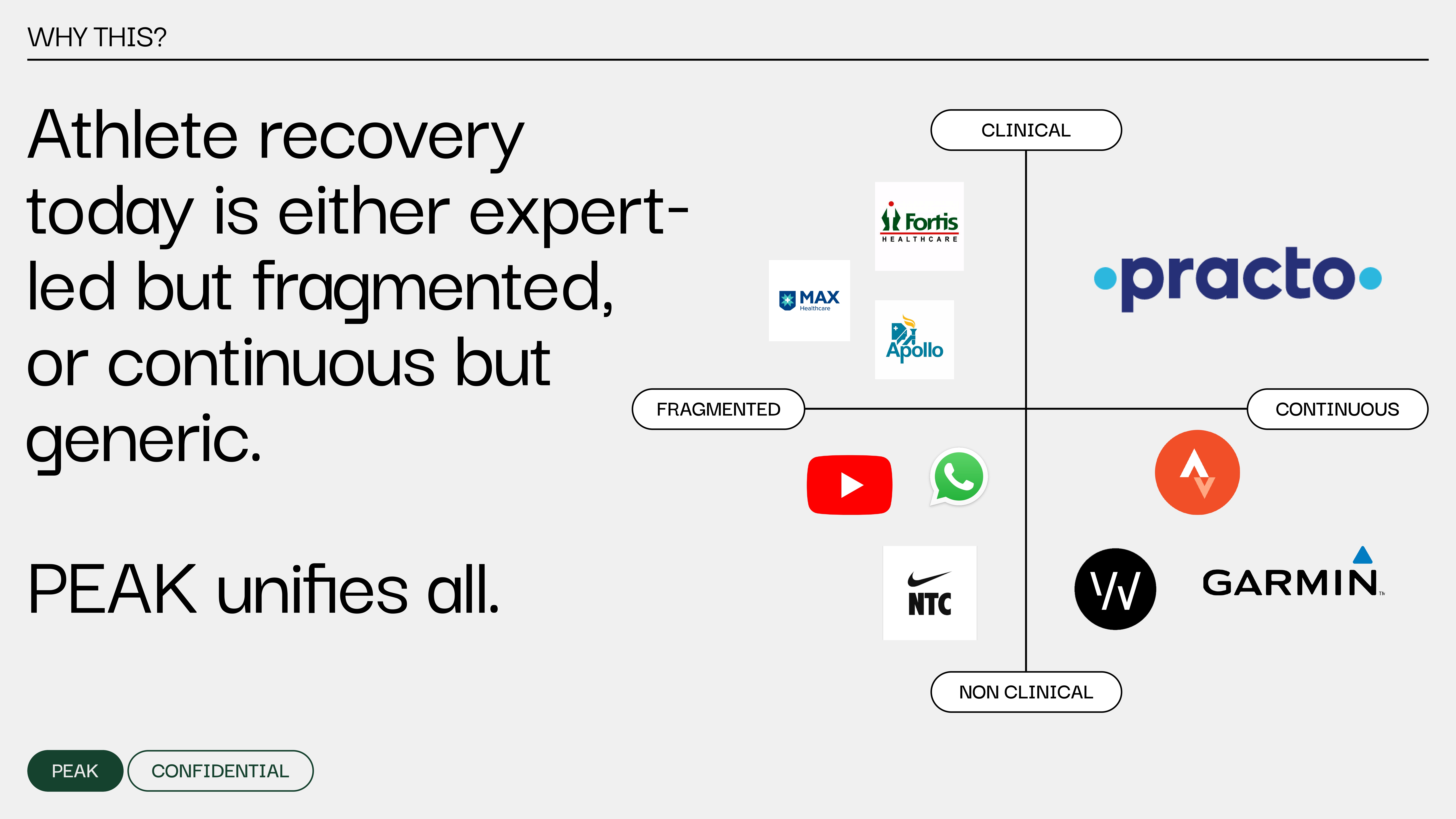
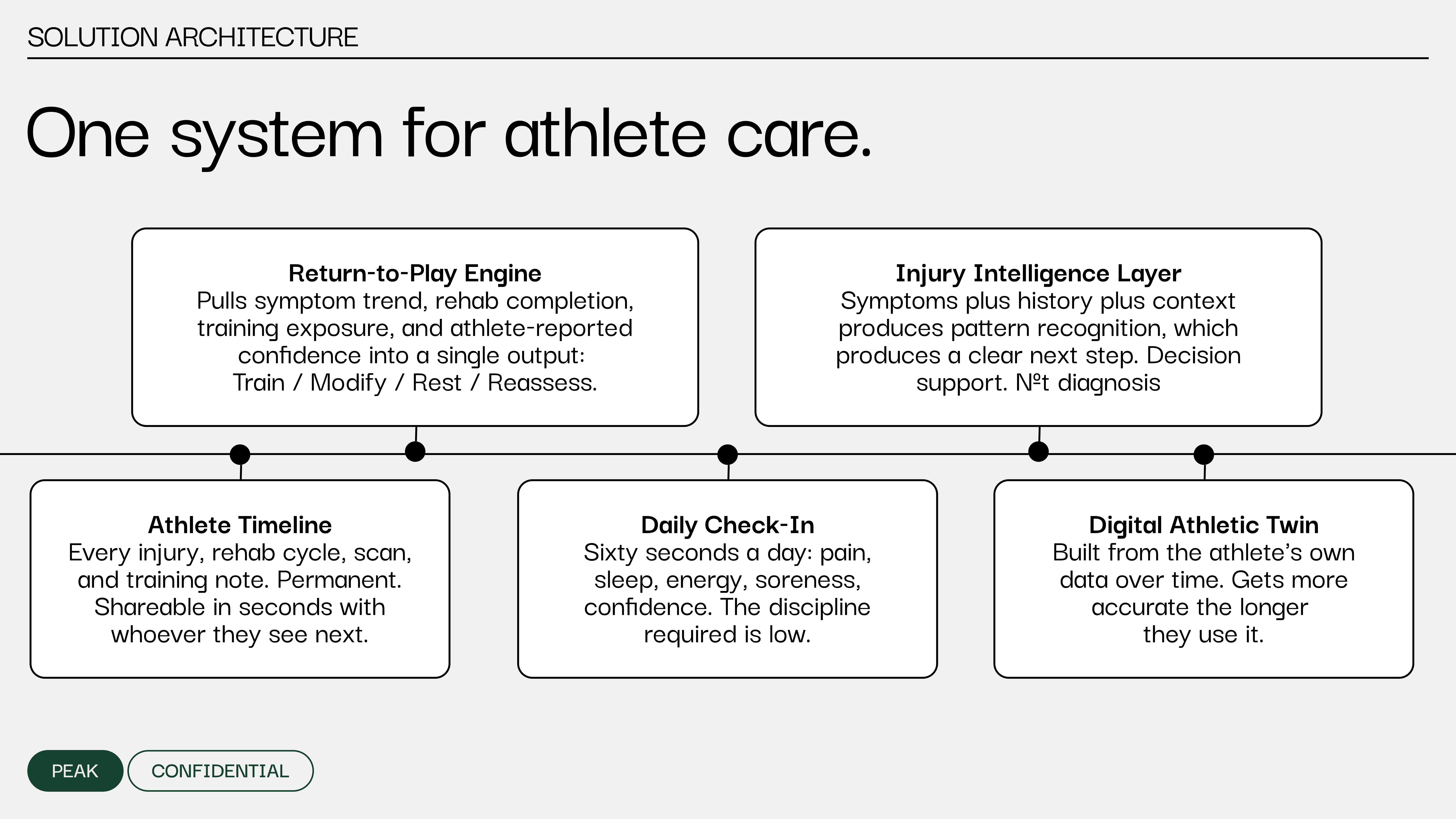
We designed PEAK around five layers that work together as one system for athlete care, rather than five separate features bolted on:
- Athlete Timeline — a permanent, shareable record of every injury, rehab cycle, scan, and training note, so an athlete's history travels with them to whoever they see next.
- Daily Check-In — a sixty-second daily log of pain, sleep, energy, soreness, and confidence, designed to be low-friction enough that athletes actually keep doing it.
- Digital Athletic Twin — a continuously updated model built from an athlete's own data over time, learning how that specific athlete recovers and what their early warning signals look like before a niggle becomes an injury.
- Injury Intelligence Layer — combines symptoms, history, and context to surface pattern recognition and a clear next step. This is decision support for practitioners, not a diagnosis.
- Return-to-Play Engine — pulls symptom trend, rehab completion, training exposure, and athlete-reported confidence into a single, unambiguous output: Train / Modify / Rest / Reassess.
Architecturally, the goal was for these layers to feed each other in a loop: the Daily Check-In and Timeline continuously train the Digital Athletic Twin, the Twin feeds the Injury Intelligence Layer, and the Injury Intelligence Layer's outputs are what practitioners and the Return-to-Play Engine act on. Applied to Arnav's story, this loop would have caught the conflict directly — the Twin would have flagged that his sleep was poor and his ankle load was still elevated, so the physio and the S&C coach wouldn't have needed to argue from two different partial views.
We built toward a three-sided model from day one — athlete subscriptions, academy/club licenses, and a referral-based specialist marketplace — because we wanted the product to be viable on its own economics rather than dependent on any single customer type.
Challenges we faced
- Designing for two very different users at once. An athlete needs something they'll open for sixty seconds a day without dread. A physio or S&C coach needs something dense enough with clinical signal to actually change a decision. Building one system that serves both without becoming either too shallow or too intimidating was the hardest product problem we hit.
- Decision support vs. diagnosis. It was important — ethically and practically — that the Injury Intelligence Layer surface patterns and recommendations without positioning itself as a medical diagnosis. Drawing that line clearly, in the UI and in the model's outputs, took real iteration.
- Cold-start data. A Digital Athletic Twin is only as good as the history behind it, and every new athlete starts with none. We had to think carefully about how the system behaves — and what it can safely recommend — before it has enough data to be confident about a specific person.
- Trust across a fragmented care network. Getting a physio, an S&C coach, and a doctor to work off the same record means convincing all three that the shared picture helps them, not that it second-guesses them. That's as much a change-management problem as a technical one, and it shaped how we designed permissions and shared views.
What's next
The mission is simple to state and hard to execute: give every athlete access to elite-level injury intelligence and coordinated care, regardless of whether they're training in a national academy or on their own. Arnav's ₹80,000 and lost trials spot shouldn't be the price of a system that couldn't share notes.

Log in or sign up for Devpost to join the conversation.