-
-
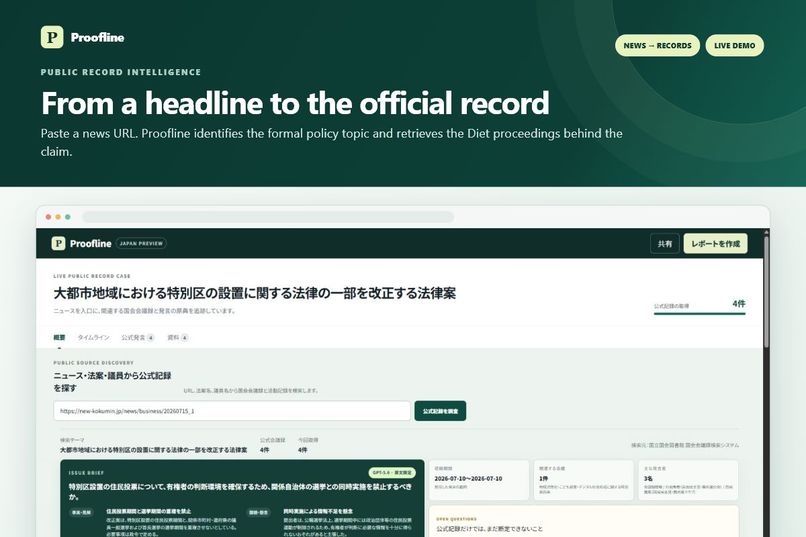
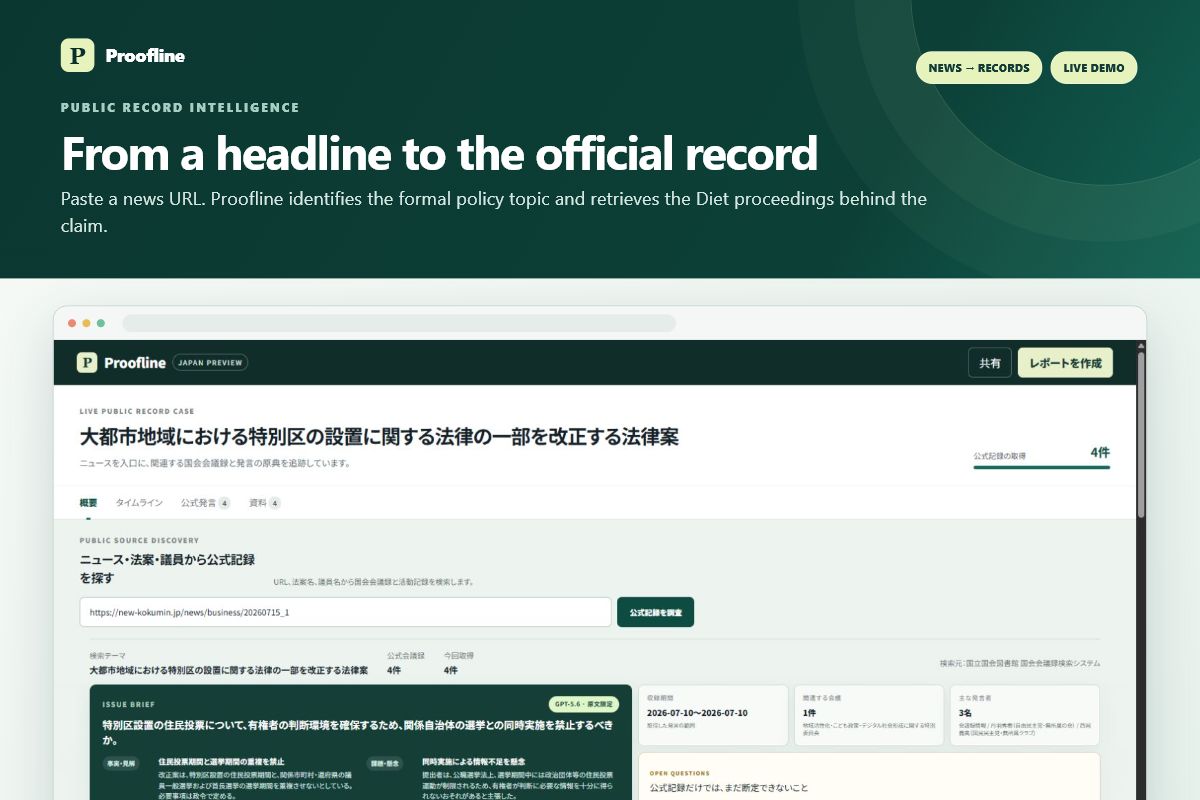
From a headline to official records. Proofline finds the related Diet proceedings.
-
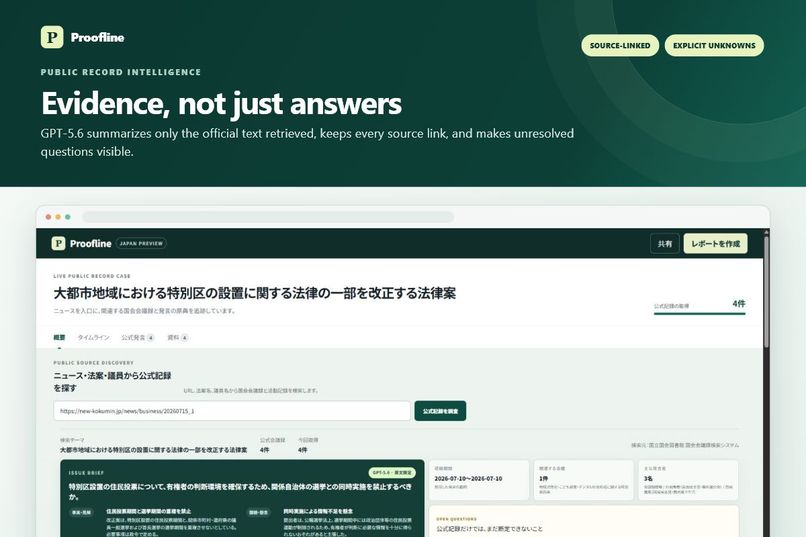
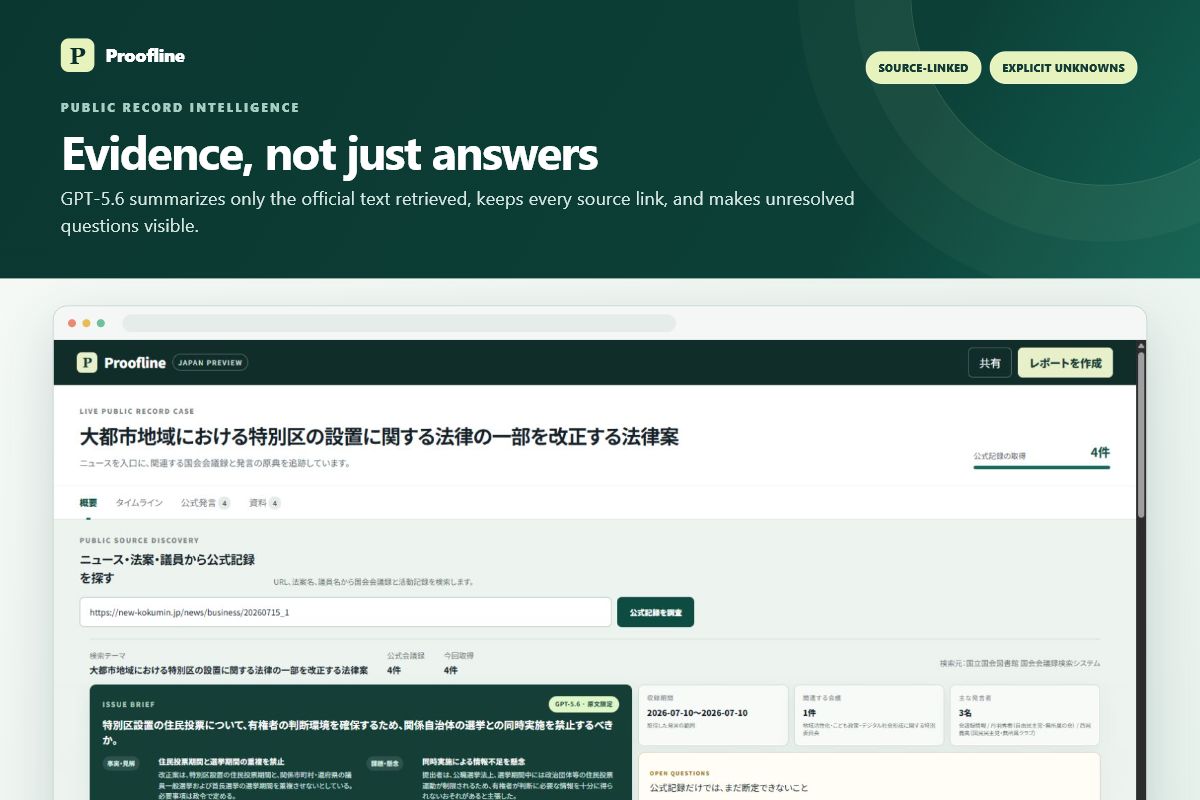
Evidence, not just answersGPT-5.6 summarizes only retrieved official text, preserves source links, and surfaces unresolved questions.
-
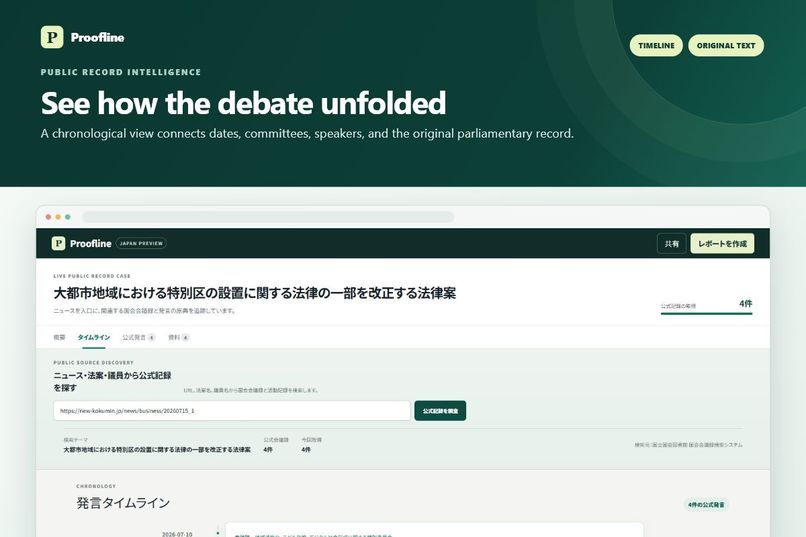
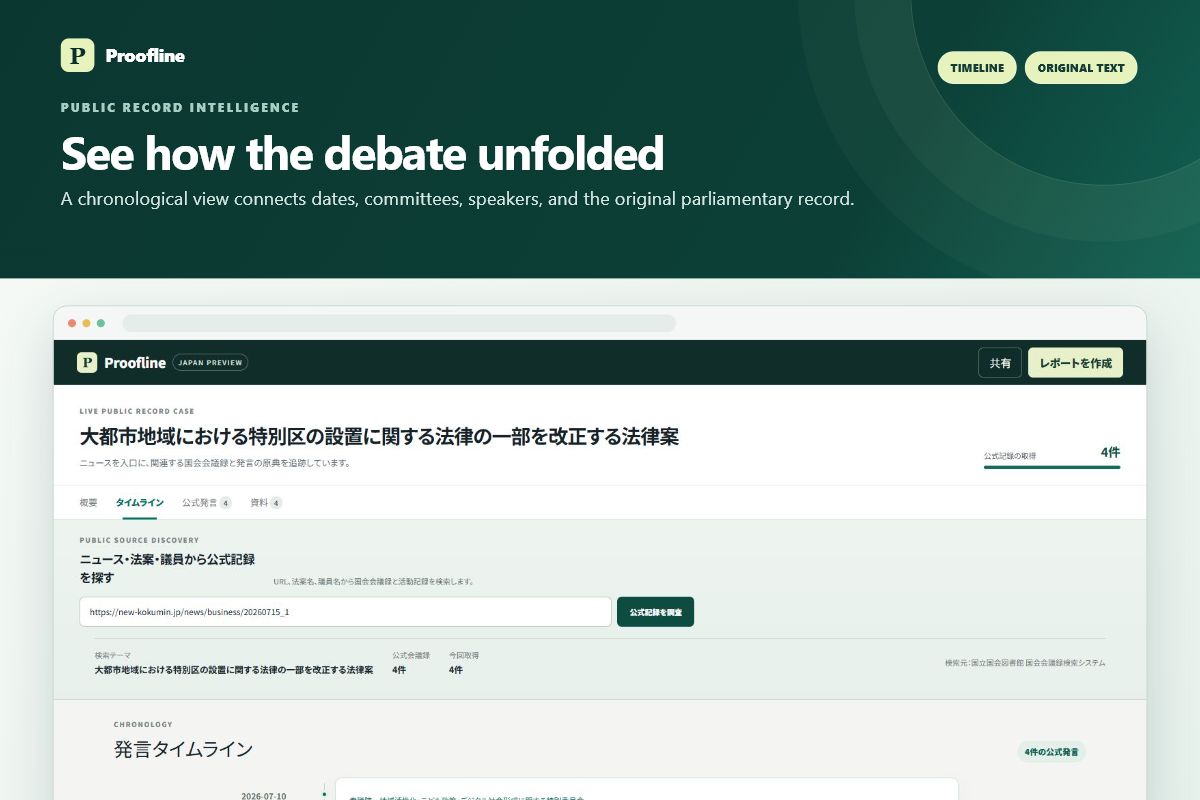
See how the debate unfoldedThe timeline connects dates, committees, speakers, and original parliamentary records.
-
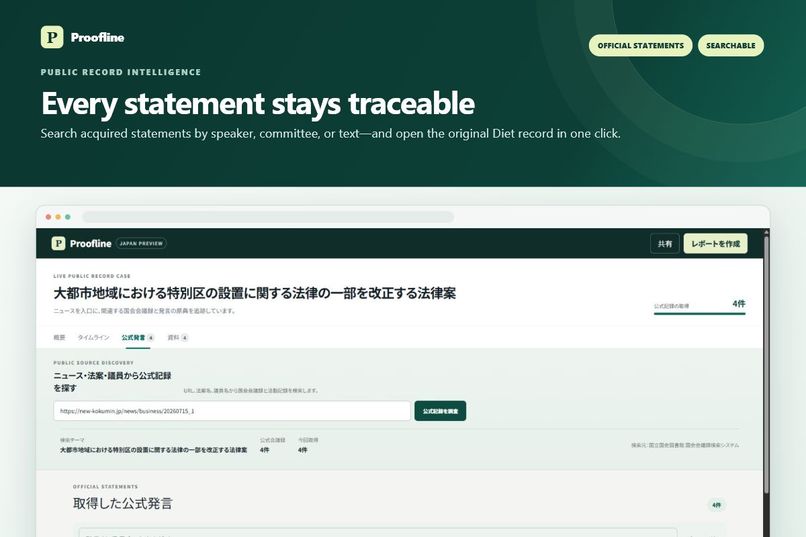
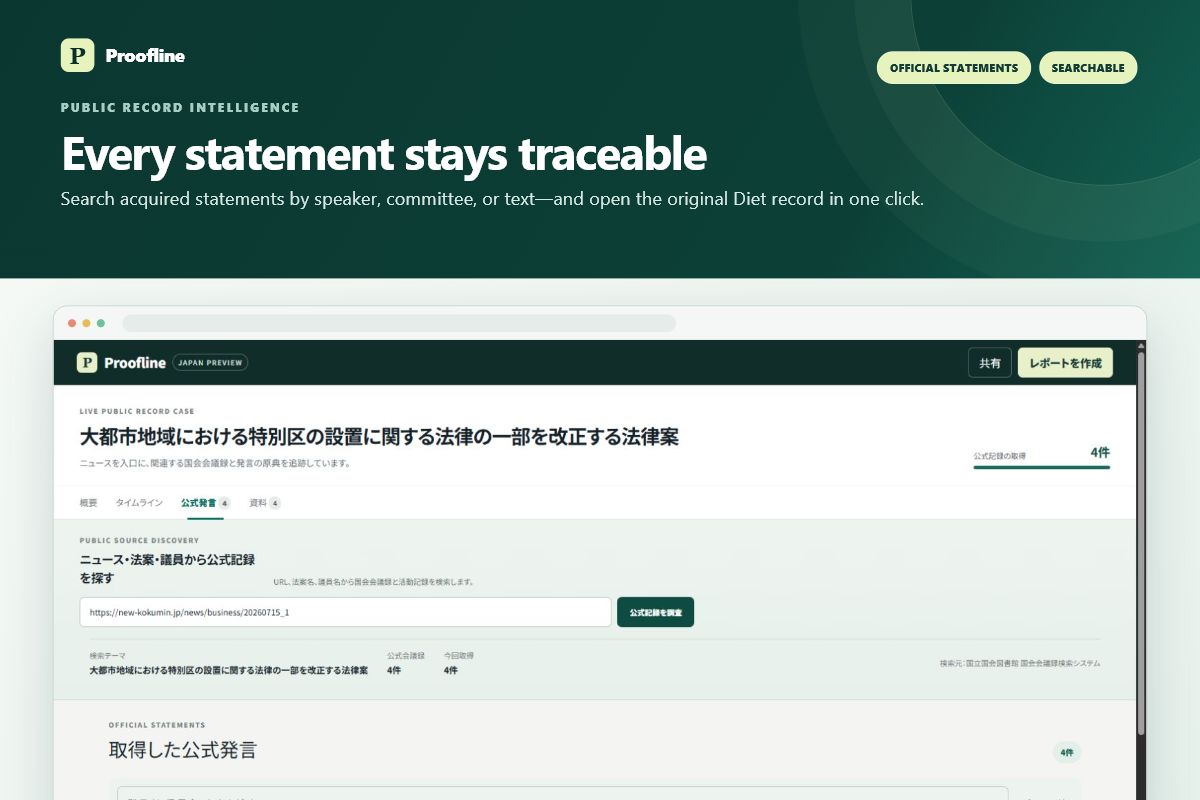
Every statement stays traceableSearch official statements by speaker, committee, or text and open the source record in one click.
-
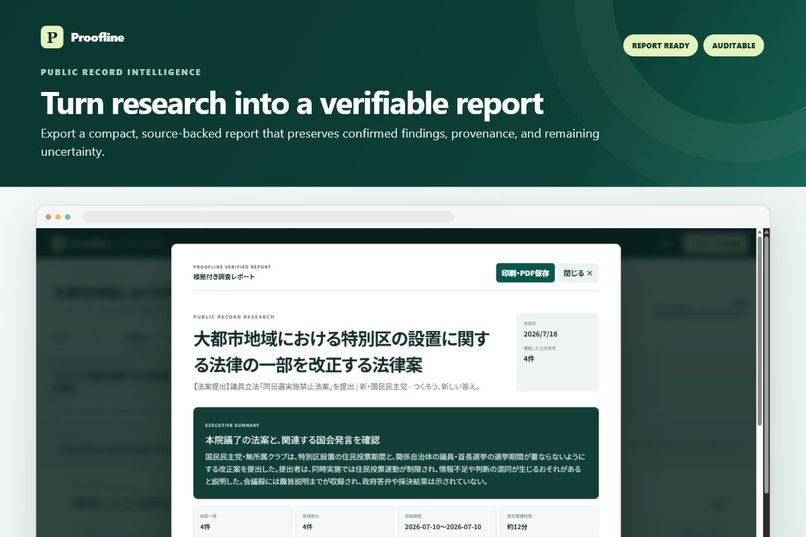
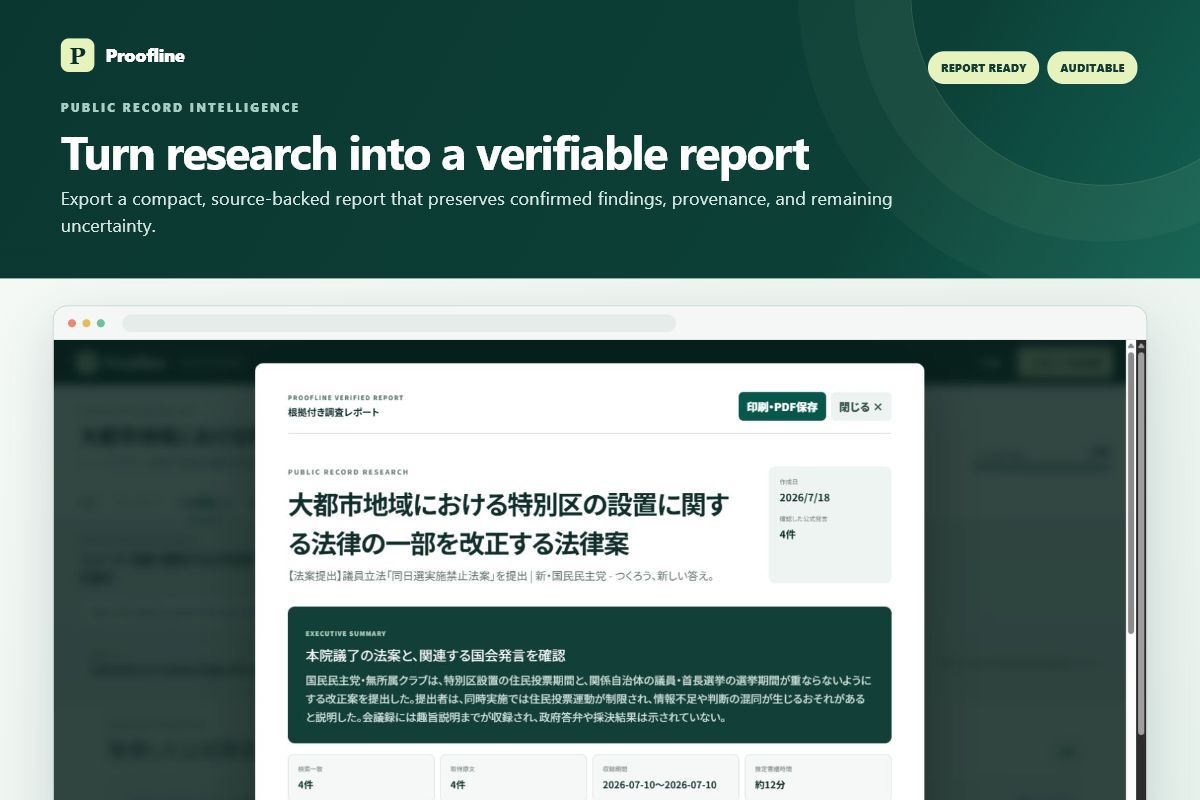
A verifiable reportExport a compact source-backed report that separates confirmed evidence from remaining uncertainty.
Inspiration
News headlines often compress complex legislation into informal labels. In Japan, verifying those claims requires manually searching fragmented Diet records, committee transcripts, bill text, and government websites.
We built Proofline Japan to make that investigation faster without hiding uncertainty. Instead of asking users to trust an AI summary, Proofline connects every finding back to the original public record and clearly shows what could not be verified.
What it does
Proofline Japan turns a news URL, bill name, or legislator name into a verifiable public-record research case.
It can:
- Extract the actual policy topic or formal bill name from a news article
- Search related National Diet proceedings and official records
- Retrieve statements with the speaker, chamber, committee, date, and original source URL
- Generate an evidence-constrained issue brief with GPT-5.6
- Separate confirmed findings from unresolved questions
- Visualize estimated deliberation time and speaking share
- Trace the issue from Diet debate to bill text and current law
- Build timelines and legislator activity summaries
- Generate a source-linked research report
Proofline does not automatically label a claim as true or false. If supporting evidence is not found, it preserves that uncertainty instead of inventing a conclusion. “Not found” does not automatically mean “false.”
How we built it
Proofline Japan is a React and TypeScript application that combines official Japanese public-record retrieval with GPT-5.6.
The retrieval layer searches National Diet Library records and preserves the metadata and original URLs for every acquired statement. GPT-5.6 receives only the retrieved evidence and produces structured issue briefs, key arguments, and open questions without treating unsupported claims as facts.
Codex was used throughout the project to design the product architecture, implement the retrieval and analysis flows, build the source-trace interface, create tests, diagnose edge cases, and rapidly iterate on the user experience.
Challenges we ran into
Japanese news articles rarely use the exact legal name of a bill. One of the hardest problems was distinguishing the article’s headline language from the formal subject that should be searched in official records.
We also had to distinguish search-result counts from records that were actually retrieved and verified. Another challenge was presenting dense parliamentary material in a compact interface while keeping every conclusion traceable to its source.
Accomplishments that we're proud of
- A working live application using real news URLs and official Diet records
- Formal bill-name identification instead of relying only on article headlines
- Evidence-constrained summaries with explicit unresolved questions
- Direct links from findings to original parliamentary statements
- Legislative timelines, speaker statistics, and bill-status tracing
- Legislator-name search with activity and policy-area summaries
- Graceful handling of missing or potentially misleading information
What we learned
For public-information research, a confident answer is less valuable than a verifiable one. Useful AI must preserve provenance, distinguish retrieved evidence from inference, and communicate uncertainty clearly.
What's next for Proofline Japan
Next, we plan to add more government and local-assembly sources, continuous monitoring when new records appear, multilingual research views, comparisons between media claims and official records, and broader coverage of legislation beyond the National Diet.
Built With
- cloudflare
- codex
- diet
- gpt-5.6
- library
- national
- next.js
- openai
- react
- tailwind
- typescript
- vite

Log in or sign up for Devpost to join the conversation.