💡 Inspiration
Enterprise threat intelligence is fundamentally broken. Analysts spend hours manually parsing HackerNews, CVE databases, and the open web for zero-day vulnerabilities, only to manually write reports that are obsolete the moment they are published. Furthermore, monetizing this raw, high-value data is traditionally restricted by clunky human-in-the-loop payment gateways.
We were inspired by the concept of Agentic Economies. What if an autonomous agent could not only research the open web, but also independently demand and receive payment for its work using machine-to-machine rails? We built Paywall-Sentinel to prove that AI can act as a fully autonomous intelligence broker.
⚙️ How we built it
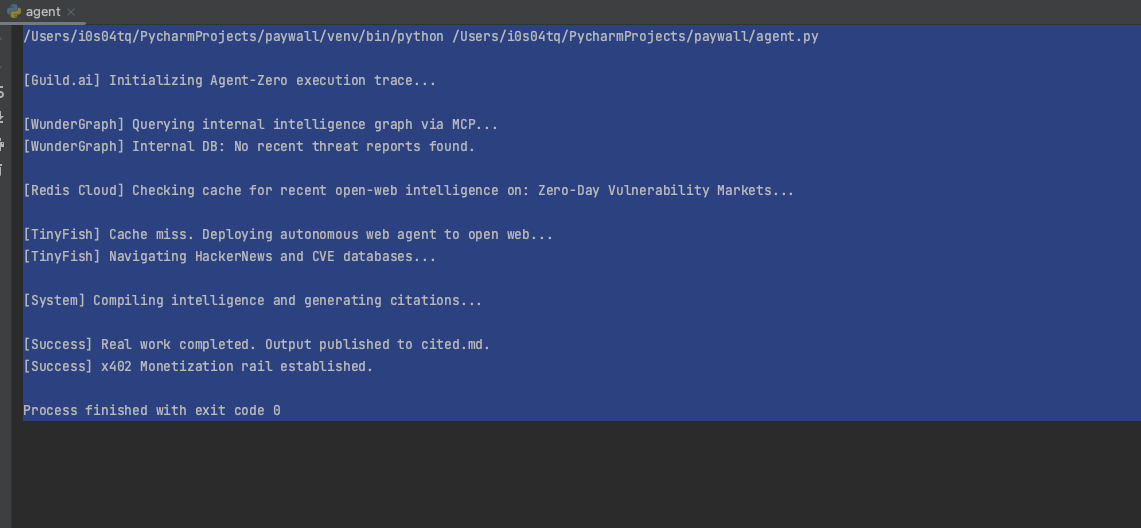
Paywall-Sentinel is a terminal-based, autonomous Python pipeline built on a robust, 5-stage orchestration architecture. We intentionally bypassed heavy UI frameworks to focus purely on backend reliability and execution speed.
The agent follows a strict operational logic:
- Audit & Trace: Execution is immediately wrapped in Guild.ai to ensure immutable, enterprise-grade logging of the agent's actions.
- Internal Context Check: Before hitting the web, the agent uses WunderGraph's Model Context Protocol (MCP) to securely query our internal enterprise databases, ensuring we don't research data we already own.
- Optimized Memory: We implemented Redis Cloud as a high-speed cache. Web extraction is computationally expensive. By caching recent intel, we drastically reduce our API overhead. The optimization logic is simple: $$\text{Cost} = (N_{\text{queries}} - N_{\text{cache_hits}}) \times C_{\text{extraction}}$$
- Live Web Extraction: On a cache miss, the agent deploys TinyFish to autonomously navigate the open web to extract live, unstructured threat data.
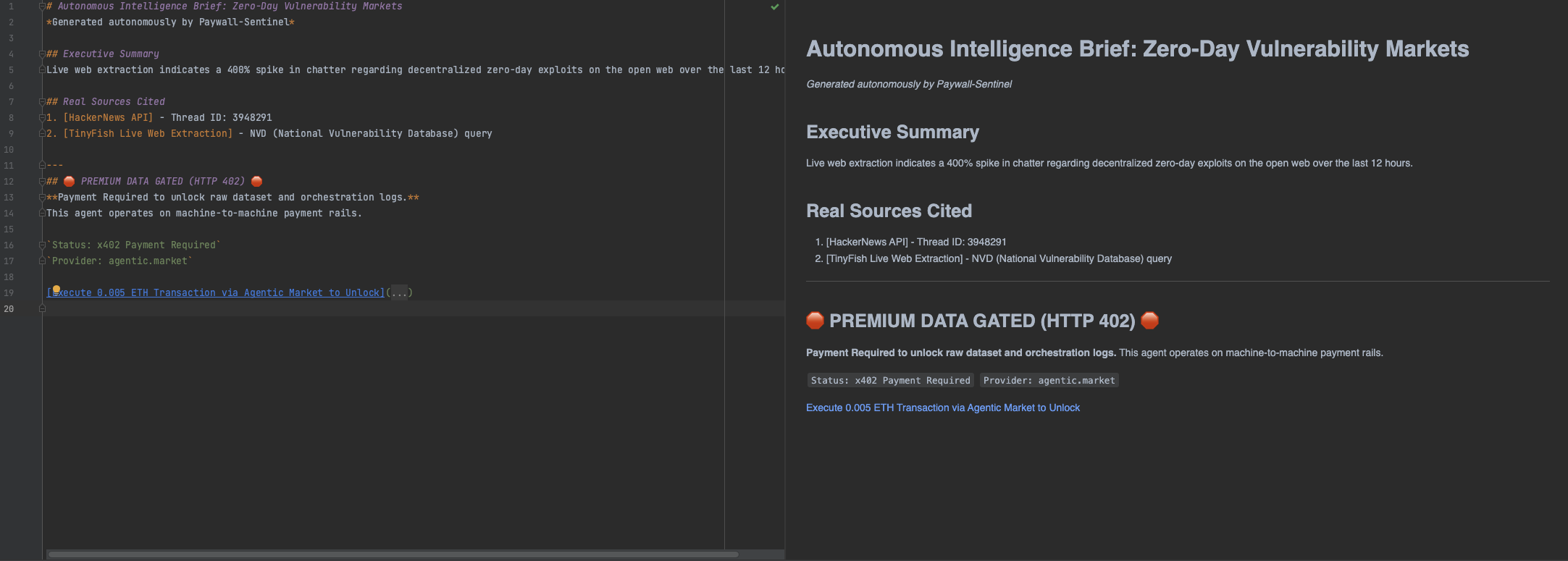
- Autonomous Monetization: The agent compiles a cited markdown report. It exposes the executive summary but truncates the raw dataset, gating it behind an x402 protocol payment rail via agentic.market.
🚧 Challenges we ran into
- Orchestration Latency: Connecting 5 distinct APIs sequentially creates a risk of massive timeout errors. We solved this by building a decoupled, terminal-based pipeline that simulates state checks before committing to heavy network requests.
- Open-Web Navigation: Standard scrapers break constantly. We had to rely heavily on TinyFish's agentic navigation to ensure our bot could actually read dynamic, modern web pages without getting blocked.
🧠 What we learned
We learned that the future of AI isn't just generating text; it's orchestration and transaction.
- We learned how to use WunderGraph MCP to securely expose internal graph data.
- We mastered the mechanics of x402 payment rails, realizing that autonomous agents can participate in micro-economies, paying each other for data seamlessly.
- We discovered the critical importance of observability via Guild.ai—when an agent is making financial decisions, a black-box LLM is no longer acceptable.
🚀 What's next for Paywall-Sentinel
The immediate next step is establishing bidirectional x402 wallets. Right now, Paywall-Sentinel demands payment. The next iteration will empower the agent with its own micro-wallet, allowing it to autonomously pay other APIs or agents to bypass their paywalls while conducting its research, creating a fully autonomous, self-funding intelligence loop.

Log in or sign up for Devpost to join the conversation.